How to Differentiate IPv4 and IPv6: A Complete Comparison

Aug 12, 2026 · Comparisons · 11 min read
TL;DR:
IPv4 uses 32-bit dotted-decimal addresses; IPv6 uses 128-bit hexadecimal addresses separated by colons. IPv6 also uses Neighbor Discovery instead of ARP, replaces broadcast with multicast, moves fragmentation to the source, and removes the IP header checksum. The protocols do not communicate directly, so migration requires dual stack, tunneling, or translation. For proxy work, verify the actual exit IP, DNS path, destination support, MTU, and allowlist syntax.
To differentiate between IPv4 and IPv6 reliably, start with the visible address, then examine how the network configures hosts, resolves neighbors, fragments packets, and reaches the other protocol family. This distinction matters to network engineers, cloud teams, application owners, and proxy users because a valid local address does not prove end-to-end reachability. The sections below connect protocol definitions to subnet examples, packet headers, security controls, Mobile IP, transition architecture, and reproducible command-line tests.
What Is IPv4 and What Is IPv6?
Internet Protocol version 4 (IPv4) is the long-standing network-layer protocol used by most legacy and current systems. Its 32-bit address space contains about 4.3 billion values. Public addresses identify Internet-routable interfaces; private ranges (10.0.0.0/8, 172.16.0.0/12, and 192.168.0.0/16) are reused inside networks and commonly translated by Network Address Translation (NAT).
Internet Protocol version 6 (IPv6) was designed to replace IPv4’s limited address space and simplify several forwarding functions. A 128-bit address space provides approximately 3.4 × 10^38 values. IPv6 defines global unicast, link-local (fe80::/10), multicast (ff00::/8), anycast, and unique local (fc00::/7) addresses. It is a different protocol, not IPv4 with a longer field.
| Feature | IPv4 | IPv6 |
|---|---|---|
| Address length | 32 bits | 128 bits |
| Notation | Four decimal octets | Eight hexadecimal groups |
| Example | 192.168.1.10 |
2001:db8:1234::10 |
| Base header | 20–60 bytes | Fixed 40 bytes |
| Configuration | Static or DHCP | Static, SLAAC, DHCPv6 |
| Broadcast | Supported | Not supported; multicast is used |
| Address resolution | ARP | ICMPv6 Neighbor Discovery |
| Transit fragmentation | Routers may fragment | Routers do not fragment |
| Address-sharing NAT | Common | Usually unnecessary for conservation |
| IPv4 interoperability | Native IPv4 | Needs dual stack, tunnel, or translation |
How to Differentiate IPv4 and IPv6 by Address Format
An IPv4 address has four decimal octets, each from 0 through 255, separated by periods. 8.8.8.8 is a public address, 127.0.0.1 is loopback, and 169.254.10.20 is link-local. 300.1.1.1 is invalid because one octet exceeds 255. Prefix notation such as /24 identifies how many leading bits represent the network.
An IPv6 address has eight 16-bit hexadecimal groups separated by colons. The full form 2001:0db8:1234:0000:0000:0000:0000:0010 can be compressed to 2001:db8:1234::10: leading zeros in a group may be omitted, and one consecutive run of zero groups may become :: once. An address such as ::ffff:192.0.2.128 is an IPv4-mapped IPv6 representation, not a native IPv4 address.
Prefixes also reveal purpose. 2000::/3 covers global unicast space, fe80::/10 is link-local, ::1 is loopback, and ff00::/8 is multicast. Every normally enabled IPv6 interface has a link-local address, even when it also has a global address.
How to Differentiate IPv4 and IPv6 Addressing Scheme With Example
Consider one office LAN implemented with both protocols:
| Parameter | IPv4 example | IPv6 example |
|---|---|---|
| Network | 192.168.10.0/24 |
2001:db8:abcd:1200::/64 |
| Mask/prefix | 255.255.255.0 |
/64 |
| Host address | 192.168.10.42 |
2001:db8:abcd:1200::42 |
| Default gateway | 192.168.10.1 |
fe80::1 (learned by Router Advertisement) |
| Host range | .1–.254 |
2^64 interface values in the subnet |
| Broadcast | 192.168.10.255 |
None; use multicast |
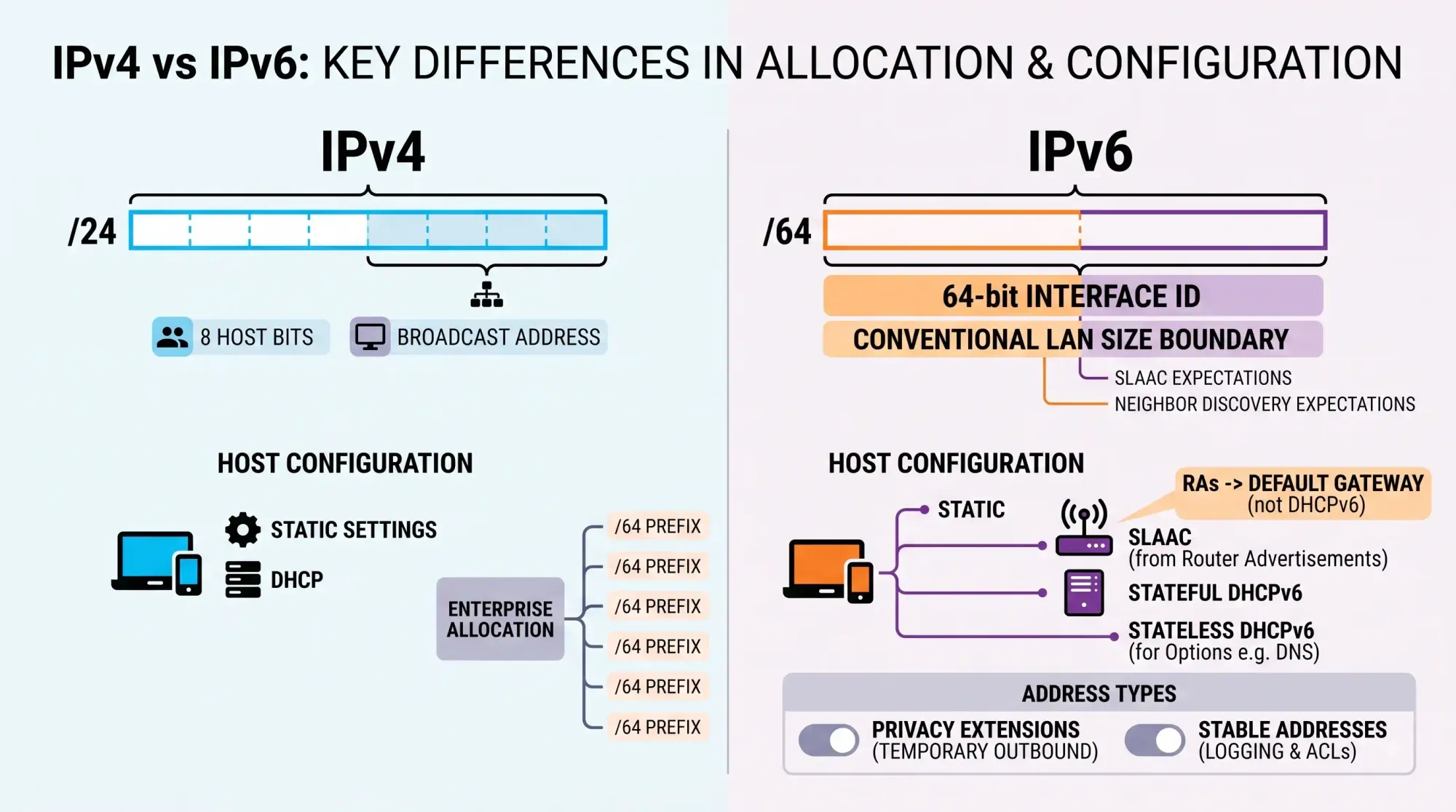
In IPv4, the /24 leaves eight host bits and a broadcast address. In IPv6, /64 leaves a 64-bit interface identifier and is the conventional LAN size because Stateless Address Autoconfiguration (SLAAC) and Neighbor Discovery expect that boundary. An enterprise can receive a larger allocation, then assign /64 prefixes to individual links.
IPv4 hosts may use static settings or Dynamic Host Configuration Protocol (DHCP). IPv6 hosts can use static configuration, SLAAC from Router Advertisements (RAs), stateful DHCPv6, or stateless DHCPv6 for options such as DNS. DHCPv6 does not normally provide the default gateway; RAs do. Privacy extensions may create temporary IPv6 addresses for outbound connections, while stable addresses support predictable server logging and access control.
Protocol Differences Beyond Addressing
Broadcast, Multicast, and Anycast
IPv4 uses limited broadcast (255.255.255.255) and directed broadcast for some discovery functions. IPv6 removes broadcast and uses scoped multicast groups, reducing broadcast storms and making membership explicit. IPv6 anycast assigns the same address to multiple interfaces; routing delivers traffic to the topologically nearest instance, a common pattern for recursive DNS and distributed services.
Fragmentation and Path MTU Discovery
An IPv4 router may fragment a packet when the next link has a smaller Maximum Transmission Unit (MTU), although Path MTU Discovery (PMTUD) is preferred. IPv6 routers never fragment transit traffic. A source host must discover the path MTU; if a packet is too large, the router sends an ICMPv6 Packet Too Big message. The source can then use the Fragment extension header when fragmentation is necessary. Blocking essential ICMPv6 messages causes black holes that often look like random application timeouts.
ARP vs. Neighbor Discovery
Address Resolution Protocol (ARP) broadcasts an IPv4 query to map an address to a link-layer address. IPv6 uses ICMPv6 Neighbor Solicitation and Neighbor Advertisement, normally sent to solicited-node multicast rather than broadcast. Router Solicitation and Router Advertisement discover routers and prefixes. Duplicate Address Detection (DAD) checks that a new address is not already in use.
NAT and End-to-End Connectivity
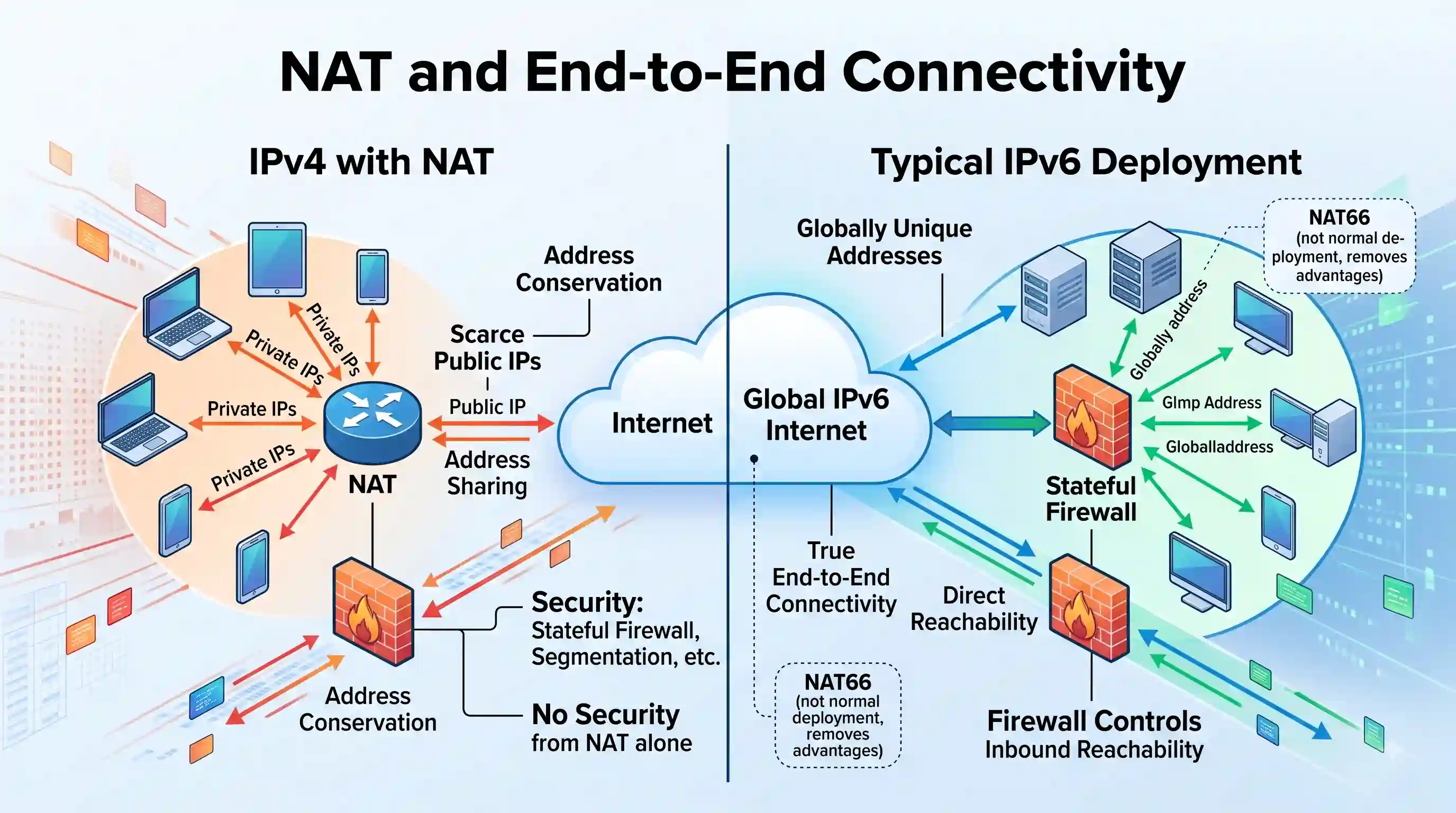
IPv4 NAT conserves scarce public addresses, but it is not a security boundary by itself. Stateful firewalls, segmentation, patching, and logging provide security policy. Normal IPv6 deployments use globally unique addresses without address-sharing NAT; a firewall still controls inbound reachability. NAT66 exists for specific designs, but using it merely to imitate IPv4 address conservation removes some of IPv6’s operational advantages.
DNS and Connection Selection
DNS A records contain IPv4 addresses; AAAA records contain IPv6 addresses. A dual-stack client may receive both and use an algorithm such as Happy Eyeballs to race connections, favoring the first reliable path. Publishing an AAAA record before testing the complete route can expose users to slow or broken IPv6 paths even when the IPv4 service works.
Differentiate Between IPv4 Header and IPv6 Header
The IPv4 header has a variable length. Its fields include Version, Internet Header Length, differentiated-services and congestion bits, Total Length, Identification, Flags, Fragment Offset, Time to Live (TTL), Protocol, Header Checksum, source and destination addresses, and optional options with padding.
The IPv6 base header is always 40 bytes. It contains Version, Traffic Class, Flow Label, Payload Length, Next Header, Hop Limit, and 128-bit source and destination addresses. Optional functions follow in extension headers such as Hop-by-Hop Options, Routing, Fragment, Destination Options, Authentication Header (AH), and Encapsulating Security Payload (ESP).
| Header characteristic | IPv4 | IPv6 |
|---|---|---|
| Length | Variable, normally 20–60 bytes | Fixed 40 bytes |
| Address fields | Two 32-bit fields | Two 128-bit fields |
| Checksum | Header checksum present | No IP-layer checksum |
| Lifetime | TTL | Hop Limit |
| Upper-layer field | Protocol | Next Header |
| Fragment fields | Base header | Fragment extension header |
| Router fragmentation | Allowed | Prohibited |
| Optional data | Options in base header | Extension-header chain |
The redesign gives forwarding hardware a predictable base layout. Removing the IP checksum avoids recalculation at every hop; transport checksums such as TCP and UDP still protect payloads. A longer address does not automatically make IPv6 slower. Processing depends on hardware, extensions, path MTU, routing, and implementation quality.
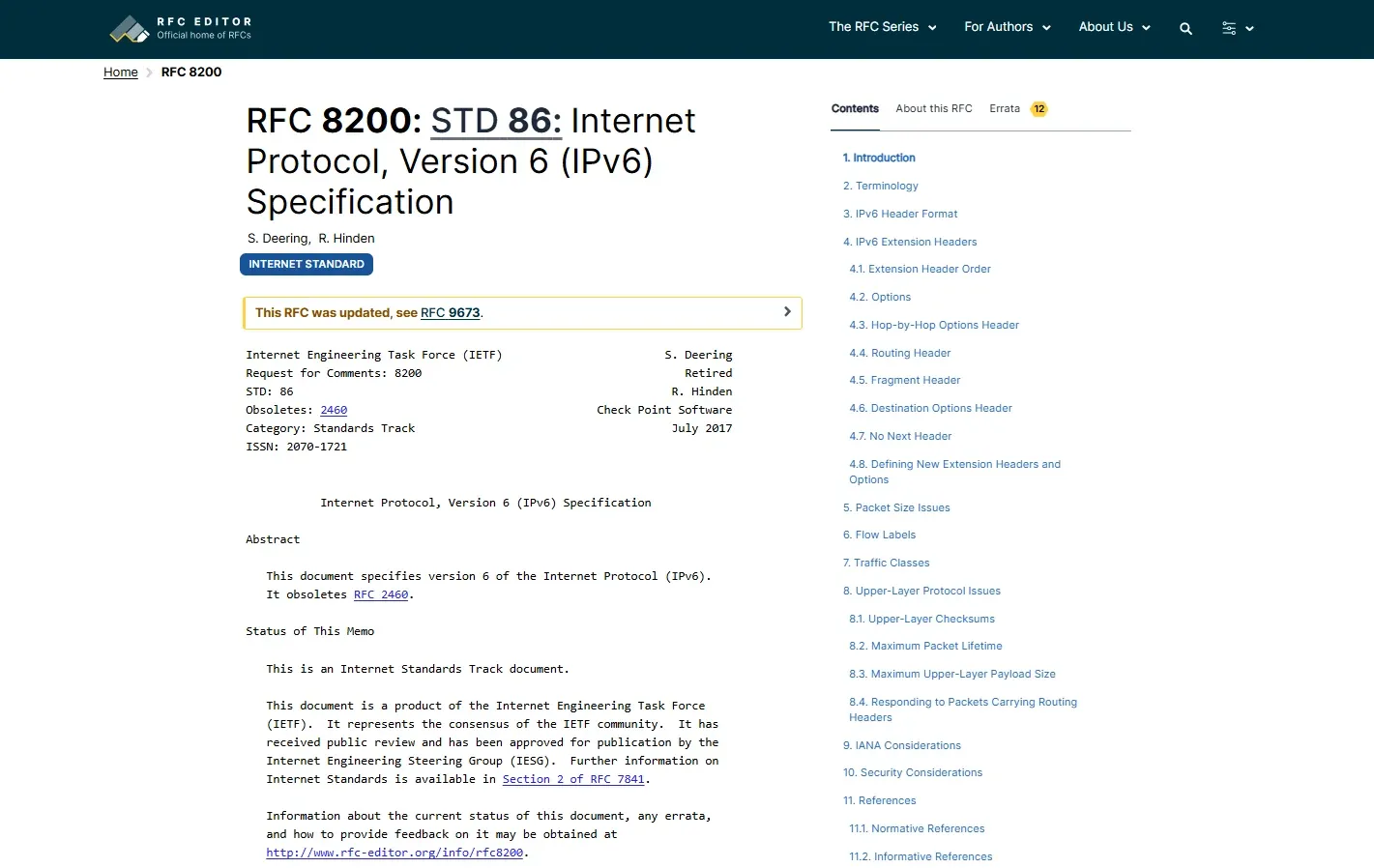
Authoritative field definitions are available in the IPv4 specification and IPv6 specification.
From Protocol Design to Production Impact
The address and header changes described above become visible in production through three practical questions: does the path perform well, is it protected consistently, and can the team operate it without hidden compatibility gaps? The answers depend on routing, configuration, and application behavior, not on the protocol label alone.
Neither protocol is universally faster. A shorter path, better peering, working PMTUD, and responsive DNS can outweigh header-processing differences. Measure latency, loss, throughput, and connection setup over both protocols from the actual client network and destination region.
IPv6 supports IPsec, but support is not the same as encryption. Security policy must cover both address families, including firewall rules, intrusion detection, endpoint hardening, routing filters, and log pipelines. An unmanaged IPv6 tunnel or automatic address can bypass an IPv4-only policy. A real incident pattern is a service that allowed IPv4 only in its firewall while a cloud interface acquired a global IPv6 address; the service became reachable on an unmonitored path until the rule set and alerts were duplicated.
IPv4 scarcity increases the cost and administrative effort of public address allocation. IPv6 planning offers abundant space and cleaner hierarchical summarization, but dual-stack operations require two sets of dashboards, allowlists, abuse controls, and troubleshooting skills. Legacy software may store addresses in 32-bit fields or reject bracketed IPv6 literals, so application testing remains necessary.
IPv4 and IPv6 in Proxy Networks
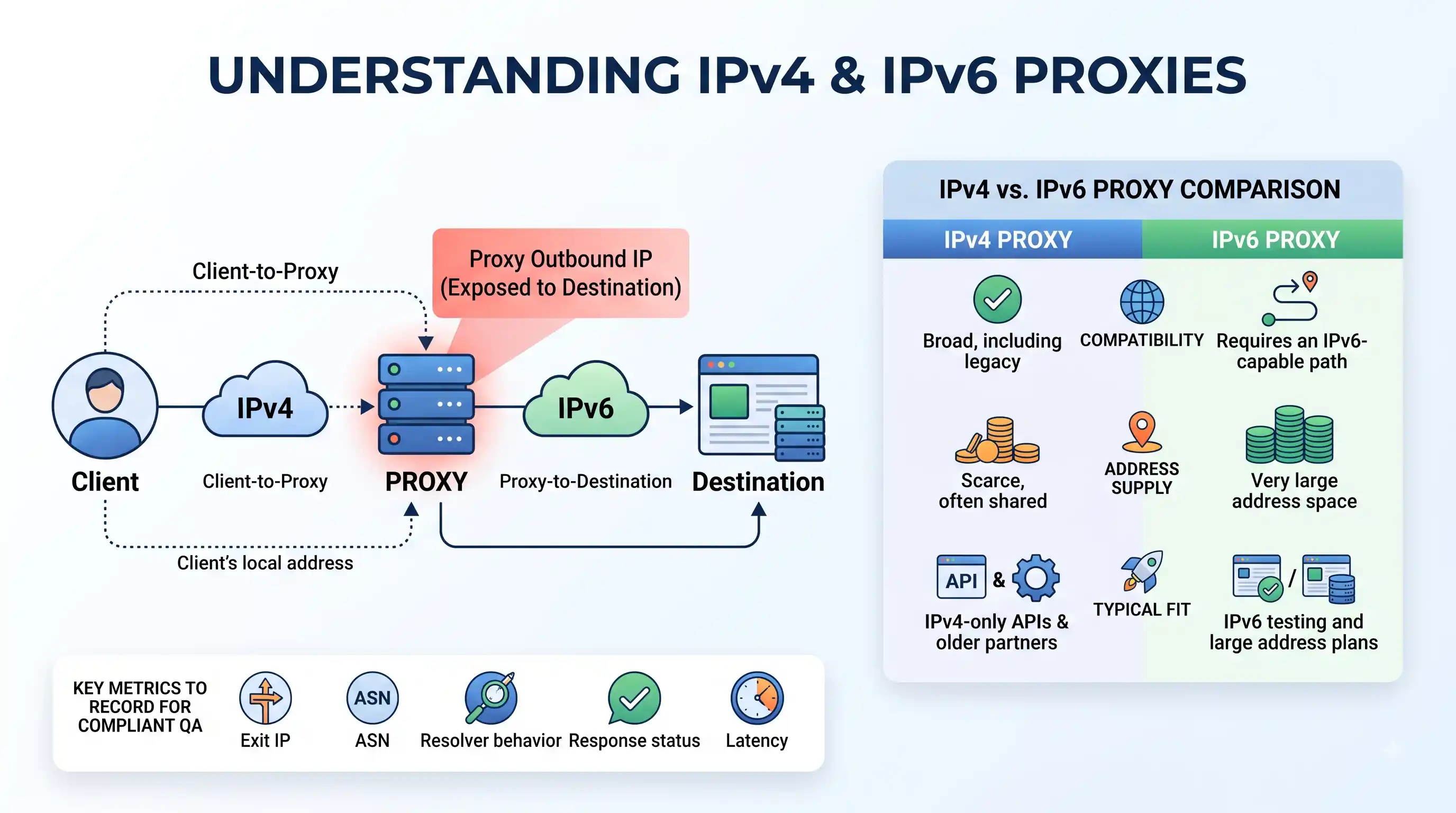
A proxy has two separate legs: the client-to-proxy connection and the proxy-to-destination connection. A client may reach a proxy over IPv4 while the proxy makes an IPv6 outbound connection, if the service supports that design. The destination observes the outbound exit address, not necessarily the client’s local address.
| Decision factor | IPv4 proxy | IPv6 proxy |
|---|---|---|
| Destination compatibility | Broad, including legacy services | Requires an IPv6-capable destination path |
| Public address supply | Scarce; often shared or costly | Very large address space |
| Allowlist syntax | IPv4 address or CIDR | IPv6 address or prefix |
| Typical fit | IPv4-only APIs and older partners | IPv6 testing and large address plans |
| Main validation | Exit IP, A records, route | Exit IP, AAAA records, route, MTU |
An authentication success proves only that the proxy accepted credentials. It does not prove that the destination is reachable over IPv6, that DNS used the intended family, or that the application supports IPv6 literals. Teams using a proxy for compliant QA, localization, uptime checks, or API integration should record the exit IP, Autonomous System Number (ASN), resolver behavior, response status, and latency for each test.
How to Verify a Proxy’s Exit IP Version
Open Rola IP’s what is my IP tool through the proxy and confirm whether the visible address contains dots or colons. Repeat with forced-family tests when supported:
curl -4 -x http://user:pass@proxy.example:8080 https://example.com/cdn-cgi/trace
curl -6 -x http://user:pass@proxy.example:8080 https://example.com/cdn-cgi/trace
Compare the result with dig A example.com and dig AAAA example.com. A failed curl -6 can indicate no IPv6 route, an IPv4-only proxy endpoint, blocked ICMPv6 PMTUD, or a destination without an AAAA record. When a proxy service exposes country, session, or rotation controls, record those proxy parameters alongside the test so repeated IPv4 and IPv6 comparisons use equivalent settings. Allowlist entries must use the correct family and prefix syntax. DNS leaks, WebRTC exposure, and a direct fallback connection should be tested separately from proxy authentication.
For teams evaluating Rola IP for an IPv6-capable exit, the static IPv6 proxy page is the relevant product context. A mobile proxy is a separate commercial category for exits associated with mobile networks; it is not the Mobile IPv6 protocol described below. Current endpoint behavior, coverage, and limits should be confirmed against the service documentation before production use.
Differentiate Between Mobile IPv4 and Mobile IPv6
Mobile IPv4 is a host mobility protocol. A mobile node keeps a home address, registers with a Home Agent, and obtains a Care-of Address on a visited network. A Foreign Agent may provide that care-of address and relay registration. The Home Agent tunnels packets to the roaming node. Without route optimization, correspondent traffic follows a triangular path through the home network.
Mobile IPv6 keeps the home address and Home Agent model but uses IPv6 Neighbor Discovery to configure a care-of address. The node sends Binding Updates and receives Binding Acknowledgements. Route optimization allows a correspondent node to send directly to the care-of address after a valid binding, reducing triangle-routing overhead. Mobile IPv6 does not require the Mobile IPv4 Foreign Agent architecture; signaling protection uses IPv6 security mechanisms, including IPsec where deployed.
| Feature | Mobile IPv4 | Mobile IPv6 |
|---|---|---|
| Foreign Agent | May be required | Not required |
| Care-of address | Foreign-agent or co-located | Configured on visited link |
| Registration | Mobile IPv4 registration | Binding Updates/Acknowledgements |
| Route optimization | Limited or optional | Designed into the protocol |
| Discovery | Agent advertisements | IPv6 configuration and ND |
| Common routing | Triangle routing | Direct route after binding |
Carrier networks often use 3GPP mobility architectures and network-based tunneling rather than exposing host-based Mobile IPv4 or Mobile IPv6 to every handset. A mobile proxy describes the network source of an exit IP; Mobile IPv6 describes how a node preserves reachability while changing links. The terms belong to different layers.
IPv4/IPv6 Compatibility and Transition
IPv4 and IPv6 have different packet formats and address semantics, so they cannot communicate directly. Coexistence keeps both protocols available; translation converts traffic between them.
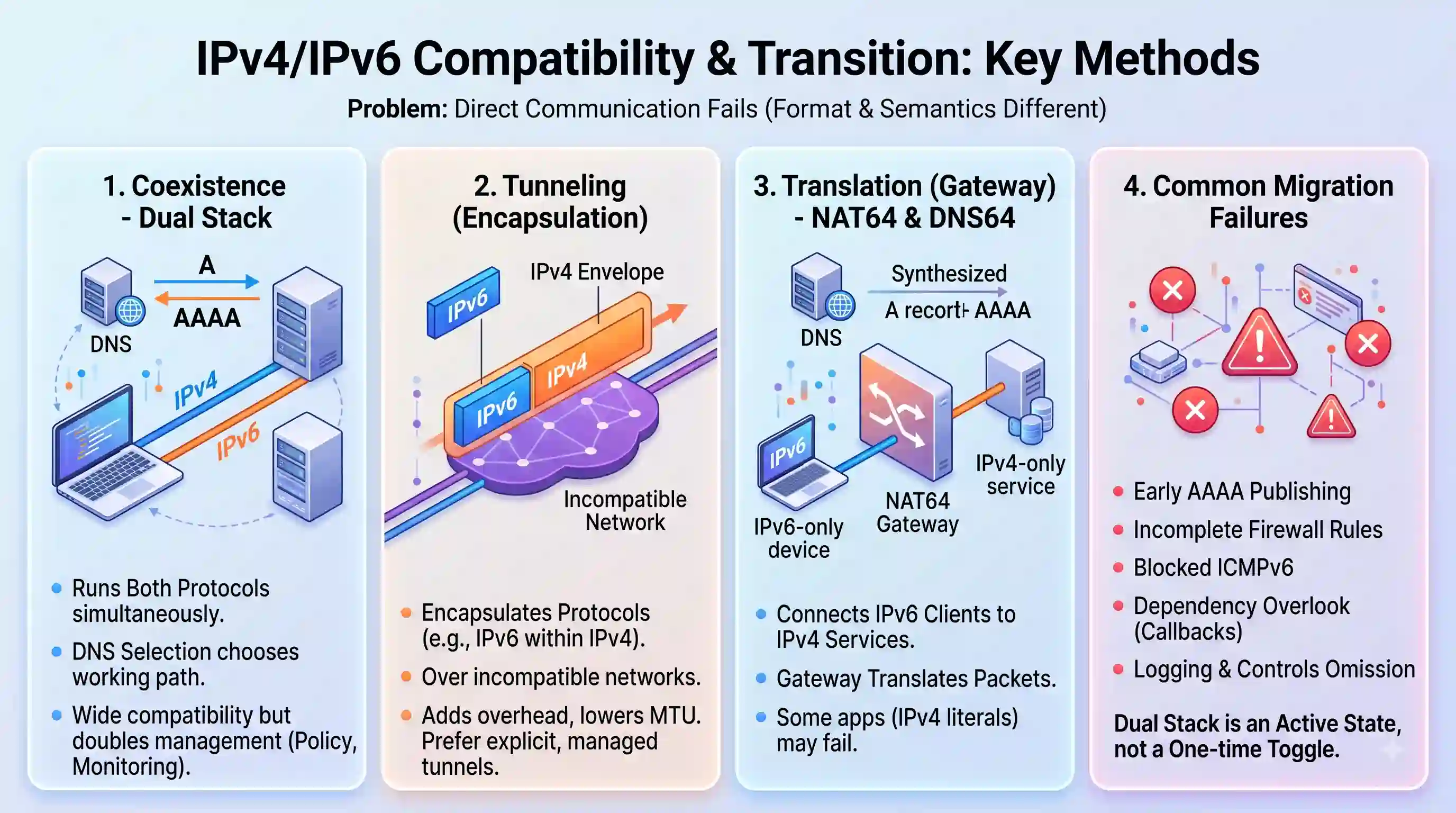
Dual stack runs IPv4 and IPv6 simultaneously. DNS returns A and AAAA; client selection then chooses a working path. It offers broad compatibility but doubles policy, monitoring, and incident-response scope.
Tunneling encapsulates IPv6 inside IPv4 (or the reverse) across an incompatible network. It adds overhead and can lower the effective MTU. Explicit, managed tunnels are preferable to relying on obsolete automatic tunnel mechanisms.
NAT64 with DNS64 lets an IPv6-only client reach an IPv4-only service. DNS64 synthesizes an AAAA record from an A record, and NAT64 translates packets at the gateway. Applications that embed IPv4 literals, depend on address formatting, or use incompatible protocols may still fail.
Migration failures commonly come from publishing AAAA too early, copying IPv4 firewall rules incompletely, blocking ICMPv6, overlooking callback and third-party dependencies, and omitting IPv6 addresses from geolocation, logging, or abuse controls. Treat dual stack as an actively managed operating state, not a one-time toggle.
How to Check Whether a Device or Website Uses IPv4 or IPv6
Windows
ipconfig
ping example.com
ping -6 example.com
tracert example.com
tracert -6 example.com
nslookup -type=A example.com
nslookup -type=AAAA example.com
Linux and macOS
ip addr                 # Linux
ifconfig                # macOS and some BSD systems
ping example.com
ping6 example.com
curl -4 https://example.com
curl -6 https://example.com
dig A example.com
dig AAAA example.com
On a server, inspect both DNS records, confirm listeners on 0.0.0.0 and :: (or explicit addresses), and review access logs from the load balancer or Content Delivery Network (CDN). Test APIs, webhooks, payment providers, and allowlists independently; a front-end that supports IPv6 does not prove every dependency does.
Which Protocol Should You Use?
Choose IPv4 when a partner, appliance, or application is IPv4-only. Choose IPv6 for new large-scale, cloud, IoT, or mobile deployments when the complete route and security tooling have been validated. Use dual stack for most public services that must serve both populations. IPv6-only with NAT64/DNS64 fits environments whose applications and operational teams have passed compatibility testing.
Why Is Dual Stack Usually the Practical Migration Choice?
Dual stack is usually practical because it preserves access for IPv4-only dependencies while allowing measured IPv6 adoption. The tradeoff is operational: both stacks need equivalent firewall policy, monitoring, logging, geolocation handling, and incident response. A staged rollout with independent IPv4 and IPv6 health checks exposes route, MTU, and DNS defects before they affect all users.
Which Is Better for a Proxy Exit, IPv4 or IPv6?
Neither is universally better. IPv4 has the widest destination compatibility; IPv6 offers abundant addressing and can avoid address-sharing NAT. The correct choice depends on the target’s AAAA support, network path, allowlist, DNS behavior, and application handling. Measure the visible exit address and destination response for the exact proxy endpoint before selecting a family.
Common Misconceptions
- IPv6 is not simply IPv4 with more addresses; its header, discovery, and fragmentation behavior differ.
- IPv6 is not automatically faster, encrypted, or safer.
- IPv4 and IPv6 need a coexistence or translation mechanism to interoperate.
- NAT is not a replacement for a firewall.
- A globally routable IPv6 address does not require unrestricted inbound access.
- IPv4 will remain necessary for many systems during a long transition.
- IPv6
::compression saves text, not bits; the address remains 128 bits.
Conclusion
The fastest way to differentiate IPv4 and IPv6 is to look for dotted decimal versus colon-separated hexadecimal notation. The operational differences are larger: IPv6 uses 128-bit prefixes, SLAAC and Neighbor Discovery, multicast instead of broadcast, source-controlled fragmentation, and a redesigned header. IPv4 remains essential for legacy compatibility, while IPv6 is the long-term address architecture. Dual stack is the common public-service transition model; NAT64/DNS64 can support carefully tested IPv6-only environments. For proxy deployments, select the family from measured exit behavior and destination compatibility, then verify DNS, MTU, allowlists, and security policy before relying on the route.