
Best Australia Proxies: 7 Providers Compared (2026)

Nov 11, 2026 · Top Picks · 11 min read
The best Australia proxies depend on the job: Decodo offers a small residential starting plan, Oxylabs suits enterprise procurement, and Bright Data offers granular targeting and managed data products. For teams comparing residential, datacenter, and mobile access under one configuration model, ROLA IP is another option to choose. Start with the Australian locations, session behavior, and first invoice your project needs.
Quick picks
- ROLA IP: multiple network types under a common configuration model.
- Decodo: a small residential starting plan with published Australian benchmark results.
- Oxylabs: enterprise procurement and a broad proxy product range.
- Bright Data: granular targeting and managed collection products.
- SOAX: residential and mobile location workflows.
- Webshare: self-service experiments across several proxy types.
- IPRoyal: intermittent residential traffic where non-expiring allowance matters.
Best Australia Proxies at a Glance
Provider |
Best fit |
Location and session options |
Public pricing reference |
Main buying consideration |
|---|---|---|---|---|
ROLA IP |
Teams comparing residential, datacenter, and mobile networks |
Country targeting and session controls; residential adds state/city selection where available |
Residential PAYG $4/GB; prepaid volume packages valid for 30 days |
Select the required AU network and location before choosing a package |
Decodo |
Small residential projects |
Residential product with sticky-session options |
3GB at $3.75/GB: $11.25 + VAT monthly |
Match the purchased plan to the required location and session features |
Oxylabs |
Enterprise operations |
AU product range with state/city positioning |
Residential advertised from $2.50/GB |
Request the actual commitment and included features |
Bright Data |
Granular location targeting or managed collection |
AU country/state/city/ZIP targeting advertised; several network types |
Depends on product and billing unit |
Separate raw proxy traffic from APIs and datasets |
SOAX |
Residential and mobile location testing |
AU residential/mobile offering with rotation or persistence |
Selected 100GB configuration: $300/month excluding VAT |
Compare the selected plan’s total spend and credit rules |
Webshare |
Self-service proxy experiments |
Datacenter, static residential, and rotating residential products |
AU page headline about $0.029/IP |
The headline per-IP price is not a residential $/GB quote |
IPRoyal |
Irregular residential traffic |
City/state targeting and flexible rotation advertised |
Residential from $1.75/GB; non-expiring traffic advertised |
The lowest unit rate may require a larger purchase |
Prices in this table describe different products and purchase conditions.
The 7 Australia proxies Providers
1. ROLA IP — Multiple Network Types Under One Configuration Model
ROLA IP is relevant when a project needs to compare different network types without maintaining a separate integration for each one. Its documented proxy networks include residential, datacenter, and mobile access, with country targeting and session controls. Rotating residential also supports state and city selection where coverage is available.
For example, a public catalog project might use datacenter traffic for pages that accept hosting networks, residential traffic for location-sensitive consumer pages, and mobile only for a carrier-specific test. Keeping the connection model consistent makes that product evaluation easier to organize.
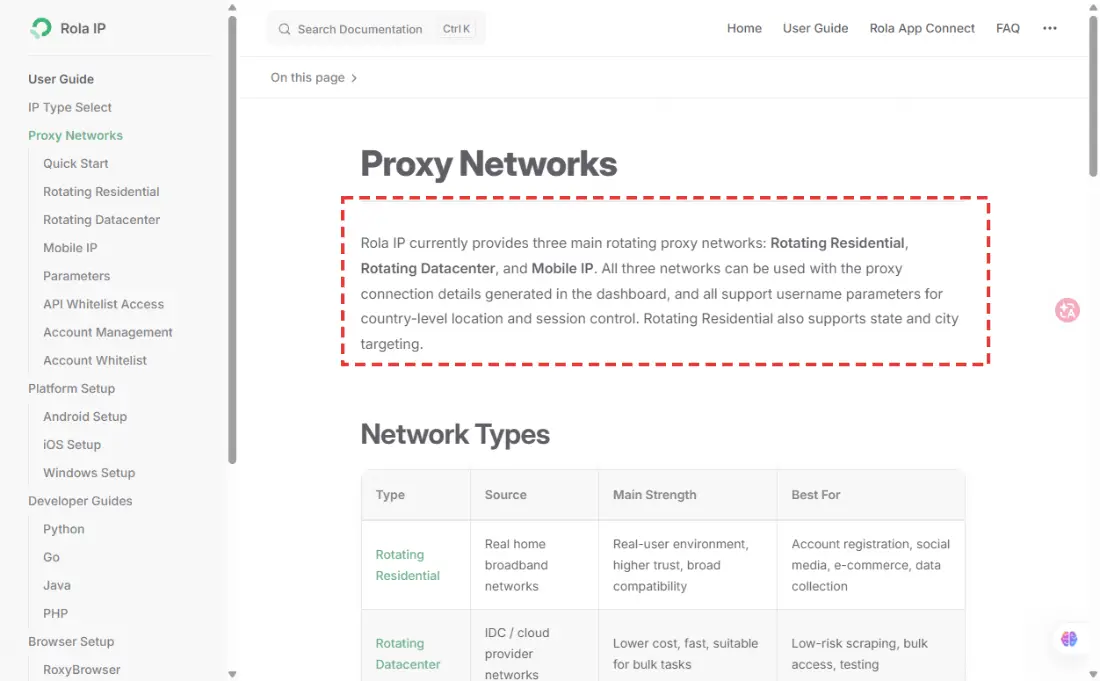
The residential proxy service is the relevant starting point when Australian consumer-network context affects prices, stock, search results, or ads. A stable session suits a multistep QA flow; rotation suits separate observations. Choose the session behavior around the task rather than rotating every request automatically.
Cost: residential PAYG is listed at $4/GB. Prepaid packages offer lower unit rates but expire after 30 days, with unused package traffic forfeited. PAYG is worth comparing for an initial evaluation; a volume package becomes attractive when measured usage justifies the commitment.
Best fit: teams evaluating more than one network type, or moving from an initial residential check to recurring collection.
Trade-off: a larger prepaid package can lower the unit rate while increasing the cost of unused capacity.
Choose the required location and network in the dashboard, then size the purchase around a small workload.
2. Decodo — A Small Residential Starting Plan
Decodo combines a relatively small public residential plan with published Australian performance results. The plan checked for this comparison offered 3GB at $3.75/GB, or $11.25 plus VAT billed monthly.
In Proxyway’s Australian residential comparison, Decodo recorded 28,986 observed unique IPs, a 99.89% average connection success rate, and a 0.78-second average response time. These results help build a shortlist; the actual target’s content and regional behavior still determine whether the service fits.
Best fit: a team that wants a modest residential starting purchase and external performance data to inform its evaluation.
Trade-off: the cost of rendering, retries, parsing, and validation remains separate when buying raw proxy traffic. A managed scraping product uses a different cost model.
3. Oxylabs — Enterprise Procurement and Product Breadth
Oxylabs has an Australia-specific offering across multiple proxy products, with state and city targeting described on its location page. Its residential starting rate was advertised at $2.50/GB; buyers should obtain the actual minimum commitment and included features for the selected product.
Proxyway reported 28,912 observed Australian IPs, a 99.89% average success rate, and a 0.79-second average response time. The 0.01-second difference from Decodo is too small to drive a purchasing decision without matching workload details and uncertainty estimates.
Best fit: organizations that need procurement support, a broad product range, and a contractual relationship around data access.
Trade-off: an enterprise-oriented service is not necessarily the smallest or simplest first purchase for a short experiment.
4. Bright Data — Granular Targeting and Managed Collection
Bright Data advertises Australian residential, mobile, ISP, and datacenter access, alongside city, state, and ZIP-level targeting. It is relevant when a country-level Australian exit is too broad, or when the team wants a managed collection product instead of maintaining the full data pipeline.
Separate those requirements before comparing costs. Raw proxy traffic, an API that returns collected results, and a pre-built dataset carry different billing units and engineering responsibilities. A higher service price may cover work that a raw proxy leaves to the customer.
Best fit: teams with specific subnational targeting requirements or a reason to buy managed collection.
Trade-off: product breadth adds pricing complexity. Budget from the normal selected-product terms rather than a temporary promotion. Proxyway’s Bright Data row is labeled 2024, so its figures are not directly contemporary with the other entries.
5. SOAX — Residential and Mobile Location Workflows
SOAX’s Australian offering includes residential and mobile networks, with options to retain an IP across requests or rotate between requests. This suits projects that need both broadband and mobile-network perspectives.
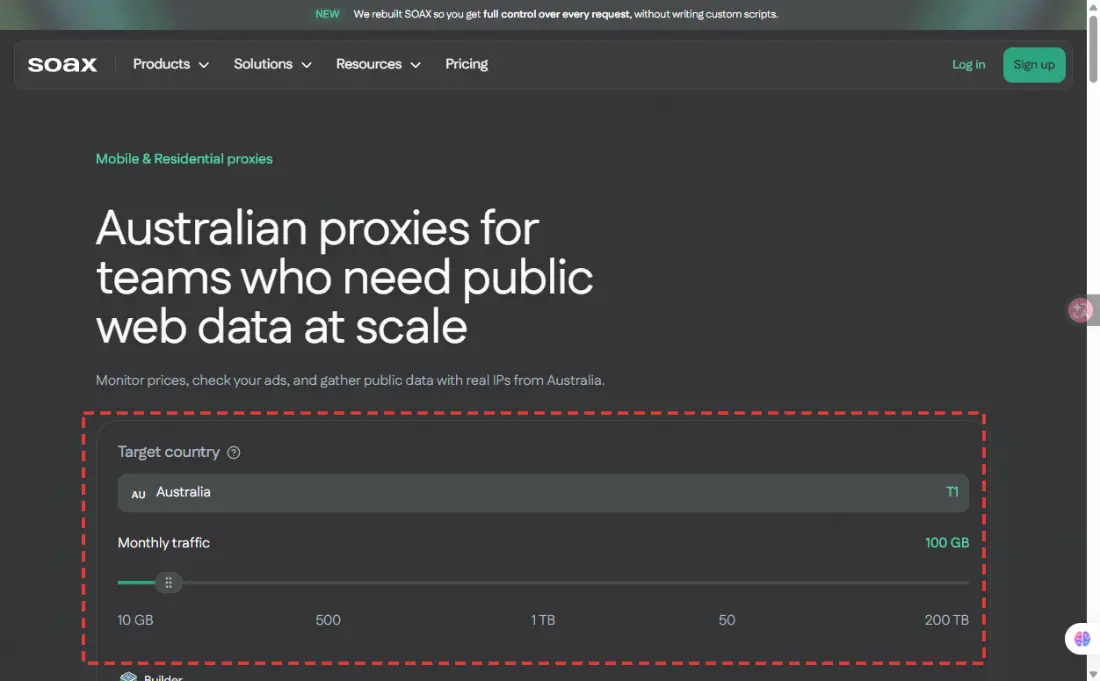
The selected Australian configuration on November 10 offered 100GB at $3/GB, totaling $300 per month excluding VAT. Other purchase configurations may have different totals. Proxyway reported 27,959 observed Australian IPs, a 99.77% average success rate, and a 2.30-second average response time.
Best fit: location testing that requires both residential and mobile access from one supplier.
Trade-off: evaluate the total configured monthly spend and credit treatment, rather than comparing the $3/GB figure alone.
6. Webshare — Self-Service Experiments
Webshare lists datacenter, static residential, and rotating residential products on its Australian page, with HTTP and SOCKS5 support. The page headline advertises about $0.029 per IP; a visible 100-proxy example totals $2.99 per month.
That price is useful only after identifying the product. It cannot be compared directly with rotating residential traffic billed per gigabyte. A datacenter experiment may fit an owned site or another permitted endpoint that accepts hosting networks, while consumer-localized pages may require residential access.
Proxyway’s residential test reported 24,628 observed Australian IPs, a 99.73% average success rate, and a 1.47-second average response time. Those measurements describe the tested residential network, not the low-priced per-IP offer.
Best fit: buyers comfortable selecting and configuring their own product for a narrowly defined experiment.
Trade-off: the smallest headline price and the benchmarked residential product are different comparison points.
7. IPRoyal — Intermittent Residential Traffic
IPRoyal advertises residential traffic from $1.75/GB, with non-expiring allowance, city/state targeting, and flexible rotation. Its Australian page also lists ISP, datacenter, and mobile products.
Non-expiring traffic can be valuable for occasional research or seasonal projects. A lower nominal rate on a time-limited package may cost more in practice if much of the purchased traffic remains unused.
Proxyway reported 6,100 observed Australian IPs, a 98.67% average success rate, and a 1.04-second average response time in its residential test.
Best fit: teams whose residential traffic is irregular and whose purchasing decision depends on allowance validity.
Trade-off: volume discounts can require a larger purchase. Compare the actual purchase amount with the traffic you expect to consume.
How the Australian Performance Figures Compare
The Proxyway Australia comparison describes 140,000 residential connection requests over seven days. Its published table provides a useful external reference:
| Provider | Observed unique AU IPs | Average success rate | Average response time |
|---|---|---|---|
| Decodo | 28,986 | 99.89% | 0.78s |
| Oxylabs | 28,912 | 99.89% | 0.79s |
| SOAX | 27,959 | 99.77% | 2.30s |
| Webshare | 24,628 | 99.73% | 1.47s |
| IPRoyal | 6,100 | 98.67% | 1.04s |
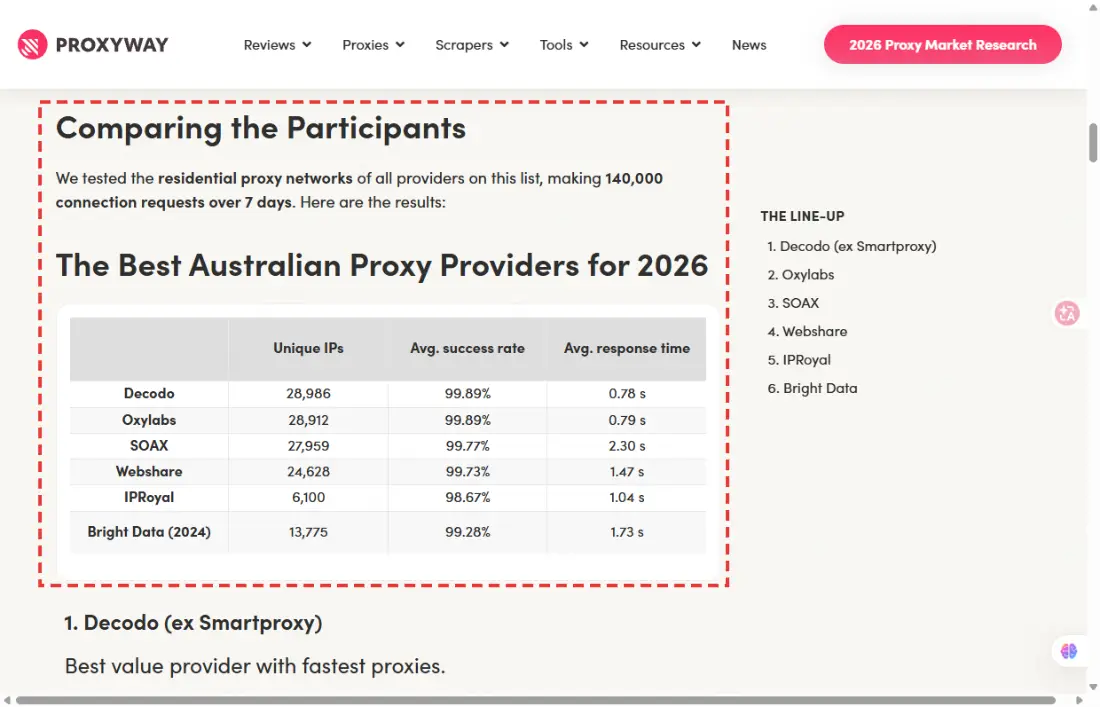
Observed unique IPs are the addresses encountered in the sample, not the provider’s total inventory. Connection success is also different from receiving the correct price, local search result, or usable record. Use these figures to narrow the field, then evaluate your own target.
Which Proxy Type Do You Need for Australia?
| Your task | Starting network | Location and session requirements |
|---|---|---|
| Local prices and store availability | Residential when consumer location affects content | Required city and delivery region; one session per shopping flow |
| Local SEO observation | Residential for consumer-network views | Consistent city, language, device, and search settings |
| Ad verification | Residential or mobile, according to the campaign | Campaign geography; separate sessions for independent observations |
| Mobile-app or carrier QA | Mobile | Required carrier where supported; stable session per test case |
| Authorized account or multistep QA | Static ISP or sticky residential | Keep the same exit throughout the sequence |
| Owned-site regional checks | Datacenter where appropriate | Australian exit and predictable routing |
| Public catalog collection | Datacenter where accepted; residential when content requires it | Bounded rotation between independent tasks |
An Australian IP does not automatically set browser language, time zone, cookies, account region, or delivery postcode. For Sydney stock checks, for example, keep the store or delivery location aligned with the network location. A Melbourne result is not necessarily a substitute.
Check the public IP’s network classification as well as its country. A Sydney datacenter address is geographically Australian, but it does not represent a consumer broadband or mobile connection. ASN registration is a useful clue, rather than a complete proof of the device or access network behind an address.
The choice between sticky vs rotating proxies depends on whether requests belong to one continuous flow or separate tasks. Preserve the exit during an authorized checkout or login test; rotate between independent observations when the task calls for it.
For recurring retail comparisons, proxies for price monitoring should support the cities, observation times, and product fields the team needs to compare consistently.
What Will an Australian Proxy Project Actually Cost?
Compare the first invoice and the cost per usable result, alongside the unit rate. A $2/GB plan is not cheaper than a $3/GB plan if it needs twice as much traffic to deliver the same valid records.
Estimate traffic from a representative workload
If one result transfers 300KB and you need 50,000 results, the baseline is about 15GB using decimal units. With 20% extra traffic for retries and failed responses, the estimate becomes 18GB. Measure the intended client: a rendered browser page can transfer much more than a direct HTML request.
At ROLA IP’s $4/GB PAYG rate, this estimated 18GB workload would cost $72 for proxy traffic, before any applicable taxes or separate software costs.
Compare package commitment with likely consumption
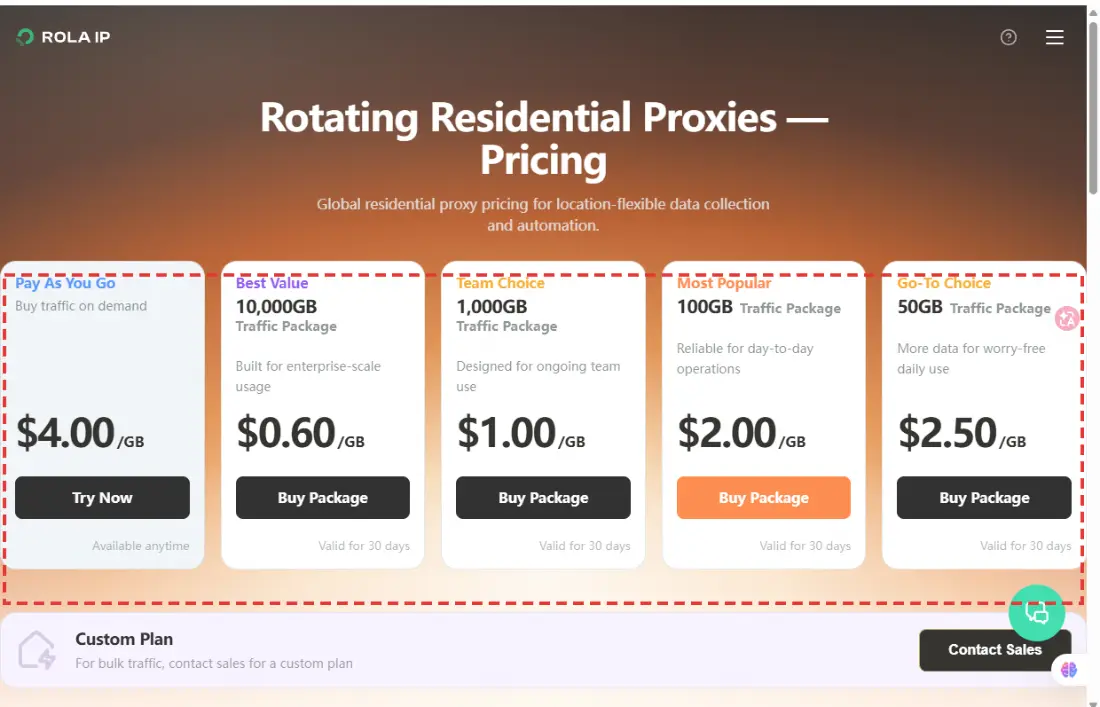
ROLA IP’s residential pricing lists a 50GB package at $2.50/GB, making the package total $125. For an isolated 18GB project, paying $125 for the package would exceed the $72 PAYG estimate even though its per-GB rate is lower. For 50GB consumed within the validity period, the same package would cost $125 versus $200 at the PAYG rate.
That is the decision to make before buying: predictable usage can justify a package, while an initial or irregular workload may favor flexible purchasing. Also include tax, renewal conditions, expiry, retry billing, and any engineering work needed to turn responses into usable data.
Cost per accepted result = total amount billed / valid results delivered
Count wrong geography, empty pages, challenges, and invalid records separately from successful results.
What Should an Australian Proxy Pilot Check?
Before scaling, run the same small, permitted workload against your shortlisted services. The evaluation should last long enough to cover the session duration your application requires.
- Location: record the exit country and required city, then check the target’s actual currency, stock, delivery region, or local results.
- Network type: compare IP-information and network-classification data with the residential, mobile, or hosting identity the task requires. Investigate conflicting classifications.
- Session continuity: check that one exit persists through a multistep flow, and that separate tasks rotate at the intended boundary.
- Usable responses: record valid content, HTTP/proxy errors, challenge pages, and missing fields.
- Cost: record billed traffic, retries, and accepted results rather than timing an IP-check page alone.
Use restricted test credentials and keep secrets out of screenshots and logs. If the target denies access or rate-limits the workload, stop and review the permitted access method rather than rotating indefinitely.
Choose a Plan Around Your First Workload
Start with the city, network type, and session behavior the task actually needs. Use the comparison to select a few candidates, then choose the one that produces valid results at an acceptable total cost.
For ROLA IP, the practical path is to check the required Australian options, select residential, datacenter, or mobile access for the job, and measure a small workload before choosing a larger traffic package. This keeps the purchase tied to actual usage rather than an attractive volume rate.