
Bing Rank Tracker: Reliable Local SERP Monitoring Guide

Aug 26, 2026 · Use Cases · 7 min read
TL;DR
- Use Bing Webmaster Tools for first-party clicks, impressions, CTR, and average-position trends on a verified site.
- Use a separate controlled observation only when you need a defined city, device, language, and query context.
- Store the URL, observed result type, timestamp, location settings, and evidence with every rank observation.
- Treat local ranking as a repeated measurement problem, not a one-time search.
- Investigate large changes with indexing, page, and SERP-layout checks before changing SEO strategy.
Start with the two kinds of Bing ranking data
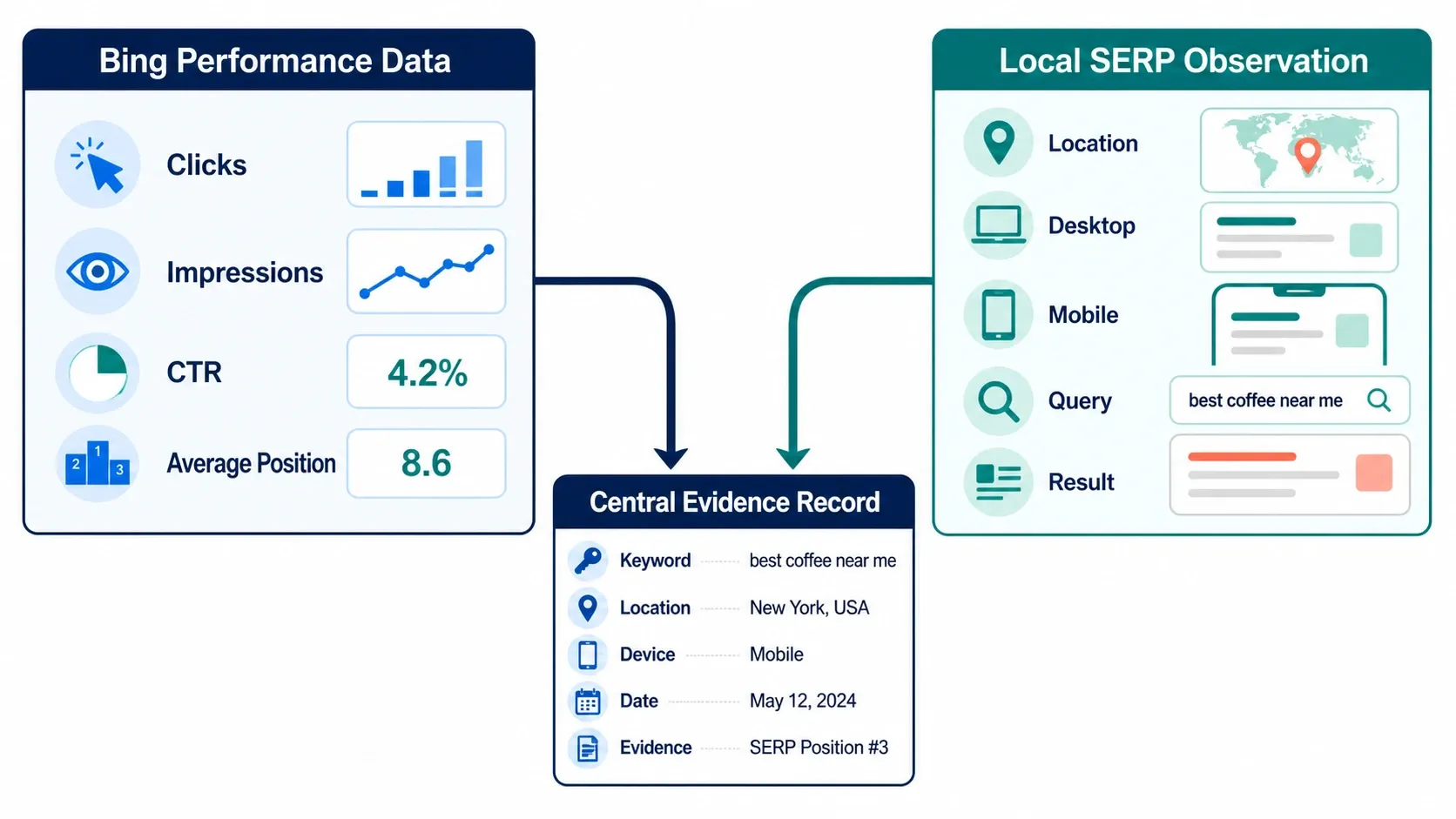
The phrase “rank” covers two different measurements. They should not be merged into one chart without labels.
| Measurement | What it answers | Best source | Main limitation |
|---|---|---|---|
| Site performance | Which queries and pages generated visibility and traffic over time? | Bing Webmaster Tools Search Performance | Average position is an aggregate metric, not a promise of one local result |
| Controlled SERP observation | What did a defined query show from one chosen location and device context? | An authorized tracker, licensed SERP feed, or permitted internal test | It is a point-in-time observation, affected by layout and configuration |
Bing’s Search Performance report provides clicks, impressions, average CTR, and average position for Web traffic, with keyword and page views for a verified site. Bing notes that data begins after the site is added and can take a few days to appear. That makes it the baseline for owned-site performance, not a replacement for a city-level spot check.
A local ranking observation answers a narrower question: “For this query, at this time, under this declared configuration, did this page appear, and in what result context?” The narrower question is valuable, but only if the context travels with the answer.
Define a monitoring specification before selecting a tool
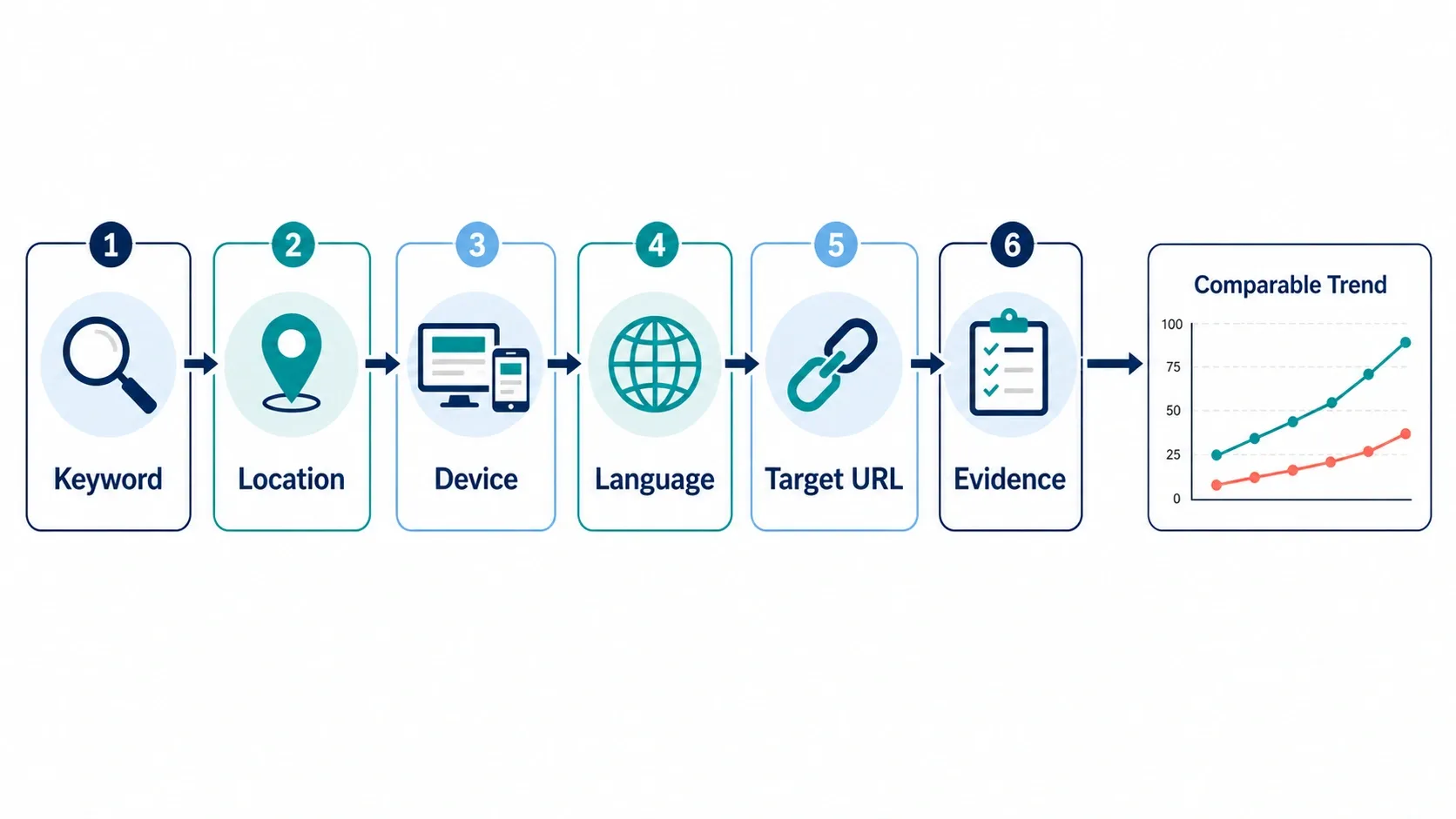
Most tracking disagreements start with an incomplete setup. Create a short specification that any Bing SERP monitoring tool or internal workflow must preserve.
| Field | Example | Why it matters |
|---|---|---|
| Keyword | emergency plumber |
Keep spelling, modifiers, and match intent stable |
| Location | Austin, Texas, US |
Local packs, organic results, and available businesses can change by place |
| Device class | Desktop or mobile | Layout and result features differ by device |
| Language and market | en-US |
Query interpretation and page selection can vary |
| Target URL | Canonical page expected to rank | Detects a ranking change versus a URL swap |
| Result type | Organic, local result, image, news, or other feature | Prevents comparing unlike positions |
| Collection time | UTC timestamp plus local time zone | Supports cadence and incident review |
| Evidence | Saved permitted result record, export, or provider run ID | Makes the observation auditable |
The tracker must also state how it handles localization, duplicates, pagination, and SERP features. A rank of “3” is incomplete if it does not identify whether it means the third organic web result, a local result, or a blended position after a feature has shifted the page.
Choose the right Bing rank tracker approach
The highest-priced platform is not automatically the right fit. Compare the workflow you need rather than a marketing feature list.
| Approach | Good fit | What to verify before adoption | Limitation to accept |
|---|---|---|---|
| Bing Webmaster Tools | Site owners monitoring verified-site performance | Verification method, reporting delay, export, query/page views | Does not reproduce one selected city SERP on demand |
| Dedicated rank tracking platform | Teams monitoring many keywords and competitors | Bing support, location granularity, device setting, evidence retention, exports | Provider methodology may differ from a manual or first-party metric |
| Local grid or geo tracker | Businesses comparing multiple points around a service area | Exact grid points, local-result definition, map versus web result handling | Grid data can create a false sense of precision if queries are inconsistent |
| Authorized internal collection | Teams with a specific data contract and engineering capacity | Source authorization, rate policy, test fixtures, logs, monitoring | You own schema changes, validation, and operational risk |
For any provider, run a two-week pilot against a small stable keyword set. Compare its recorded URL, result type, and date with Bing Webmaster trends rather than expecting exact numeric equality. The systems answer related but different questions.
Build the tracking sheet and baseline
Use a spreadsheet, database, or provider export, but keep the schema explicit. Start with 20-50 priority keywords, not every phrase in the account. Group them by page, intent, and geography so the report can answer a business question.
observed_at_utc,keyword,location,device,language,target_url,result_type,observed_position,evidence_id
2026-08-24T09:00:00Z,emergency plumber,Austin TX US,mobile,en-US,https://example.com/emergency-plumber,organic,4,run-20260824-001
2026-08-24T09:00:00Z,emergency plumber,Austin TX US,mobile,en-US,https://example.com/emergency-plumber,local_result,2,run-20260824-001
Keep organic and local results in separate records. This prevents a local feature from making an organic movement appear larger or smaller than it is. Save the exact configuration and the provider’s evidence ID or permitted export reference, not just a screenshot that cannot be searched later.
Then create a baseline:
- Verify the site in Bing Webmaster Tools and allow its performance reports to populate.
- Export a date range for the target pages and queries. Bing supports CSV export from Search Performance.
- Run the selected local observation method with the same keyword, location, device, and language settings you will use later.
- Record the result type, target URL, and evidence ID for every observation.
- Set a cadence that matches the business decision: weekly for routine local SEO, more often only when a documented use case and source policy justify it.
The Bing Webmaster Tools overview also includes URL inspection, Site Explorer, sitemaps, and SEO reports. These are especially useful when a change in a tracker is paired with an indexing or crawl issue.
Make local SERP observations comparable
Location is only one variable. A reliable Bing rank tracker locks the variables that can be locked and labels the ones that cannot.
| Keep fixed | Record when it changes | Do not assume |
|---|---|---|
| Keyword spelling, market, device class, cadence | Location, target URL, tool/provider version, result type | One position equals the experience of every searcher |
| Approved method and rate policy | SERP features, index status, page title or content release | A feature-rich SERP has the same organic space as a plain SERP |
| Evidence format and retention period | Business hours, campaign timing, major site changes | A short-term movement proves a lasting trend |
When a permitted workflow needs a region-specific test route, residential proxies for SEO monitoring can be evaluated after the source rules, collection purpose, and rate limits are documented. They do not create permission to collect Bing results or override a platform’s controls. For broader competitive analysis, proxies for market research should likewise be used only within an authorized data-collection plan.
If your workflow uses Rola IP, keep country, city, and session settings in the run record. The proxy parameters reference can help map those configuration fields, but it is not a replacement for source authorization or a tracking methodology.
Investigate a ranking change before acting on it
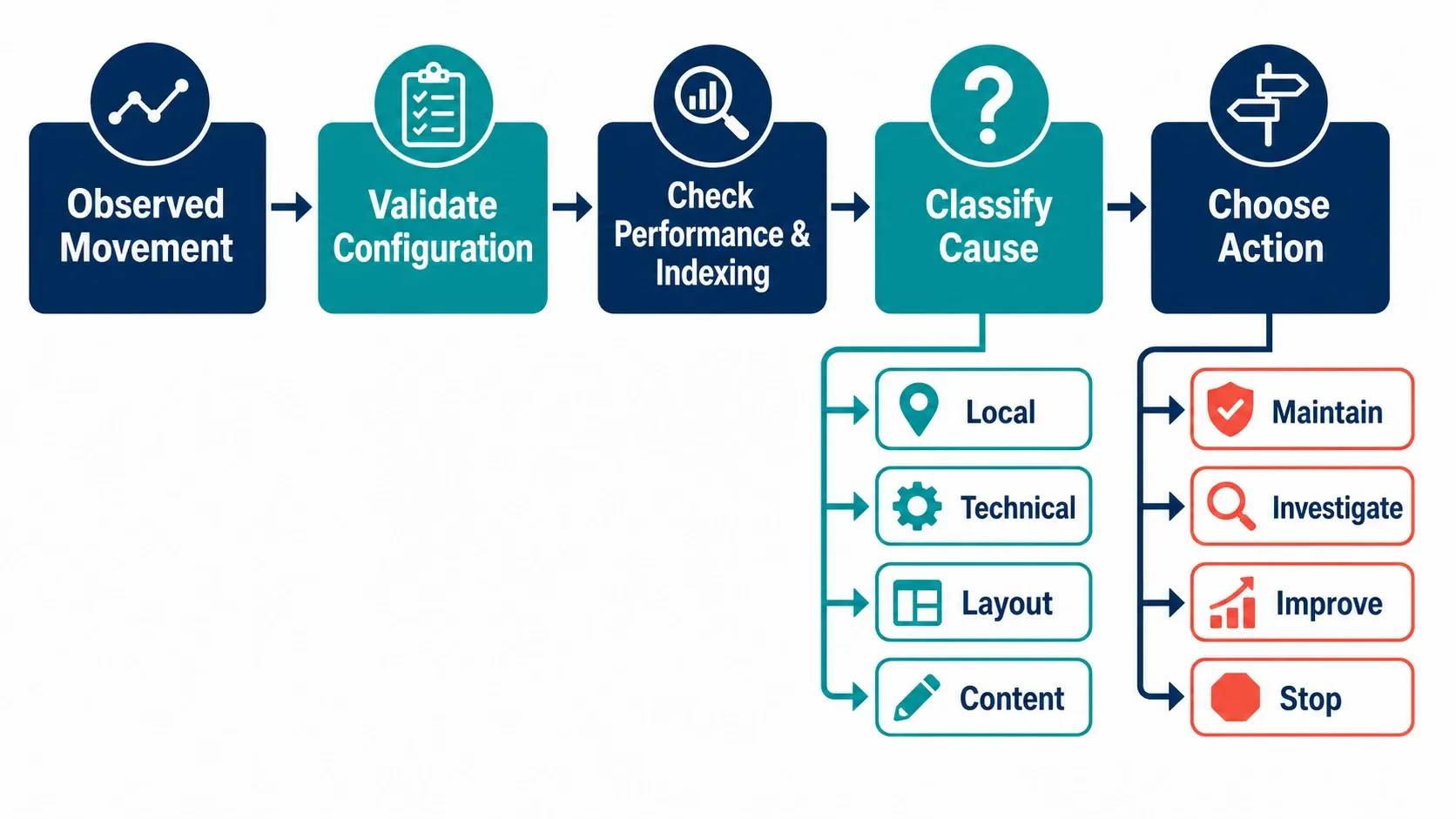
Avoid rewriting a page because of one unexpected data point. First classify the change.
| Symptom | Likely explanation | How to verify | Next step |
|---|---|---|---|
| Only one city moved | Local results or location configuration changed | Repeat the same controlled setup; compare result type and target URL | Check local relevance signals and keep the observation labeled |
| Many keywords fell together | Indexing, crawl, site release, or measurement issue | Use Bing URL Inspection, Site Explorer, and Webmaster trend data | Resolve technical issue or roll back a harmful release before content changes |
| Position changed but clicks did not | Layout shifted or query volume changed | Compare impressions, CTR, and result features | Treat as a visibility investigation, not a conversion conclusion |
| Different URL now appears | Cannibalization, canonical change, or Bing chose another page | Check page-level query data and canonical signals | Decide whether the new URL is acceptable; then align internal links and content |
| Tracker returns a limit or access error | Policy, quota, or configuration issue | Review vendor status and approved access terms | Stop retries; use the documented support, export, or API route |
For large change windows, annotate the report with deployments, content updates, local listing changes, and site incidents. A web scraping proxy is relevant only to an authorized collection system; it is never a remedy for a denied request or a way to evade rate limits.
Turn the data into an SEO decision
Each reporting cycle should produce one of four decisions: maintain, investigate, improve, or stop tracking. A concise decision note is more useful than a dashboard full of unqualified averages.
| Finding | Decision | Evidence required |
|---|---|---|
| Stable visibility and clicks | Maintain | Four or more comparable observations plus Webmaster trend context |
| Local decline in one service area | Investigate | Same-configuration repeat, target URL check, and local-result classification |
| Persistent loss on a priority page | Improve | Verified indexing, page relevance review, and query-to-page mapping |
| Query has no business value or no reliable data | Stop tracking | Search intent review and documented reason |
Bing Webmaster Tools now also provides an AI Performance report for supported Microsoft AI experiences. It measures citation activity, not rankings, so keep it in a separate report rather than adding it to Bing organic position charts.
Conclusion: Build a monitoring system people can trust
A good Bing rank tracker does more than report a number. It identifies the page, query, location, device, result type, time, and evidence behind that number. Start with Bing’s verified first-party data, add controlled local observations only when the decision requires them, and investigate changes before reacting. That gives SEO teams a stable record for improving Bing visibility without mistaking normal SERP variation for a crisis.