
Ecommerce Proxies in 2026: Types, and Provider Comparison

Nov 5, 2026 · Use Cases · 11 min read
Ecommerce proxies are not valuable simply because they “change an IP address.” Their real value is helping authorized data collection and website testing maintain the correct geographic context, session state, and measurement criteria.
Price monitoring needs to retrieve actual product prices; localization checks need to confirm currencies and inventory regions; and automation tasks need to track valid-result rates, latency, and cost per valid record. This guide compares proxy types, establishes a reproducible local testing method using terminal commands, and evaluates six services available for consideration in 2026 using consistent criteria.
TL;DR
When collecting public product data across multiple regions, start by testing residential proxies for geographic accuracy, valid product-result rates, and cost per valid record. If stable sessions are important, compare ISP proxies with sticky residential sessions. Consider mobile proxies only when you specifically need to verify the mobile-network perspective.
What Are Ecommerce Proxies Used for?
Product catalogs, prices, promotions, and inventory often vary by region, language, or delivery destination. A page retrieved through a single exit IP may represent only one market. For price monitoring or market research, record the target region, search criteria, product ID, currency, retrieval time, and final URL together.
Operations teams performing multi-region store QA can also check whether category pages, product pages, and pre-cart displays are consistent. However, prices from different regions should not be combined into a single figure without accounting for those differences.
Common use cases fall into three categories:
- Periodically collecting authorized public product pages.
- Using a browser to inspect localized pages and promotional displays.
- Automating inventory or content maintenance within an authorized account.
The third category involves login state and personal data, so platform APIs and official integrations should be the first choice. A proxy controls the network exit; it does not replace login authorization or permission to use data.
If a task involves product, order, or inventory pages behind a login, first confirm that you have permission to use the account and data. Login workflows also require correct cookies, CSRF handling, and session persistence. A proxy changes only the network exit and cannot substitute for authorization. For field design and export workflows for public product catalogs, see Scrape an Ecommerce Website.
How to Choose Between Residential, Datacenter, ISP, and Mobile Proxies
| Proxy type | Typical use case | Session and geographic characteristics | Main trade-off |
|---|---|---|---|
| Datacenter proxies | Low-sensitivity, high-volume requests within the permitted scope | Stable and often lower-cost | May not reflect a local consumer’s perspective |
| ISP proxies | Repeated visits that need a more stable exit | Fixed IPs can make session persistence easier | City coverage and available inventory must be verified |
| Residential proxies | Multi-region product and price monitoring | Suitable for region-based routing and rotation | Bandwidth charges and valid-result rates must be evaluated together |
| Mobile proxies | Page QA from a real mobile-network perspective | Carrier and geographic conditions need verification | Usually unnecessary for ordinary catalog tasks |
A mobile proxy for ecommerce is worth prioritizing only when the task genuinely depends on a mobile-network environment. For example, you may need to separately validate mobile-versus-desktop availability, localized displays, or a route associated with a particular carrier. Mobile proxies are not simply an “upgraded” version of residential proxies for every use case. If the goal is only to collect permitted public product-catalog data, begin with a small sample and compare residential and ISP routes by cost per valid record.
Choose the session method according to the task as well. Rotation can work for independent page-by-page collection. When search results and product-detail pages in the same region need a consistent state, test sticky sessions and release them after the task is complete. Frequent IP changes can make pagination results and geographic measurement inconsistent.
If you are unsure whether a task justifies paying for mobile-network access, compare the use cases in Mobile Proxy vs Residential Proxy, then run a small test against the target website.
How We Compared Ecommerce Proxies
We first considered providers with public product information, verifiable connection methods, and products suitable for geographic ecommerce testing. We then evaluated six criteria under the same conditions:
- Availability in target countries and cities.
- Session persistence and IP rotation.
- Accuracy of product fields and currency.
- Integration and troubleshooting costs.
- Usage-based billing and the cost of failed retries.
- Support and compliance information.
Network-size and success-rate figures published on provider websites are treated as claims to verify, not as automatic scoring inputs.
For repeatable tests, keep the SKU, target region, collection time window, and access permissions fixed. Run the same batch of public or otherwise authorized product pages through each provider. Record the HTTP status, final URL, product ID, price, currency, inventory, latency, and traffic consumed.
Count a page as a valid result only when its fields are complete and its geographic context is correct. Divide total proxy cost by the number of valid records to calculate cost per valid record. If no real trial data is available, recommendations should be based on use-case fit; do not invent a winner or a success rate.
Price-monitoring tasks should also specify the product variant, delivery destination, and timestamp. Otherwise, quotes returned through different exits may not be comparable. Use best proxies for price monitoring as a reference for designing the sampling criteria.
Ecommerce Proxy Providers to Compare in 2026
“Best ecommerce proxies providers 2026” is not a fixed ranking that can be produced from provider marketing figures alone. The providers discussed below all offer residential proxy products, but the right choice depends on your ecommerce task, target markets, session requirements, and cost per valid record.
Rola IP
Product overview: Rola IP’s residential proxies are intended for collection and page-inspection tasks that need network exits in multiple regions. For cross-city product-catalog, price, and inventory monitoring, start with a small sample in each market. Then compare the currency, price, and inventory for the same SKU across different exits. Rola IP’s Shopify proxy use-case page describes a related workflow.

Key features: Rotation, geographic selection, and session options are central to this type of ecommerce task. First verify which countries or cities are available in your account, whether an exit can maintain the same session, and whether the target page actually displays the selected region’s currency and delivery information. Do not judge success solely by an IP geolocation database.
Best for: Teams that want to pilot product catalogs in several target markets, inspect Shopify stores, and capture periodic price snapshots. If a task needs only one fixed exit, compare ISP routes as well rather than defaulting to rotating residential proxies.
Integration and workflow: Configure the endpoint and authentication in your existing Python or browser workflow, then test rotating and sticky sessions separately. For setup guidance, see How to Set Up a Residential Proxy and Python Requests Proxy. When collecting product data from a platform, verify that the intended access is permitted.
Costs and limitations: Before a trial, confirm the plan or bandwidth-based billing model, geographic granularity, retry traffic charges, concurrency limits, and support response times. Rola IP’s published metrics do not represent the valid-result rate on a target store. Start by testing 100 authorized product pages in one or two markets.
Related ecommerce use cases: For price monitoring, Rola IP has price monitoring proxies. If your focus is Shopify product fields and pagination, they also have web scraping shopify.
Oxylabs
Product overview: Oxylabs residential proxies are designed for teams that need geotargeting, session management, and documented integration methods. If you already operate an internal scraping platform or multiple business systems, verify the endpoints, geographic parameters, authentication method, and usage reporting before integrating the service.
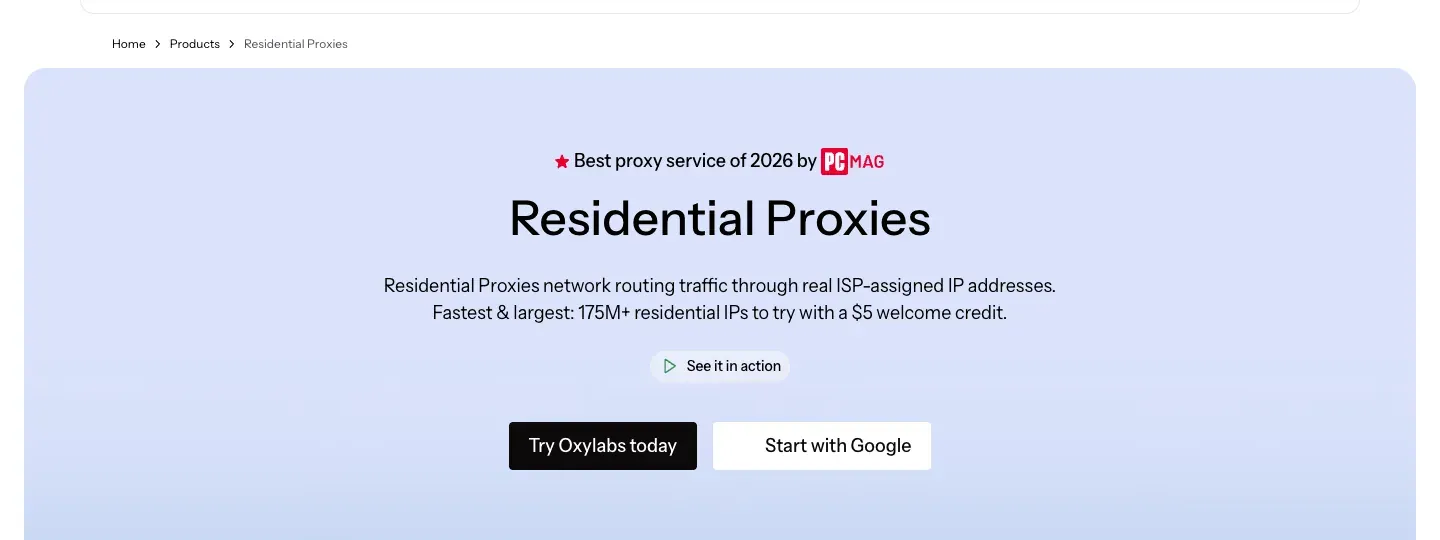
Key features: Official product and developer materials describe geographic targeting and session-control options. Verify the actual availability of target countries, cities, or states; session duration; authentication settings; and traffic visibility. Do not interpret a global coverage figure as proof that usable exits are available in every city.
Best for: Organizations with engineering teams maintaining multiple collection workflows and a need for consistent parameters and documentation. For a small project with only a few SKUs, first calculate whether integration and plan costs exceed the value of the data.
Integration and workflow: Use the same product URL to compare rotating and sticky sessions. Use rotation to evaluate geographic coverage; use sticky sessions to check whether currency, delivery destination, and session state remain consistent when moving from a category page to a product-detail page. Test records should include the exit region, final page, and response time.
Costs and limitations: Confirm trial allowances, minimum purchase requirements, concurrency or bandwidth limits, whether failed retries are billable, and available support channels. Provider-reported network size and response times cannot replace measuring valid product-result rates on the target ecommerce website.
Bright Data
Product overview: Bright Data’s residential proxy page describes geographic selection at the country, state, and city levels, as well as rotation and sticky-session options. This makes it a candidate for fine-grained geographic testing. Its product ecosystem also includes tools beyond network exits, so define the scope of the purchase before evaluating it.
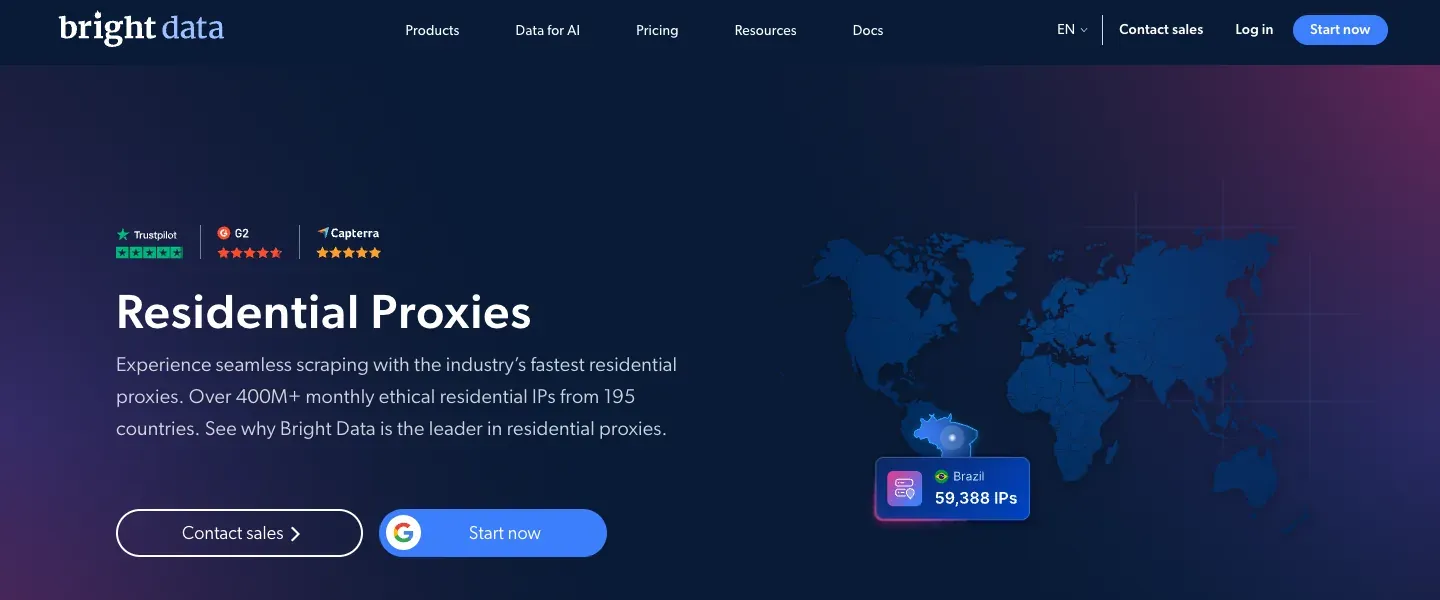
Key features: Evaluate geographic selection, session persistence, rotation, and integration with other collection tools. If the business needs to validate ZIP-code-level or more granular locations, first confirm that the required locations are available in the current account. Then verify currency, inventory, and delivery coverage on the product page rather than checking only the exit IP label.
Best for: Teams that need coverage across multiple countries, require fine-grained localization checks, and are willing to invest engineering time in trials and invoice verification. A simple public-catalog task in one region may not need the full product suite.
Integration and workflow: Assign the same SKU set to the target regions and check consistency across search, product, and inventory pages. If you are also evaluating browser or web-unlocking products, test them separately from the proxy network itself. Otherwise, success rates from different products may be mixed together.
Costs and limitations: Clarify the boundaries between bandwidth-based charges, plans, and add-on products. Compare providers using cost per valid product record. Quotes, promotions, and plans may change; use the current contract and account dashboard before purchasing.
Decodo
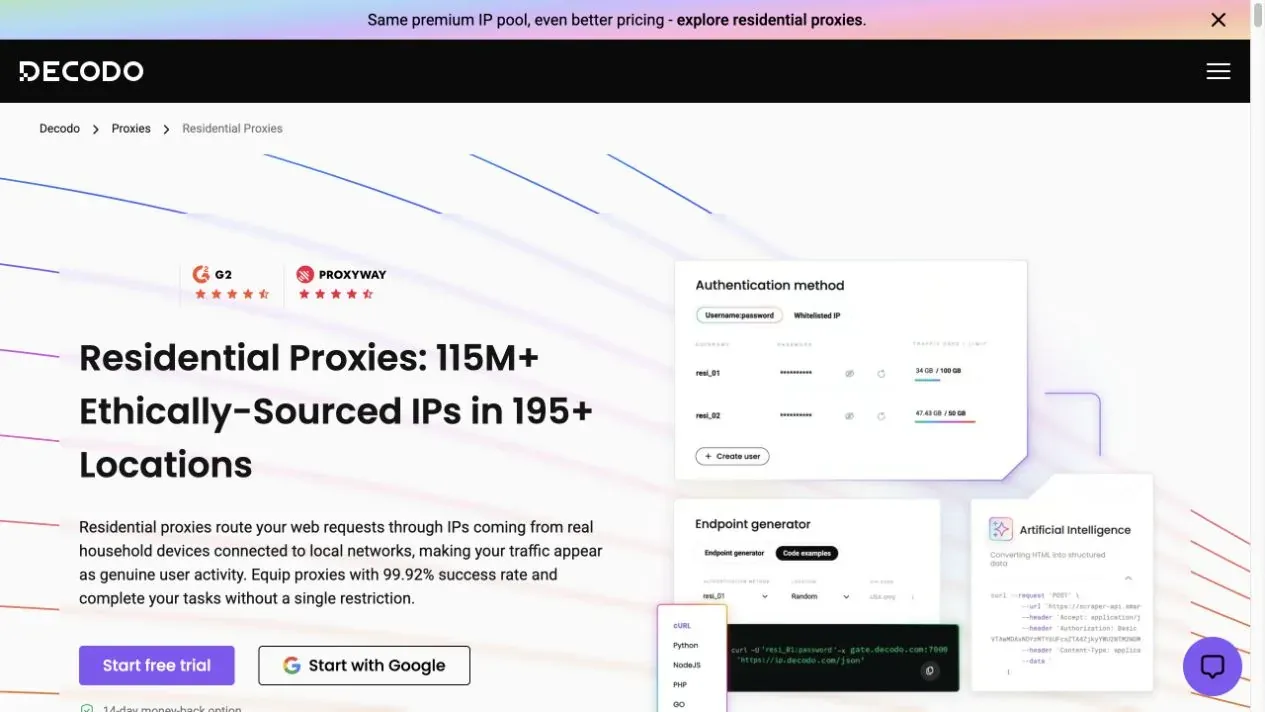
Product overview: Decodo (formerly Smartproxy) offers residential proxies with multi-region exits, rotation, and sticky sessions. Its dashboard supports endpoint generation and usage statistics, and allows traffic limits to be set for users. This can help teams gradually integrate small-scale tests into existing scripts.
Key features: Officially listed options include HTTP(S), SOCKS5, and geographic targeting by country, state, and city. ZIP-code targeting is also available in some locations. Rotation is suitable for independent product-page requests, while sticky sessions are useful for continuous checks that need to preserve geographic and page state.
Best for: Small and midsize data teams that want self-service setup, quick comparisons of product pages across regions, and traffic controls by user or task.
Integration and cost considerations: Confirm that the target city or ZIP code is actually available under the selected plan and location before testing product fields. Do not rely solely on a headline such as “195+ locations.” The provider offers pay-as-you-go and subscription plans, but a lower unit price may require a higher usage tier. Compare costs using your actual expected purchase volume.
SOAX
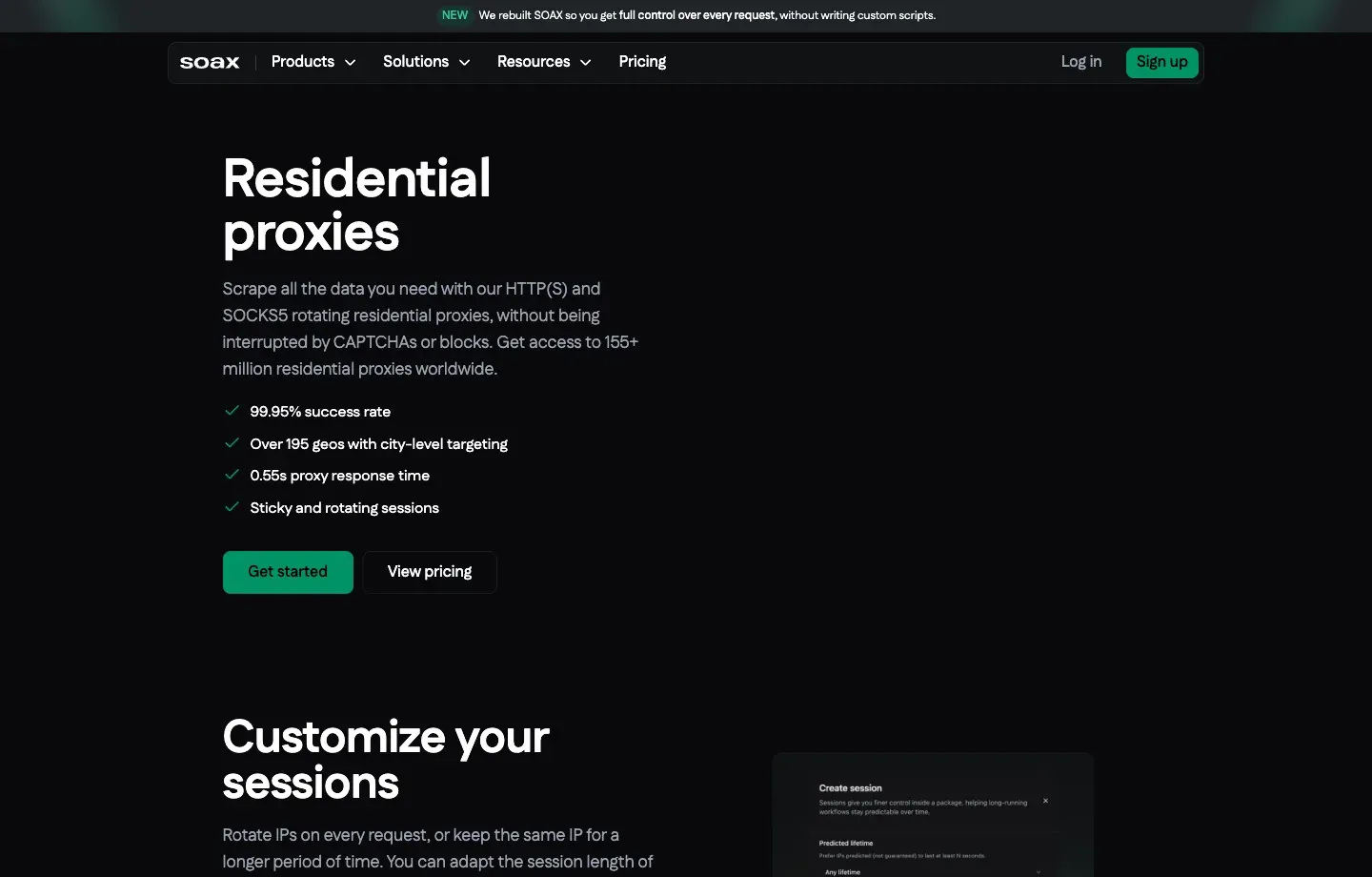
Product overview: SOAX offers residential and mobile proxy networks. Its residential product supports per-request rotation and sticky sessions. For teams that need to inspect desktop product pages and also validate the mobile-network perspective, it can be considered as a source of both route types under one provider. Results from the two types should still be measured separately.
Key features: The service supports HTTP(S), SOCKS5, geographic filters, and custom session durations. Its product materials list filtering by country, region, city, and ASN. Verify the availability of advanced targeting options under the selected plan.
Best for: Teams that monitor public product data across multiple regions and perform mobile-page QA, while needing flexible control over rotation frequency.
Integration and cost considerations: SOAX billing depends on geographic tier, plan, and allowance. The same amount of traffic may cost different amounts in different target countries. During a trial, keep the country, product sample, and request frequency fixed, and calculate the cost per valid record separately for residential and mobile routes.
IPRoyal
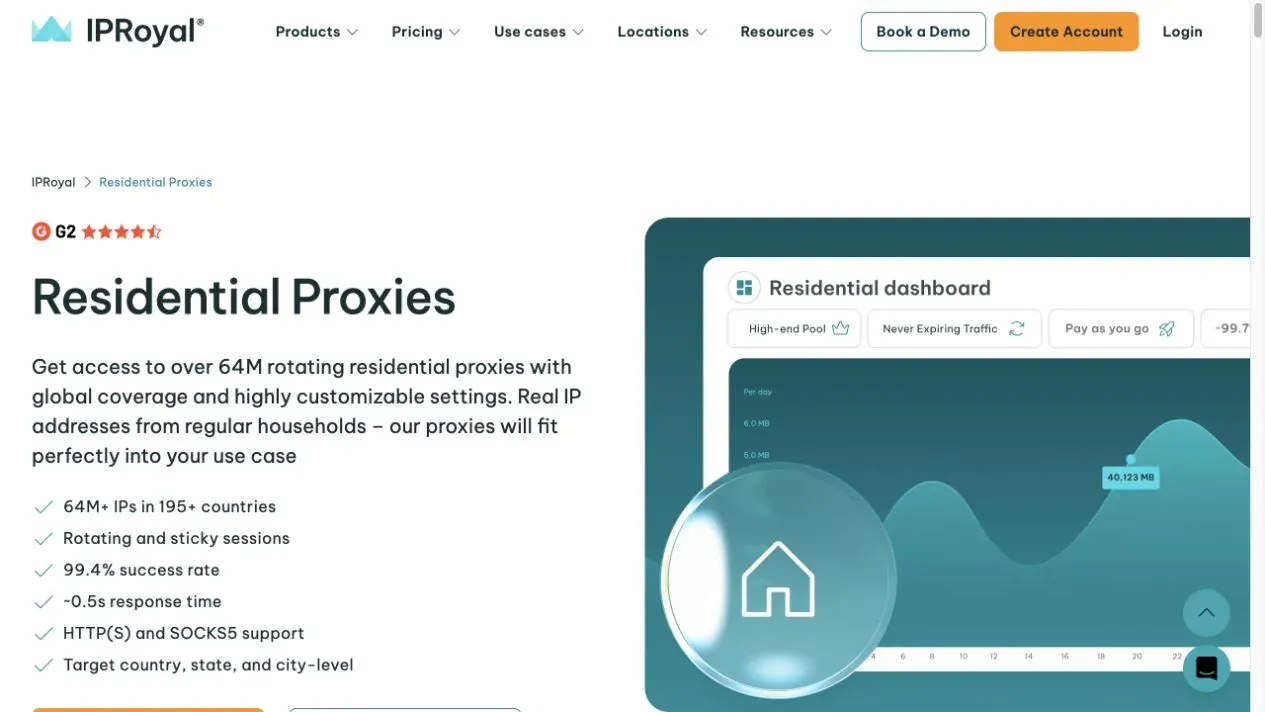
Product overview: IPRoyal residential proxies support geographic selection, per-request rotation, and sticky sessions, with both subscription and pay-as-you-go purchasing options. The provider states that purchased residential proxy traffic does not expire. This is worth comparing for seasonal promotion monitoring or market research that does not run continuously.
Key features: The dashboard allows users to set a country and, where available, a state or city; choose random rotation or a Sticky IP; and configure session duration. It also provides usage statistics and proxy-testing tools. A maximum session-duration setting does not guarantee that the underlying residential IP will remain online. Continuous workflows still need to handle IP changes.
Best for: Teams with irregular collection schedules and relatively small usage per run that want to purchase traffic and use it as needed. It may also suit teams that want to validate product displays in a specific region using a small sample first.
Integration and cost considerations: Do not treat the lowest advertised price per GB as the price for a small purchase. Prices vary by traffic tier and between subscription and pay-as-you-go plans. Before making a final selection, test geographic accuracy, product-field completeness, and actual traffic consumption on the target website.
How to Test Proxy Integration with a Product Page
Use the same product URL, region, session policy, timeout, and retry settings for each provider. Count a response as valid only when the expected product fields and geographic context are present. The following Python example sends one authorized request through a proxy and checks the response status, content type, and final URL. It does not contact a real store until you provide an approved target URL.
import os
from urllib.request import ProxyHandler, Request, build_opener

proxy_url = os.environ['ECOM_PROXY_URL']
target_url = os.environ['APPROVED_PRODUCT_URL']

opener = build_opener(
    ProxyHandler({'http': proxy_url, 'https': proxy_url})
)

with opener.open(Request(target_url), timeout=20) as response:
    print(
        response.status,
        response.geturl(),
        response.headers.get_content_type()
    )

If the response is successful, parse the product ID, price, currency, inventory, and final URL into your test record. An HTTP 200 response alone does not prove that the correct product or region was returned. If a product page requires JavaScript rendering, consult the official Playwright proxy configuration documentation after obtaining authorization.
Conclusion
When choosing ecommerce proxies, the key question is not which provider has the largest IP pool. It is whether the service can consistently return the target region, correct currency, and complete product information. We recommend testing the same batch of authorized product pages with all six providers, then comparing valid-result rates, session stability, and cost per valid record.
If your main focus is monitoring product catalogs, prices, or inventory across regions, Rola IP is worth including in your trial. Start with one or two target markets and a small sample to validate localized pages and integration with your existing collection workflow. Once the results meet your requirements, gradually expand the task volume.