
Best Proxies for Price Monitoring 2026: 5 Providers Compared

Jul 30, 2026 · Comparisons · 11 min read
Ecommerce prices can change by location, promotions, inventory, delivery context, and seller activity. At scale, direct collection from one IP can lead to rate limits, CAPTCHAs, incomplete pages, or results that do not reflect the intended market. Proxies for price monitoring help businesses collect authorized public pricing data more reliably across the markets that matter.
TL;DR
Rola IP is a strong option for flexible, location-specific ecommerce price monitoring. Use residential proxies for protected product pages, ISP proxies for longer multi-step sessions, and datacenter proxies for lower-risk targets; test providers against your target sites and valid-record cost before scaling.
How Ecommerce Companies Use Proxies for Price Monitoring

Bypass rate limits and IP blocks
Price-monitoring systems distribute authorized public-page requests across multiple IPs instead of repeatedly relying on one address. This can make continuous daily or high-frequency monitoring more resilient, but it does not permit bypassing logins, paywalls, technical protections, or a site’s access rules. Use controlled concurrency, limited retries, and the target site’s permitted access model.
Access geo-specific prices
Retailers may vary price, currency, taxes, shipping fees, promotions, and availability by country, city, ZIP code, language, or delivery context. A matching proxy location supports market-specific checks, but proxy location alone is not enough. The collection specification should also record currency, language, delivery address assumptions, cookies where permitted, and the page flow being checked.
Improve data quality
Proxies reduce only one source of incomplete records. A usable price record still needs a product-ID match, price, currency, stock state, shipping or promotion fields where relevant, timestamp, and page-state validation. Treat CAPTCHAs, 403 and 429 responses, empty pages, default-region pages, and product mismatches as exceptions rather than price observations.
Support near-real-time price tracking
Distributed checks can help a team monitor more SKUs and locations without concentrating every request on one IP. Actual freshness still depends on the monitoring schedule, page-update cadence, response time, and target-site limits. A system that checks once per day cannot identify the time of a change that occurred between checks.
A simple price-monitoring workflow
- Define the SKU, target market, and shopper context to measure.
- Collect authorized public-page data through a matching proxy location.
- Validate price, currency, stock, shipping, and promotion conditions.
- Normalize comparable records and trigger alerts only after validation.
Core Proxy Types for Price Monitoring
Residential proxies
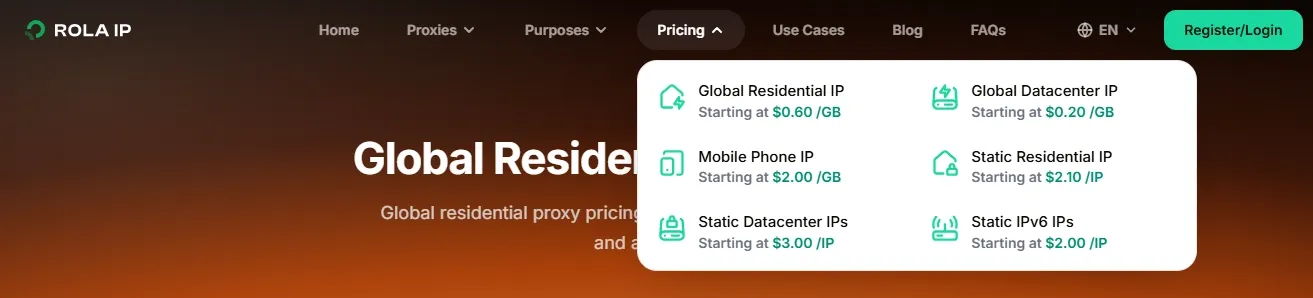
Residential proxies are usually the best starting point for major ecommerce websites, marketplaces, and country- or city-level retail price checks. Their higher cost means teams should measure valid-record output rather than assume they are necessary for every page.
Datacenter proxies
Datacenter proxies can be a fast, cost-efficient option for less protected websites, owned properties, and high-volume basic product-page checks. They should be tested against the actual target set because some retailers treat datacenter-origin requests differently from consumer-network traffic.
ISP proxies
ISP proxies are useful for stable, longer sessions and repeatable workflows. They are worth testing when a price check moves from a product page to a cart, delivery estimate, or other multi-step flow where changing the network context mid-session could affect the result.
Mobile proxies
Mobile proxies can be useful for mobile-specific offers or restrictive targets that genuinely require a mobile-network comparison. They are normally best used selectively because the total cost can be higher than for a standard product-page monitoring workflow.
Rotating IPs vs. sticky sessions
Use rotating IPs for broad SKU monitoring and independent product-page checks. Use sticky sessions when a price check requires multiple sequential actions, such as a search, product page, cart, and delivery estimate. Do not pay for a longer session where independent requests provide the same validated result.
How to Choose a Price Monitoring Proxy Provider
How we reviewed these providers
The comparison uses public product documentation, current pricing information where available, published network controls, and real-world price-monitoring requirements. Features, prices, and location coverage can change, so they should be rechecked before publication and procurement. Providers are compared by workload fit, not as a universal winner for every business.
IP quality, reputation, and validated success rate
IP-pool size is not a substitute for measurement. For each priority target, assess the percentage of records that pass product, price, currency, stock, shipping, promotion, and page-state checks. Record block or challenge rate, response time, retries, and failures caused by the parser separately from failures caused by the request workflow.
Geographic targeting precision
Assess country, state, city, ZIP code, and ASN targeting only where the target market requires them. Match the proxy location to the shopper context being measured and confirm that language, currency, tax treatment, shipping assumptions, and session context are comparable before treating two prices as the same market observation.
Cost and pricing model
Compare pay-as-you-go bandwidth with monthly subscription plans, then include page size, JavaScript rendering, retries, monitoring frequency, and the number of markets. Cost per GB is only an input; cost per validated price record is the operating metric that shows whether an apparently lower-priced plan produces usable data.
Quick bandwidth estimate
Monthly bandwidth = pages monitored x average page size x checks per month x retry factor
For example, a program monitoring 1,000 SKUs in three markets twice per day at an average 0.8 MB response size with a 1.2 retry factor would use about 172.8 GB per month. This is an estimate only. Measure a sample of real target pages because scripts, images, rendering, retries, and verification passes can materially change usage.
Operational controls, integration, and support
Review concurrency controls, rotation, sticky-session options, authentication, API access, dashboard usability, and compatibility with the existing monitoring workflow. Also confirm support channels, account security, data-handling terms, and responsible data-collection practices. A provider that fits a simple pilot may not fit a governed multi-team program, and the reverse can also be true.
Test before scaling
Test three to five priority target sites across the locations and SKU types that matter most. Keep the parser, request schedule, validation rules, and shopper context constant for each candidate. Compare validated-record success rate, CAPTCHA or block rate, P50/P95 response time, retries, location match, and cost per validated price record.
Top 5 Proxy Providers for Price Monitoring in 2026
The five providers below are a shortlist for different workloads and are listed in no particular performance order.
Provider |
Best for |
Recommended proxy type |
Geo-targeting |
Rotation / sessions |
Pricing model |
Key consideration |
|---|---|---|---|---|---|---|
Rola IP |
Flexible multi-market price monitoring |
Residential; ISP sessions where required |
Confirm needed country, city, or other targeting level |
Test rotation for independent checks and sticky sessions for continuous flows |
Compare current usage options with valid-record cost |
Validate target-site results before scaling |
Oxylabs |
Enterprise-scale global programs |
Residential and ISP |
Review targeting depth for required markets |
Test product-page and cart workflows separately |
Evaluate enterprise plans against total volume and support needs |
Budget and implementation scope can be higher |
Bright Data |
Complex or JavaScript-heavy targets |
Residential and collection tools where justified |
Confirm location controls for target sites |
Validate session consistency and rendering workflow |
Assess proxy, tooling, and maintenance costs together |
Setup and compliance requirements can be more demanding |
Decodo |
Mid-market routine monitoring |
Rotating residential |
Test target locations for priority markets |
Confirm sticky-session duration where needed |
Compare plans with actual bandwidth and concurrency |
Do not assume a small test scales unchanged |
IPRoyal |
Pilots and controlled workloads |
Residential |
Check priority-country availability |
Test session options and peak-period behavior |
Compare entry price with retry-adjusted cost |
Validate concurrency and usable output first |
1. Rola IP: Best Overall for Flexible Price Monitoring

Best for: Ecommerce teams monitoring products across multiple locations and categories.
Recommended proxy type: Start with residential proxies for protected retail targets and geo-specific monitoring; add ISP-style persistent sessions only where the page flow requires continuity.
Key strengths: The relevant Rola documentation covers IP-type selection, residential setup, and configuration parameters. Use the IP type selection guide, rotating residential proxy setup, and proxy parameters documentation to map the workflow before a trial.
Geographic and session controls: Verify the targeting levels, rotation settings, session behavior, and authentication options required by the target markets in current documentation and the account.
Pricing approach: Compare the available usage options with expected bandwidth and cost per validated price record, not only the advertised unit price.
Key consideration: Test priority websites, countries, SKU types, and monitoring volumes before scaling.
Who should choose it: Teams seeking flexible, location-aware price monitoring without assuming that every workflow needs the same proxy type or session model.
2. Oxylabs: Best for Enterprise-Scale Monitoring
Best for: Large organizations running high-volume, global monitoring programs.
Recommended proxy type: Test residential and ISP proxies against separate workloads: independent product pages, cart flows, and multi-step quotes.
Key strengths: The fit to evaluate is an enterprise program that needs controls and support alongside proxy traffic, rather than a single low-cost page-checking tool.
Geographic and session controls: Review the targeting depth and session-management options required for each market and flow in the official documentation linked below.
Pricing approach: Evaluate enterprise plans against total traffic, integration, support, governance, and operational requirements.
Key consideration: Higher budget and greater implementation complexity may not be proportionate for a bounded pilot.
Who should choose it: Enterprises with complex collection requirements and substantial monitoring volume that can justify a broader operational evaluation.
Official reference, checked July 29, 2026: Oxylabs residential proxy documentation.
3. Bright Data: Best for Complex and Highly Protected Targets
Best for: Technically mature teams monitoring JavaScript-heavy, regionally complex, or restrictive ecommerce targets.
Recommended proxy type: Test residential proxies and specialized collection tools only where rendering or the collection workflow is needed to obtain a valid price field.
Key strengths: The relevant consideration is the ability to evaluate proxy traffic together with a broader data-collection toolchain, rather than treating the proxy as the whole operating cost.
Geographic and session controls: Confirm the controls needed for location-specific target sites in the official documentation linked below, then test post-render price fields and session consistency.
Pricing approach: Assess infrastructure, tooling, parser maintenance, evidence storage, and proxy costs together.
Key consideration: Setup, pricing, and compliance requirements may be more demanding; simple server-rendered targets may not justify added tooling.
Who should choose it: Teams handling difficult websites at scale that can operate and validate a more involved collection workflow.
Official reference, checked July 29, 2026: Bright Data residential proxy documentation.
4. Decodo: Best for Mid-Market Teams

Best for: Growing ecommerce businesses that need practical proxy management for routine competitor monitoring.
Recommended proxy type: Start with rotating residential proxies for independent product pages, then add sticky sessions for carts, delivery estimates, or other continuous flows only when needed.
Key strengths: The fit to evaluate is a monitoring workflow that must balance routine coverage, usable controls, and gradual scaling.
Geographic and session controls: Test priority locations and the required session duration using the official documentation linked below as the product reference.
Pricing approach: Compare plan terms with expected monthly bandwidth, peak concurrency, and retry-adjusted usage.
Key consideration: Verify success rates and session controls on the actual target sites; do not extrapolate a small standard-page test to a larger or multi-step workload.
Who should choose it: Mid-market teams that want to evaluate the balance of usability, coverage, and measured output before expanding their monitoring program.
Official reference, checked July 29, 2026: Decodo residential proxy documentation.
5. IPRoyal: Best Budget-Conscious Option
Best for: Smaller teams, pilot projects, and controlled monitoring workloads.
Recommended proxy type: Test residential proxies for lower-volume ecommerce monitoring where the target-country and session requirements can be confirmed.
Key strengths: The fit to evaluate is a focused project with a defined hypothesis, such as monitoring a fixed SKU set across two target countries.
Geographic and session controls: Check priority-country availability and session options in the official documentation linked below, then test peak-period behavior.
Pricing approach: Compare entry pricing with the effective cost after retries, validation traffic, and manual review.
Key consideration: Test concurrency and valid-record output before relying on the service for a sustained or broader workload.
Who should choose it: Businesses starting with a focused price-monitoring project or adding secondary-market coverage.
Official reference, checked July 29, 2026: IPRoyal residential proxy documentation.
Price Monitoring Use Cases and Recommended Proxy Setups
What to capture in every price record
| Field | Why it matters |
|---|---|
| Product identifier | Confirms the expected item was collected |
| Source URL and seller | Preserves the review path |
| Proxy location | Explains market context |
| Currency and listed price | Defines the observed commercial value |
| Discount, stock, and shipping | Prevents incomplete price comparisons |
| Timestamp | Supports historical analysis |
| Collection and validation status | Keeps invalid pages out of alerts |
Ecommerce competitor SKU tracking
Use rotating residential proxies for broad product-page coverage, with controlled concurrency and finite retries. Set monitoring frequency according to SKU value and price volatility: higher-value or fast-moving products may justify more checks than long-tail items.
Travel and fare aggregation
Use location-specific proxies for airline, hotel, and ticket pricing, and sticky sessions for permitted multi-step searches where session continuity affects the displayed result. Record origin, date, traveler count, currency, and all other search conditions so unlike quotes are not compared.
MAP compliance monitoring
Track seller name, listing URL, advertised price, stock status, and an evidence timestamp. Validate suspected differences for tax, coupon, bundle, and regional conditions before alerting internal teams or taking action.
Multi-country retail pricing
Match proxy location, language, currency, and shopper context to each market. Normalize taxes, shipping, promotions, and availability before comparing prices, or a display difference may be misread as a competitor price change.
Common Price-Monitoring Mistakes and How to Avoid Them
Choosing proxies based on price alone
Avoid free or poorly documented public proxies that introduce security, reliability, and data-quality risks. Select providers using a controlled target-site test and cost per validated price record rather than only cost per GB.
Monitoring every market from one location
Do not use a single-country IP to compare global retail prices. Create a market-to-location matrix specifying the required proxy location, language, currency, delivery context, and shopper assumptions for each comparison.
Using the wrong proxy type
Do not assume datacenter traffic is suitable for a target that needs residential context, or that residential and ISP sessions are necessary for a lower-risk independent page. Match proxy type and session model to the target’s protection level and the steps required to reach the final price.
Control requests, retries, and bandwidth usage
Use controlled concurrency, adaptive pacing, and limited retries. Reduce unnecessary page assets only when doing so preserves the content needed to validate the price and product context. Treat CAPTCHAs, 403 responses, 429 responses, and empty pages as signals to validate or adjust the workflow.
Detect and prevent silent failures
Do not treat error pages, blocked pages, incomplete product results, or an HTTP 200 response as a real price by default. Validate price, currency, stock, shipping, promotion, product ID, and page-state markers before creating an alert.
Conclusion
Choose a provider based on target-site difficulty, location requirements, monitoring frequency, session needs, and validated data quality. Rola IP is a strong option to evaluate for flexible, scalable, location-aware price monitoring. Oxylabs and Bright Data may suit enterprises with complex technical requirements and larger budgets, while Decodo and IPRoyal can be evaluated for mid-market programs, pilots, and defined workloads.
Start with a controlled test matrix that includes priority sites, locations, SKU types, session needs, and validation rules. Then select the provider that delivers the most accurate, location-specific pricing data at a sustainable cost. Start collecting more accurate, location-specific pricing data with Rola IP.