
ProxySite Review 2026 and the Best ProxySite Alternatives

Sep 9, 2026 · Comparisons · 17 min read
Introduction
ProxySite is a free browser-based web proxy that works well for temporarily opening ordinary web pages, but it is not suitable for sensitive logins, whole-device protection, automation, or business workflows that require stable location and session control. If you are looking for a ProxySite alternative for web scraping, regional verification, or application integration, Rola IP is our top choice in this article.
This proxysite review was completed on September 8, 2026. We used the server currently recommended on the official website to open example.com, and the page loaded successfully. We also checked the server list, settings page, public privacy policy, and terms of service.
Our testing found that an IP-check URL containing query parameters was rejected as invalid, while the same URL without query parameters also failed to complete loading. This shows that ProxySite is straightforward for simple web pages, but it should not be treated as a proxy network that scripts, browsers, or operating systems can reliably call as infrastructure.
| Conclusion | ProxySite Performance |
|---|---|
| Best for | Short-term access to ordinary web pages without registration |
| Biggest advantage | Open and use immediately, with simple US/EU server selection |
| Main limitation | Proxies only the current web page/tab; limited compatibility with URLs and complex web apps |
| Privacy highlight | Public web proxy logs are retained for 14 days under the official policy |
| Not recommended for | Banking, healthcare, enterprise accounts, long-term logins, APIs, or automation |
| Best commercial alternative | Rola IP, for workflows that need proxy credentials, location control, rotation, sticky sessions, and tool integration |
What Is ProxySite and How Does It Work
ProxySite.com is a web relay service. Users submit a target URL to ProxySite, its servers request the target page, and the processed content is returned to the browser. The target website will usually see the relay server’s address rather than the user’s public IP address. However, this protection only applies to browsing initiated through the ProxySite page. It does not automatically cover email clients, desktop applications, other browser tabs, or the entire device.
The ProxySite official homepage currently offers US and EU servers and emphasizes web relaying and SSL connections. At a basic level, an HTTP proxy sends requests on behalf of a client; MDN proxy servers and tunneling provides a more complete technical explanation of forward proxies, intermediary hops, and tunneling.
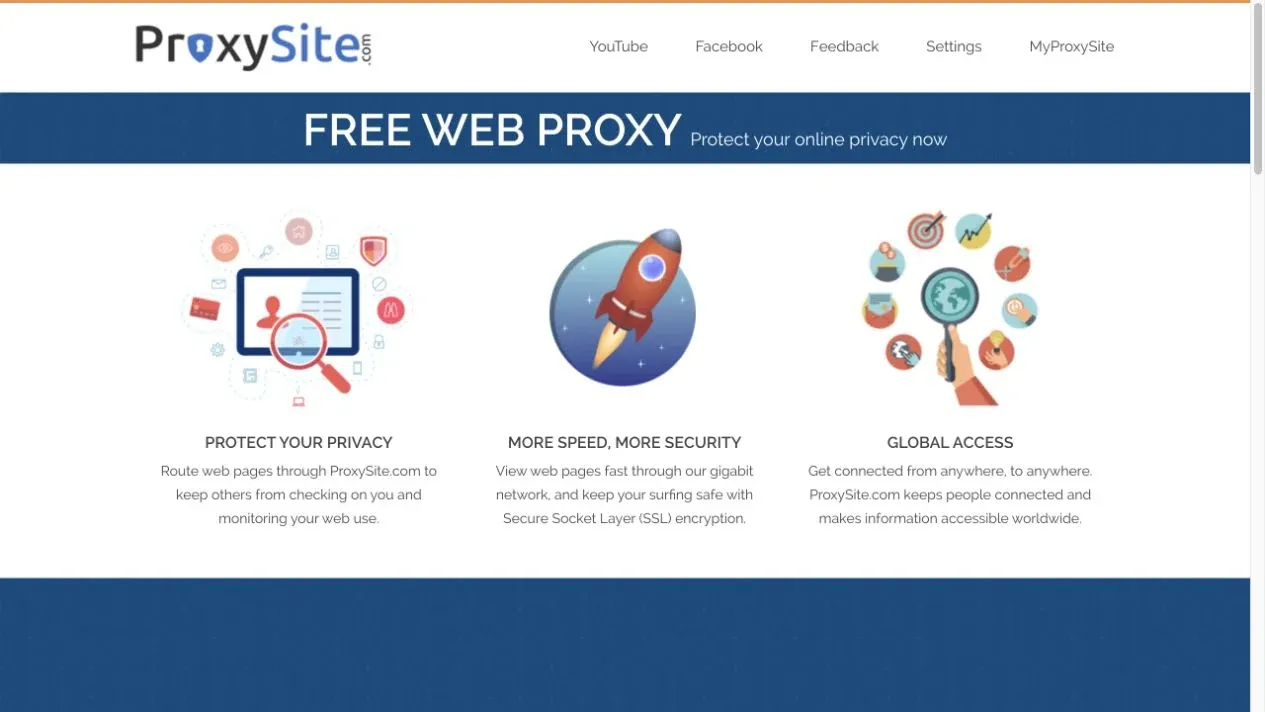
Figure 1: ProxySite’s English homepage, showing the free web proxy entry point and current product positioning.
How Is ProxySite Different from a Standard Proxy Service?
| Comparison | ProxySite Web Proxy | Residential or Datacenter Proxy Network |
|---|---|---|
| Connection method | Enter a URL on the website | Configure host, port, username, and password in an application |
| Coverage | Current proxied page | Browser, scripts, crawlers, testing tools, or system proxy |
| Location control | US/EU server selection | Country, region, or city selection depending on product support |
| Session control | Mainly managed through the website interface | Rotation, sticky sessions, or static sessions are commonly available |
| Automation | No standard proxy endpoint for direct use in business code | Common HTTP/SOCKS5 integration |
| Observability | Suitable for manually checking whether a page opens | Can record exit IP, latency, status codes, success rate, and traffic |
Therefore, a proxysite.com alternative may refer to three very different product categories: another free web proxy, a VPN that covers the entire device, or a professional proxy network that integrates with business tools. Alternative comparisons only make sense after the actual requirement has been defined.
How We Conducted This ProxySite Review
This review of ProxySite used repeatable basic tasks and checks against public policies. We did not present a single session as a global performance benchmark. The test environment was desktop Chrome, the test date was September 8, 2026, and the target page was https://example.com/, which is specifically maintained for documentation examples.
The review steps were:
- Open the English homepage and record the default recommended server, server range, and on-page ads.
- Load https://example.com/ through the recommended node and confirm the final page and ProxySite toolbar.
- Check the Allow Cookies, Remove Scripts, Remove Objects, User Agent, and Referrer settings.
- Submit public IP-check URLs with and without query parameters and observe compatibility.
- Compare the findings with the ProxySite privacy policy and ProxySite terms of service, focusing on logs, cookies, ads, usage restrictions, and service guarantees.
- Review Multilogin’s ProxySite review, plus related articles from Octo Browser, RapidSeedbox, DICloak, and FloppyData, to check whether common search questions had been missed.
We did not enter account credentials, passwords, payment information, or private URLs, and we did not test access restrictions imposed by target websites. Server load, ads, and recommended nodes can change, so these results represent this session rather than every location and time period.
ProxySite Hands-On Review
ProxySite’s actual usage flow is very short, but its ease of use comes with ads, limited geographic granularity, and compatibility differences for complex URLs. That is why a proxysite.com review cannot stop at saying it is “free” and “requires no installation.”
Homepage and Server Selection Experience
The homepage has only a server dropdown, a URL input field, and a Go button, so there is almost no learning curve for a first-time user. At the time of testing, the page listed 20 US nodes and 20 EU nodes, with one US node and one EU node marked as recommended. The recommended nodes changed across our page sessions, which looks more like dynamic availability selection than a guarantee of a fixed location.
The advantage is low operational effort. The drawback is that users can only see US/EU labels and node numbers, rather than explicitly choosing a city, ASN, carrier, or session duration as they can with professional proxy services. The page also displays third-party ads, and ad content varies by location and session. “Free” should therefore not be interpreted as meaning there is no other commercial exchange.
Results When Loading a Simple Static Web Page
We submitted https://example.com/ to the currently recommended server. The page displayed successfully, while the address bar remained on ProxySite’s processed URL. The toolbar at the top showed the original target URL, node number, and controls for cookies, scripts, and objects. This proves that a simple HTML page worked during this session, but it does not mean that streaming services, login pages, or complex JavaScript applications will also work.
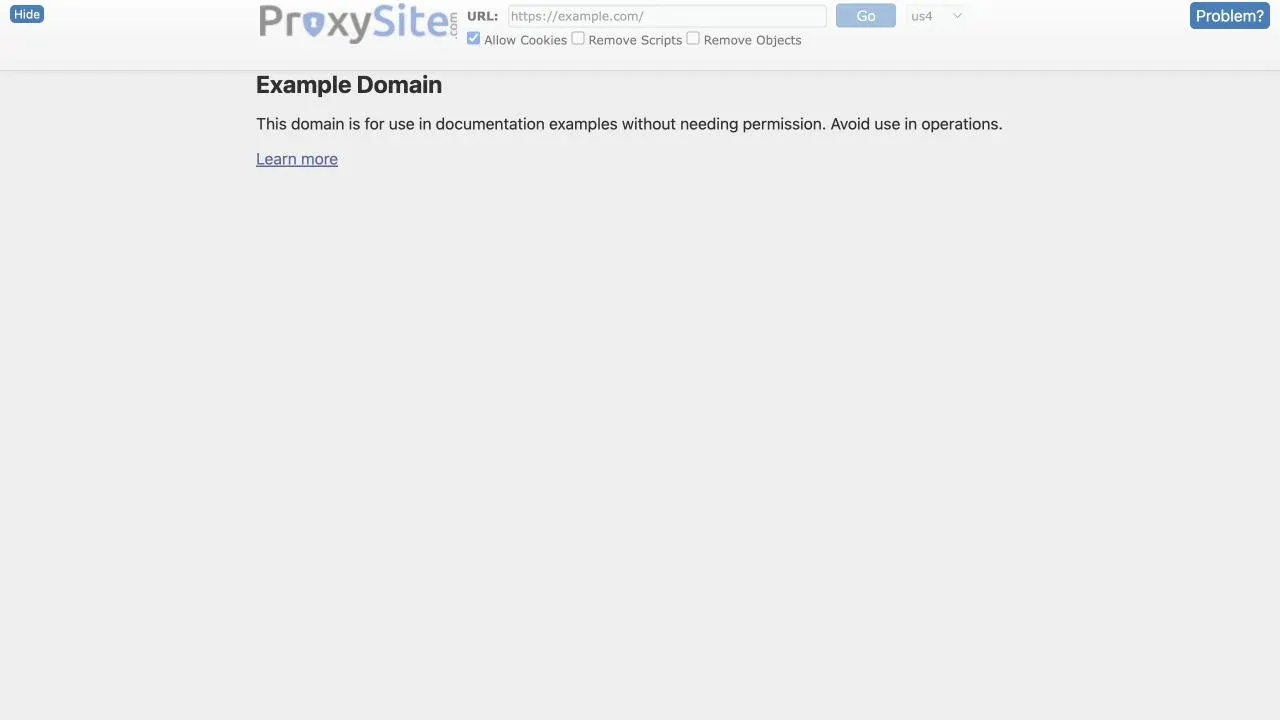
Figure 2: ProxySite successfully loads Example Domain through a recommended node, while keeping the web proxy control bar at the top.
Browsing Settings and Session Controls
The ProxySite settings page allows users to change the User Agent and Referrer and to view cookies generated through the service. The proxy-page toolbar also lets users disable scripts or objects. These options can help troubleshoot page-display issues, but disabling scripts may directly break modern web apps. Spoofing a User Agent also does not simultaneously change JavaScript behavior, fonts, WebGL, or device characteristics, so it should not be treated as full browser-environment isolation.
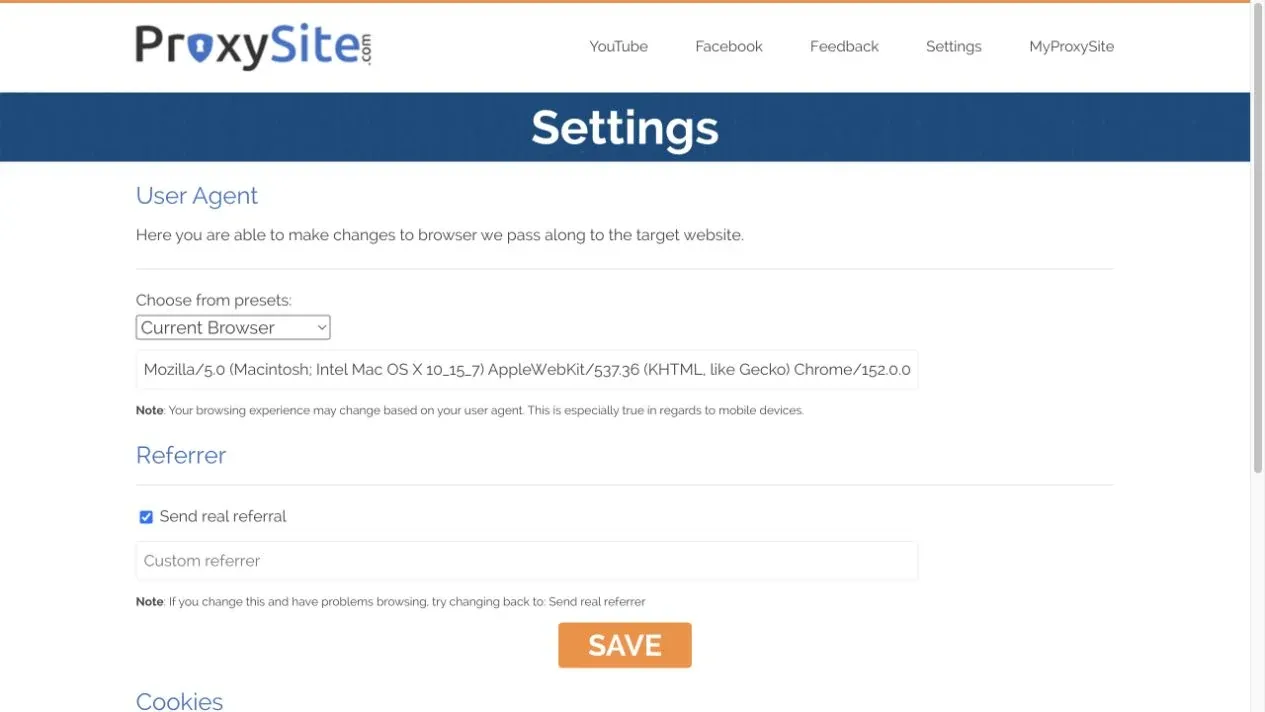
Figure 3: ProxySite’s settings page provides User Agent, Referrer, and Cookie management.
URL and Application Compatibility
In our test, https://api.ipify.org?format=json was reported by the page as an invalid URL. We then submitted https://api.ipify.org/ without the query parameter, but the content still did not finish loading. ProxySite successfully opened example.com but did not complete this simple IP API test, which suggests it is better suited to manual web browsing and should not be used as a substitute for an API client or an automation pipeline.
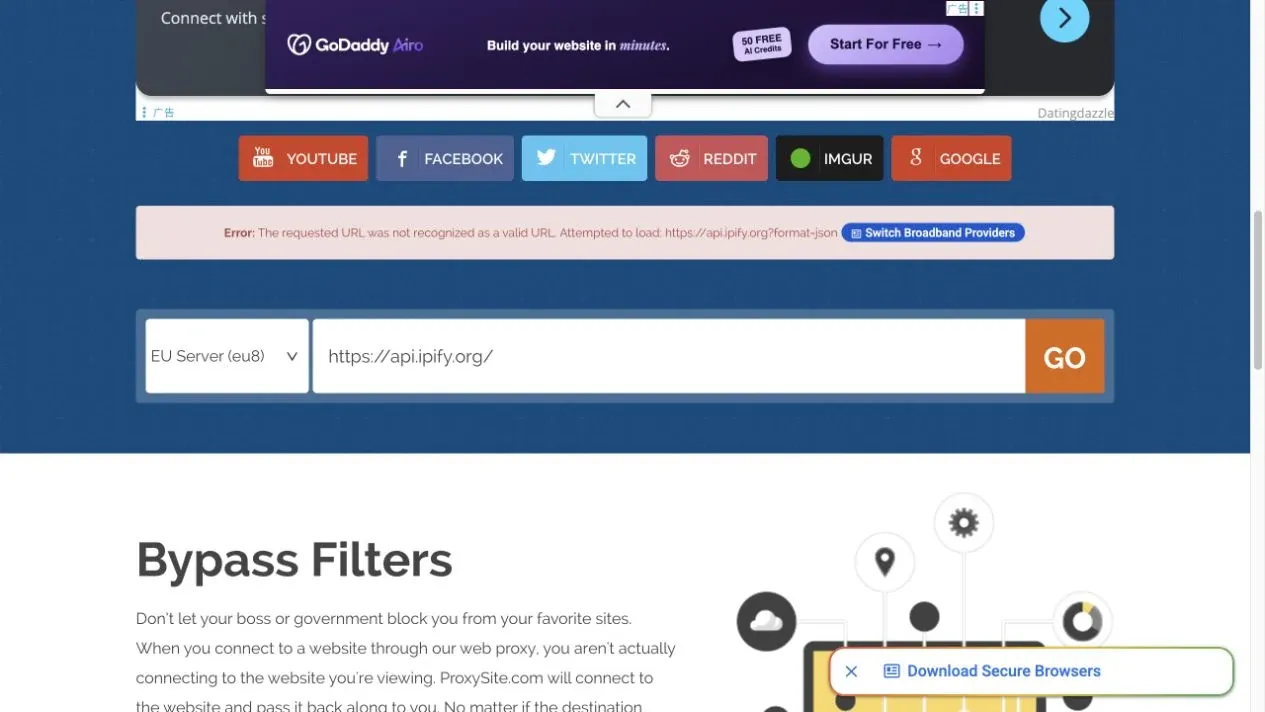
Figure 4: ProxySite returns an invalid URL message for a public IP-check URL containing query parameters.
This is not a universal conclusion about every API, and it is not enough on its own to diagnose a node failure. A more accurate conclusion is that if a task depends on query parameters, JSON, downloads, WebSocket, Service Worker, complex login redirects, or stable cookies, each requirement should be tested inside the real workflow rather than assuming success because the homepage loads.
Speed and Stability
Example Domain returned successfully during this session, but one lightweight static page is not enough to prove sustained ProxySite speed during peak load, streaming use, or cross-region scenarios. The recommended homepage node changes, and the official terms explicitly state that service coverage, speed, location, and quality are not guaranteed. A more reliable test would fix three representative pages, run each several times on both US and EU nodes, and separately record success rate, time to first visible content, full-load time, and page errors instead of publishing a single fastest result.
YouTube Login Pages and Complex Web Apps
The ProxySite homepage provides quick links for YouTube, Facebook, X, Reddit, and other sites, but a product shortcut does not mean that every feature, video, and login flow will work reliably. Octo Browser’s review recorded failures with YouTube playback and access to Facebook and Reddit, while DICloak’s article presents a more positive everyday-browsing experience. These results are not necessarily contradictory: shared-server load, target-platform policies, node choice, and test timing can all change the outcome. Sensitive accounts should not be logged in through a public web proxy. If you only need to view public content, start by testing a page that does not require an account.
Is ProxySite Safe and Private
ProxySite can hide the user’s IP address from the target website, but “hiding an IP” does not mean no logs, end-to-end anonymity, or suitability for transmitting sensitive data. A safety assessment should consider five parts of the chain: browser to proxy, proxy to target, the proxy operator, advertising, and cookies.
ProxySite states on its homepage that SSL is used between the browser and the service. For HTTPS targets, users should still confirm that the page certificate, target domain, and login flow are what they expect. A web proxy sits in the request path and can theoretically observe metadata. For that reason, do not enter banking information, healthcare data, work-account credentials, identity documents, or other highly sensitive information through a public free proxy.
More importantly, the official privacy policy states that the public web proxy monitors URLs in real time to prevent abuse and retains logs for 14 days. Log files may include IP address, browser type, ISP, time, referring/exit pages, and click counts. The policy also says that personal information is not sold and that the service does not look at or capture data transmitted through its network. Readers should rely on the official text rather than third-party summaries that describe the service as “completely anonymous” or “zero-log.”
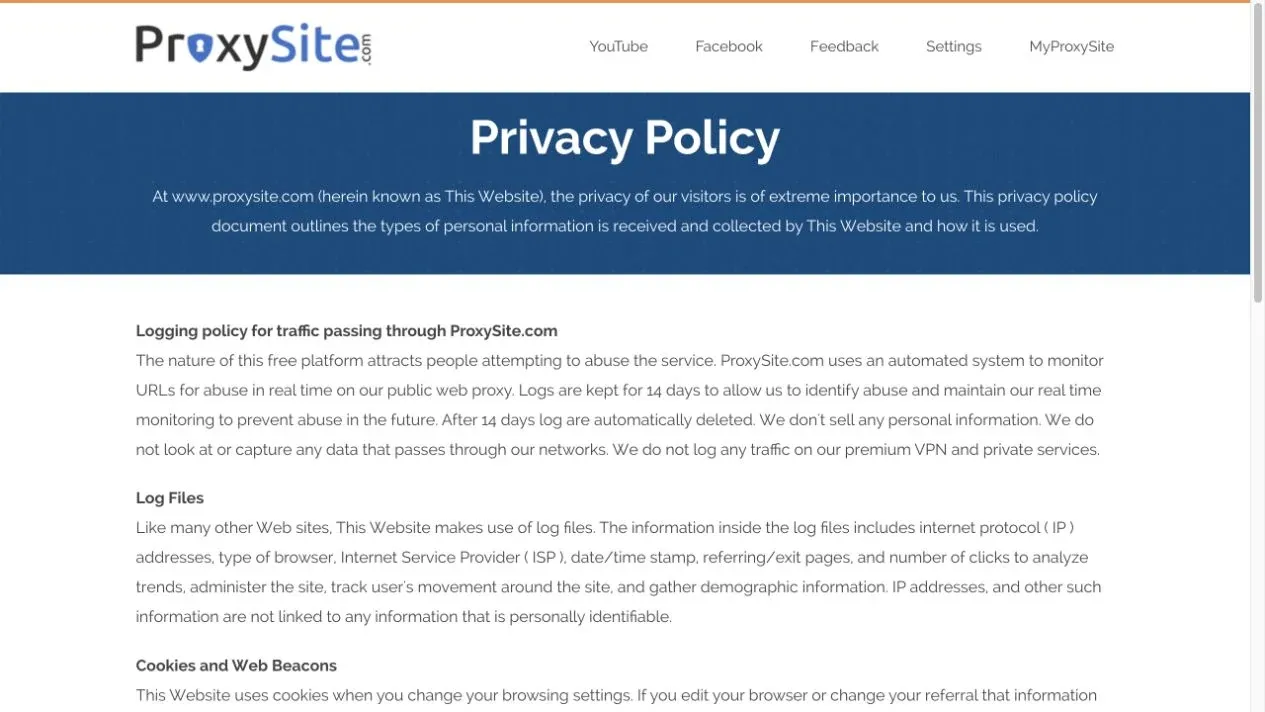
Figure 5: ProxySite’s official privacy policy discloses public proxy log retention, log files, cookies, and third-party advertising.
Safe Use Boundaries
- It can be used for temporary browsing of ordinary public pages that do not contain personal information.
- Do not enter passwords, payment-card data, medical information, enterprise-admin credentials, or recovery codes.
- Do not assume target content is trustworthy solely because ProxySite appears in the address bar.
- Do not disable TLS verification or ignore certificate warnings.
- Read applicable local laws, target-site terms, and your organization’s network policies first.
- If you need whole-device protection, consider a trustworthy VPN. If you need business-tool integration, use a controlled proxy network.
Octo Browser’s ProxySite.com review also emphasizes the shared IPs, speed limits, login constraints, and complex-application limitations of a free web proxy. DICloak’s positive ProxySite guide, by contrast, focuses more on no installation, US/EU nodes, and fast page opening. The difference between these two types of articles shows that evaluation depends on the task: temporary browsing and production workflows should not be judged by the same standard.
ProxySite Review of Features Pros and Cons
ProxySite’s strongest advantage is zero installation and immediate use. Its biggest weakness is that it covers only the proxied page and lacks the location, protocol, session, and observability controls found in professional proxy services.
Main Advantages
- No client download or account creation is required to get started.
- US and EU nodes are available, and switching servers is straightforward.
- A simple static page loaded successfully in our hands-on test.
- Users can manage User Agent, Referrer, cookies, scripts, and objects.
- It is useful for quickly checking ordinary public web pages when no sensitive data is involved.
Main Disadvantages
- It only covers content opened through the web form, not the entire device.
- It cannot be configured directly in code, browsers, or testing tools like a standard HTTP/SOCKS5 proxy.
- It lacks granular control over city, ASN, carrier, fixed IP, rotation, and sticky sessions.
- Public proxy logs are retained for 14 days under the current privacy policy.
- The page contains third-party advertising and related cookie risks.
- Compatibility with APIs, complex URLs, logins, JavaScript applications, and streaming sites must be tested site by site.
- The official terms explicitly state that speed, location, quality, reachability, and data delivery are not guaranteed.
RapidSeedbox’s ProxySite guide covers basic usage, pros and cons, and privacy practices, but some broad claims that the service is “safe” should not replace the official policy. When writing a proxysite.com review, ProxySite’s own policies and terms should be cited first, with third-party reviews used as supplementary evidence about user experience.
Who Should Use ProxySite
ProxySite is suitable for one-off, low-risk, manually completed web tasks. It is not suitable when stability, identity consistency, or data confidentiality is a core requirement.
| User or Task | Suitable? | Reason |
|---|---|---|
| Occasionally opening ordinary public information pages | Use with caution | No registration and few steps |
| Temporarily comparing US/EU page reachability | Useful as an initial check | Only region and node number can be selected |
| Protecting traffic for the entire device | Not suitable | Only proxied-page traffic is handled |
| Banking, healthcare, or enterprise account logins | Not suitable | Public intermediary and logging risks are not appropriate |
| SEO, price monitoring, and compliant data collection | Not suitable | No standard endpoint, automation, session, or monitoring capabilities |
| Multi-step logins and long-running sessions | Not recommended | Cookie and complex-app compatibility can be unstable |
| HTTP/SOCKS5 integration for development teams | Not suitable | Use a network service with configurable proxy credentials |
Why Look for a ProxySite Alternative
When the requirement grows from “temporarily open one web page” to whole-device protection, more locations, stable sessions, automated integration, or auditable business traffic, it is time to look for a proxysite alternative.
Common triggers include:
- You need to configure a standard proxy in a browser, script, crawler, mobile device, or QA tool.
- You need country-, region-, city-, or carrier-level geographic targeting.
- You need rotating IPs, fixed IPs, or sticky sessions.
- You need visibility into traffic, success rate, sub-accounts, allowlists, and billing.
- You need to cover the entire device rather than a single web tab.
- You do not want work data passing through an ad-supported public web proxy.
- You need an SLA, support team, procurement documentation, and compliance materials.
If you only want another free URL input box, CroxyProxy or hide.me is closer to ProxySite. If you want to protect an entire device, a VPN is a better fit. If the task is regional verification, web scraping, or application integration, proxy networks such as Rola IP and Decodo are more appropriate.
Best ProxySite Alternatives at a Glance
The best ProxySite alternative depends on whether you are replacing a browser-based web entry point, a device-level tunnel, or business proxy infrastructure.
FloppyData’s ProxySite alternatives comparison mainly compares commercial proxy providers on the same dimension. This article also keeps web proxies and VPNs as separate categories because users searching for proxysite alternatives do not necessarily need developer integrations. The table below first distinguishes product type and then compares capabilities, which avoids ranking fundamentally different tool categories in one misleading list.
Alternative |
Product Type |
Best For |
Main Upgrade over ProxySite |
Main Trade-Off |
|---|---|---|---|---|
Rola IP |
Residential, ISP, mobile, and datacenter proxy network |
Regional verification, scraping, applications, and team proxy use |
Standard endpoints, location controls, rotation, sticky sessions, and multiple network types |
Requires an account, configuration, and paid traffic |
CroxyProxy |
Free web proxy |
Ordinary browsing with the same web-proxy workflow |
Still opens immediately and supports common web content |
Still has the privacy and compatibility limitations of a free shared proxy |
hide.me Web Proxy |
Free web proxy plus VPN upgrade path |
Simple web browsing and a path to VPN |
Web-proxy location selection plus a same-brand VPN |
The free web proxy still does not equal a whole-device VPN |
Proton VPN |
VPN |
Whole-device everyday privacy and public-network protection |
System-level tunneling, mature clients, and a free plan |
Not a rotating proxy API for scraping tools |
Decodo |
Commercial proxy network |
Teams needing large-scale residential proxies and developer integration |
Broad location options, authentication, sessions, and developer tools |
More complex and more expensive to configure than a web proxy |
Best ProxySite Alternatives
1. Rola IP - Best for Business Proxies and Regional Verification
Rola IP is our top commercial proxysite.com alternative because it provides proxies as configurable network resources rather than simply relaying one URL through a webpage. This means users can connect proxies to browsers, scripts, scrapers, testing tools, or system environments and build stable workflows around location, IP type, and session design.
As of September 8, 2026, the English pages we reviewed on Rola IP showed residential, static residential/ISP, mobile, and datacenter proxy products. Its residential proxy page displayed 190+ countries, 80M+ IPs, country and city targeting, rotation, and the plan information shown on the page at the time. Rola’s current proxy protocol documentation states that rotating and static IPs support HTTP/S and SOCKS5, while its parameter guide documents country, state, city, and session controls. Coverage, inventory, pricing, and session capabilities can change, so deployment decisions should be based on the current dashboard and order page.

Figure 6: Rola IP’s English residential proxy product page, as reviewed on September 8, 2026.
How Rola IP Improves the ProxySite Workflow
- Multiple network types: Residential proxies are suited to regional content and local results; ISP/static residential proxies fit authorization flows that require stable exits; datacenter proxies suit public-data tasks where cost and speed matter most; and mobile proxies help verify differences across mobile networks.
- Standard protocol integration: HTTP/SOCKS5 connections generated in the current dashboard can be configured in proxy-compatible software without relying on webpage relaying.
- Location and sessions: Rola’s current parameter documentation supports country, state, city, and session controls; users can select locations, rotation, or sticky sessions instead of manually changing web nodes each time.
- Engineering observability: Teams can record observed IP, country, ASN, status, latency, session, and cost per valid result.
- Accounts and authentication: Rola’s current account-management documentation supports credential-based sub-accounts, traffic usage visibility, traffic limits, and account allowlists, which fits team workflows better than a public web relay.
Four Steps to Migrate from ProxySite to Rola IP
- Choose a residential, ISP/static residential, mobile, or datacenter network based on the task.
- Create a proxy endpoint in the dashboard and choose username/password authentication or an allowed allowlist method.
- Follow the proxy quick start and configure the host, port, and credentials in the target tool.
- First access an approved IP-check endpoint, record the exit IP, country, ASN, status, and latency, and then test the real business URL.
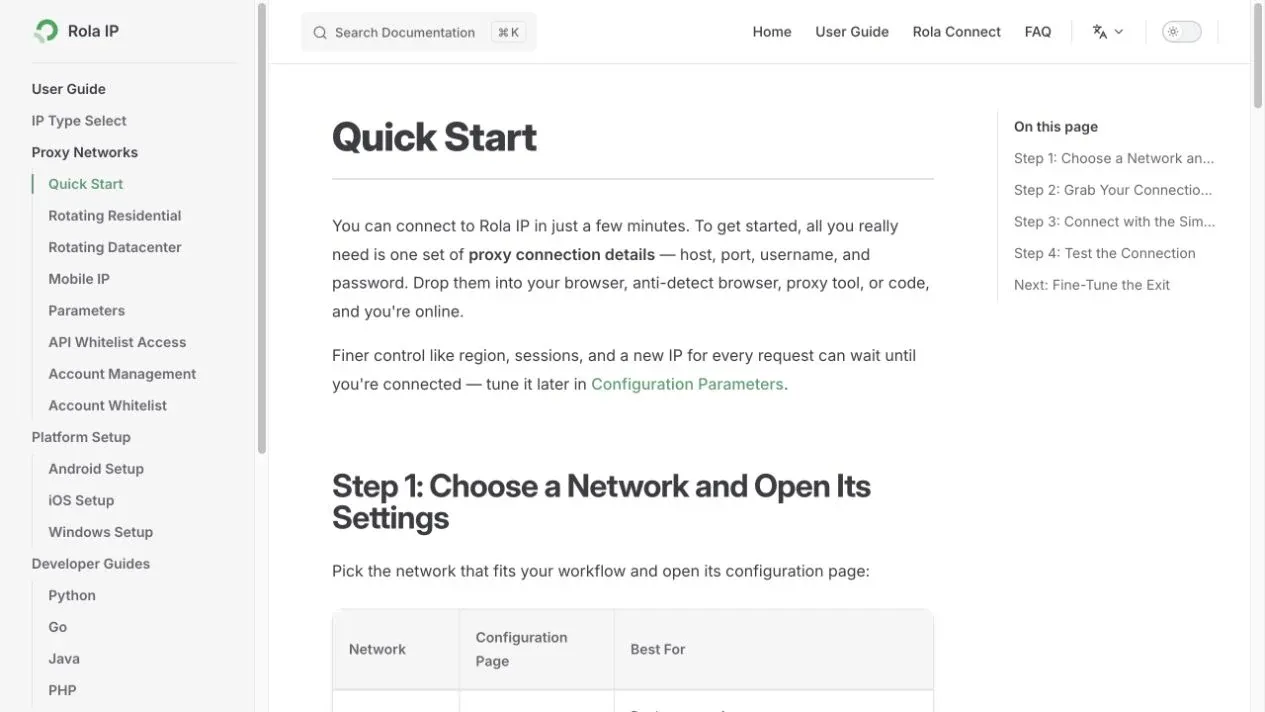
Figure 7: Rola IP’s English Quick Start documentation explains network selection, configuration, and connection workflow.
Rola IP is not a one-click replacement for ProxySite’s web form. It requires an account and proxy configuration, and it does not automatically execute JavaScript, manage browser fingerprints, or grant access rights to target data. Its advantage is that it turns the proxy layer into a controllable, reusable business component. Sensitive accounts should still follow organizational security policies. Scraping workflows should comply with target terms, robots.txt, authorization requirements, and reasonable request rates.
2. CroxyProxy - Closest to the Free Web Proxy Experience
CroxyProxy is suited to users who want to preserve the “enter a URL and open it directly” experience, making it the closest ProxySite alternative in form. The CroxyProxy official site currently provides a free web entry point and promotes support for video, social websites, and modern web content.
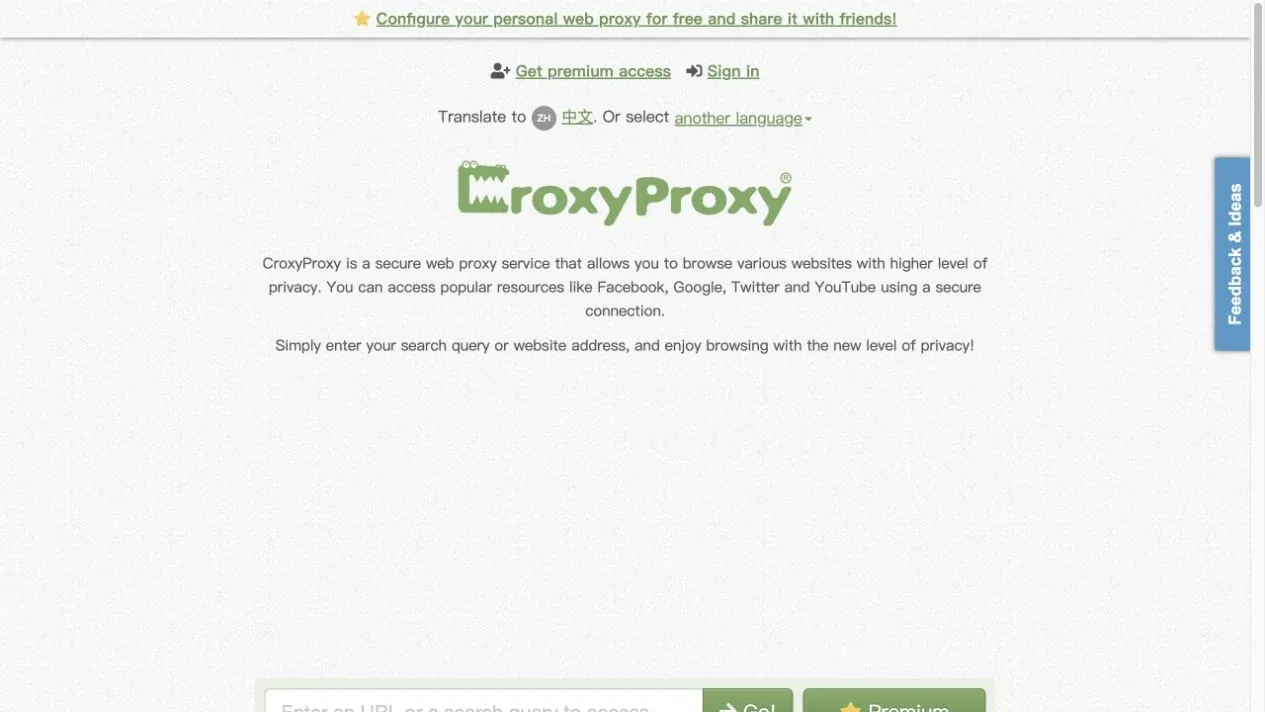
Figure 8: CroxyProxy’s English web proxy entry page.
Its main advantage is that users do not need to enter proxy credentials in the operating system or an application, so migration effort is low. The drawback is that it is still a third-party web relay, so shared free exits, ads, cookies, complex-login compatibility, and the privacy policy must still be reviewed separately. It is suitable for one-off, low-sensitivity browsing, but not for teams that require stable sessions, precise location control, or automation as hard requirements.
3. hide.me Web Proxy - Best for Simple Web Access
hide.me Web Proxy is suitable for ordinary users who need a free web proxy and want a small set of proxy locations to choose from. The hide.me free proxy currently provides a URL input field and location selection and presents the full VPN product as an upgrade option.
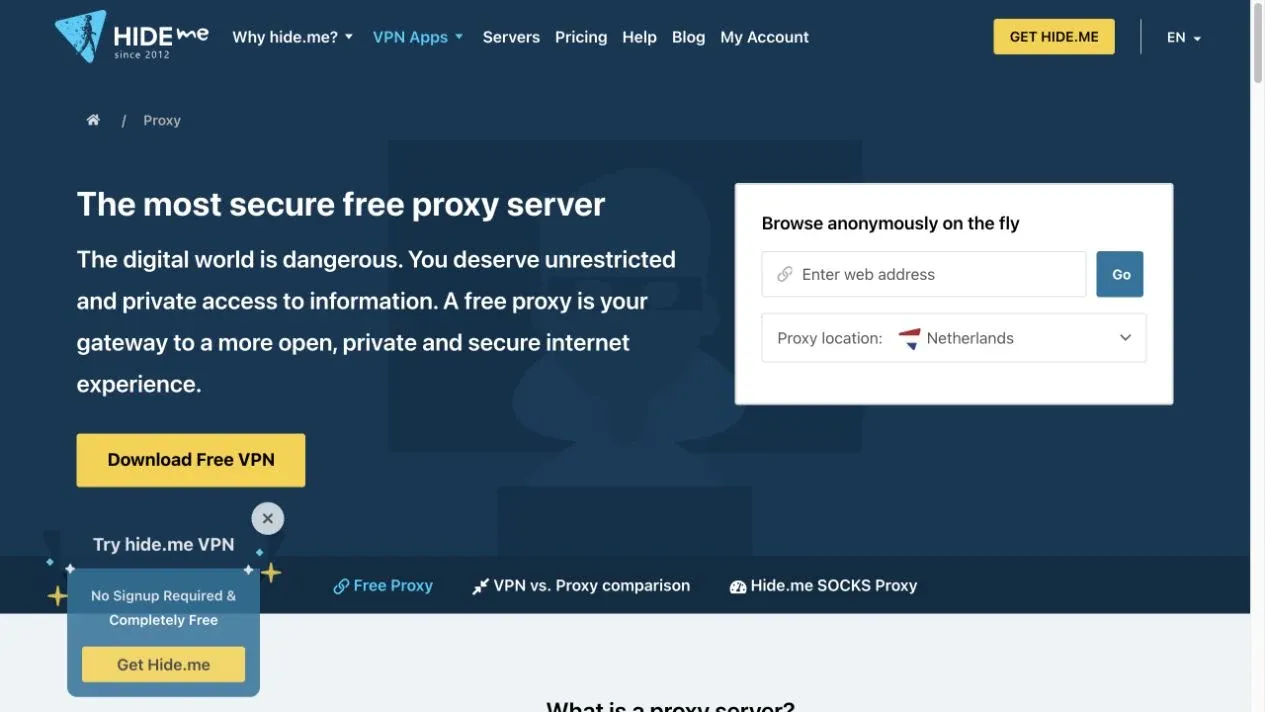
Figure 9: hide.me’s English free web proxy page and location selector.
Compared with ProxySite, it presents the boundary between web proxy and VPN more clearly: a web proxy is for temporary pages, while a VPN covers device traffic. It is still not a scraping API or a rotating residential proxy service, and passwords or work data should not be processed through the free web entry point. Before choosing, review the privacy policies for the web proxy and VPN separately rather than assuming two products under the same brand are identical.
4. Proton VPN - Best for Whole-Device Traffic Protection
Proton VPN is a more suitable ProxySite alternative for users who need a system-level tunnel rather than webpage relaying. The Proton VPN official site offers desktop and mobile clients and a free plan, making it suitable for routing device traffic consistently on public networks or during everyday browsing.
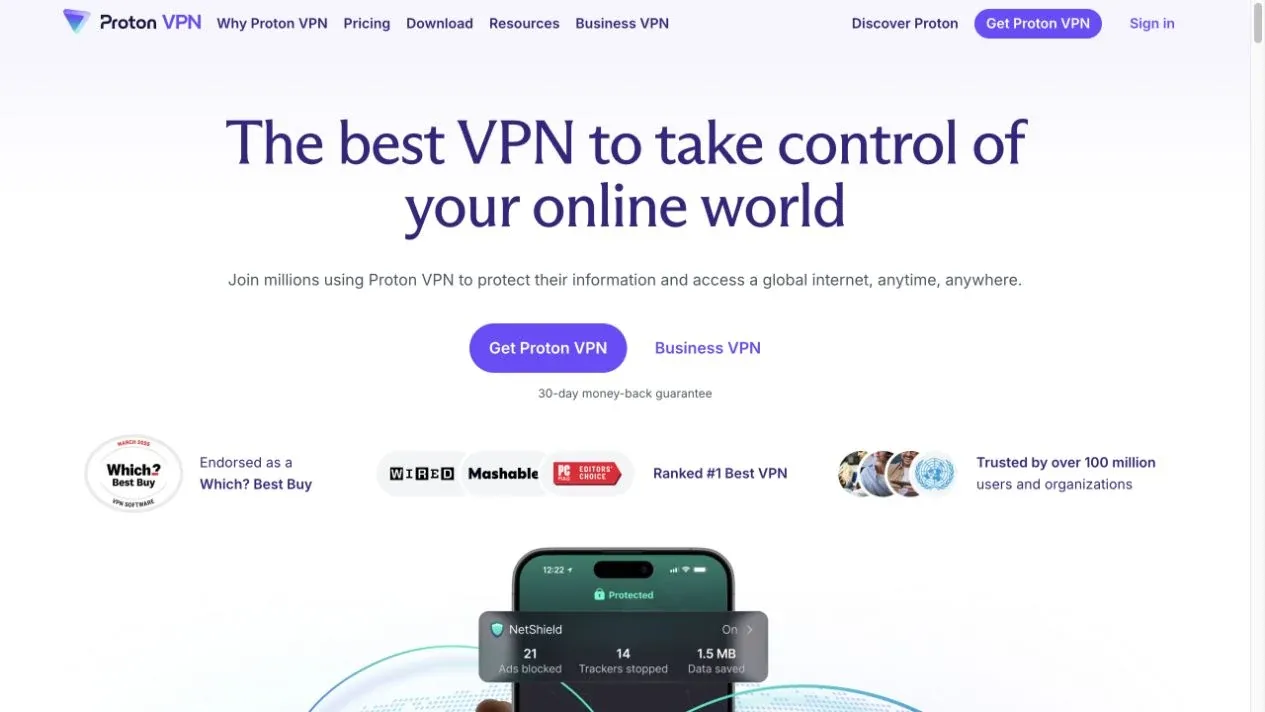
Figure 10: Proton VPN’s English official site presents a device-level VPN product.
Its core improvement over ProxySite is not “more web nodes” but coverage beyond the browser and less need to paste a URL for every page. Its limitations are equally clear: a VPN is generally not a residential proxy pool that rotates per request, nor is it designed for large-scale scraping, city-level exit combinations, or independent proxy credentials per task. Use it in accordance with local law, company policies, and target-service terms.
5. Decodo - Best for Mature Proxy Teams
Decodo is suitable for teams that need commercial residential proxies, developer integration, and a larger network scale. It is a feature-rich proxysite alternative, but with higher cost and complexity. As of the review date, the Decodo residential proxies page showed its current network scale, locations, authentication methods, and endpoint generator. These figures and prices can change, so the purchase-time page should be treated as authoritative.
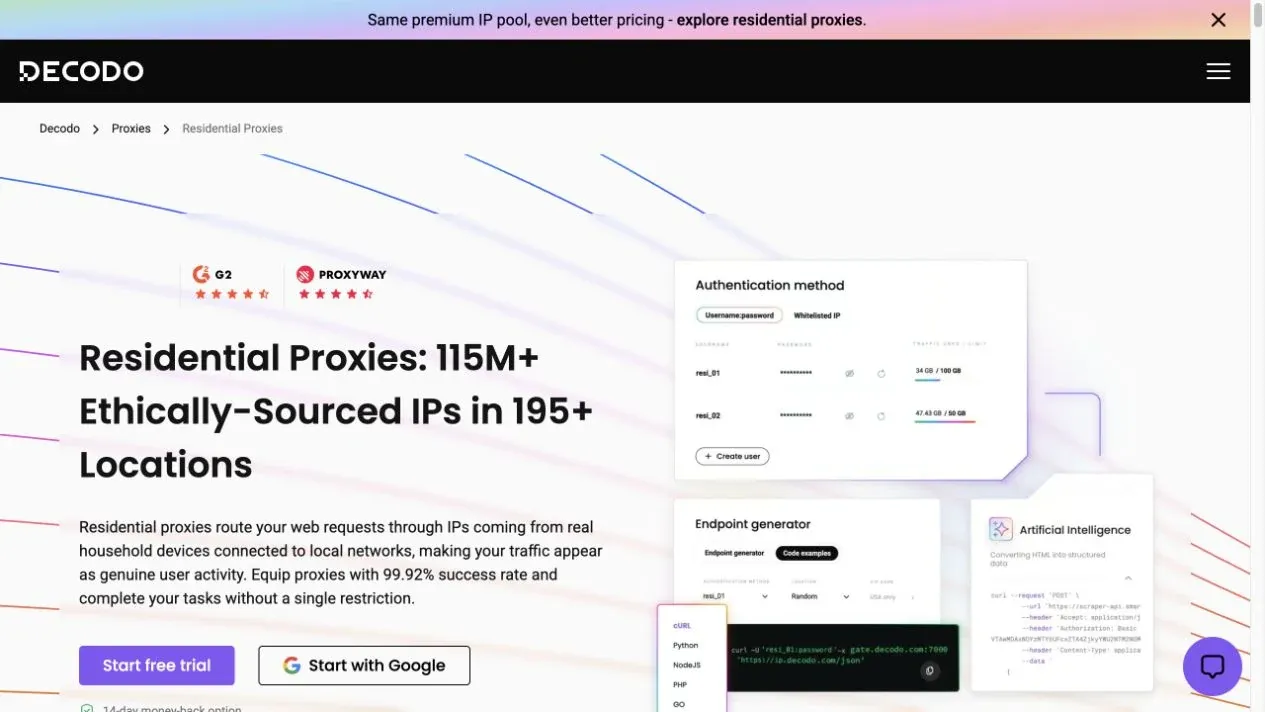
Figure 11: Decodo’s English residential proxy page displays authentication methods and the endpoint-generation interface.
Compared with ProxySite, Decodo is better suited to automation, regional routing, and team-scale usage, with more complete documentation and product options. The trade-off is that users need to understand traffic billing, target restrictions, session parameters, and concurrency strategy. It is not a no-registration web tool. If the only need is to temporarily open one public page, a commercial proxy network may add unnecessary configuration.
How to Choose the Right ProxySite Alternative
Choose the product category based on traffic coverage and working method first, then compare price, location, and speed. This helps avoid buying a product that solves the wrong problem.
You Only Want to Temporarily Open Ordinary Web Pages
Compare ProxySite, CroxyProxy, and hide.me Web Proxy first. Focus on ads, privacy policies, URL compatibility, cookies, scripts, and whether the target page renders correctly. Do not transmit sensitive data.
You Want to Protect the Entire Device
Choose a trustworthy VPN and review operating-system clients, kill switch behavior, DNS, privacy policy, audits, and local availability. A web proxy cannot cover background applications or other browser traffic.
You Need Regional Verification and Business-Tool Integration
Choose a standard proxy network such as Rola IP or Decodo. Run a small sample using the same country, target URL, session length, and concurrency, and compare valid-field rate, 403/429 responses, P95 latency, traffic usage, and cost per valid result.
You Need a Fixed Identity or Continuous Session
Prioritize ISP/static residential proxies or sticky residential sessions, while also managing cookies, time zone, language, and application state. The proxy IP is only one part of the environment and cannot, by itself, guarantee account security or identity consistency.
Conclusion
The conclusion of this proxysite review is that ProxySite still has value for low-risk, one-off access to ordinary web pages, but its public logging, advertising, webpage-only scope, and compatibility limitations mean it should not carry sensitive or production workloads. In this session, Example Domain opened successfully while the IP API URL test did not complete. That kind of mixed result is closer to real usage than simply declaring that ProxySite “works” or “does not work.”
When choosing a ProxySite alternative, do not put the product name before the requirement. If you want to continue using a web entry point, compare CroxyProxy or hide.me. For whole-device protection, choose Proton VPN. For regional verification, scraping, or tool integration, test Rola IP first and make the final decision based on valid-result rate, location accuracy, session stability, and total cost on real target sites.