
7 Best LimeProxies Alternatives in 2026: Pricing, Pros, Cons, and Use Cases

Nov 3, 2026 · Comparisons · 12 min read
The best LimeProxies alternatives depend on your traffic volume, target locations, and session requirements. This guide compares seven rotating residential proxy providers by entry price, purchase commitment, traffic validity, and use case. LimeProxies also sells residential proxies, so switching makes sense only when another provider better meets your needs.
Key Takeaways
- Small or irregular workloads: Webshare offers a 1GB monthly entry plan, Rola IP offers pay-as-you-go traffic, and IPRoyal offers non-expiring bandwidth.
- Existing scraping pipelines: Rola IP is a candidate for replacing the proxy connection layer; Decodo offers more granular location and ASN controls.
- Larger procurement needs: Compare Oxylabs and Bright Data for enterprise support and broader product access, and SOAX when costs need to reflect a known mix of countries.
- Compare the total purchase: Bulk rates, subscriptions, promotions, and traffic expiration can change the real monthly bill. Test each candidate on the same target pages before migrating.
LimeProxies Review: First Identify What You Actually Want to Replace
LimeProxies’ official residential proxy page lists HTTP(S), SOCKS5, country- and city-level targeting, and both rotating and static residential IPs. Older reviews focused solely on datacenter proxies cannot be used to assess its current residential offering directly. Existing customers should first record target-site success rates, bandwidth cost per valid record, accuracy of city-level exit locations, and whether failures cluster at particular times.
Its residential proxy pricing page lists Mini at $12/month for 1GB, Starter at $50/month for 5GB, and Advanced at $1,000/month for 125GB. For a 100GB workload, Advanced is a published option that covers the required volume, although it leaves 25GB unused. This creates a concrete reason to compare alternatives: a smaller purchase commitment or lower spend for the same traffic requirement. Existing customers with negotiated rates should compare their own invoices instead.
If the real problem involves CAPTCHAs, request headers, page parsing, or concurrency settings, switching IP providers alone may not solve it. The strengths and limitations below are buying considerations based on public product information and prices—not independently benchmarked performance on identical target websites.
LimeProxies and 7 Alternatives: Entry Costs at a Glance
The table below shows entry offers for paid rotating residential traffic. Monthly plans and PAYG purchases remain distinct; free trials and bulk headline rates are excluded.
| Provider | Entry offer | Best suited for | Purchase condition |
|---|---|---|---|
| LimeProxies — baseline | $12/month for 1GB | Existing users assessing whether to migrate | Mini monthly plan; annual billing has a different effective price |
| Rola IP | PAYG at $4/GB | Keeping custom scripts while replacing the proxy layer | On-demand traffic; larger packages have separate validity terms |
| Decodo | PAYG usage: $4 for 1GB | Granular targeting and integration tools | Wallet top-up required; VAT additional |
| Webshare | $3.50/month for 1GB | Small trials followed by scaling | Monthly rotating residential plan |
| IPRoyal | PAYG: $7.35 for 1GB | Irregular usage; non-expiring traffic | Subscription alternative: $7 for 1GB |
| Oxylabs | $30/month for up to 5GB | Mid-sized and large teams needing enterprise support | Shared product credits; VAT may apply |
| Bright Data | PAYG at $8/GB; $4/GB during the 3-month promotion | Compliance workflows and multiple products | Promotion eligibility and KYC |
| SOAX | Sandbox usage at $5/GB for Tier 1 | Teams budgeting by geography | Prepaid top-up required; $5 is a usage rate, not a confirmed minimum deposit |
How to Evaluate Proxy Alternatives: Three Key Dimensions
Proxy Type and Session Control
Confirm whether you are buying rotating residential, static residential, or datacenter proxies. Rotating residential proxies work well for collecting public web pages through many different exit IPs. Tasks requiring persistent logins or long-lived identities should be evaluated separately on static residential/ISP networks. A sticky session keeps an exit IP for a limited period; it does not mean you permanently own that IP.
Calculate the Cost per Usable Record
For every provider, track total spend divided by the number of valid records—not just the per-GB price. Retries, CAPTCHAs, browser-loaded images, and scripts all consume traffic. Factor in whether monthly allowances expire, unused bandwidth rolls over, or certain countries cost more.
Geographic Targeting, Integration, and Support
Define country, city, or ZIP-code targeting as explicit test criteria. Check HTTP(S)/SOCKS5 support, username/password or IP-allowlist authentication, concurrency limits, endpoint generation, and technical support. Published IP-pool sizes are vendor claims, not a substitute for measuring usable capacity in your target cities.
7 Best LimeProxies Alternatives
1. Rola IP
Overview: Rola IP offers rotating residential proxies as well as static residential proxies. For teams that already operate their own scrapers, data-cleaning pipelines, and schedulers, it can function as a replaceable network layer: keep your existing request and parsing logic, and change only endpoints, credentials, and session settings.
Pricing: Rola IP residential proxy pricing starts at $4/GB pay-as-you-go. The 50GB package costs $125 ($2.50/GB), and 100GB costs $200 ($2/GB). Packages expire after 30 days, and unused traffic does not roll over. The $0.60/GB rate requires a 10,000GB purchase costing $6,000.
Pros: Both on-demand billing and tiered packages are available, with country/city targeting and rotating or sticky sessions. When traffic needs are uncertain, validating with pay-as-you-go traffic can limit the cost of experimentation.
Cons: Prepaid packages expire after 30 days without rollover. A team buying 100GB but consuming only 50GB would still pay $200, making its effective cost $4 per used GB rather than the advertised $2/GB package rate.
Best use cases: Price monitoring, collecting public product pages, verifying regional search results, and migrating existing Python or Node.js applications.
Rola IP residential proxies suit workflows that rotate exit addresses or use temporary sticky sessions. Projects requiring a longer-lived exit identity should evaluate static residential proxies separately.
2. Decodo
Overview: Decodo (formerly Smartproxy) serves teams that want to generate proxy endpoints quickly from a dashboard. Its residential proxy pages provide targeting options, authentication guidance, and code examples. It is suitable for teams treating proxies as regular infrastructure rather than a one-off experiment.
Pricing: Pay-as-you-go starts at $4/GB. A 3GB monthly plan costs $11.25 ($3.75/GB), while 10GB costs $35/month. VAT is shown separately. The advertised “from $2/GB” rate corresponds to a 1TB enterprise tier.
Pros: Comprehensive country, state, city, ZIP, and ASN targeting. Official resources also cover HTTP(S)/SOCKS5, rotating/sticky sessions, browser extensions, and setup documentation. The onboarding path is relatively clear for multi-region QA teams.
Cons: The $2/GB rate requires a 1TB monthly plan costing $2,000 before VAT. PAYG costs $4/GB, uses Wallet billing, and cannot run alongside an active residential monthly subscription on the same account.
Best use cases: City- or ZIP-level page verification, multi-region advertising and price checks, and collection workflows that need dashboard-driven endpoint generation and team management.
3. Webshare
Overview: Webshare sells datacenter, static residential, and rotating residential proxies. For users who have not yet determined whether residential IPs work on their target sites, a small rotating residential plan is more sensible than committing to hundreds of GB upfront.
Pricing: Its official product comparison lists rotating residential proxies at $3.50/month for 1GB, $2.25/GB at 100GB, and $1.40/GB only at 3,000GB. The lowest figure is not an entry-level rate.
Pros: A 1GB plan enables small-sample testing. The website lists country, state, city, ZIP, and ASN targeting, as well as HTTP/SOCKS5 and API support. Comparing the three proxy categories side by side helps identify the correct network type.
Cons: The $1.40/GB rate requires a 3,000GB monthly purchase costing $4,200. A 1GB plan instead costs $3.50/GB, so the large-volume headline rate offers no saving to a small project.
Best use cases: Budget-conscious initial validation, lightweight price tracking, and projects that first need to confirm the suitability of regional exits.
4. IPRoyal
Overview: IPRoyal emphasizes pay-as-you-go rotating residential proxies, non-expiring traffic, and rotating/sticky sessions. This billing model suits teams with bursty demand rather than workloads consuming large volumes continuously each month.
For a provider-specific assessment of its features, costs, and fit, read our IPRoyal review.
Pricing: A 1GB subscription is listed at $7/GB, while 1GB of pay-as-you-go traffic costs $7.35/GB. At 10TB (10,000GB), the advertised subscription rate is $1.75/GB; the corresponding pay-as-you-go rate is $1.84/GB. These are bulk rates, not small-trial prices.
Pros: The provider states that traffic does not expire, and it offers city targeting, HTTP(S)/SOCKS5, and rotating/sticky sessions. For seasonal or campaign-driven collection, preventing bandwidth expiration may be more valuable than the lowest unit price.
Cons: PAYG costs $7.35 for 1GB or $55.10 for 10GB. Non-expiring traffic avoids a usage deadline, but it does not offset that higher purchase cost when a project reliably consumes its allowance every month. The $1.75/GB headline rate also requires a 10TB subscription purchase.
Best use cases: Research with irregular traffic, short-term market studies, and small allowances used across multiple quarters.
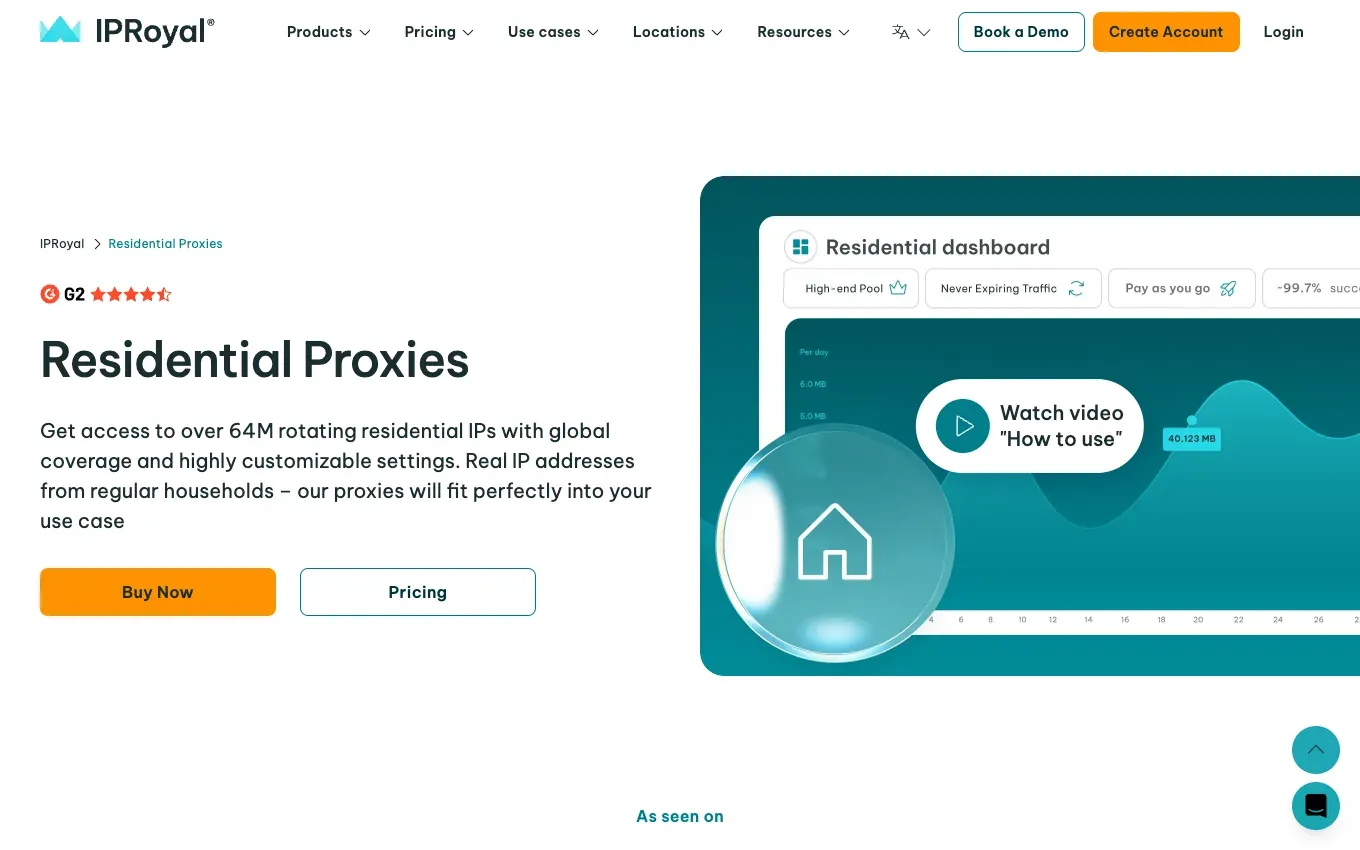
5. Oxylabs
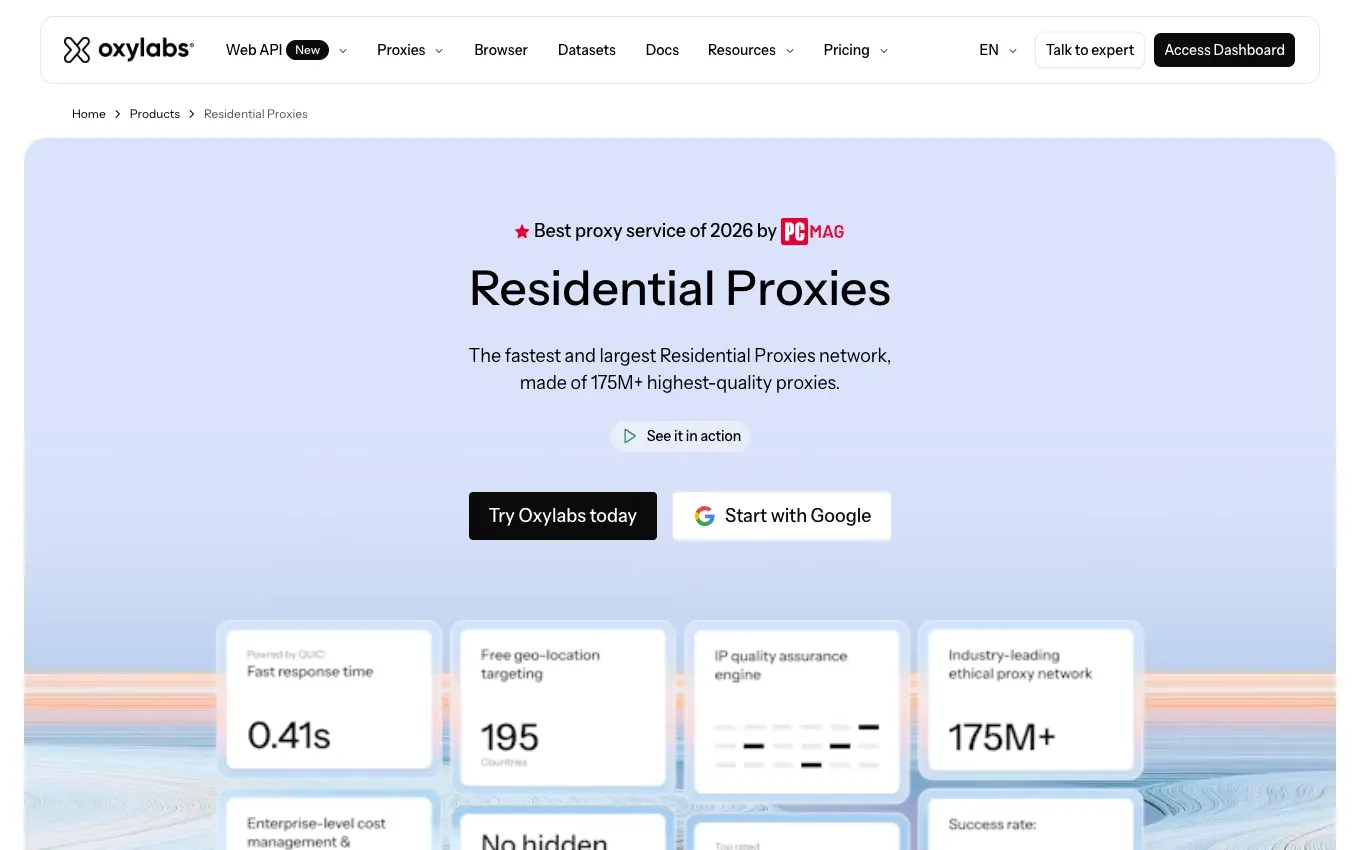
Overview: Oxylabs positions its residential proxy products for ongoing, large-scale collection and provides custom plans and enterprise support. If procurement, invoicing, and sustained support matter alongside traffic, it deserves consideration beyond a lowest-price comparison.
Pricing: Oxylabs lists Starter at $30/month for up to 5GB of residential traffic ($6/GB), Basic at $100/month for up to 20GB, and Flexible at $500/month for up to 125GB. These subscriptions provide access to multiple products; the residential allowance assumes the credits are spent on residential traffic. VAT may apply.
Pros: Multiple allowance tiers and enterprise options are publicly available. Product materials emphasize global coverage, targeting, and technical support, allowing teams to match their traffic requirements to a plan.
Cons: The paid Starter subscription requires $30 upfront. Flexible costs $500/month for up to 125GB of residential traffic, and using the same credits on other products reduces that allowance. Self-service purchases are non-refundable.
Best use cases: Always-on enterprise data pipelines, long-term collection across multiple countries, and procurement workflows requiring defined support channels.
6. Bright Data
Overview: Bright Data offers residential, datacenter, ISP, and mobile proxy networks, as well as Proxy Manager and managed scraping products. Its broad product portfolio appeals to enterprises seeking to procure proxies, unlocking tools, and data delivery through a single vendor.
Pricing: Standard residential proxy pay-as-you-go pricing is $8/GB. Code RESIGB50 offers 50% off for three months, bringing the PAYG rate to $4/GB during the promotion.
Pros: Country, city, ZIP, and ASN targeting; proxy management tools; and multiple network types. Teams considering a later move from self-managed proxies to managed scraping can evaluate those options within one provider.
Cons: The product portfolio and billing structure are relatively complex. The website notes that residential or mobile networks may require KYC before use. For individual projects needing only a small amount of residential traffic, that process and the standard price may be disproportionate.
Best use cases: Large multi-region collection, enterprise teams with stricter compliance review, and projects evaluating both proxy networks and unlocking APIs.
7. SOAX
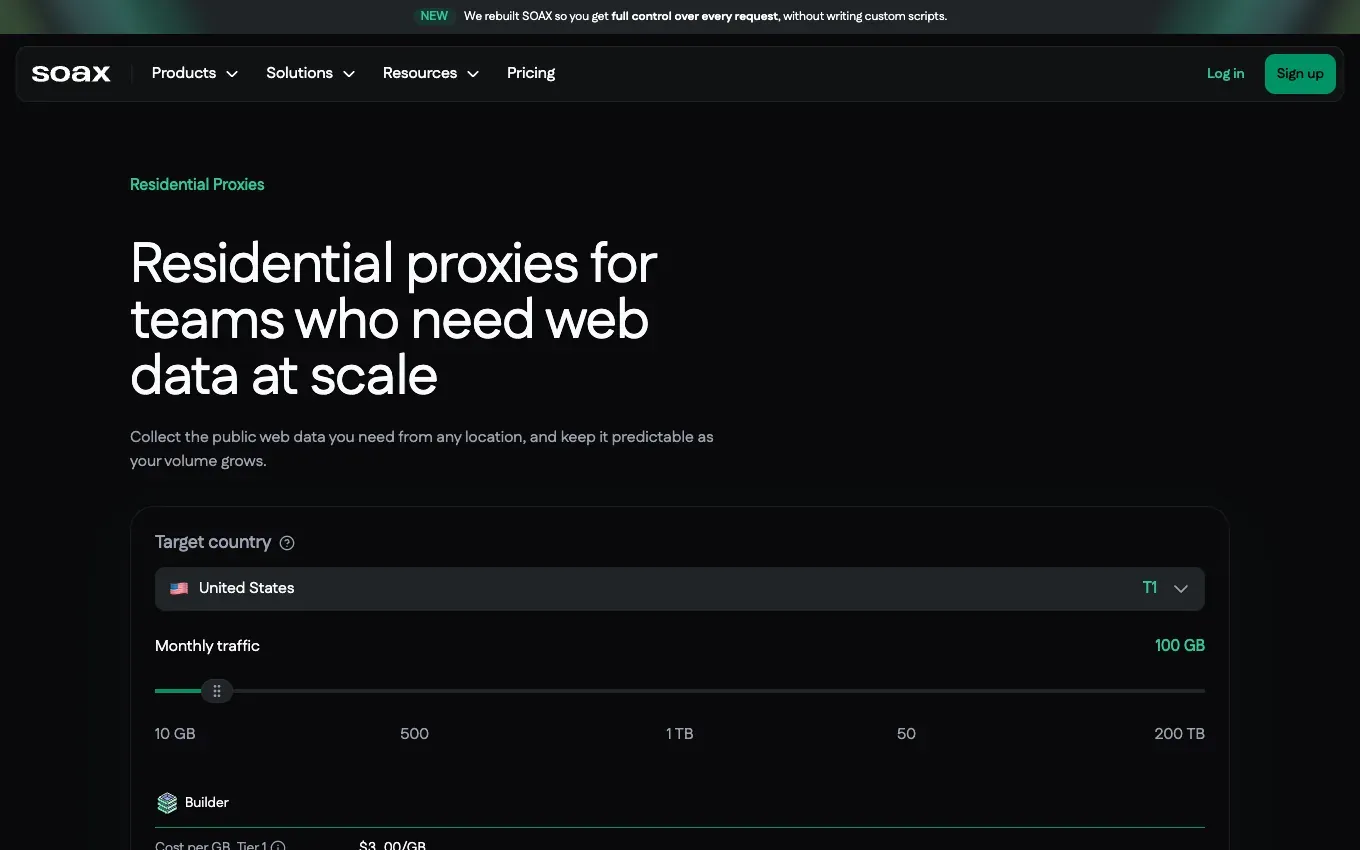
Overview: SOAX organizes proxy traffic into geographic tiers based on exit country and uses prepaid credits to manage spending. Its model is better suited to teams that know which countries they collect from regularly and are willing to forecast costs.
Pricing: Sandbox has no subscription fee and includes no credits; Tier 1 traffic costs $5/GB. Builder costs $200/month plus VAT and includes 200 prepaid credits, with Tier 1 traffic charged at $3/GB. Tier 2 and Tier 3 rates are lower, depending on the exit country. Credits added on Sandbox or monthly plans expire after 60 days; credits added on annual plans expire after 12 months.
Pros: Country-based pricing allows more detailed modeling for predictable workloads concentrated in specific locations. Proxy packages and allowances can also be allocated by team or project.
Cons: Different countries attract different rates, so bills for cross-border collection are less intuitive than flat per-GB pricing. Monitor credit expiry and price changes when upgrading plans.
Best use cases: Multinational market monitoring, high-volume public data collection from a known mix of regions, and organizations allocating proxy costs by team or project.
What Would 100GB of Residential Proxy Traffic Cost?
Assume one month of 100GB of billable residential traffic. The examples below exclude tax, free trials, and bonus credits, and assume the full 100GB is consumed. They show specific purchase routes rather than a claim that each is the provider’s cheapest possible quote. SOAX uses Tier 1 exits; other geographic mixes cost differently.
| Provider | Purchase route for the example | Amount paid | Allowance and timing |
|---|---|---|---|
| LimeProxies | Advanced monthly plan | $1,000 | 125GB included; 25GB left after the workload; rollover not specified on the cited pricing page |
| Rola IP | 100GB package | $200 | Exactly 100GB; 30-day validity; no rollover |
| Decodo | 100GB monthly subscription | $275 | Exactly 100GB in the monthly plan |
| Webshare | 100GB monthly rotating residential plan | $225 | Exactly 100GB in the monthly plan |
| IPRoyal | Ten separate 10GB PAYG purchases at $55.10 each | $551 | 100GB total; traffic does not expire; a single bulk quote may differ |
| Oxylabs | Flexible monthly subscription | $500 | Up to 125GB if credits are used only for residential traffic; 25GB capacity left after the workload |
| Bright Data | 100GB at the standard PAYG rate | $800 standard; $400 with the eligible promotion | Usage-based; discounted rate applies for three months |
| SOAX | Builder, plus $100 of extra credits | $300 | $200 monthly plan plus the top-up covers the published 100GB Tier 1 example; monthly credits expire after 60 days |
Prices are drawn from the provider pricing pages linked in the profiles above. For IPRoyal, $551 is a repeat-purchase calculation using the listed 10GB PAYG offer, not an advertised 100GB tier. The SOAX total follows its published 100GB Tier 1 calculator.
This makes the migration decision more concrete: compare your current LimeProxies bill with the amount you would actually buy, then divide that spend by the valid records produced. Lower traffic spend is useful only if the candidate also delivers the locations and usable pages your workflow needs.
A Practical Migration Checklist: Moving from LimeProxies to Another Provider
- Establish a baseline: Use the same 30–50 public URLs with your current LimeProxies configuration, recording successful-page rate, response time, exit location, and total bandwidth.
- Change only the proxy: Replace authentication details and endpoints with the candidate provider while keeping headers, timeouts, concurrency, parsers, and retry rules unchanged.
- Retest each location: Check important cities or countries individually. Distinguish proxy connection errors, target-site blocking, CAPTCHAs, and parsing failures.
- Calculate unit economics: Divide total spend by valid records, accounting for failed requests, retries, and bandwidth lost to monthly expiration.
- Switch after sustained testing: Cover at least one normal operating cycle and a peak period. Keep the existing provider as a short-term fallback.
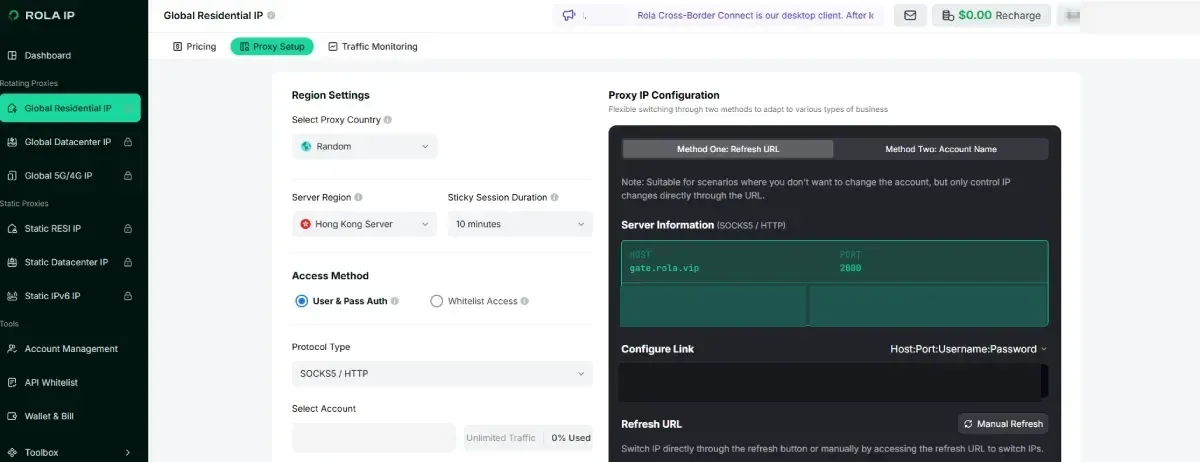
In Rola IP’s Proxy Setup interface, choose the service region and session duration, select authentication and protocol settings, and copy the endpoint. Figure 8 shows this step in the residential proxy setup tutorial, with account credentials obscured.
The Python Requests proxy tutorial provides a request-level configuration pattern for Python migrations. For sustained collection, web scraping proxies should be evaluated against the regions and traffic patterns of your production workload. Follow the target site’s terms and applicable data protection requirements.
Which Alternative Should You Shortlist?
For less than 5GB per month, start with the entry-cost table: Webshare offers the lowest listed 1GB monthly purchase in this comparison, while IPRoyal deserves a place on the shortlist when traffic is used across several months.
At 100GB per month, the example purchases are $200 for Rola IP, $225 for Webshare, and $275 for Decodo, before tax. Rola IP’s package requires consumption within 30 days; Decodo adds granular targeting controls. Compare these routes against your current LimeProxies invoice and the locations each provider can supply.
For enterprise procurement, evaluate support commitments, billing reconciliation, and access to other products alongside traffic costs. Oxylabs and Bright Data offer broader product access; SOAX is useful when the country mix is predictable enough to model its geographic rates.