
Best Data Center Proxies in 2026: Seven Providers Compared

Nov 17, 2026 · Comparisons · 14 min read
The best data center proxies depend on what your application needs from an exit IP. A rotating pool billed by traffic fits a different job from a fixed address used for allowlisting. We reviewed the published datacenter plans, pricing, connection options, and buyer terms of Rola IP, Oxylabs, Bright Data, Webshare, Decodo, IPRoyal, and Rayobyte on November 12, 2026. The result is a shortlist by workload, with the purchasing conditions that can change each quote.
Quick verdict: Start with Rola IP rotating datacenter proxies when you need to test a stateless, country-level collection workflow with a traffic-based plan. Compare its per-GB cost with Decodo or Oxylabs at your expected volume. For a persistent allowlisted exit, compare Rola IP static datacenter proxies with a dedicated-IP quote from IPRoyal or Rayobyte. Webshare’s shared plan is a low-cost integration check, while Bright Data offers a broader set of shared, dedicated, and traffic-based configurations. These are product-fit findings, not speed or target-site acceptance scores.
Who Should Consider a Datacenter Proxy?
Datacenter IPs are a useful first candidate for authorized public-page collection, product-price monitoring, and other stateless requests where traffic cost and request throughput matter. A fixed datacenter IP is also convenient when your own API or partner system requires an allowlisted address. Before choosing one, decide whether you need the same IP over time, which country the exit must be in, and whether the target permits your request pattern.
An IP can be recognized as belonging to a datacenter ASN. Changing proxy providers does not resolve account, cookie, browser-fingerprint, or destination-site policy problems. If the target requires a city-level view, confirm that the specific product can deliver it; a provider’s global location list does not make every plan city-targetable.
What Did We Compare?
The assessment uses five buyer-facing criteria: product format (shared, dedicated, or rotating); minimum published purchase; protocol and geographic controls; traffic, term, and retention limits; and the stated trial or refund conditions. A public “from” price is an entry on a pricing page, not a checkout quote for your country, quantity, tax status, or promotion. The comparison draws on official product pages, pricing pages, and help documentation reviewed on November 12, 2026.
For a meaningful comparison, screen rotating per-GB offers together and fixed per-IP offers together. Then calculate total spend for a real workload. A free shared sample, a 30-day traffic package, and a dedicated monthly IP are three different purchases.
Seven Providers: Published Plan Results
Rotating traffic plans
| Provider | Example product and purchase | Sharing, term, and main cost boundary | Assessment |
|---|---|---|---|
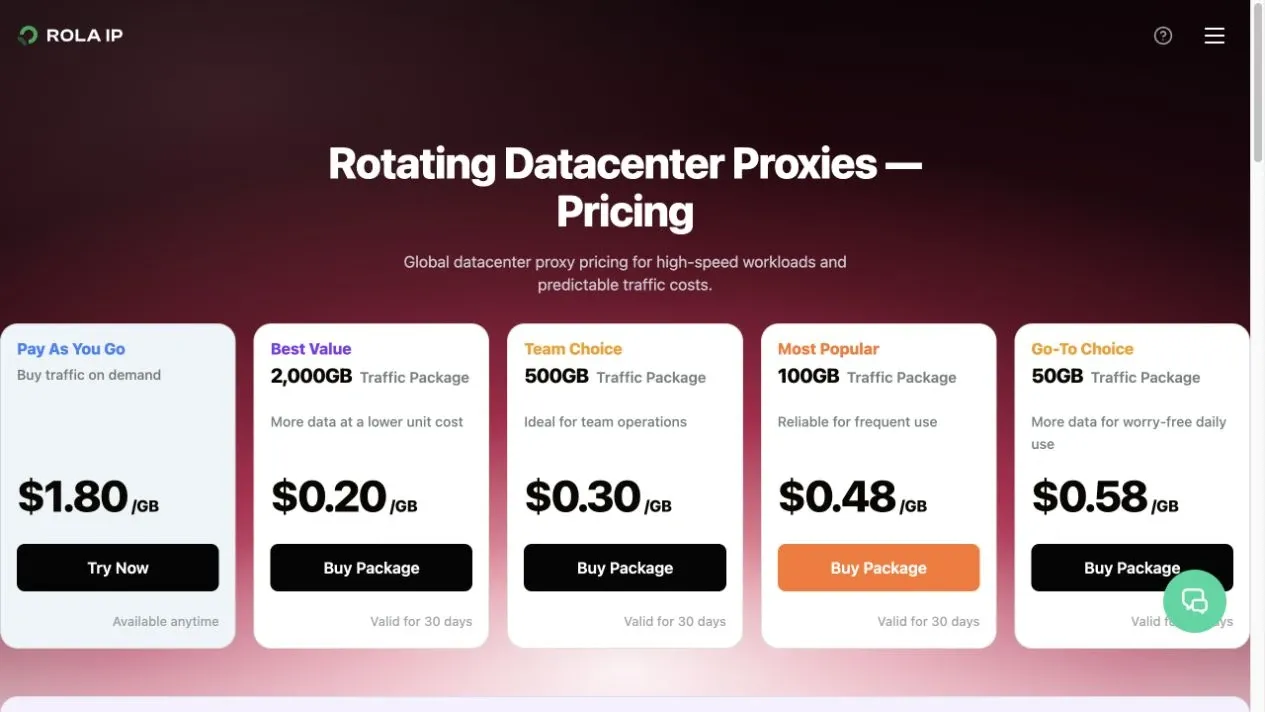
| Rola IP pricing | $1.80/GB pay-as-you-go; 100 GB package at $0.48/GB ($48) | Rotating pool; package valid 30 days, unused GB does not roll over; checkout tax and current promotion must be checked | Clear baseline for a country-level, stateless workload with predictable traffic |
| Oxylabs | Starter subscription $15/month; datacenter pay/GB rate $0.60/GB at that tier; VAT may apply | One credit balance funds multiple products; unused credits expire at the billing-cycle end unless an upgrade carries them over | Compare the full $15 commitment and actual credit use, not just the per-GB rate |
| Bright Data | Pay-as-you-go at $0.60/GB; monthly traffic tiers also shown | Shared rotating product; price and available country depend on the selected configuration | Flexible pay-as-you-go comparator; save the selected-region quote |
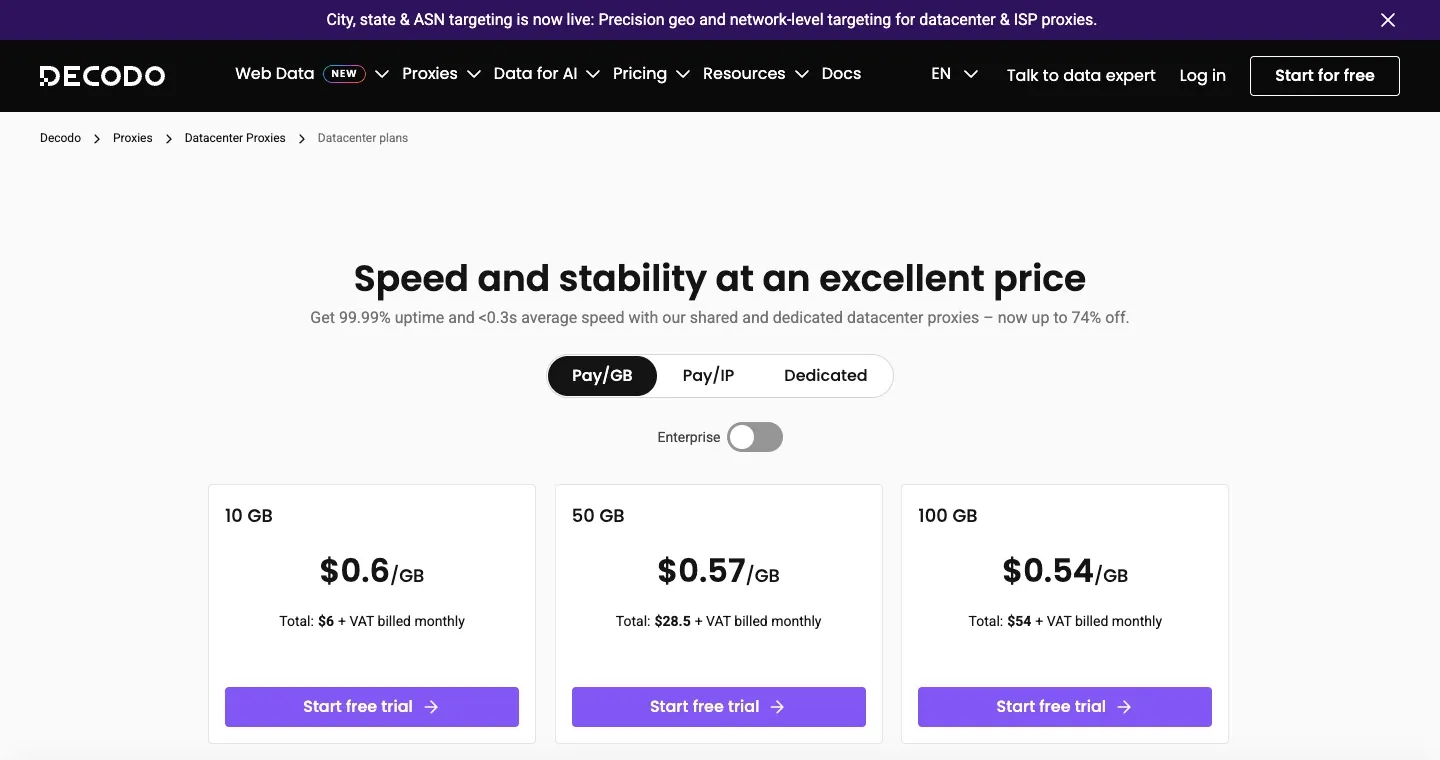
| Decodo | Pay/GB: 10 GB for $6/month ($0.60/GB), plus VAT | Shared rotating pool; monthly billing and tax differ from Rola’s 30-day package | Practical lower-volume comparator to Rola IP |
Fixed-IP plans
| Provider | Example product and purchase | Sharing, term, and main cost boundary | Assessment |
|---|---|---|---|
| Rola IP static pricing | From $3/IP; public page describes a monthly flat fee | Fixed IP; confirm target country, exclusivity, available quantity, renewal, and retention in the order | Baseline for a stable exit and allowlisting |
| Oxylabs | Starter $15/month credit balance; dedicated rate $2/IP and shared per-IP rate $1/IP at that tier; VAT may apply | Rates draw from the same subscription credits; dedicated and shared are separate products; bandwidth has fair-use wording | Compare the $15 account commitment and dedicated-IP rate with other fixed-IP offers |
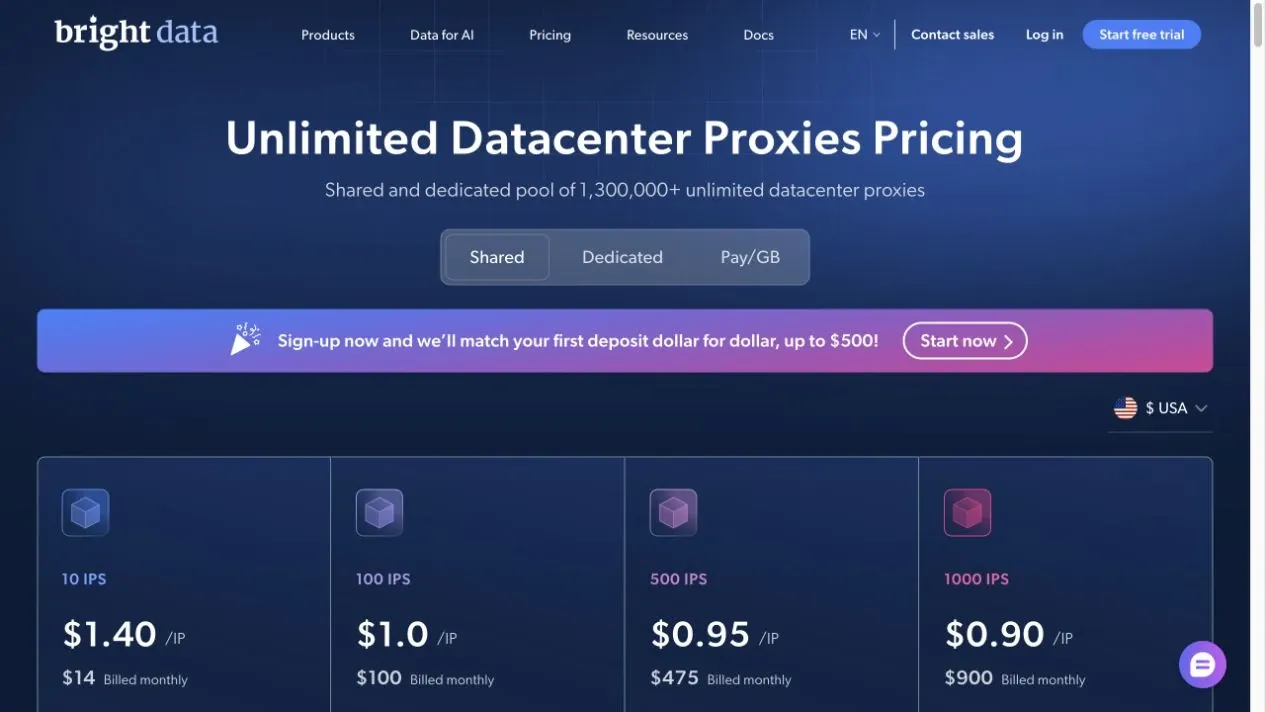
| Bright Data | Shared: 10 IPs for $14/month; dedicated: 10 IPs for $22/month | Its pricing FAQ states a 100 GB/IP monthly fair-use allowance and possible extra charges above it | Good when country and quantity can be specified before purchase |
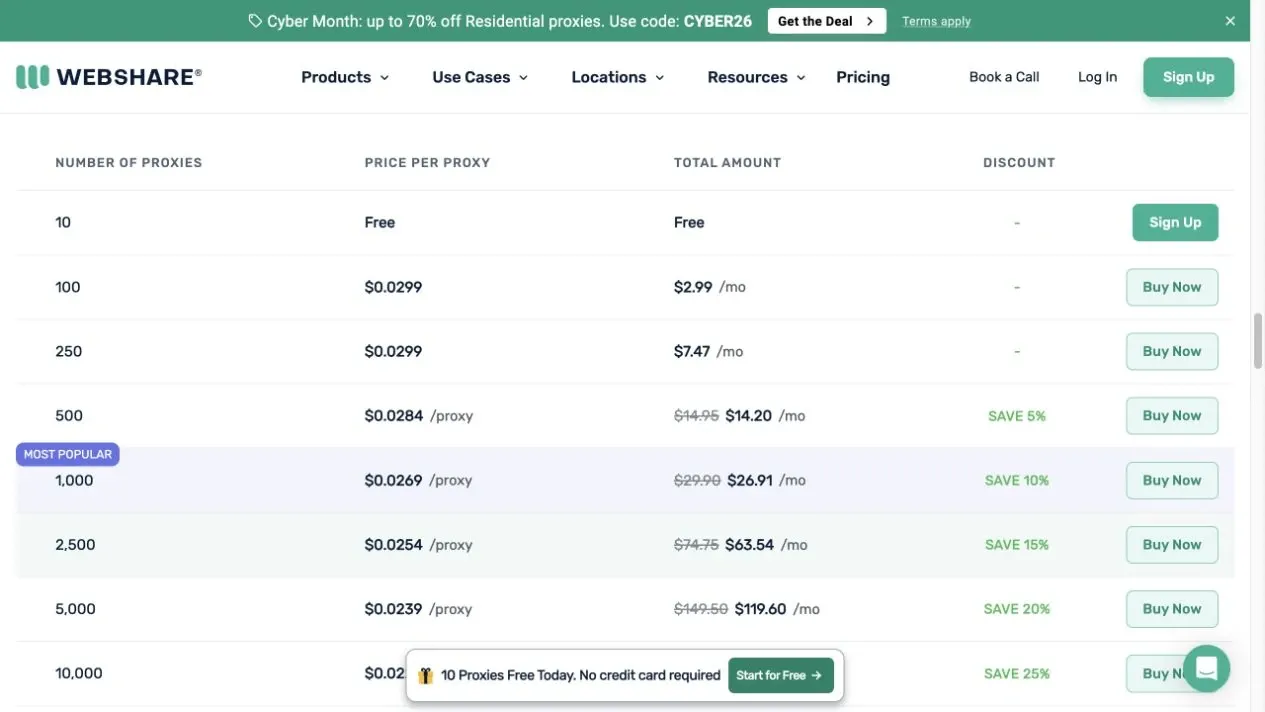
| Webshare | 100 shared proxies from $2.99/month; 10 free proxies are a separate sample | Shared exits; bandwidth, threads, and country selection vary by plan; free tier has 1 GB/month | Low-cost client and authentication check, not a substitute for dedicated IPs |
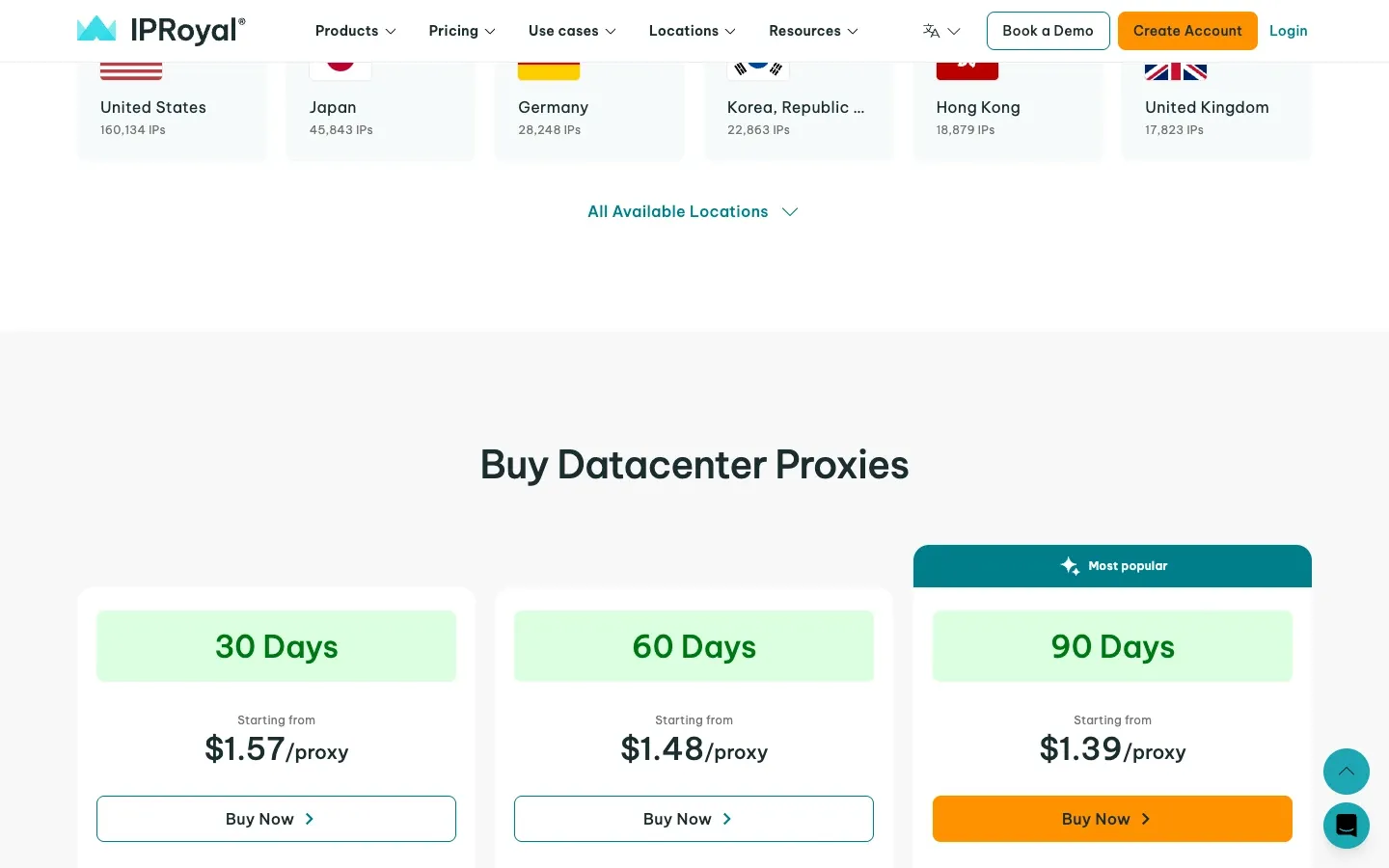
| IPRoyal | Dedicated static IPs from $1.57/IP for 30 days; longer 60/90-day offers have different entry rates | 100 GB/IP per monthly cycle pooled within the order; speed may be reduced after the allowance, with extra bandwidth available | Fixed-exit candidate when retention and pooled traffic fit the job |
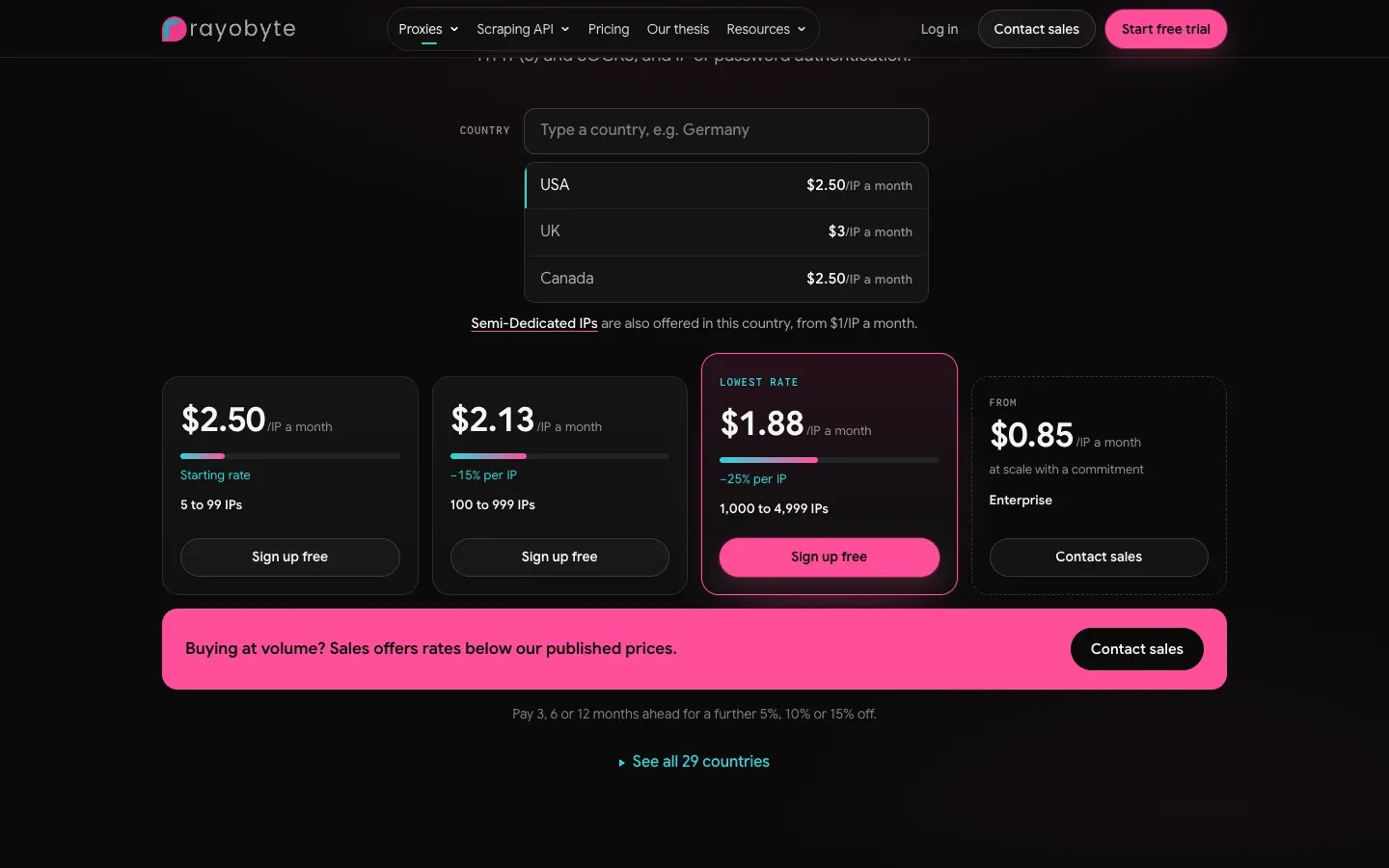
| Rayobyte | US dedicated: 5–99 IPs at $2.50/IP/month; 100–999 at $2.13/IP/month | Five-IP entry tier; country changes price; the $0.85/IP headline is a committed enterprise offer | Strong comparator when a US buyer needs several dedicated IPs |
Prices shown here are published examples, not a ranking from cheapest to most expensive. Country, quantity, term, tax, promotions, bandwidth, and replacement rules should be checked in the order summary. In particular, IPRoyal’s and Bright Data’s fixed-IP traffic allowances and Rayobyte’s minimum quantity can matter more than their headline per-IP rates.
Which of the Seven Best Data Center Proxies Fits Your Workload?
1. Rola IP: One baseline for rotating traffic and fixed exits
Result: Rola IP is a practical first comparison candidate because its datacenter catalog covers both rotation billed by GB and static IPs billed per address. For a stateless collection job, the 100 GB rotating package has a published base of $48 for 30 days; for a whitelisted integration, the static page starts at $3/IP. Those two products solve different needs and should be quoted separately. Rotating pricing and static pricing were checked on November 12, 2026.
Strengths and fit: Rola’s datacenter setup guide documents the gateway, account marker, country parameter, rotation control, and HTTP/SOCKS5 connection examples. That makes the product straightforward to integrate into an existing proxy client. The rotating product is a sensible first screen for authorized public-page requests; the static product is the one to quote when an allowlist or persistent exit is mandatory.
Limits to check: The rotating datacenter guide describes country-level targeting, so a city-specific SERP job requires a different product or verified location capability. A 30-day package can lose unused traffic at expiry. On the static side, confirm the selected country’s stock, whether the IP is exclusive, the duration for which it can be retained, and the exact renewal cost. The site’s 99.9% uptime statement is a published service claim; a buyer requiring credits or compensation should ask for the applicable order’s written SLA.
2. Oxylabs: Multiple network formats under one provider
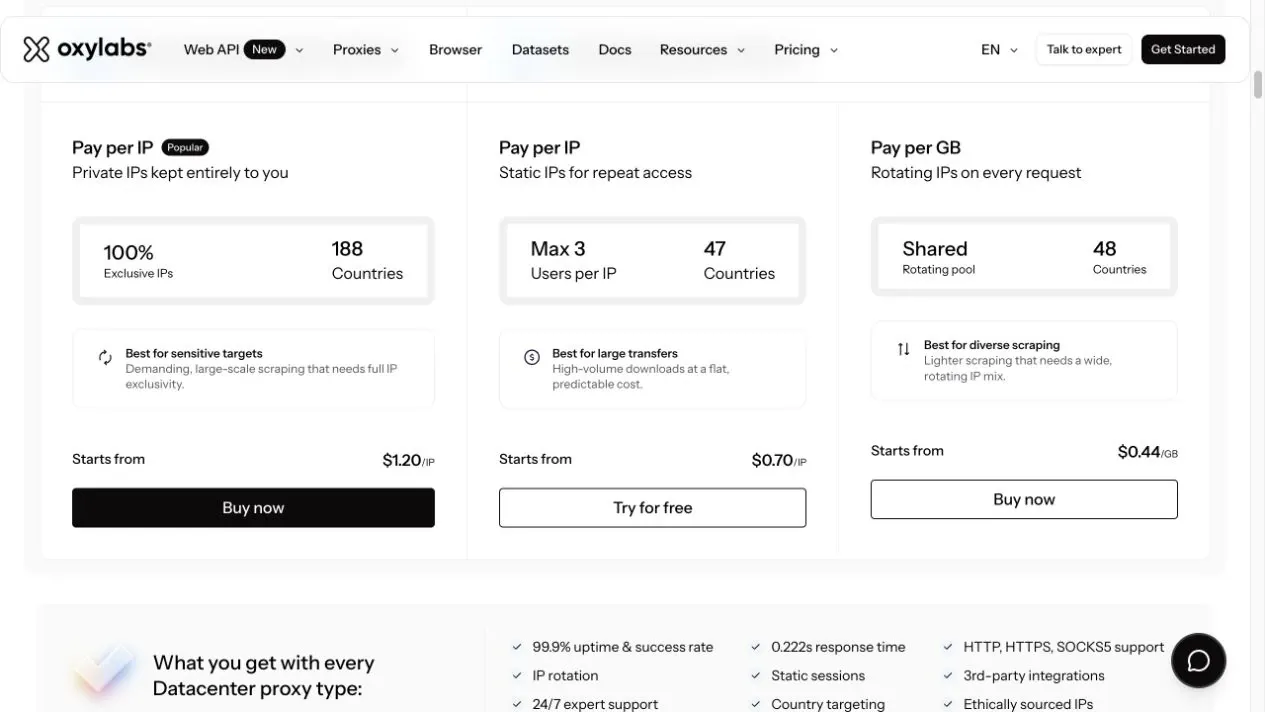
Result: Oxylabs offers dedicated IPs, shared fixed IPs, and shared traffic-billed datacenter proxies through one credit-based subscription. Its Starter tier is $15/month before any applicable VAT; at that tier the page lists $0.60/GB for traffic, $2 per dedicated IP, and $1 per shared IP. The subscription is the monthly account commitment, not three independent minimum orders. Credits are deducted according to usage and normally expire at the billing-cycle end. Source: subscription pricing and billing FAQ, checked November 12, 2026.
Strengths and limits: The published options make it easy to compare fixed and rotating use within one account, with HTTP(S) and SOCKS5 listed. Buy dedicated when exclusivity is a hard requirement, and check the product and country’s inventory before funding the subscription. The site’s stated response time and success rate are provider-wide promotional metrics, not a substitute for your target’s acceptance. Confirm the fair-use rules, credit expiry, and tax at checkout; its FAQ says self-service purchases are non-refundable.
3. Bright Data: Configurable shared, dedicated, and traffic options
Result: Bright Data’s pricing page separates shared IP, dedicated IP, and pay/GB modes. The published 10-IP examples are $14/month for shared and $22/month for dedicated; pay-as-you-go rotating traffic starts at $0.60/GB. These figures make Bright Data worth quoting when a buyer can specify the country, volume, and exclusivity up front. Source: pricing page and FAQ, checked November 12, 2026.
Strengths and limits: The menu covers both fixed and rotating needs and scales by IP quantity. Its own FAQ attaches 100 GB per IP per month as a fair-use allowance for the “unlimited” datacenter plans; extra charges may apply above that level. A buyer should therefore compare a 10-IP plan as a $14 or $22 monthly commitment plus any excess traffic, rather than treating the per-IP figure as the entire bill. The trial button is an entry point; its exact product eligibility and credit should be read in the account offer.
4. Webshare: Lowest-friction shared proxy integration check
Result: Webshare publishes 100 shared proxies from $2.99/month and offers ten free datacenter proxies. Its help page specifies that the free plan has 1 GB/month of bandwidth and is separate from paid plans. This is useful for checking whether a tool accepts a proxy list, credentials, and the required protocol before choosing a larger purchase. Source: free-plan terms, checked November 12, 2026.
Strengths and limits: HTTP and SOCKS5 are listed, and paid plans let buyers configure proxy count, countries, bandwidth, and threads. The free and $2.99 examples are shared IPs, not equivalent to a dedicated static exit. Free-tier traffic and region selection are too narrow to estimate a production bill. Compare a paid configuration with the same bandwidth and country requirements before calling it the lowest-cost option.
5. Decodo: A small monthly per-GB comparator
Result: Decodo publishes a 10 GB shared rotating datacenter tier at $6/month plus VAT and a 50 GB tier at $28.50/month plus VAT. Those clear traffic blocks make it a useful comparison against Rola IP’s rotating offer for a small authorized collection job. It also sells Pay/IP and Dedicated formats, which require their own quote. Source: datacenter pricing page, checked November 12, 2026.
Strengths and limits: HTTP(S) and SOCKS5 appear on its pricing page, and the 10 GB minimum reduces the first cash commitment. The listed monthly billing and VAT differ from Rola’s 30-day package. Decodo’s 14-day money-back claim has formal conditions: the refund FAQ limits it to eligible first self-service purchases, excludes purchases following a free trial and cryptocurrency payments, and caps proxy usage at the earlier of 20% of plan traffic or 1 GB. Refund policy, checked November 12, 2026.
6. IPRoyal: A fixed-IP option with a pooled traffic allowance
Result: IPRoyal sells dedicated static datacenter proxies on 30-, 60-, and 90-day terms. Its public entry price is $1.57/IP for 30 days, with lower per-IP headlines on longer terms. It belongs on a shortlist for a persistent exit, allowlisting, or a country-specific fixed-IP requirement. Source: product and pricing page, checked November 12, 2026.
Strengths and limits: The page lists HTTP(S), SOCKS5, and more than 60 locations. Its FAQ specifies 100 GB per IP per monthly cycle, pooled across IPs in the same order; reaching the allowance reduces speed, and extra bandwidth can be bought. For ten IPs, that is a 1,000 GB pooled monthly allowance, not unrestricted bandwidth. Check the selected location’s stock, the actual order total, and whether the same addresses remain available on renewal. Its datacenter refund FAQ sets time and 500 MB usage conditions, so the cheaper long term should not be chosen solely for its headline rate.
7. Rayobyte: Dedicated US IPs with visible quantity tiers
Result: Rayobyte lists US dedicated static datacenter IPs at $2.50/IP/month for 5–99 IPs and $2.13/IP/month for 100–999 IPs. The advertised $0.85/IP/month is an enterprise quote at scale with a commitment, not the price for a five-IP order. It fits buyers who can estimate a fixed IP count and keep that pool in use. Source: country and quantity pricing page, checked November 12, 2026.
Strengths and limits: The page lists HTTP(S), SOCKS, and IP or password authentication, with prices exposed by country. It labels bandwidth “unlimited” with an asterisk; inspect the applicable fair-use and order terms before sizing a high-transfer workflow. Five US IPs imply a published base of $12.50/month, while a buyer needing a different country or semi-dedicated service must price that configuration separately. Rayobyte’s refund guidance describes a two-day window for certain eligible static proxy packages, often a single five-proxy trial package; confirm eligibility before ordering.
How Should You Compare Per-GB and Per-IP Costs?
First decide whether a stable, exclusive address is required. If it is, eliminate rotating and shared offers before comparing prices. If exits may rotate, estimate traffic actually used within the paid period. The two price units become comparable only after the candidates meet the same region, protocol, session, and target-acceptance requirements.
For example, Rola IP’s published 100 GB rotating package is $48 for 30 days. At 60 GB used before expiry, its base cost is $0.80 per GB used, before any tax or promotion. That is an arithmetic scenario, not a measured traffic result. A fixed-IP calculation instead starts with IP count × the price for the selected country and term, then adds any traffic overage, tax, or required add-on. Bright Data’s and IPRoyal’s per-IP allowances, Rayobyte’s five-IP entry tier, and Rola’s IP retention terms all belong in that calculation.
For either model, keep a worksheet with: order amount, tax, included GB, GB consumed before expiry, overage, successful requests, valid records, and retry traffic. If two configurations meet the task equally well, compare total spend per 1,000 valid requests or per valid record. Neither unit can override a hard requirement for a dedicated or persistent exit.
What Do the Trial, Refund, and Service Terms Actually Cover?
| Provider | Public entry or refund finding | Buyer action |
|---|---|---|
| Rola IP | Refund policy, updated July 17, 2026: review for duplicate or incorrect charges and extended provider-attributable unavailability; consumed or partially consumed services generally excluded | Check the exact order and campaign terms; ask for a written SLA if compensation matters |
| Oxylabs | The published offer includes a $5 welcome credit to new users; this is a credit, not a recurring free datacenter allowance | Confirm the selected product can use it and note any expiry or spend cap |
| Bright Data | The datacenter product lists a trial entry | Confirm the product, eligibility, credit, payment method, and renewal in the account offer |
| Webshare | Help center gives ten shared datacenter proxies with 1 GB/month on the free plan | Do not project free-tier bandwidth or behavior onto paid dedicated plans |
| Decodo | Refund FAQ sets a 14-day first-purchase window and a proxy-usage ceiling of 20% or 1 GB, whichever comes first | Check trial history, payment method, product type, and renewal before purchase |
| IPRoyal | Datacenter refund FAQ conditions requests on the reason, timing, and no more than 500 MB used | Keep the order time and traffic record; read the renewal-specific rule |
| Rayobyte | Refund guidance describes a two-day window for certain static packages | Confirm whether the chosen SKU and quantity qualify and when renewal begins |
These are different product-specific offers. “Free sign-up,” a welcome credit, a free shared sample, and a refundable purchase are not the same entitlement. Likewise, a provider’s published uptime figure should not be treated as a contract remedy without the applicable SLA’s measurement and credit terms.
How Do You Move an Existing Proxy Job to Rola IP?
- Record the current proxy’s protocol, country, fixed or rotating behavior, authentication, IP allowlists, usage, and monthly bill. Select the Rola datacenter product that meets those same constraints; keep the existing configuration available for rollback.
- In the Rola IP dashboard, activate the chosen product and copy its account-specific HOST, PORT, and authentication details. For a rotating pool, follow the datacenter setup guide for its username parameters and session options. A static-IP order uses its own supplied connection details.
- Add the endpoint to your existing proxy client’s secure credential fields or secret store. Avoid placing the password in a command line, shell history, shared configuration, screenshot, or log. Restrict access to local config files and rotate a credential if it was exposed.
- Route a small, authorized sample through Rola IP. Verify the proxy connection, exit IP and country, application output, and usage counter. If your system uses allowlisting, add the new fixed IP before switching traffic. Increase the share only after the agreed acceptance criteria are met; revert to the old endpoint if errors or effective costs exceed the threshold.
For authentication failures, the 407 Proxy Authentication Required guide covers common credential checks. For an authorized collection workflow, see proxy server for web scraping.
How Can You Test the Two Finalists Fairly?
Use the same authorized target URLs, country, protocol, request payload, and business-success definition for each comparable product. Run a stable public page and a representative business page in three named UTC time windows. As a starting protocol, make 100 requests per window per provider at concurrency 5, with a 15-second timeout. Allow at most one retry after a fixed 10-second pause for timeouts and server errors; record 429 responses separately and honor a Retry-After header rather than retrying blindly. If the target’s rules require a lower rate, use that lower rate for both candidates.
For each request, capture the timestamp, provider and exact SKU, country, exit IP/ASN, HTTP status, timeout, CAPTCHA or block indicator, latency, bytes, retry count, and whether required fields parsed into a valid record. Keep counts of 403, 407, 429, and timeouts separately. For each test window, compute valid-response rate, P50/P95 latency among valid responses, total elapsed time including retries, GB billed, total spend including tax and add-ons, and cost per valid record. For static IPs, also verify that the address remained the same; for rotating IPs, count distinct exits and /24s.
This procedure produces a decision about your target and purchased SKUs. A provider page’s claimed uptime or response time uses a different measurement scope and should not be inserted into this result sheet. Stop or reduce requests when the destination indicates a rate limit or access restriction.
Conclusion
The seven providers are strongest in different purchase situations. Rola IP gives a clear baseline for both rotating traffic and a fixed datacenter exit, with a documented integration path. Decodo is a close low-volume per-GB comparator; Oxylabs and Bright Data offer broader plan menus; Webshare is useful for low-cost shared-proxy integration checks; and IPRoyal and Rayobyte deserve fixed-IP quotes when their traffic and quantity rules fit. Narrow the choice by required IP behavior and country first, compare the complete order cost second, and make the final decision from the same authorized target and success criteria.