
Infatica Review: Pricing, Proxy Features, and a Rola IP Alternative

Nov 9, 2026 · Comparisons · 11 min read
TL;DR
Infatica offers residential, ISP, datacenter, and mobile proxies. Its current residential pricing table lists $4/GB pay as you go and a 100GB package at $360. Rola IP currently lists $4/GB pay as you go and a 100GB package at $2/GB, with a 30-day validity period shown on its pricing page. Rola is an alternative worth testing if that package size and its location and session controls fit your workload. This article compares published information and attributed third-party reviews; it does not contain a like-for-like performance test of the two providers.
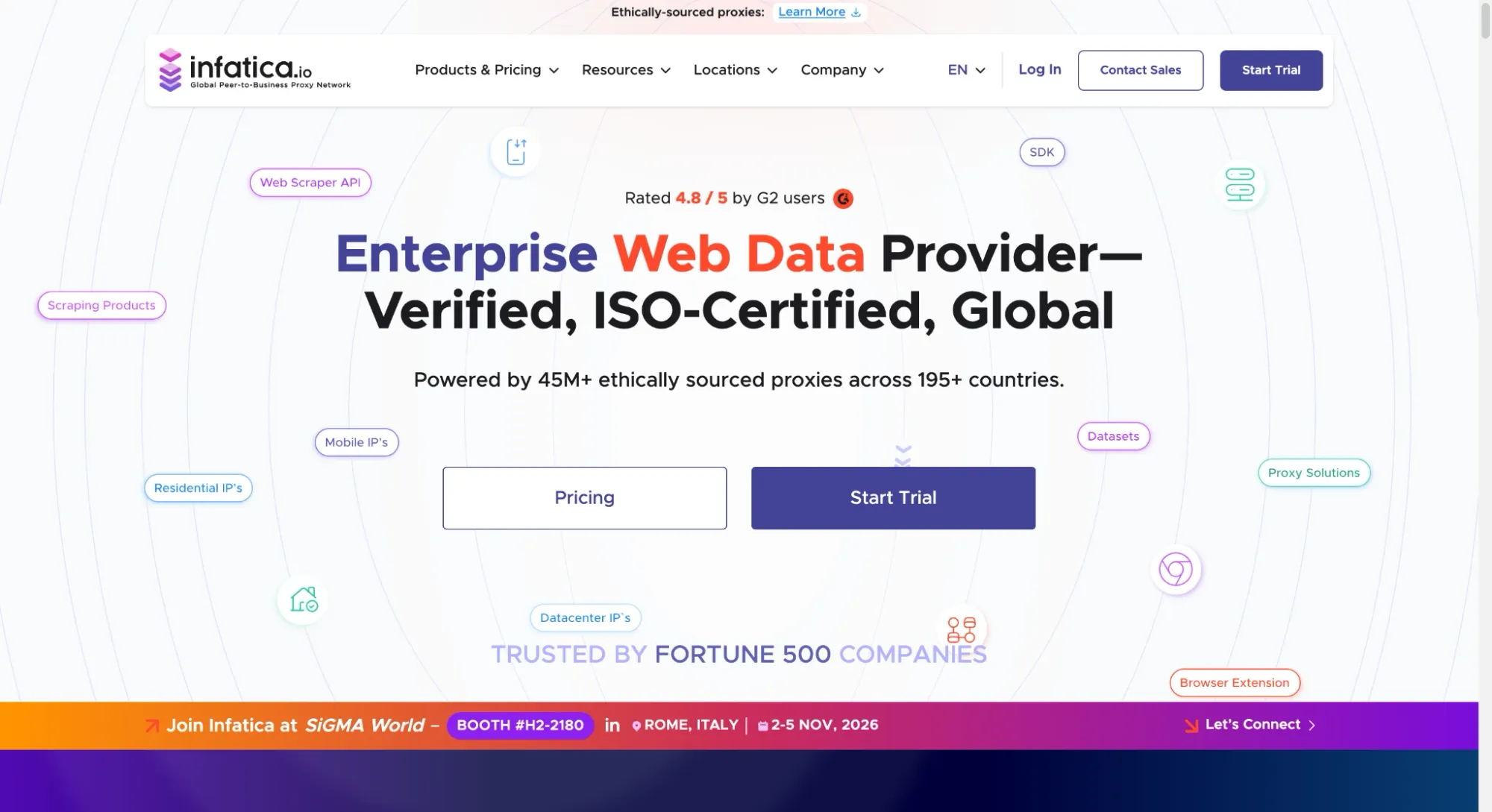
This review answers a practical question: should you keep evaluating Infatica, or compare an alternative before committing production traffic? The answer depends less on the biggest advertised IP-pool number than on four things you can actually test: how traffic is billed, which locations and sessions you can select, how the service handles your required protocol, and whether the same authorized sample succeeds consistently.
What is Infatica?
Infatica is a business-focused proxy and web data provider. Its current product set includes residential, ISP or static residential, datacenter, and mobile proxies, alongside scraping-oriented products. Infatica’s own materials position the service around business data collection, market research, ad verification, brand protection, and related workflows. Its residential documentation explains how to create and use residential proxy lists in software or a browser.
Independent reviews place Infatica in the mid-market rather than treating it as a free or casual proxy tool. That distinction matters. A business buyer should assess account verification, billing commitments, data retention, support expectations, and acceptable-use requirements before comparing per-GB prices.
Infatica review: products, controls, and published tests
Proxy types and targeting
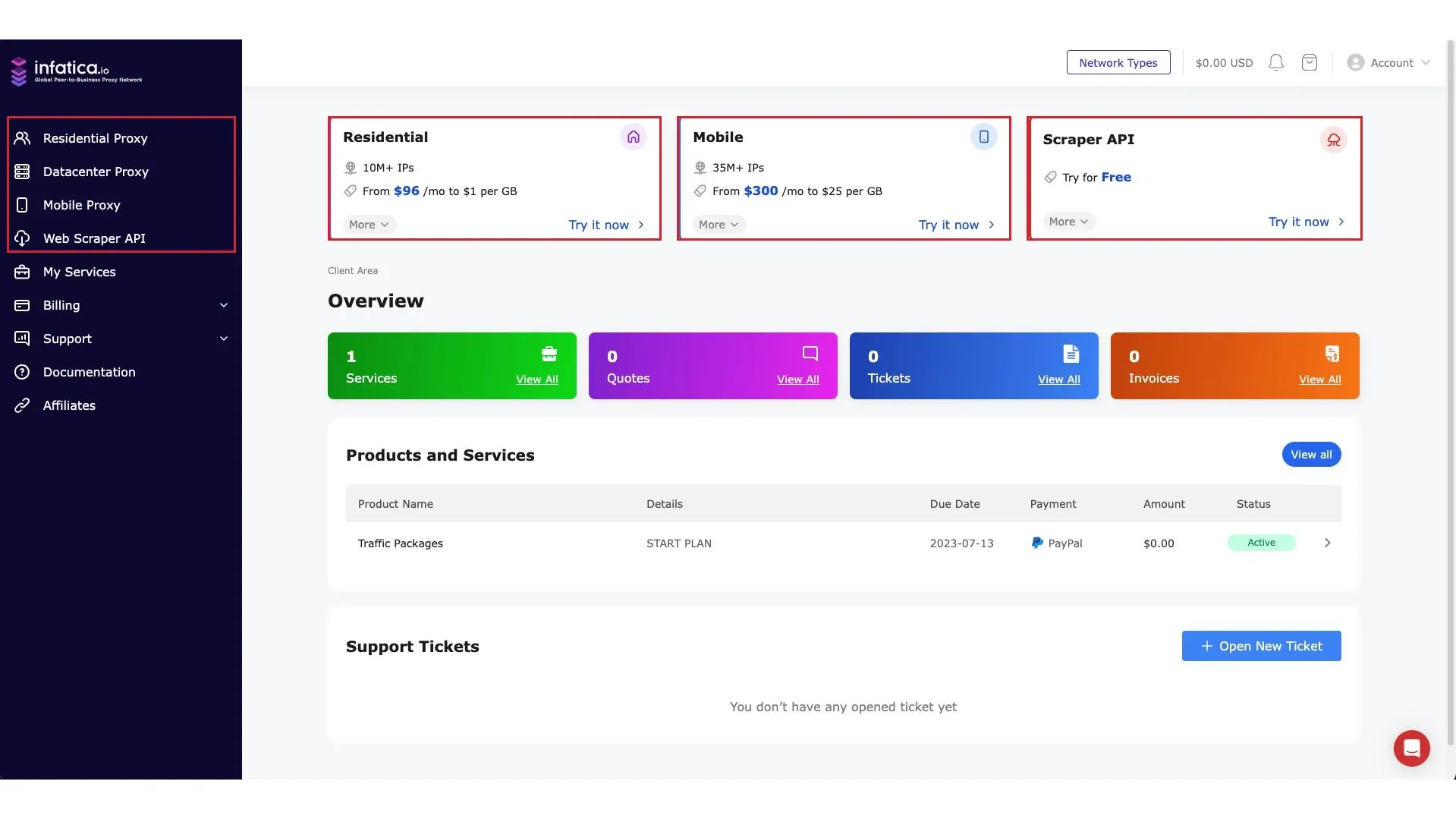
Infatica’s range is one of its practical strengths. Residential proxies are aimed at traffic that benefits from consumer-network egress. ISP or static residential proxies are a better fit when a workflow needs a more stable address. Datacenter proxies can make sense for server-side testing where the target accepts them, while mobile proxies are relevant only when mobile-network egress is genuinely part of the test.
The current independent review from Proxyway reports country, city, ISP, ASN, ZIP, and other filtering options for parts of the network. It also reports rotating and sticky residential sessions, including 5 to 60 minute presets. Treat those details as product and plan conditions to confirm in the account you will actually buy. A filter shown in documentation does not prove that every country, ISP, or session length is available at the same price.
Protocol and authentication boundaries
Infatica supports HTTP and HTTPS. Independent review evidence also lists SOCKS5 support, with a TCP-only caveat. That last detail is easy to miss. SOCKS5 is a proxy protocol, not encryption, and a SOCKS5 label does not automatically mean that UDP traffic is available. If your client, DNS behavior, or workload depends on UDP, confirm the exact support path before purchase.
Credential authentication and IP allowlisting are both common integration patterns in proxy services. Keep credentials in environment variables or a secret manager, never in a screenshot, repository, or command history. For a production pilot, record the exit IP, country, ASN, HTTP status, and application-level result separately. A 403, 429, sign-in page, or CAPTCHA is a stop-and-review signal, not a reason to rotate endlessly.
Performance: what the available tests actually show
Proxy performance is target-specific. Proxyway states that it last tested Infatica’s residential proxies in April 2026 and separates pool composition, infrastructure success rate, and response time. Those results belong to Proxyway’s test environment and show regional variation; they are not measurements produced for this article or a universal promise. A CDN endpoint, a search engine, an ecommerce page, and a logged-in application can produce very different results.
The right way to use an Infatica review is to borrow the measurement design, then repeat it for your own authorized workload. Use the same URL set, payload size, timeout, concurrency, session rule, and success definition for every provider. Count a response as successful only when it reaches the expected application state, not merely when the proxy returns a TCP connection.
Infatica pricing: is it worth the cost?
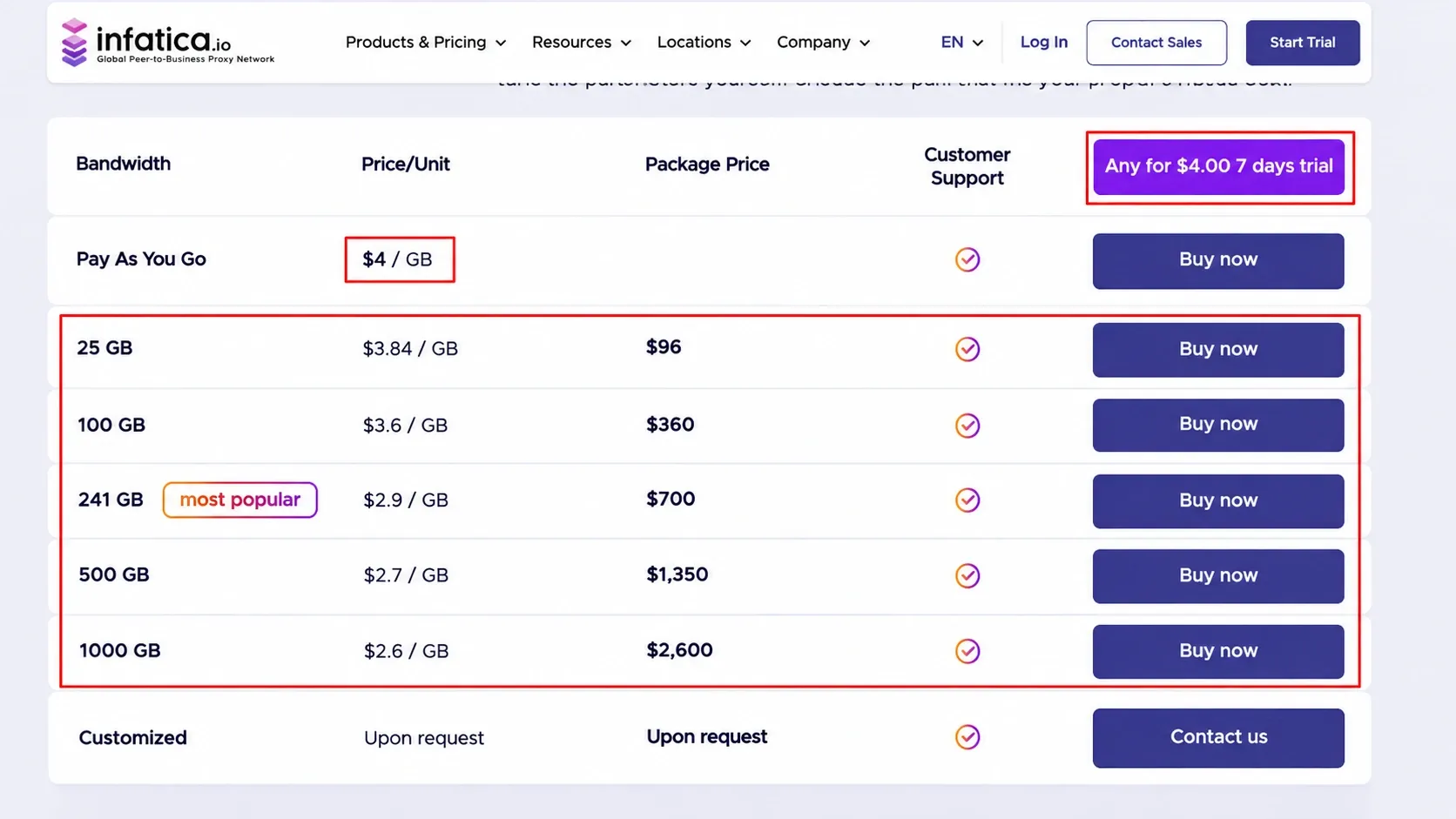
In the pricing table checked on November 9, 2026, Infatica lists residential pay-as-you-go traffic at $4 per GB, 25GB at $96, 100GB at $360, and larger packages with lower unit rates. The page also presents a $4 seven-day trial entry. Older third-party reviews may describe different package sizes. For example, TechRadar discusses a historical 40GB/$360 plan; that figure should not be treated as a current alternative to Infatica’s present 100GB/$360 listing.
The important buyer question is not simply “which provider has the lowest number?” Compare:
- pay-as-you-go versus subscription pricing;
- package size and whether unused traffic expires;
- trial conditions and identity checks;
- the cost of the required location or session settings;
- whether the plan can be topped up without starting a new cycle;
- support and account-management expectations.
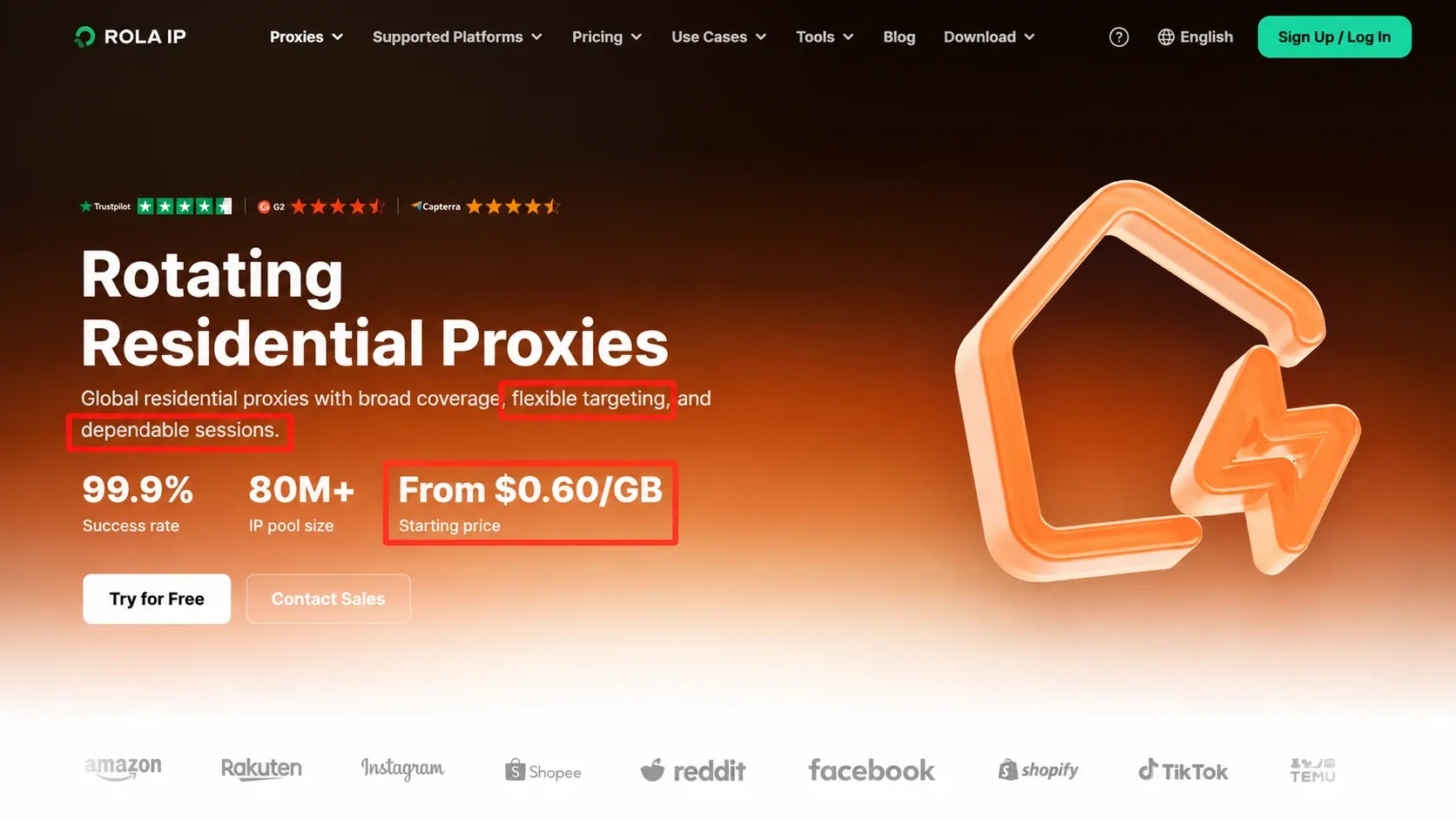
The comparable public Rola IP table lists $4 per GB for PAYG, $200 for 100GB, and $0.60 per GB for a 10,000GB package. Rola states that traffic packages are valid for 30 days and unused traffic is forfeited at expiry. The 10,000GB rate is an enterprise-scale commitment, not a small-purchase price. Check the current rotating residential pricing page and account checkout terms before purchase.
| Public residential price snapshot | Infatica | Rola IP |
|---|---|---|
| Pay as you go | $4/GB | $4/GB |
| 100GB package | $360 ($3.60/GB) | $200 ($2.00/GB) |
| 10,000GB package | Not shown in the reviewed public table | $6,000 ($0.60/GB) |
| Published validity or rollover note | Confirm in account terms | 30 days; unused traffic does not roll over |
At the 100GB tier, the public price difference is $160. If a team buys 100GB but uses only 80GB, the effective purchased-cost-per-used-GB would be $2.50 for Rola ($200 / 80GB) and $4.50 for Infatica ($360 / 80GB). This is an illustrative utilization calculation, not a total-cost comparison. Infatica’s expiry or rollover conditions were not established here, and taxes, promotions, refunds, payment fees, account-specific pricing, and performance costs are excluded.
The price difference is therefore conditional. Rola matches Infatica’s published $4 per GB PAYG entry and lists a lower public 100GB package price in this snapshot. That does not mean every Rola configuration is cheaper, and it does not replace a checkout-level comparison for your exact location, session, traffic, expiry, and support requirements.
Infatica pros and cons
What Infatica does well
- It covers the major proxy categories a business buyer may need.
- Its residential offering supports pay-as-you-go purchasing and multiple location filters.
- Its documentation provides product-specific setup material rather than treating every proxy type the same.
- Proxyway reports a fast, satisfactory experience with Infatica’s 24/7 live chat; that is the reviewer’s observation, not a response-time guarantee.
- Its network and performance are documented through dated third-party testing, giving buyers a useful baseline for their own pilot.
What to weigh before buying
- TechRadar describes the dashboard as unintuitive, while Proxyway criticizes parts of plan management. These are third-party usability judgments, not findings from this article.
- Proxyway reports that KYC is required before proxy use, which can add an onboarding step for some buyers. Confirm the current process with Infatica.
- Proxyway lists SOCKS5 as TCP-only for the reviewed product. Confirm the exact protocol scope for the plan you intend to buy.
- Published performance varies by region and target, so a generic success-rate claim is not a substitute for a workload pilot.
- Plan expiry, renewal, and top-up behavior deserve attention before a large purchase.
Why consider an Infatica alternative?
There are four sensible reasons to compare an alternative.
First, your cost model may not match Infatica’s preferred plan structure. A small team with uneven monthly demand may prefer PAYG. A high-volume team may prefer a package with a lower unit rate, provided the validity window is realistic.
Second, the onboarding path may not fit your organization. If identity verification, payment methods, or procurement steps are deal-breakers, identify that early rather than after implementation work has started.
Third, your protocol or session requirement may be more specific than the comparison page suggests. A workflow that needs stable IP identity, HTTP(S), SOCKS5 TCP, country targeting, or sticky sessions should compare those fields directly.
Fourth, an independent benchmark may not match your targets. A second provider gives you a controlled comparison, not a magic access guarantee. Keep collection authorized, respect the target’s terms and rate limits, and stop when the target refuses the request.
Is Rola IP a good Infatica alternative?
Rola IP is worth testing when you need a published residential pricing ladder, country, state, or city targeting, and rotating or sticky sessions. Its listed 100GB package price is below Infatica’s current public 100GB price, but that does not establish a performance or total-cost winner. Compare both providers on the same authorized targets, regions, session rules, and accepted-data criteria before switching.
That product fit is especially relevant for three workloads:
- Authorized web data collection: use residential proxies when the workflow needs regional consumer-network egress, then validate the target’s response and the extracted fields.
- SEO and market monitoring: use location controls to compare regional results, but store the request location, session identifier, timestamp, and response status with each observation.
- Price or availability research: use web scraping proxies as a network component in a permission-aware data pipeline. The proxy does not grant permission or guarantee access.
Rola’s clearest public-source advantage in this comparison is the lower listed 100GB package price and a visible 30-day validity rule. Its product pages also publish HTTP(S) and SOCKS5 support plus location and session controls. These are reasons to include Rola in a pilot, not evidence that it will outperform Infatica on every target.
Infatica vs Rola IP
| Decision factor | Infatica | Rola IP | Pilot check |
|---|---|---|---|
| Residential PAYG starting point | Official page shows $4/GB | Official page shows $4/GB | Exact checkout terms |
| Published 100GB package | $360 ($3.60/GB) | $200 ($2.00/GB), valid for 30 days | Checkout terms and expected utilization |
| Lowest rate discussed here | $2.60/GB at 1,000GB in the reviewed public table | $0.60/GB at 10,000GB | Do not compare unlike commitment levels |
| Residential proxy types | Residential, ISP, datacenter, mobile | Residential, static residential, datacenter, mobile pages | Required network type |
| Location controls | Independent reviews report country, city, ISP, ASN, and ZIP options | Official page publishes country, state, and city targeting | Exact location availability |
| Sessions | Independent review reports rotating and sticky options | Official page publishes rotating and sticky sessions | Session duration and rotation behavior |
| SOCKS5 | Supported in independent review, TCP-only caveat | Official page publishes HTTP(S) and SOCKS5 support | Client and DNS behavior |
| Performance evidence | Proxyway publishes dated Infatica tests; results vary by region and target | No matching Rola test is supplied in this article | Run the same authorized URL sample, location, session, timeout, and success check on both providers |
| Public-source fit | Broad business proxy catalog | Lower listed 100GB price plus published location/session controls | Controlled side-by-side pilot |
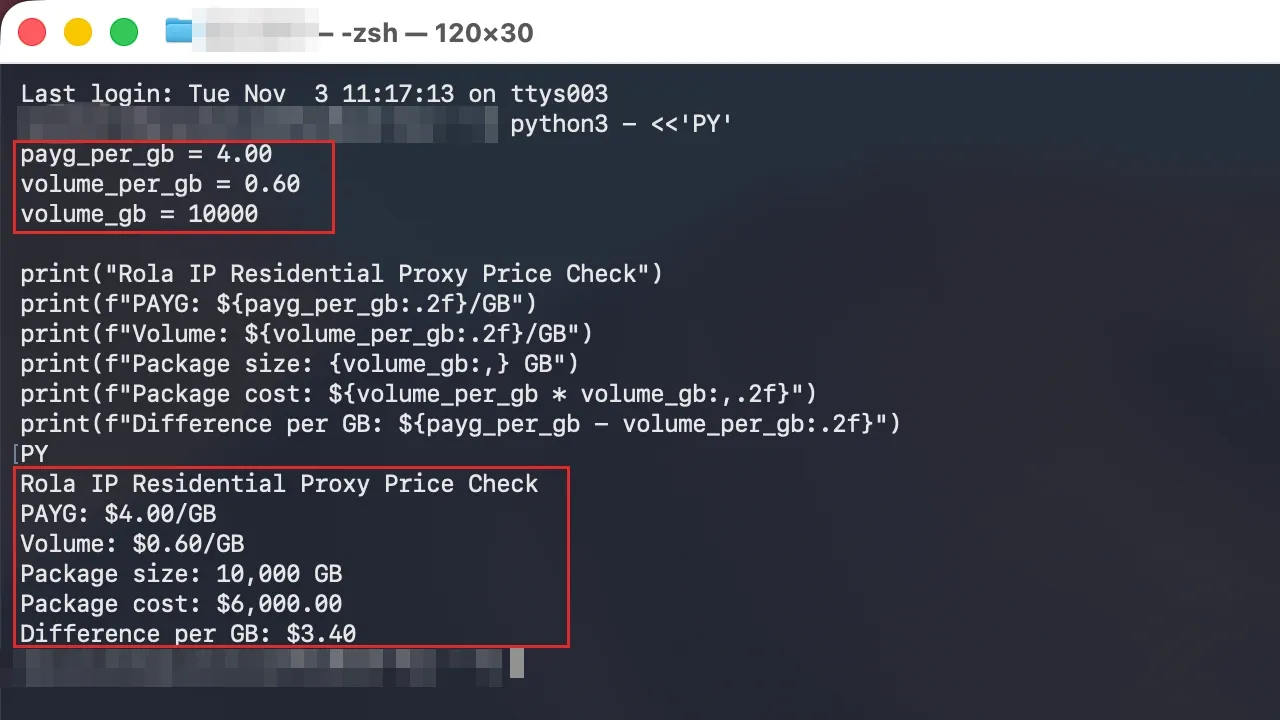
The terminal output uses manually entered Rola page prices: $4/GB PAYG and $0.60/GB at 10,000GB. It verifies only the arithmetic. It does not retrieve live prices, test a proxy connection, or measure latency, success rate, or IP quality. Check current package terms on the pricing page and run a controlled pilot before making a provider decision.
Other Infatica alternatives worth evaluating
Rola is not the only candidate. If you are building a shortlist, the site’s IPRoyal review and Bright Data alternatives pages cover two different provider profiles. Apply the same pilot method to every candidate rather than treating brand lists as a ranking.
A safe pilot checklist before switching
Before migrating production traffic, run a small authorized pilot:
- Define the target, purpose, permitted fields, rate limit, and stop conditions.
- Choose the same proxy type and location requirement for each provider.
- Keep credentials outside source code and redact proxy URLs from logs.
- Record exit IP, country, ASN, protocol, session rule, status code, response time, and expected application fields.
- Separate proxy errors from target refusals and parser errors.
- Stop on 403, 429, authentication pages, or CAPTCHA challenges and review the workflow.
- Compare cost per accepted record, not only cost per gigabyte.
If the public 100GB price and 30-day validity fit your forecast, review Rola’s current residential pricing, select the same region and session policy you would use with Infatica, and run a small authorized pilot before scaling.
Conclusion
Infatica is a reasonable business proxy provider with a broad product catalog, flexible residential purchasing, and useful targeting controls. Its limitations are familiar to serious buyers: plan and onboarding friction, protocol details that need careful reading, and performance that varies by region and target.
Rola IP is a strong Infatica alternative to evaluate when a visible pricing ladder, a lower listed 100GB package price, HTTP(S)/SOCKS5 access, location targeting, and rotating or sticky sessions match your requirements. Choose only after a controlled pilot identifies the better authorized result for your workload, with utilization, accepted records, and limitations written down before scale.