
ProxyEmpire Review (2026): Our Best Alternative for Predictable Bulk Residential Use

Nov 24, 2026 · Comparisons · 13 min read
TL;DR
Rola IP is our best ProxyEmpire alternative to test for predictable bulk residential use that can consume a large package within 30 days. This is a billing-fit recommendation, conditional on location availability, usable output, and confirmed purchase terms. ProxyEmpire may fit irregular demand better because unused bandwidth retains future value. Team controls exist on both services, and advertised pool totals do not establish faster responses or higher success rates. Use the decision tables below before committing to a bulk plan.
Quick Verdict: Is ProxyEmpire Worth It?
| Your situation | Starting choice | Decision gate |
|---|---|---|
| Recurring residential demand near 1,000GB per 30 days | Trial Rola IP | Use the allowance before expiry; verify cost per valid record |
| Seasonal or unpredictable traffic | Consider keeping ProxyEmpire | Confirm that unused balance will serve future jobs |
| Carrier-specific mobile access, fixed IPs, or strict throughput requirements | Compare the relevant product separately | This bulk residential recommendation does not settle those needs |
What Is ProxyEmpire?
ProxyEmpire sells rotating residential, rotating mobile, dedicated mobile, static residential/ISP, and rotating datacenter proxies, plus a separate unlimited residential product. Its official website advertises HTTP, HTTPS, SOCKS5, browser integration, and 24/7 support.
Coverage, billing, and session behavior vary by product. A rotating pool changes exits; a static service allocates a persistent address; an unlimited product trades per-GB billing for a speed or usage condition. A proxy connection alone does not provide parsing, browser-state management, or validated data.
Older reviews can also miss documented features. ProxyEmpire’s API now includes sub-user management, and its lineup includes unlimited residential access. The API help page’s October 23, 2026 update date identifies a documentation change, not necessarily a feature launch.
ProxyEmpire Proxy Types and Core Features
Choose the network type before comparing prices. The same provider can offer very different terms for rotating traffic, static addresses, and dedicated mobile access.
Rotating residential proxies
The residential product page advertises 30M+ IPs across 170+ countries, with country, region, city, and ISP targeting. Rotation suits independent requests; sticky sessions help keep related requests together. Session continuity still depends on the underlying peer remaining available.
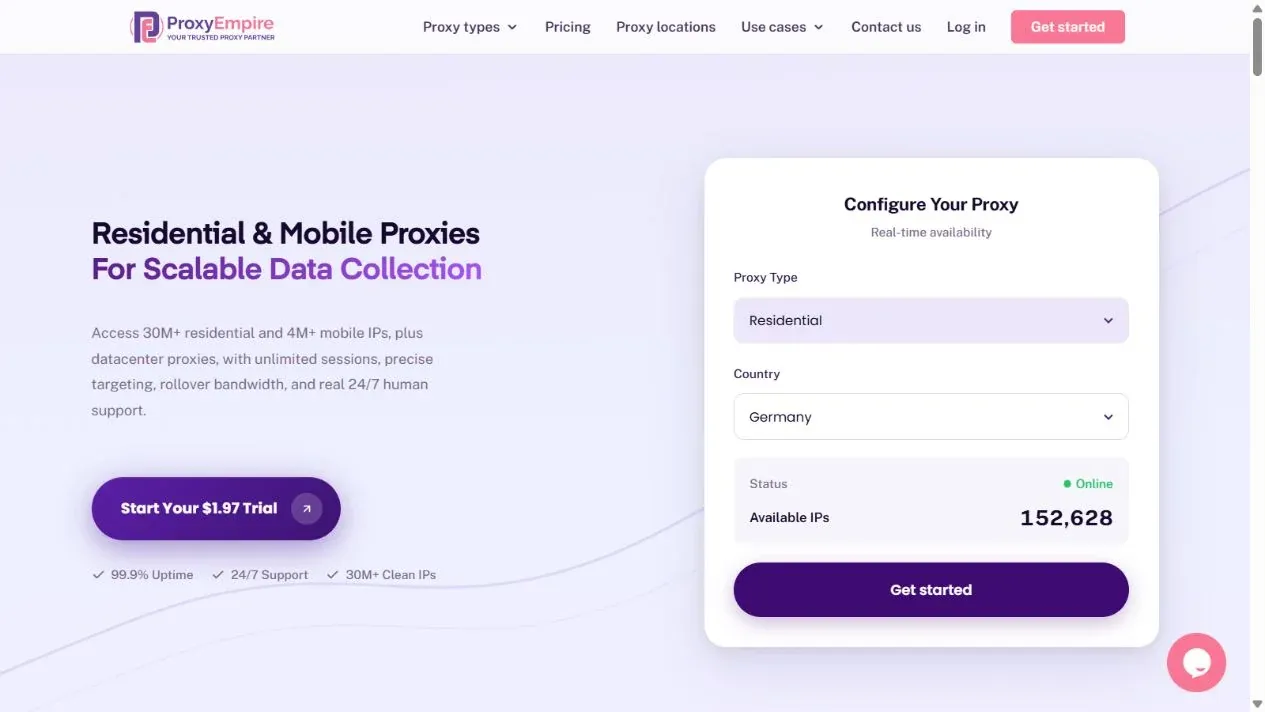
Our public-interface check selected Residential → Germany. It confirms the selection workflow, not live German inventory or the exit location of a paid proxy request.
Rotating mobile proxies
ProxyEmpire advertises 4M+ mobile IPs, 3G/4G/5G/LTE access, carrier selection, per-request rotation, sticky sessions, and timed changes up to two hours. A sticky session may continue longer while its peer remains online.
Evaluate mobile access when the carrier network matters to the job, such as app localization or mobile ad verification. A mobile premium does not automatically improve ordinary HTML collection.
Dedicated mobile proxies
The dedicated mobile offering lists a $250/month USA Verizon package with 50 locations and on-demand resets. Its $125/month multi-country option lists three US locations plus the UK, Austria, and Israel, with four to five resets daily.
Bandwidth remains subject to carrier fair-use policies. Dedicated connection access does not guarantee that a carrier’s public IP will never change.
Static residential/ISP proxies
The static residential page lists dedicated IPs in 24 countries. Monthly pricing starts at $3.50 for one IP and reaches $2/IP at 2,000 IPs.
Its unlimited-traffic wording includes a 100GB/IP/month fair-use cap. Confirm that allowance, location, and replacement terms if your workflow needs both continuity and heavy transfer.
Datacenter and unlimited residential proxies
The datacenter service advertises 62 countries and rates from $0.35/GB. Test whether your targets accept hosting-network exits before selecting it for cost alone.
The separate unlimited residential product advertises country-level targeting in 85+ countries and a $1,500/month 100Mbit plan. Compare speed allocation and utilization with metered plans; unlimited transfer does not mean unlimited throughput.
How to Use ProxyEmpire: Setup, Authentication, and Support
The following flow summarizes public documentation. It is not an account walkthrough or a report of paid-network testing.
Registration and the first connection
Create an account, activate the appropriate product, and use Proxy Manager to choose targeting and session settings. Copy the resulting endpoint and credentials into your client, following the connection guide.
Start with a country filter, verify the exit with an IP-information endpoint, and repeat requests to check rotation or persistence. Then inspect a small sample from the actual target. A successful IP check does not establish usable search results or complete product records.
Authentication, API, and browser tools
The authentication documentation describes username/password access without requiring a whitelist. This does not establish whether every product supports your required source-IP restrictions; confirm those separately.
The public API supports balances, proxy lists, location discovery, sticky-session rotation, sub-users, bandwidth transfers, and usage history. Account-management tokens and proxy passwords serve different purposes; keep both private.
ProxyEmpire also links a Chrome proxy-manager extension. Browser configuration and server-client configuration remain separate. During migration, recheck endpoint format, protocol, credentials, session behavior, and persistent connections.
KYC, refunds, support, and sourcing
According to the KYC help page, ordinary purchases and the trial do not require identity checks; requests for restricted destinations or additional ports require review. Port 25 remains unavailable.
The refund policy does not offer an unconditional money-back guarantee. ProxyEmpire advertises 24/7 support, but this review has no comparative response-time measurements.
For either provider, ask about peer consent, data retention, abuse handling, and applicable contracts. Marketing statements alone do not establish IP provenance or a particular logging policy.
ProxyEmpire Performance: What the Evidence Shows
Available third-party results describe ProxyEmpire’s infrastructure. There is no equivalent Rola IP dataset in this review, so they cannot support a performance ranking between the two services.
Independent measurements and their limits
Proxyway reports an April 2026 residential test with 2,058,387 unique IPs across 3.6 million global requests over 21 days. Its global infrastructure success rate was 98.17%. For a 6KB response from the nearest global CDN server, the global gateway row, tested from Germany, recorded 1.32 seconds average and 5.45 seconds p95. These are attributed third-party results, not our measurements. Source: Proxyway’s benchmark and methodology.
The CDN target matters: those numbers are not Google or Amazon extraction success rates. Average latency also hides slow requests that can delay a batch.
Validate useful output, not only connectivity
HTTP 200 can contain a CAPTCHA, incomplete fields, or the wrong regional page. For product monitoring, check identifiers, currency, availability, and delivery region. For search monitoring, check query, language, location context, and actual results.
Measure valid records, retries, p50/p95 latency, billed traffic, and session continuity under the same conditions. Neither a worldwide pool total nor a published concurrency allowance guarantees enough usable exits for one city-and-ISP filter.
ProxyEmpire Pricing: Published Rates and Billing Conditions
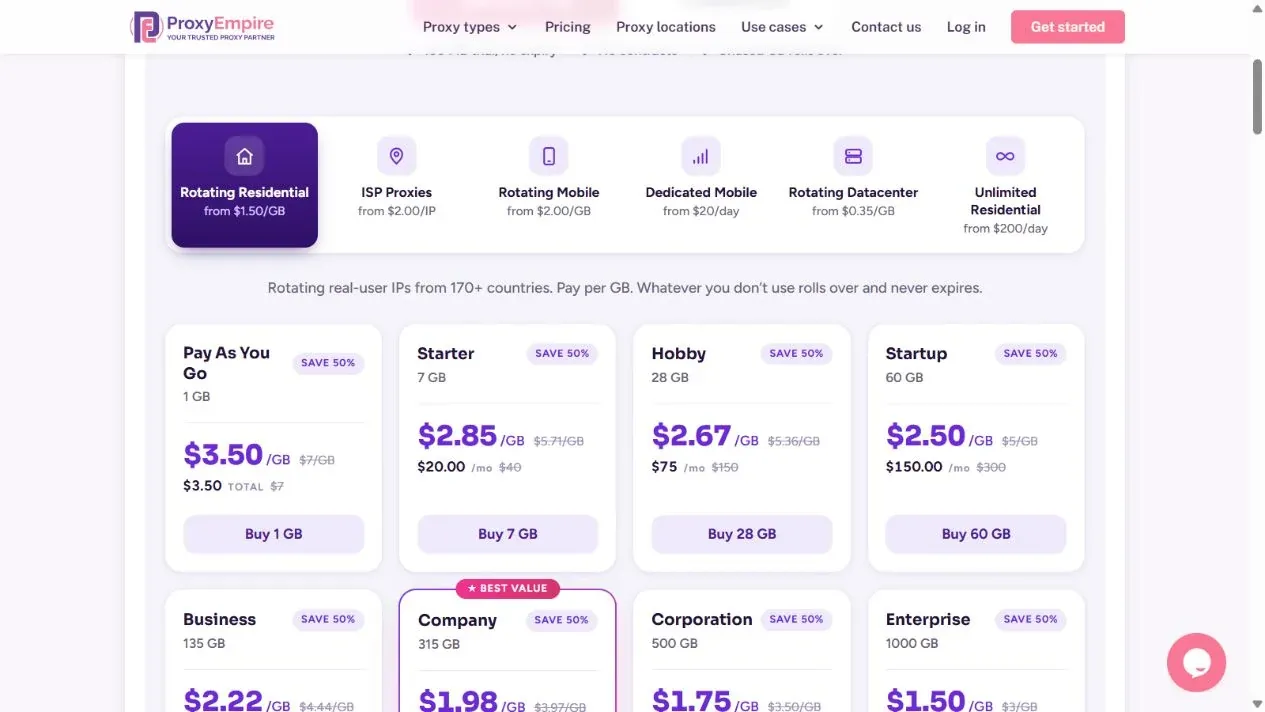
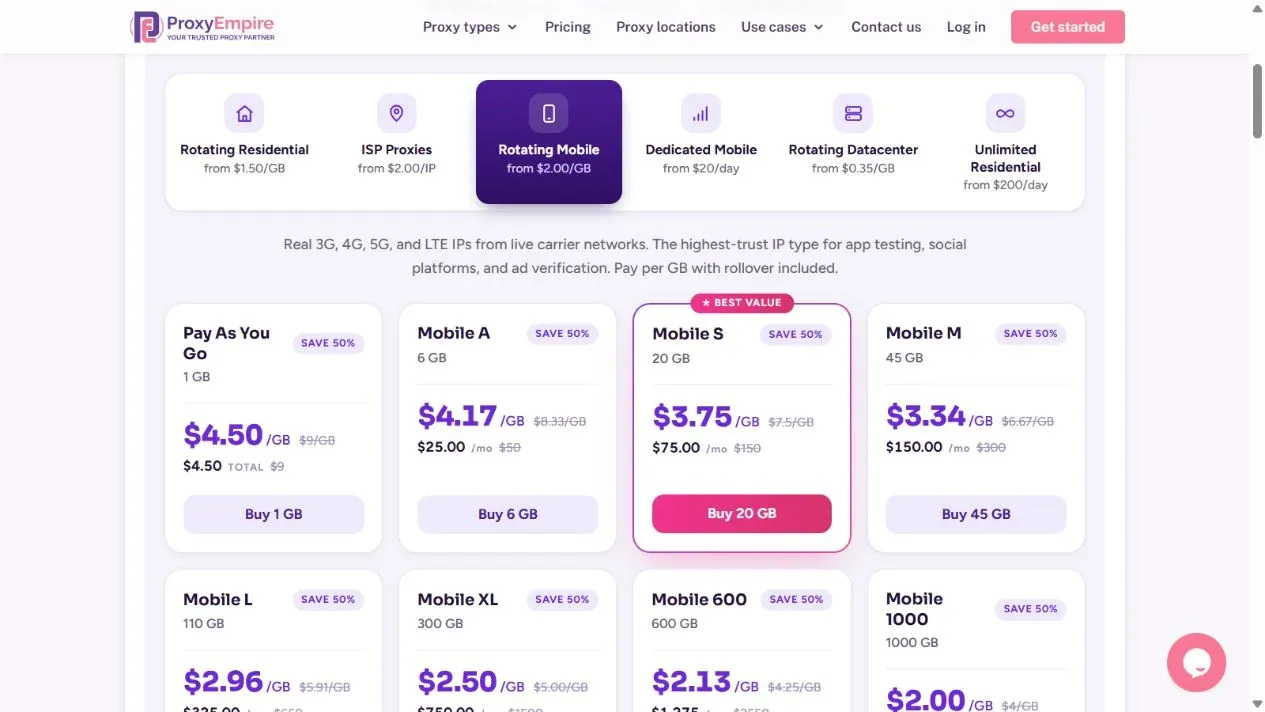
Public USD rates below were rechecked November 12, 2026. Eligible rotating residential and mobile plans display EMPIRE50; static and unlimited plans are excluded. Offer expiry, account eligibility, tax, and renewal totals were not verified at checkout. Source: ProxyEmpire pricing.
| Product and tier | Displayed amount | Condition |
|---|---|---|
| Residential, 1GB | $3.50 | Promotional top-up |
| Residential, 60GB | $150 | $2.50/GB |
| Residential, 1,000GB | $1,500 | $1.50/GB |
| Rotating mobile, 1GB | $4.50 | Promotional top-up |
| Rotating mobile, 1,000GB | $2,000 | $2/GB |
| Trial | $1.97 | 100MB residential + 50MB mobile |
Rollover can change the buying decision
ProxyEmpire’s bandwidth-expiry documentation says purchased unused traffic stays available without an active subscription. That is useful for seasonal work, but the balance has practical value only if you expect to use it. Preserve the distinction between future traffic value and cash paid today.
ProxyEmpire Pros and Cons
Advantages: Non-expiring bandwidth, several network types, granular residential targeting, documented team-management tools, and a small paid trial.
Tradeoffs: Bulk rates require upfront spend. Static traffic has a stated fair-use cap; unlimited residential access has separate speed and targeting terms. Source-IP access restrictions require product-specific confirmation. None of these points establishes worse target-site performance.
Which ProxyEmpire Alternatives Fit Other Requirements?
The best ProxyEmpire alternatives depend on the requirement you cannot meet today. This review evaluates Rola IP as one candidate for predictable bulk residential use. For needs outside that scope, shortlist the following product types instead of treating this recommendation as a complete provider ranking.
| Primary requirement | What to shortlist | Evidence needed before buying |
|---|---|---|
| Predictable bulk residential traffic | Rola IP’s metered residential plans | 30-day utilization and cost per valid record |
| Irregular usage with long gaps | Non-expiring metered plans; keeping ProxyEmpire is also an option | Balance validity, minimum spend, future demand |
| Exact mobile carrier or location | Carrier-specific mobile plans | Live carrier availability and target results |
| A fixed address with heavy transfer | Dedicated static/ISP plans, compared separately | Written speed, fair-use, validity, and replacement terms |
| Very high sustained transfer | Speed-based unlimited plans | Throughput allocation and supported targeting |
| Parsed results without maintaining a scraper | Managed scraping APIs | Supported targets, valid-output billing, retry policy |
A larger pool advertisement alone is not a reason to switch. If a specialist requirement drives the purchase, expand your supplier comparison around that requirement.
Rola IP: Our Best Alternative to Test for Predictable Bulk Residential Use
Our recommendation concerns a recurring residential workload that can consume its package within 30 days. It remains conditional on final charges and a successful target-specific pilot. Static or mobile requirements need their own selection process.
Advertised reach is a screening criterion
Rola IP advertises 80M+ residential resources across 190+ countries and regions, direct sourcing, a 99.9% uptime target, and 24/7 support. Those are provider statements. They do not prove more available IPs in your chosen city, cleaner exits, higher success rates, or faster responses than ProxyEmpire.
Team controls are useful, but not exclusive
Rola IP’s rotating residential proxies advertise location and session controls, API integration, sub-account traffic allocation, whitelist controls, and mainland China routing optimization.
Team management is a shared capability: ProxyEmpire also documents sub-users and bandwidth transfers. Compare the implementation your workers need rather than treating the existence of sub-accounts as a unique Rola advantage. Confirm authentication behavior, and test any mainland China routing benefit from your actual worker region.
Static traffic terms require a separate quotation
Rola IP’s static residential IPs are advertised as dedicated, fixed addresses with unlimited traffic during the validity period. We have not verified the chosen plan’s contractual speed limits or fair-use restrictions. Obtain those terms, plus the location, lease duration, and replacement policy, before using this claim in a cost comparison. It does not establish unrestricted throughput or superiority over ProxyEmpire’s static product.
Bulk residential pricing depends on utilization
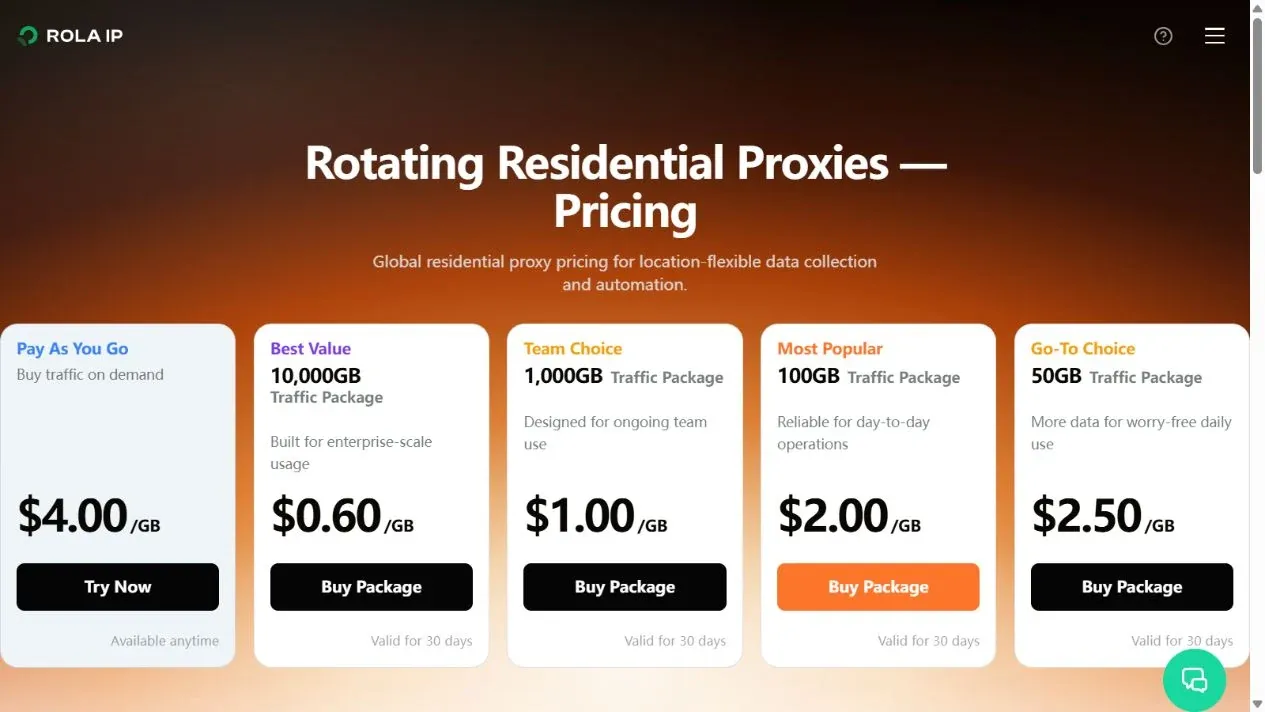
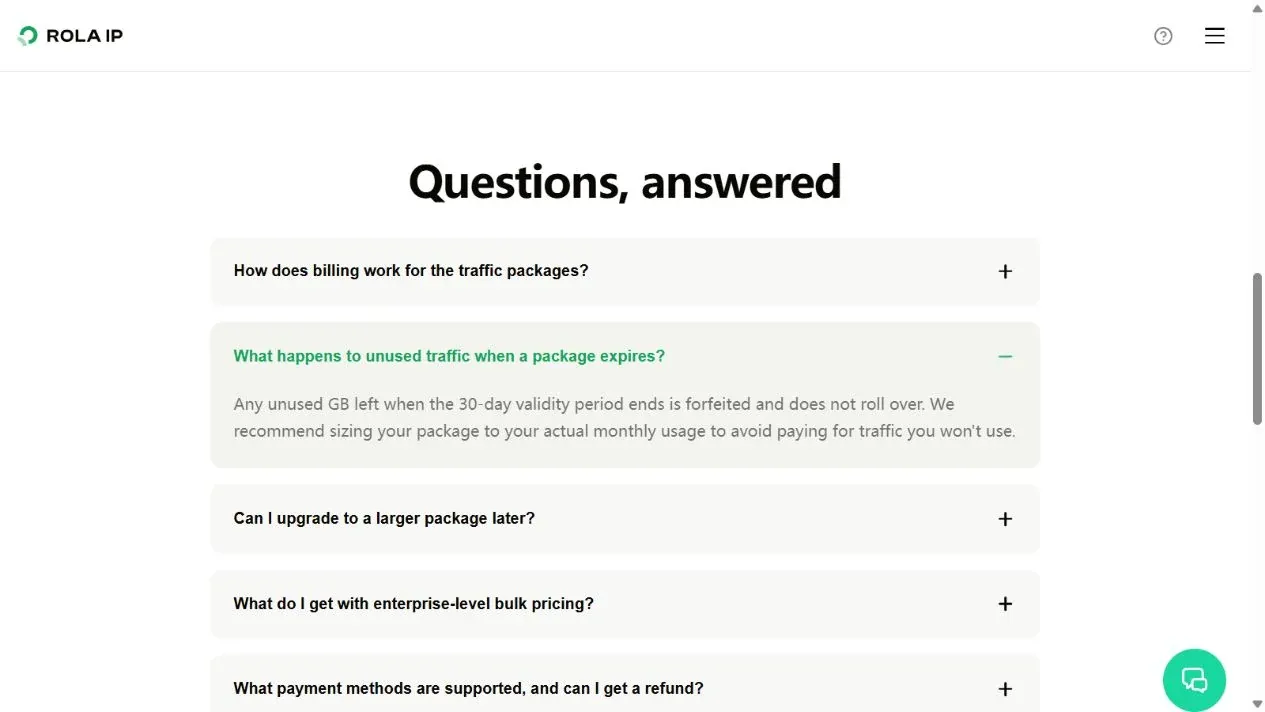
The Rola IP residential pricing page lists $4/GB pay as you go, $2.50/GB at 50GB, $2/GB at 100GB, $1/GB at 1,000GB, and $0.60/GB at 10,000GB. Packages last 30 days, with unused traffic forfeited.
At 1,000GB, multiplying the displayed unit rate gives a $1,000 Rola subtotal; ProxyEmpire displays $1,500 for its promotional tier. These are public-price inputs, not matched final checkout offers. The cost model below shows when expiry and future usage can change the recommendation.
ProxyEmpire vs. Rola IP: What Actually Differs?
These are published specifications, not matched performance measurements. Sources appear in the product sections above.
| Decision factor | ProxyEmpire | Rola IP |
|---|---|---|
| Advertised residential footprint | 30M+ IPs; 170+ countries | 80M+ resources; 190+ countries/regions |
| Unused metered residential traffic | Non-expiring balance | 30-day packages; unused GB forfeited |
| Country/city targeting | Documented; ISP filters also available | Advertised; validate the exact location |
| Team management | Sub-users and bandwidth transfers | Sub-account allocations; shared capability, not a unique advantage |
| Authentication | Username/password; whitelist not required | Credentials and whitelist options advertised |
| Static traffic | 100GB/IP/month fair-use cap | Advertised unlimited during validity; contract limits unverified |
| Support | Advertised 24/7 | Advertised 24/7; response speed not compared |
For steady bulk consumption, trial Rola IP against the purchase and output criteria below. For irregular demand, value the balance you would retain with ProxyEmpire before switching.
When Does the Cost Recommendation Reverse?
Start with confirmed purchase totals for the same workload, including taxes, fees, eligible discounts, and any bonus traffic. Compare smaller packages as well as bulk tiers. A cheaper 1,000GB offer can still be the wrong-sized purchase.
A conditional utilization threshold
Let C_R and C_P be the final charges for the Rola and ProxyEmpire packages. Let V represent the realistic future value of ProxyEmpire’s unused balance: spending you expect it to replace later, adjusted for uncertainty and delay. This is not a refund or a reduction in cash paid now.
For a 30-day comparison, the simplified cost model favors Rola when C_R < C_P − V. It favors ProxyEmpire when the inequality reverses. This assumes comparable usable results and billed traffic; unequal success rates require a cost-per-valid-record comparison instead.
Using the public $1,000 and $1,500 figures as an illustration, the balance-value threshold is $500. If all remaining ProxyEmpire traffic will eventually be used and valued at $1.50/GB without discounting, the corresponding Rola utilization threshold is approximately 667GB out of 1,000GB, or 66.7%, within 30 days. The general formula under those assumptions is 1,000 × C_R ÷ C_P GB. This is a planning threshold between these two packages, not a measured savings claim or a universal buying rule.
| Observed or expected situation | What the model says | Purchase action |
|---|---|---|
| Use nearly 1,000GB within 30 days; similar valid output | Little allowance is wasted; a lower confirmed Rola charge can matter | Trial Rola, then size the purchase to real demand |
| Use 600GB now and later use all 400GB left with ProxyEmpire | At illustrative prices, PE retains $600 of future value; $1,500 − $600 = $900, versus Rola’s $1,000 | PE may offer better value over time; cash paid today is still $1,500 |
| Use about 667GB now, with full future use of PE’s remainder | Approximate tie in this model | Let final charges and usable output decide |
| Future work is uncertain, or far away | Remaining balance may be worth less than its purchase-rate valuation | Reduce V; compare smaller packages before choosing either bulk tier |
| Taxes, coupon eligibility, fees, or bonus GB differ | Public subtotals and the 667GB threshold no longer suffice | Recalculate with confirmed charges and allowances |
| One network needs more retries or returns fewer valid records | Equal-GB comparisons are misleading | Choose by measured cost per usable output |
Estimate traffic, then validate the assumption
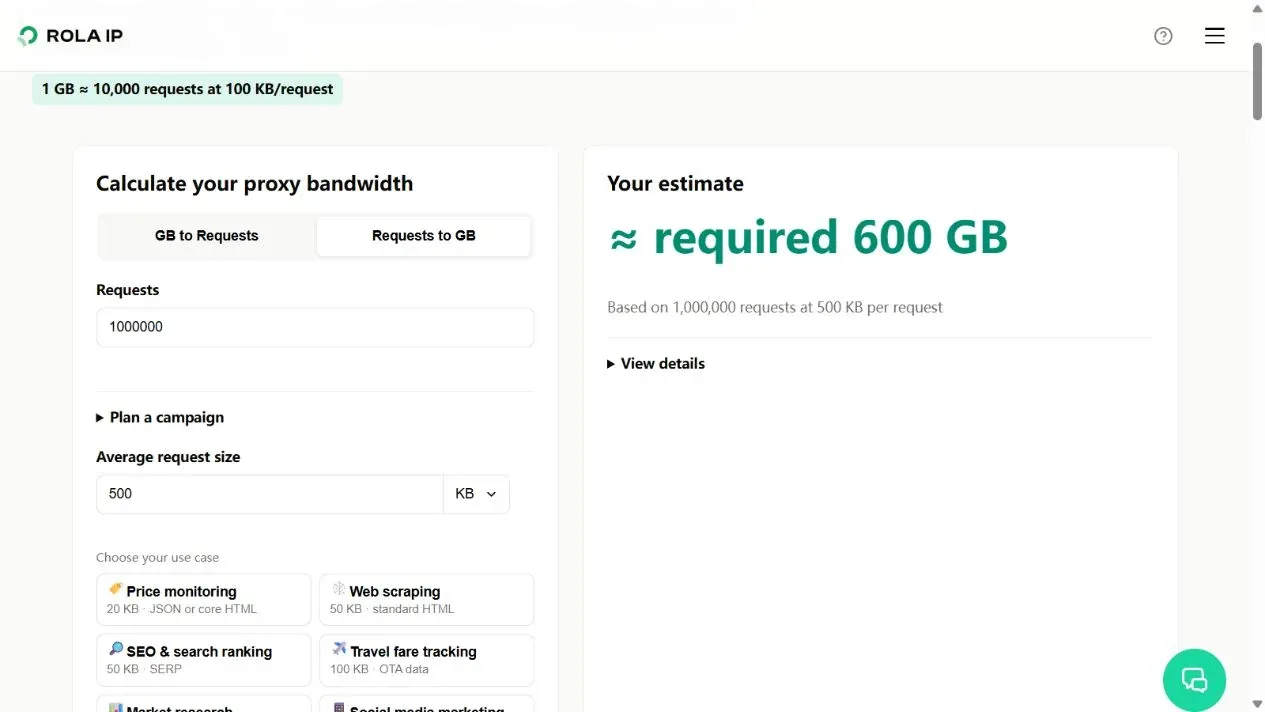
The Rola IP bandwidth calculator screenshot shows 1,000,000 requests, 500KB each, and a 600GB result. The margin control is not visible. The accompanying manual calculation explicitly assumes a 20% margin and decimal units:
1,000,000 × 500,000 bytes × 1.20 ÷ 1,000,000,000 = 600GB.
This is a chosen-input example, not a scraping run. Replace payload estimates with your own logs and reconcile them with billed traffic.
Test a representative workload before switching
Run the same small URL sample through both providers. Match worker region, exit location, client, session policy, concurrency, timeout, and payload settings; repeat during a typical peak period.
Define a valid record first. Log each plan, test date, attempts including retries, valid records, billed GB, actual and allocated spend, p50/p95 latency, and failure types. Check session recovery after a worker restart or lost exit, and verify location-specific content. Keep the allocation method consistent.
Cost per 1,000 valid records = allocated proxy spend ÷ valid records × 1,000. Include retries in spend and exclude blocked, duplicate, incomplete, or wrong-region records from valid output. Record expected unused traffic separately. Expand only when the results meet your quality, session, location, and budget requirements. These are proposed evaluation steps; we did not conduct this comparison.
Final Verdict
ProxyEmpire is worth considering for irregular traffic, non-expiring balances, and requirements covered by its varied network products. Shared team controls and advertised IP totals do not settle which provider performs better.
Rola IP is our best alternative to test for predictable bulk residential use that can consume a large package within 30 days. That recommendation rests on published billing fit. It reverses if retained traffic has greater practical value, a smaller plan fits better, or target-specific results favor another option. Confirm the purchase terms and run a small comparison before moving production traffic.