
Perplexity SEO in 2026 How to Get Cited by AI

Nov 5, 2026 · Guides · 19 min read
TL;DR: Perplexity SEO makes a page accessible, directly useful, and easy to verify when Perplexity answers a question. Check crawl access, canonical URLs, and the answer itself; then measure citations with fixed prompts. This guide also provides a Rola IP configuration template, an exit-location check, and observation files for permitted research. Proxy IPs control test conditions. They do not strengthen a page’s evidence or guarantee a citation.
This guide is for content and SEO teams that need both a useful source page and a repeatable way to assess AI visibility. It connects content improvements, public-page HTTP checks, and regional proxy research. Public HTTP checks are recorded observations; the credential-dependent proxy commands and citation rows are explicitly marked as templates.
What Perplexity SEO actually measures
Perplexity SEO is the work of improving a website’s visibility as a source in Perplexity answers. It sits within generative engine optimization, often shortened to GEO. A useful campaign measures several outcomes separately:
- Brand mention: the answer names your company, with or without a link.
- Website citation: a source link points to a page on your domain.
- Recommendation: the answer suggests your product for a particular need.
- Referral and conversion: a reader visits your site and completes a meaningful action.
A mention on a third-party comparison site can contribute to discovery without sending a visitor directly to you. A citation can support a narrow factual statement without recommending your product. Counting every occurrence as a sales endorsement gives a misleading picture.
For an IP provider, a useful target might be citation of a tutorial explaining when a sticky session expires. That is more actionable than an ambition to “rank first” for every proxy-related prompt.
How it relates to Google and other AI search surfaces
Keep Google SEO fundamentals in place: useful content, accessible pages, descriptive titles, internal links, and a usable mobile experience. Google’s guidance says its AI features do not require special technical optimization; eligibility still depends on the usual Search requirements. Google Search Central explains the requirements.
Use a separate observation record for each search surface:
- Google organic search: record the query, landing page, search context, and observed position or clicks.
- Google AI features: record the specific answer experience and linked source, separately from ordinary organic listings.
- Perplexity: save the prompt, mode, answer, cited URL, and supporting passage.
- Other answer engines: use a separate cohort with its own interface and model labels.
A position or citation observed on one surface does not establish visibility on another. These are measurement choices, not claims about shared ranking factors.
How Perplexity discovers and retrieves sources
As checked on November 4, 2026, Perplexity documents two relevant agents. PerplexityBot helps surface websites in search results. Perplexity-User retrieves pages for user-triggered actions and generally ignores robots.txt because a user requested the fetch. The documentation says neither agent is used to collect content for foundation-model training. The official guidance recommends allowing PerplexityBot and validating requests against published IP ranges. Perplexity crawler documentation.
That documentation explains access, not a complete citation-scoring formula. Treat relevance, evidence quality, source identity, clarity, and appropriate freshness as editorial priorities. Do not present an exact weighting, fixed number of source slots, or required keyword density as an established Perplexity rule.
For practical diagnosis, ask three questions in order. Can the page be reached? Does it answer the actual question? Does it contain something worth citing? A successful HTTP response resolves only part of the first question.
How to rank in Perplexity with useful and verifiable content
Match a specific research question
Start with questions your customers need answered before selecting or configuring a proxy. Examples include “When should SEO monitoring use a sticky session?” and “Why does my proxy return HTTP 407?” Each question points to a different answer and a different next step.
Use keyword research to identify demand, then examine the intent behind the phrase. A Google keyword difficulty score is not a measurement of Perplexity citation competition. A narrow question can be a sensible starting point because you can answer it precisely, not because low search volume guarantees AI visibility.
Group related questions into a useful topic structure: proxy protocols, authentication, IP rotation, location verification, troubleshooting, and monitoring. Give each page a distinct purpose. Consolidate overlapping pages when they repeat the same explanation without serving a different need.
Answer early without inventing a word count rule
Place the direct answer near the beginning of the page and under relevant headings. An answer of roughly 40–70 words can be a useful editing target, but there is no verified “first 100 words” threshold that guarantees a citation.
For example, a section about sticky sessions could begin:
“Use a sticky session when several requests need the same exit IP, such as a sequence of regional search checks. Keep the session identifier and browser context consistent during the test. Record the actual exit IP because a session setting alone does not prove that the address stayed unchanged.”
The rest of the section should explain setup, limitations, and verification. Readers can use the opening answer immediately and continue when they need operational detail.
Publish evidence that another researcher can check
Replace vague claims with observations that include the test conditions. A statement such as “all locations worked perfectly” is difficult to verify. A useful report identifies the target pages, test date, request method, sample size, failures, and limits of the conclusion.
For proxy performance tests, record the requested country, observed exit location, protocol, connection timeout, successful responses, and failed attempts. Report connection success separately from target-site acceptance. Receiving a block page with HTTP 200 is not a successful content retrieval.
Original evidence can also be qualitative: a troubleshooting sequence, an annotated configuration screen, a reproducible request, or an explanation of why two apparently similar products behave differently. Do not add invented percentages merely to increase statistical density.
Make each section understandable on its own
Use descriptive H2 and H3 headings, short paragraphs, and numbered steps for procedures. Name the product or concept in the paragraph rather than relying on an ambiguous “it.” Keep the important answer available as text, even when a screenshot illustrates the task.
Clean HTML makes maintenance and extraction easier. Use proper headings and real links, and make essential information available without requiring a login or a click through a complex interface. On mobile, check that code, screenshots, and long URLs remain readable.
Use relevant structured data to describe visible content accurately. Article markup can identify a headline, author, image, and publication or modification date. It does not turn an unsupported claim into evidence. Google’s Article documentation describes the applicable properties.
Rule checked November 4, 2026: Google stopped showing FAQ rich results from May 7, 2026. Keep helpful questions and answers for readers, but do not promise a Google FAQ display or a Perplexity citation from FAQPage markup. Google’s documentation update records the change.
Update facts when the underlying information changes
A guide about proxy session settings needs review when the provider changes those settings. A page about an API needs review when the supported parameters change. Evergreen explanations can remain useful without cosmetic weekly edits.
Display an honest modification date after a meaningful revision, and keep it consistent with structured data. Retain the original publication date. For a test, distinguish the date the measurements were taken from the date the article was edited.
Useful updates include replacing an outdated screenshot, rerunning a failed example, correcting product availability, and explaining a newly observed limitation. Changing only the year in the headline gives readers no additional evidence.
Build topical credibility beyond one article
Publish connected tutorials that show real understanding of proxy behavior. Link from a general monitoring guide to the specific authentication or session explanation a reader needs. Make the author and reviewer identifiable when there is an actual person with relevant experience; do not invent credentials.
For a Rola IP routing case study, start with one reproducible question, such as whether a documented session setting retained the exit across a permitted sequence. Publish the method, configuration without credentials, observation dates, failures, and the limited conclusion on a stable URL. Share the relevant finding where that question is already being discussed, disclose the commercial connection, and invite independent replication.
If another publication cites the work, check the factual context and retain the link in your monitoring record. Correct the source when a retest changes the conclusion. Do not purchase ranking links, invent reviews, or repeat the same promotional post across communities. The useful contribution is the evidence another author can assess; a third-party mention remains separate from a Perplexity citation.
Treat accessibility as an ongoing operational check
Check robots.txt, HTTP responses, canonical URLs, indexing directives, and the rendered page. Also inspect CDN and firewall logs when available. A robots.txt allowance does not override authentication, a challenge page, or a server error.
The next section shows how to turn that advice into a small, auditable check before investing in a larger citation campaign.
A reproducible technical check before tracking citations
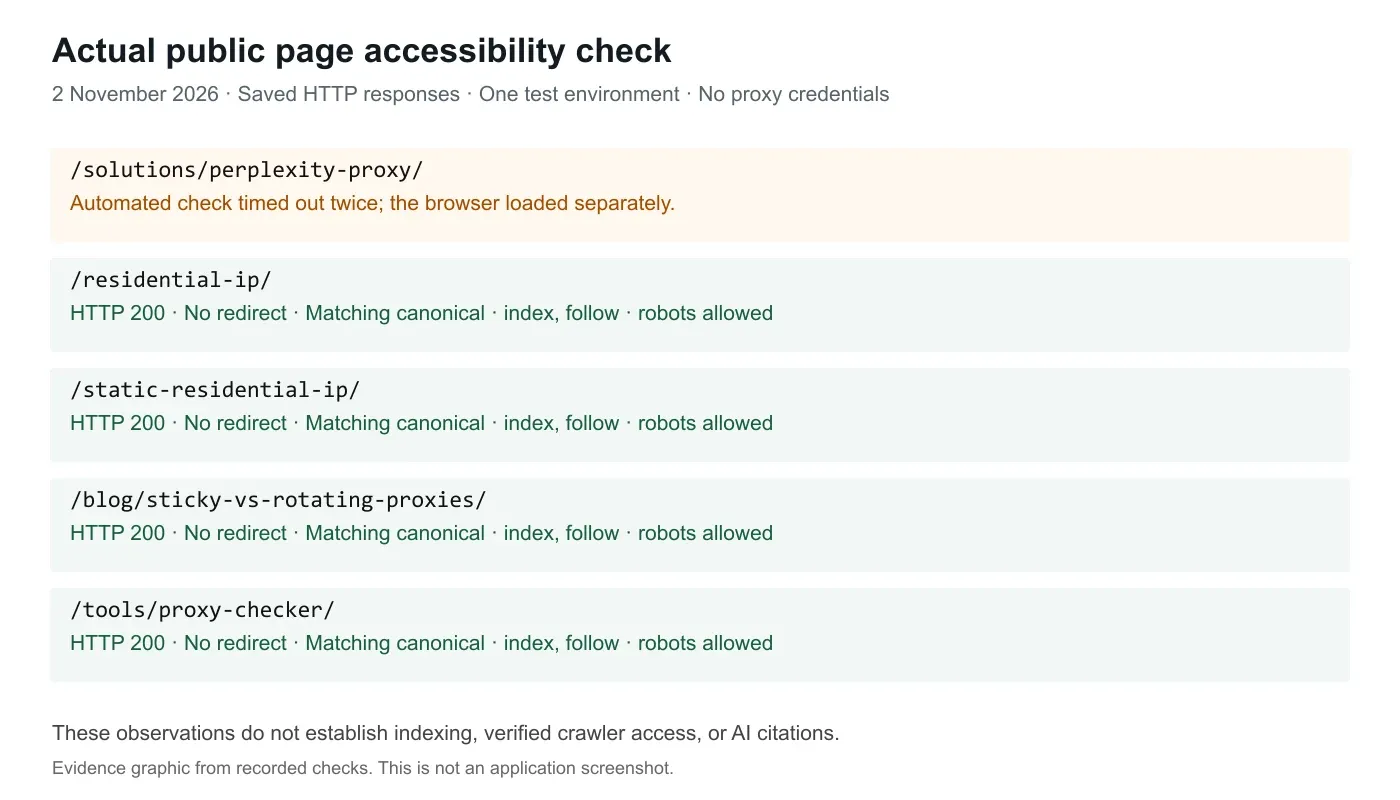
On November 4, 2026, we repeated five public-page GET requests from Windows 11 using curl 8.21.0. Each request used RolaEditorialAudit/2.0, a 10-second connection timeout, a 30-second total timeout, zero automatic retries, and at most five redirects. Requests ran sequentially, with a one-second pause. No Rola credentials or configured proxy were used.
All five returned HTTP 200 with saved HTML in this run: the Perplexity solution page, rotating residential page, static residential page, sticky-versus-rotating guide, and proxy checker. Each returned its own canonical URL and an index, follow robots meta directive. Full URLs, commands, request headers, response headers with cookies redacted, body hashes, timestamps, and errors are included in the accompanying evidence files.
The earlier November 2 snapshot recorded four HTTP 200 responses and a timeout for the solution page. It is retained below as a historical observation, not a statement of current availability. The November 4 recheck retrieved that page. A separate request group to four Rola documentation pages returned HTTP 403; those failed responses are also retained. Differences across dates and routes require diagnosis, not an invented explanation about the server or proxy.
Success criteria matter. These results establish only that the specified client received source HTML and extracted basic metadata. A content acceptance check must also confirm that the expected answer is readable, the canonical is appropriate, and no challenge or error page replaces the answer. Rendered content and an actual Perplexity retrieval were not tested. HTTP 200 alone is not a citation, indexing, or proxy-performance result.
Inspect the current robots rules
Open your site’s robots.txt and examine the group that applies to the crawler and the exact path being tested. In the Rola IP snapshot, the wildcard group disallowed operational paths such as /api/, /admin/, and /dashboard/; the five public paths were outside those exclusions in both the November 2 snapshot and the November 4 recheck.
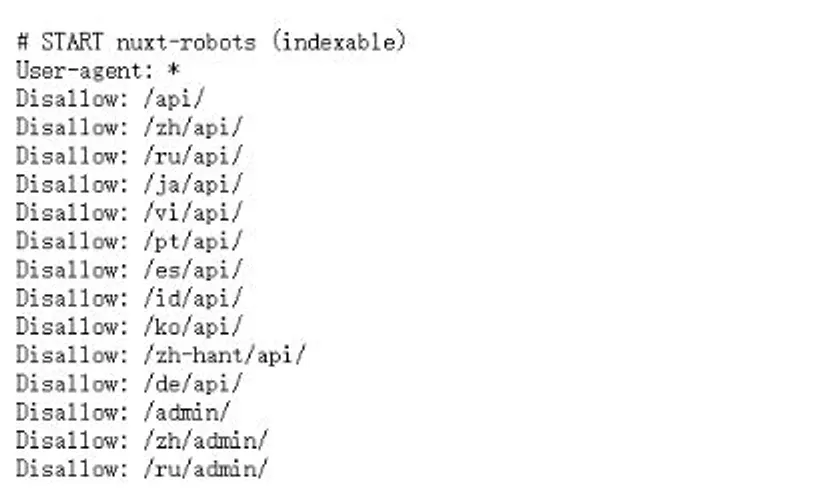
If you add a dedicated bot group, preserve the exclusions that still matter for that group. The following is an illustrative public-site pattern, not a replacement for an existing robots.txt:
User-agent: PerplexityBot
Allow: /
Disallow: /admin/
Disallow: /dashboard/
Disallow: /api/
Private content still needs authentication. robots.txt is not an access-control mechanism. Also review how your robots parser selects specific groups before adding one; copying only an Allow: / line can accidentally omit restrictions previously supplied by a wildcard group.
Check the firewall with verified crawler identity
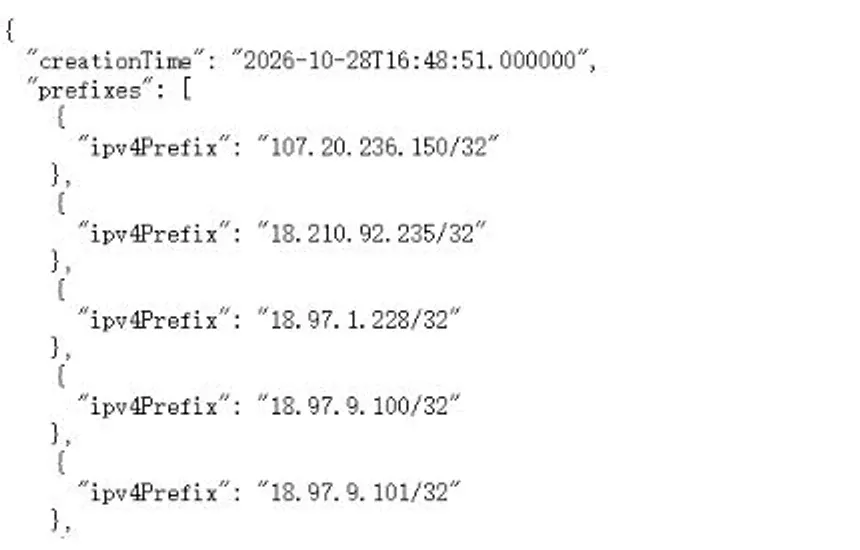
The official guidance checked on November 4, 2026 publishes separate IP lists for the two agents. Match the user agent with the corresponding current ranges when configuring a crawler exception, and review actual logs afterward. A user-agent string alone can be copied by anyone. Official crawler and WAF guidance.
A basic local request can help reproduce an accessibility issue. For example, the following PowerShell command uses curl.exe to save headers and HTML for your own public page:
curl.exe --silent --show-error --location --max-redirs 5 `
  --connect-timeout 10 --max-time 30 --retry 0 `
  --user-agent "RolaEditorialAudit/2.0" `
  --dump-header headers.txt --output page.html `
  "https://YOUR-DOMAIN.example/public-guide/"
Replace the example URL before running it. Inspect the status and redirects, search the HTML for canonical and robots tags, and confirm the expected answer text is present. If your client fails, record the error before changing network conditions. This test does not impersonate a verified crawler or prove that the page is indexed.
How to get cited by Perplexity and measure the result
After the page is accessible and useful, measure whether it appears in answers. Use a fixed prompt set that reflects real customer questions. Separate branded prompts from unbranded discovery prompts so existing brand awareness does not inflate the discovery result.
Start with a manageable pilot. For example, 12 prompts across two market contexts and three repeated observations produce 72 planned observations. This is a suggested test design, not a recommended platform request rate or a claim about statistical certainty. Schedule the work within the limits of the interface or API you use.
For each observation, retain the exact prompt, timestamp, language, target market, session type, selected mode or model when visible, answer text, cited URLs, and any error. Keep requested market and verified network location as separate fields. Record whether the prompt explicitly names a country.
Measure citations and failures separately
Use a clear denominator for each metric:
- Citation rate: completed answers citing your domain divided by all completed answers in that cohort.
- Prompt coverage: distinct prompts that cited your domain at least once divided by distinct prompts successfully tested.
- Completion rate: completed observations divided by planned attempts.
- Referral conversion rate: tracked conversions from attributable Perplexity sessions divided by those sessions.
As an arithmetic illustration, suppose 60 of 72 planned observations complete and 15 completed answers cite your domain. Citation rate is 25%; completion rate is 83.3%. Those figures are illustrative, not measured Rola IP performance. Reporting only the citation rate would conceal the missing observations.
Check whether each cited URL supports the statement attached to it. Save the URL and the relevant passage rather than counting only the domain. A brand can gain mentions while the underlying description becomes less accurate.
Separate measurement channels
A standard Google rank tracker answers a different question from an AI citation tracker. If a tool supports both, confirm how it captures the actual answer, source links, market context, and failed runs.
For programmatic research, evaluate the platform’s official API first. Keep API observations separate from consumer-interface observations: a request made through an API should not be presented as proof of the exact answer a person saw in the website interface.
Use your analytics system to review referrals associated with Perplexity alongside citation observations. Referral data can miss visits when referrer information is absent, and a cited answer can create awareness without a click. Avoid assigning an exact traffic value to every mention.
Keep a reusable observation record
Use the accompanying citation-observations.csv as a starting point. Its core fields are prompt, timestamp, language, requested_market, verified_exit_country, session_type, model_or_mode, answer_status, cited_url, cited_passage, error, and referral. Additional fields identify the observation, channel, evidence status, exit label, and saved answer file.
The following JSON is a NOT RUN template, not an observed answer or verified US exit. The CSV includes separate website and API template rows. Replace the timestamp only when a real observation begins; keep unknown values empty.
{
  "observation_id": "example-001",
  "channel": "website",
  "evidence_status": "TEMPLATE_NOT_RUN",
  "prompt": "When should SEO monitoring use a sticky session?",
  "timestamp": "",
  "language": "en-US",
  "requested_market": "US",
  "verified_exit_country": "",
  "session_type": "sticky",
  "model_or_mode": "",
  "answer_status": "NOT_RUN",
  "cited_url": "",
  "cited_passage": "",
  "error": "TEMPLATE",
  "referral": ""
}
For a real completed observation, use COMPLETED, save the answer, and record each citation with its supporting passage. Keep one observation ID across multiple citation rows, so an answer with three sources counts once in the denominator. For a failure, use FAILED with the actual error and leave unobserved answer or citation fields empty. Store referral sessions separately and join only when attribution supports it; an answer row is not automatically a visit.
Turn observations into edits
If the same competing source appears repeatedly, inspect what it contributes: a definition, benchmark, example, comparison, or current specification. Improve the missing substance on your page instead of copying its headings.
Change a limited set of pages, record the revision date, and repeat the same prompt cohorts. Compare against unchanged pages or prompts where possible. A before-and-after increase is a signal to investigate; changing answers, models, and competing pages can also affect the result.
How do I configure a proxy for a Perplexity citation test
Choose a route that fits the observation, copy the current connection details from your Rola account, verify its exit, and use that same configured client for the permitted test. Keep prompt wording and session context fixed. Save the answer, sources, and failures. A working proxy connection verifies a route to the check endpoint; it does not verify Perplexity access or promise a citation.
Choose the session and obtain account parameters
Step 1: select the session model. Use rotating residential routes for separate samples, a sticky session for a short sequence, or an assigned static IP for a longer fixed route. When a sequence must retain an exit, do not request a new IP on every request. Verify continuity before and after the sequence.
Step 2: copy current connection details. Follow Rola’s proxy setup guide: choose the network, open its settings page, and copy the generated host, port, username, and password. The host is the connection endpoint, not necessarily the exit IP. Use the protocol supplied for that endpoint; an HTTPS destination does not mean that the proxy itself uses an https:// endpoint.
Rola’s proxy parameters describe location and session controls in the username. Its quick-start example test_1-country-us-sessiontime-10 illustrates account test, session 1, requested country us, and a ten-minute session setting. It is not a working credential. Generate the value for your actual account and selected network instead of assuming the example is universally valid.
For API whitelist access, add the client machine’s public egress IP to the account allowlist, select the extraction settings, and use the returned IP:port with the selected protocol. This is distinct from restricting a username/password account to permitted client IPs. Omit proxy credentials only when the account’s generated access method explicitly uses credential-free whitelist access.
Set variables and verify the exit
Step 3: prepare the client. The following PowerShell example uses placeholders and is a not-yet-run template. Replace the endpoint, port, and generated username using your account. The credential prompt keeps the password out of the example and command history. Confirm that the endpoint supports the chosen protocol.
$env:ROLA_PROXY_HOST = "REPLACE_WITH_ACCOUNT_HOST"
$env:ROLA_PROXY_PORT = "REPLACE_WITH_ACCOUNT_PORT"
$env:ROLA_PROXY_SCHEME = "http" # or socks5h for SOCKS5
$env:ROLA_PROXY_USER = "REPLACE_WITH_GENERATED_USERNAME"
$env:ROLA_COUNTRY = "US"
$credential = Get-Credential -UserName $env:ROLA_PROXY_USER `
  -Message "Rola proxy credentials"
$proxy = "${env:ROLA_PROXY_SCHEME}://" +
         "${env:ROLA_PROXY_HOST}:${env:ROLA_PROXY_PORT}"
$proxyAuth = $credential.UserName + ":" +
             $credential.GetNetworkCredential().Password

curl.exe --silent --show-error --fail-with-body `
  --proxy $proxy --proxy-user $proxyAuth `
  --noproxy "localhost,127.0.0.1" `
  --connect-timeout 10 --max-time 30 --retry 0 `
  --dump-header exit-headers.txt --output exit.json `
  "https://ipwho.is/"
if ($LASTEXITCODE -ne 0) { throw "Exit lookup failed" }
$exitData = Get-Content -Raw exit.json | ConvertFrom-Json
if ($exitData.success -ne $true) { throw "Lookup rejected" }
if ($exitData.country_code -ne $env:ROLA_COUNTRY) {
  throw "Requested and observed countries differ"
}
$exitData | Select-Object ip, country_code
Step 4: check the returned exit. Save the observed IP, country code, time, and lookup service. The lookup API documents the ip, success, and country_code fields and supports HTTPS; its country value is database-based geolocation, not proof of a person’s physical location. See the IP lookup API documentation. Respect that service’s usage limits too. For a sticky or static route, compare the exit before and after the sequence. A rotating route can legitimately change between requests, so one preliminary lookup cannot prove the exact exit of a later request.
Run one observation and retain failures
Step 5: use the verified research client. Configure the permitted browser or API client with the same endpoint and session settings. A curl check does not configure your browser or prove its route; verify the exit inside that client as well. Run the fixed prompt only through an interface and account whose terms permit the intended research. Keep website and API observations separate. Follow the applicable account quota, target-site rules, and published request limits; this example authorizes no automated prompt loop.
Step 6: save the result. Record the actual timestamp, mode, route context, answer status, cited URL, supporting passage, and error in the observation template. Redact credentials and use a consistent exit label in shared records. Retain any real IP mapping privately only when needed for verification.
- 407: HTTP proxy authentication is required or rejected. Check the generated username, password, and applicable allowlist. SOCKS5 authentication failures may appear as a curl transport error instead of HTTP 407.
- 403: access was refused by the responding service or an intermediary. Inspect the response to identify the issuer; it is not proof that credentials are wrong. Review access rules instead of repeatedly rotating IPs.
- 429: a service imposed a rate limit. Stop the run, honor
Retry-Afterwhen supplied, and check the relevant quota before resuming. - Timeout: retain the curl error and timing. A timeout can occur during connection, TLS negotiation, or response transfer; it does not establish a single cause. This template performs no automatic retries.
The downloadable verify-proxy-exit.ps1 adds placeholder validation, whitelist handling, and a saved summary. It has been syntax-checked, but no credentialed Rola route or Perplexity answer was tested for this article.
Where proxy IPs help a Perplexity SEO workflow
Proxies let a research team compare country routes or hold an exit steady. Verify the route before interpreting an answer; network control does not improve source authority.
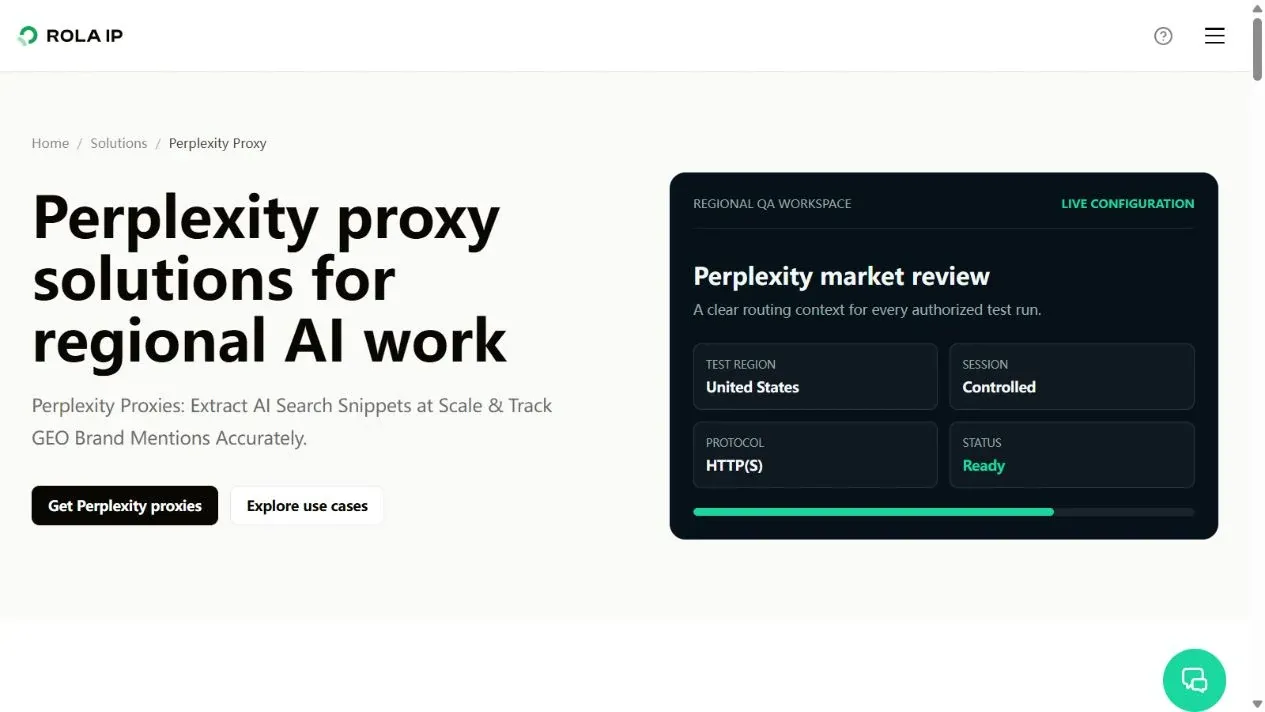
Rola IP’s Perplexity proxy solutions outline regional QA and session controls. Start with one permitted test, then expand when the findings justify it.
Use rotating residential IPs for independent samples
For separate permitted research sessions, a rotating residential pool can provide different exit routes. Keep each observation traceable and avoid changing the route in the middle of a sequence that depends on continuity.
For Rola IP rotating residential routes, verify current country availability, rotation behavior, billing, and restrictions for the selected plan before purchase. Service descriptions are provider-stated; they are not a measured Perplexity acceptance rate or citation guarantee. This guide does not use pool-size or uptime advertising as test evidence.

Use stable sessions when comparing a sequence
A sticky session on a rotating network attempts to retain an exit IP for a period or session. A static IP product provides a fixed assignment under its service terms. They address related needs, but they are not interchangeable guarantees of duration.
For repeated checks requiring a persistent route, consider Rola IP’s static residential proxies. Verify the assigned location, validity period, replacement conditions, traffic policy, and authentication method in the current order terms. The product description is provider-stated and is not a Perplexity citation or acceptance guarantee.

Choose by the variable you need to control:
- Rotating residential: separate samples with changing routes. Record the requested market, rotation setting, and what can actually be verified for each observation. It does not guarantee a unique IP or an unbiased sample.
- Sticky residential session: related requests within a session window. Record the session label, configured duration, and before-and-after exits. It does not guarantee uninterrupted availability.
- Static residential: repeated observations using an assigned route. Record the assignment label, region, validity, and any replacement. It does not guarantee stable answers or platform acceptance.
Verify the route before interpreting the answer
Check connectivity, then verify the exit location through the same route used by the research client. A check from a different machine or connection does not validate the route of your actual request.
Hold prompt wording, language, account state, and browser context steady while testing network location. Then run a separate language comparison if needed. IP location is one possible contextual input; it should not be treated as the sole explanation for different answers.
Keep credentials outside screenshots and source code. When a request fails, distinguish proxy authentication errors, connection timeouts, target-site blocks, and platform rate limits. Stop and diagnose repeated failures; changing IPs is not evidence that the underlying problem has been solved.
Common mistakes that weaken the campaign
Treating a checklist as a ranking formula. A certain number of statistics, a short opening paragraph, or schema markup can improve presentation without guaranteeing selection. Judge each addition by whether it helps answer the question.
Confusing a mention with endorsement. Record the surrounding text and cited source. A comparison can mention a brand while recommending another option.
Publishing near-duplicate location pages. A country page needs information useful to that market, such as availability, measured routing behavior, or local setup constraints. Swapping a place name across hundreds of pages creates little value.
Using a proxy to manufacture engagement. Generating artificial visits or repeatedly prompting for your brand is not a meaningful citation strategy. Invest in source quality and reliable observation.
Refreshing dates without retesting facts. If a screenshot, API example, or product specification is outdated, fix the substance and explain meaningful changes.
A practical first month
During the first week, choose the prompts and pages, record a baseline, and resolve accessibility problems. During the second, improve the direct answers and publish the evidence your strongest pages are missing.
Use the third week to organize internal links, review author information, and check mobile presentation. In the fourth, repeat the original observations under comparable conditions and inspect citations, errors, referrals, and conversions together. This is a work schedule, not a promise of citation growth within 30 days.
Before publishing or refreshing a page, confirm that:
- The opening answers the main question in plain language.
- Important factual claims have an identifiable source or test method.
- Public content is accessible, with suitable canonical and indexing directives.
- The robots and firewall checks cover the actual URL and crawler identity.
- Screenshots show real pages or clearly identified examples.
- The date reflects a meaningful update.
- Internal links lead to the next useful explanation or product choice.
- Measurement records both completed answers and failed attempts.
- The final slug and self-referencing canonical use the chosen production URL.
- HTTP status, robots.txt, meta robots, and X-Robots-Tag permit the intended indexing; remove staging noindex only when the page is ready.
- Article or BlogPosting fields match the visible headline, real author, publication date, substantive update date, and uploaded image URLs.
- External source links retain their required
relvalues after the CMS renders them. - Mobile readers can see image alt text where appropriate, scroll long code blocks, and follow the contents links.
Validate the deployed page, not just the source Markdown. A local preview cannot establish the website’s HTTP headers, canonical handling, indexing state, or final mobile layout.
Conclusion
Effective Perplexity SEO combines a useful answer with credible evidence, accessible pages, and disciplined measurement. Begin with one customer question and one page you can improve meaningfully. Record what changes, repeat the same observations, and learn from the sources that actually appear.
When that work expands across markets, select the Rola IP routing and session model that fits the research design. Better network control makes the evidence easier to interpret. The content still has to earn the citation.