
7 Best Proxies for Market Research in 2026

Oct 21, 2026 · Use Cases · 15 min read
Modern market research extends well beyond surveys and interviews. Businesses also need to continuously observe competitor prices, product catalogs, inventory, consumer reviews, advertisements, and search results across regions. Yet the same website may return different content depending on location, account status, language, currency, or request frequency. As collection scales, IP restrictions and failed-request retries can increase costs further.
This is where proxies for market research add value. Controllable network egress allows research teams to access public pages across multiple markets and build comparable datasets. This article compares seven providers, explains residential, mobile, ISP, and datacenter proxies, and outlines a practical workflow from defining objectives and configuring locations to validating data.
Quick Answer: What Are the Best Proxies for Market Research?
If your primary requirement is observing prices, search results, and ads across countries or cities, consider Rola IP’s regional targeting and session options. Bright Data combines proxies, scraping APIs, browsers, and datasets in one ecosystem. Oxylabs offers proxies and scraping APIs for large collection projects. Decodo provides integration tools and templates; SOAX offers residential and mobile routing under a credit-based pricing model; DataImpulse provides non-expiring traffic; and Proxidize offers residential and mobile options, with residential bandwidth rollover.
The deciding factors are reliable access in target regions, controllable sessions, content that actually belongs to the intended market, and total cost per valid record.
Best Proxies for Market Research at a Glance
Provider |
Research Fit |
Proxy Options Discussed |
Geo-Targeting |
Public Residential Price Basis |
|---|---|---|---|---|
Rola IP |
Localized research |
Residential, static residential, mobile |
Country, state/province, city |
PAYG $4/GB; $0.60/GB at 10,000GB ($6,000); 30-day package validity |
Bright Data |
Enterprise market intelligence |
Residential, mobile, ISP, datacenter |
Country, state, city, ZIP, ASN |
Residential PAYG $8/GB; displayed promotion $4/GB |
Oxylabs |
Large-scale collection |
Residential, mobile, ISP, and others |
195 locations; finer controls including city |
From $30/5GB, approximately $6/GB |
Decodo |
Quick integration |
Residential, mobile, and others |
Country, state, city, ZIP, ASN |
From $11.25/3GB; PAYG $4/GB |
SOAX |
Flexible residential/mobile combinations |
Residential, mobile, and others |
Country, region, city, ISP; higher tiers include ZIP/ASN |
Sandbox Tier 1 $5/GB; Builder $200/month plus VAT, including 200 credits |
DataImpulse |
Budget-sensitive projects |
Residential, mobile, and others |
Country included; advanced targeting may cost extra |
New-customer Intro $5/5GB; residential $1/GB |
Proxidize |
Residential and mobile research |
Residential, mobile |
Country, city, ISP |
$25/25GB; approximately $1/GB |
Listed prices distinguish PAYG, subscriptions, and volume packages rather than treating every advertised rate as the same purchase option.
Why Use Proxies for Market Research?
Collect Geo-Specific Market Data
Websites may change currency, language, catalogs, tax notices, delivery coverage, and ads based on the IP’s country or city. Regional proxies turn access location into a controllable variable, allowing researchers to compare the same page across markets. However, a proxy changes network egress only. Account country, cookies, browser language, store selection, delivery postal code, and GPS may still override IP-based results.
Monitor Competitor Prices and Product Availability
Ongoing pricing research tracks public prices, promotions, inventory, and catalog changes using consistent SKUs, specifications, delivery destinations, tax treatment, and observation times.
Improve Research Coverage and Scalability
Multi-IP networks distribute requests across exit points. Combining them with controlled concurrency, backoff, caching, and session reuse helps teams expand coverage while managing traffic costs. Sticky sessions suit continuous browsing, while per-request rotation better fits batches of independent URLs.
Analyze Local Search Results and Advertisements
Local search engine results pages (SERPs) and ads depend on location, language, device, time, login status, personalization, and bidding. Proxies provide observation points in target regions for SEO monitoring and ad verification. Keeping the other inputs consistent makes regional differences easier to interpret.
Residential vs. Mobile vs. Datacenter Proxies for Market Research
Residential Proxies for Market Research
Residential proxies use exits associated with household broadband or ISP networks and are often a practical starting point for regional pricing, e-commerce catalogs, public reviews, and SERP research. They commonly use traffic-based billing and support rotation or retaining the same exit for a period.
For a closer look at network sourcing and routing, see how residential proxies work.
Mobile Proxy for Market Research
A mobile proxy for market research accesses public content through a mobile carrier network. It suits mobile-ad verification, mobile-first websites, carrier-specific differences, and regional mobile-content visibility research. If the research does not distinguish mobile networks, lower-cost residential or datacenter proxies may be more appropriate.
A mobile IP does not fully simulate a real phone. It does not automatically set the device model, screen size, operating system, app version, GPS, SIM state, account history, or browser fingerprint. End-to-end mobile-experience research also needs real devices or controlled device environments in its test design.
Datacenter and ISP Proxies for Market Research
Datacenter proxies suit less restricted public pages, connectivity tests, and throughput-oriented tasks, generally making speed and cost easier to control. ISP proxies better suit relatively stable egress, long-running batches, or session continuity.
| Type | Best For | Advantages | Limitations |
|---|---|---|---|
| Residential | Regional prices, products, SERPs | Broad coverage; rotating or sticky sessions | Higher traffic costs; city labels require validation |
| Mobile | Mobile ads, carrier research, mobile pages | Mobile-network identity | Higher cost; does not establish device or GPS conditions |
| ISP | Long-running batches, stable sessions | Stable egress, easier repeat observations | Regional inventory may be limited |
| Datacenter | Less sensitive public information, performance testing | Generally manageable speed and unit costs | Network type is easier to identify |
Leading Proxy Providers for Market Research
1. Rola IP
Overview
Rola IP provides residential and mobile proxies for distributing the same research task across countries or cities. Region, session mode, and network source can be combined into repeatable research configurations. Rola IP advertises a residential network of more than 80 million IPs across over 190 countries, with city targeting across more than 210 metropolitan areas.
For research that needs a fixed exit, Rola IP also offers static residential proxies with per-IP billing. This is a separate option from the traffic-based residential and mobile plans below.
Key Features
- Country, state/province, and city targeting.
- Rotating and sticky sessions for distributed collection or continuous page workflows.
- HTTP(S) and SOCKS5 support, with residential or mobile exits.
- Public residential PAYG pricing of $4/GB; the listed 10,000GB package costs $6,000 ($0.60/GB). Mobile PAYG is $5/GB; the listed 1,200GB package costs $2,400 ($2/GB). Traffic packages are valid for 30 days, and unused package traffic does not roll over.
Market Research Use Cases
Rola IP fits a research design organized around regional comparison: collect the same SKU, keyword, or ad placement through country or city exits, then compare currency, promotions, availability, and visibility. Residential exits suit regional catalog and review observations; mobile exits add a carrier-network perspective. A static residential option supports batches that need a fixed exit.
Pros
- Residential and mobile networks allow teams to choose exits suited to the research subject.
- Combined region and session configurations suit cross-border e-commerce and multi-market batches.
- Clear public pricing tiers offer PAYG and lower high-volume rates.
Considerations
- The 30-day traffic-package validity suits scheduled batches; include expected monthly usage when choosing between PAYG and a volume package.
- Static residential plans use per-IP billing, while the residential and mobile traffic plans above use per-GB billing.
Best for: Businesses conducting multi-region competitor research, localized price monitoring, and observations of public search results and ads.
2. Bright Data
Overview
Bright Data offers Scraper APIs, Browser API, and datasets alongside its proxy networks, making it suitable for enterprises purchasing network access, rendering, and data delivery within one ecosystem. Residential, mobile, ISP, and datacenter proxies support varied workloads, with country, state, city, ZIP, and ASN targeting.
Key Features
- Residential, mobile, ISP, and datacenter proxies, with rotating and sticky sessions.
- Advanced country, state, city, ZIP, and ASN targeting.
- Scraper APIs, Browser API, and datasets that can reduce some collection and maintenance work.
- Regular listed residential PAYG pricing is $8/GB. The pricing page also displays a $4/GB promotion and lower rates for selected monthly commitments; compare the promotion terms separately from standard PAYG pricing.
Market Research Use Cases
Bright Data fits projects purchasing several layers of data infrastructure together. A team can use proxy access for its own collector, Browser API for browser-based workflows, and datasets for information it wants delivered ready for analysis. This product mix is relevant when procurement spans both network access and data delivery; teams comparing vendors can also review these Bright Data alternatives before committing to an integrated stack.
Pros
- A comprehensive range spanning proxies, browsers, APIs, and ready-made data.
- Fine-grained targeting for complex global research designs.
Considerations
- Numerous procurement and configuration options mean proxy cost per GB alone is insufficient.
- Promotions, committed volumes, and additional products change the final bill.
Best for: Large enterprises with mature data-engineering and procurement processes that need integrated market-intelligence infrastructure.
3. Oxylabs
Overview
Oxylabs serves large-scale proxy and web-data projects. Its official pages advertise over 175 million residential IPs across 195 locations, with finer controls including city targeting. Web Scraper API can move some anti-bot handling, rendering, and result delivery out of an internal crawler.
Key Features
- Residential, mobile, ISP, and other proxy resources with enterprise support.
- Country, state/region, and city selection; dimensions vary by product.
- Web Scraper API for e-commerce, search, and other web-data tasks.
- A public residential entry plan of $30/month for 5GB, or approximately $6/GB. Larger examples include $100/20GB and $500/125GB, bringing rates down to approximately $4/GB.
Market Research Use Cases
Oxylabs fits recurring catalog, e-commerce, and search collection projects that need a choice between direct proxy integration and Web Scraper API. Teams can decide which tasks to maintain in an existing crawler and which to route through an API handling rendering and result delivery, with enterprise support as part of the service selection. See our Oxylabs review for a closer look at the product and pricing trade-offs.
Pros
- Broad global coverage and a large advertised pool.
- Separate proxy and scraping-API options to match engineering capabilities.
Considerations
- Entry-level unit pricing is higher than that of some usage-based providers.
- Direct proxy traffic and Web Scraper API are separate purchasing paths; compare the cost of the path your project will use.
Best for: Teams needing high-concurrency, multi-region, continuous web-data collection with enterprise service. If those requirements or the budget do not fit, compare Oxylabs alternatives alongside the other providers here.
4. Decodo
Overview
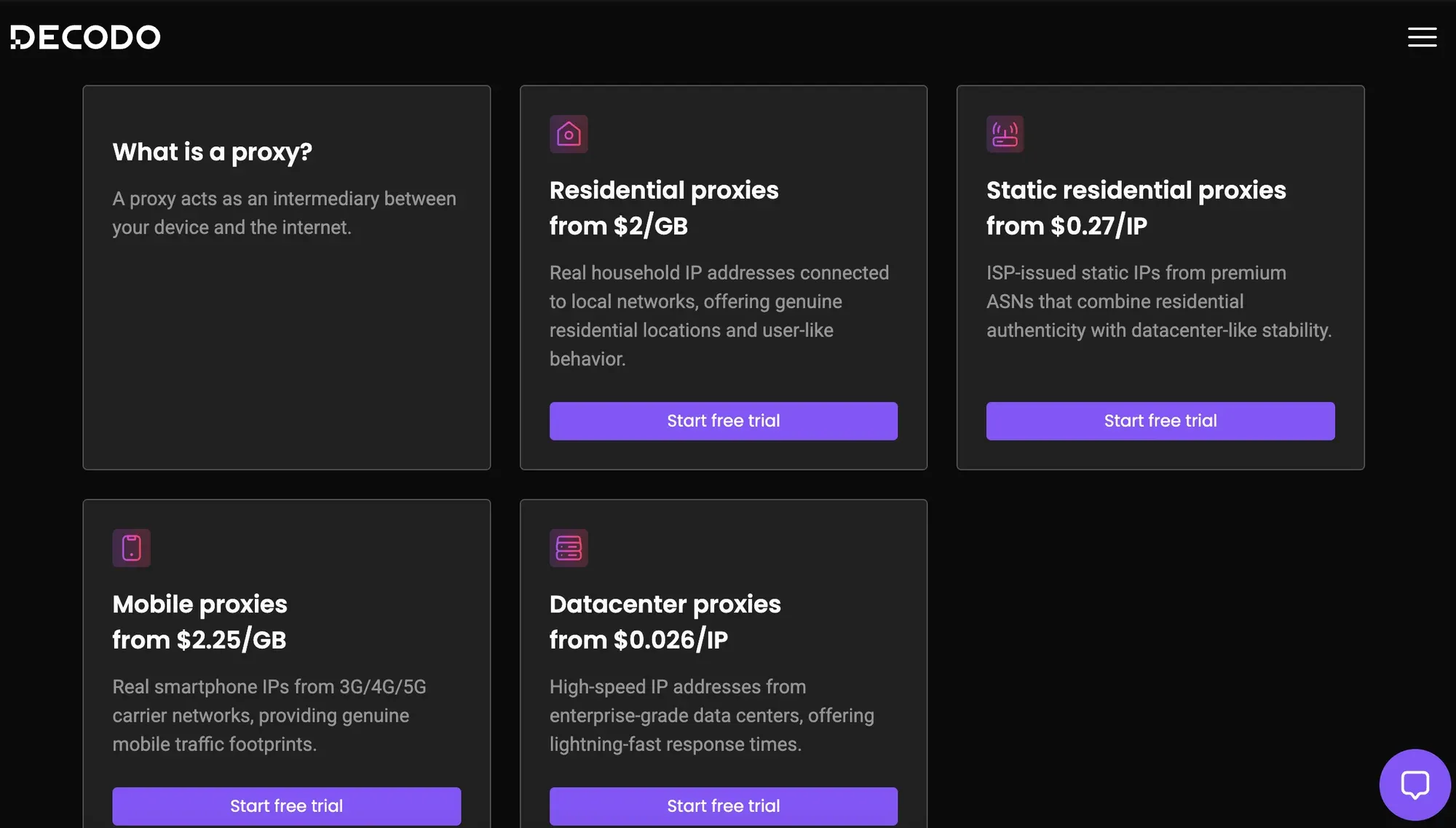
Decodo combines residential, mobile, and other proxy products with Web Scraping API and ready-made collection templates, making it suitable for smaller teams seeking faster integration. Its official pages advertise over 115 million IPs across more than 195 locations, with country, state, city, ZIP, and ASN filters.
Key Features
- Residential, mobile, and other proxies with rotating and sticky sessions.
- Continent, country, state, city, ZIP, and ASN targeting.
- Web Scraping API and templates for launching common collection tasks.
- Entry residential subscriptions of $11.25/month for 3GB ($3.75/GB). PAYG is $4/GB; the listed 1TB plan costs $2,000 ($2/GB). Prices exclude VAT.
Market Research Use Cases
Decodo fits pilots that can start from an existing collection template. For price monitoring, product information, or localized search, teams can compare the template’s output with their required fields before deciding how much custom collection code to build. Direct proxies remain an option for an existing crawler.
Pros
- Entry costs and documentation are approachable for small projects.
- Proxy and scraping-API paths accommodate different engineering capabilities.
Considerations
- “From” prices typically correspond to higher volumes, not every team’s actual rate.
- Templates simplify integration, but teams still need to define fields, quality rules, and evidence retention.
Best for: Teams seeking simpler integration and a quick start for market-research pilots.
5. SOAX
Overview
SOAX emphasizes flexible residential and mobile routing. Targeting includes country, region, city, and ISP, with higher tiers potentially including ASN and ZIP. Customizable rotation and sticky sessions allow separate configurations for one-off page checks and continuous browsing.
Key Features
- Residential and mobile proxies for ordinary web research and mobile-network observations.
- Country, region, city, and ISP targeting; some advanced dimensions are plan-restricted.
- Rotation and customizable sticky sessions.
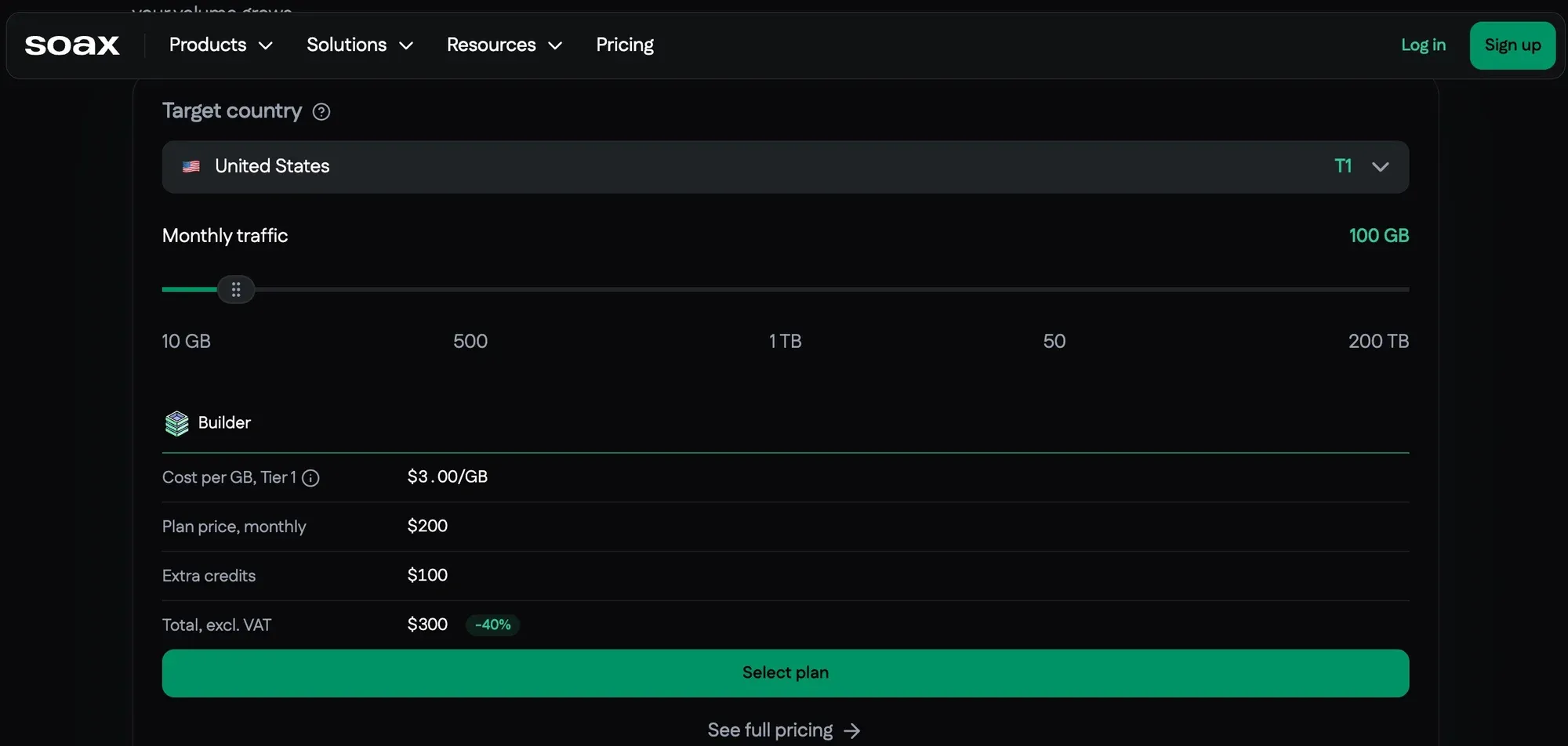
- Sandbox has no subscription fee and no included credits; users can purchase top-up credits at the displayed Sandbox rates. Builder is $200/month plus VAT, includes 200 credits, and lists Tier 1 traffic at $3/GB.
- For 100GB of US Tier 1 traffic, the Builder calculator shows $300 before VAT: $200 in included plan credits plus a $100 top-up. Credits on monthly plans expire 60 days after they are added.
Market Research Use Cases
SOAX fits studies that compare residential and mobile-network observations by country, city, or ISP. For example, a mobile-ad project can separate carrier-related visibility from general regional visibility, while its credit-based plans allow the budget to be calculated for the selected country tier and traffic volume. Our SOAX review provides additional context on its credit model and targeting controls.
Pros
- Flexible combinations of residential and mobile networks.
- Session and regional controls for different research stages.
Considerations
- Credits, country tiers, VAT, and plan restrictions make effective prices more complex than one $/GB figure.
- Forecast usage by country tier and collection schedule to account for credit expiry.
Best for: Research teams switching between residential and mobile networks and segmenting by carrier or region.
6. DataImpulse
Overview
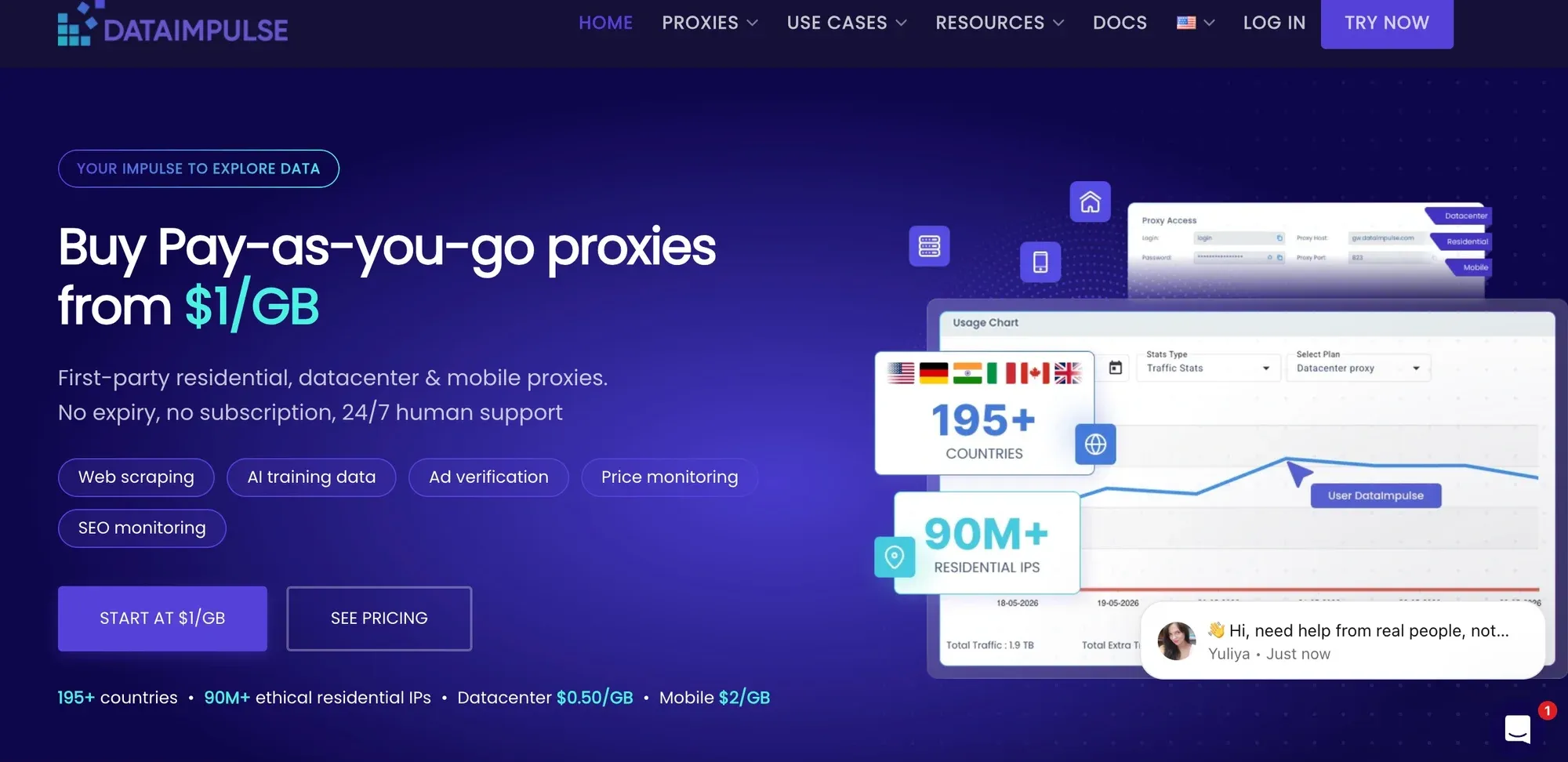
DataImpulse lowers the entry threshold for pilots with inexpensive usage-based residential proxies. Its official pages advertise over 90 million residential IPs. Traffic does not expire, making it useful for irregular collection schedules that would otherwise waste monthly allowances.
Key Features
- Residential pricing starts at $1/GB. The $5/5GB Intro offer is a one-time option for new customers; the listed Basic purchase is $50 for 50GB.
- Country targeting included in base traffic; advanced state, city, ZIP, and ASN targeting billed at twice the base traffic usage.
- Rotating and sticky sessions.
- A public 1TB price of $800, or $0.80/GB, with non-expiring traffic.
Market Research Use Cases
DataImpulse fits irregular collection schedules, such as a seasonal competitor check or a pilot paused between research rounds. Non-expiring traffic lets the team retain the remaining allowance between batches. Country-level collection uses the base targeting option; finer geographic segmentation changes the traffic budget. See our DataImpulse review for more detail on the introductory offer and usage-based pricing.
Pros
- Low minimum purchase and non-expiring traffic suit irregular tasks.
- Basic country targeting supports initial, coarse-grained market comparisons.
Considerations
- Advanced geographic targeting consumes traffic at twice the rate; city-level research cannot be budgeted solely at $1/GB.
- Low traffic prices still need to be assessed alongside success rates, latency, and retry costs.
Best for: Teams validating a research workflow at low cost or collecting data on irregular schedules.
7. Proxidize
Overview
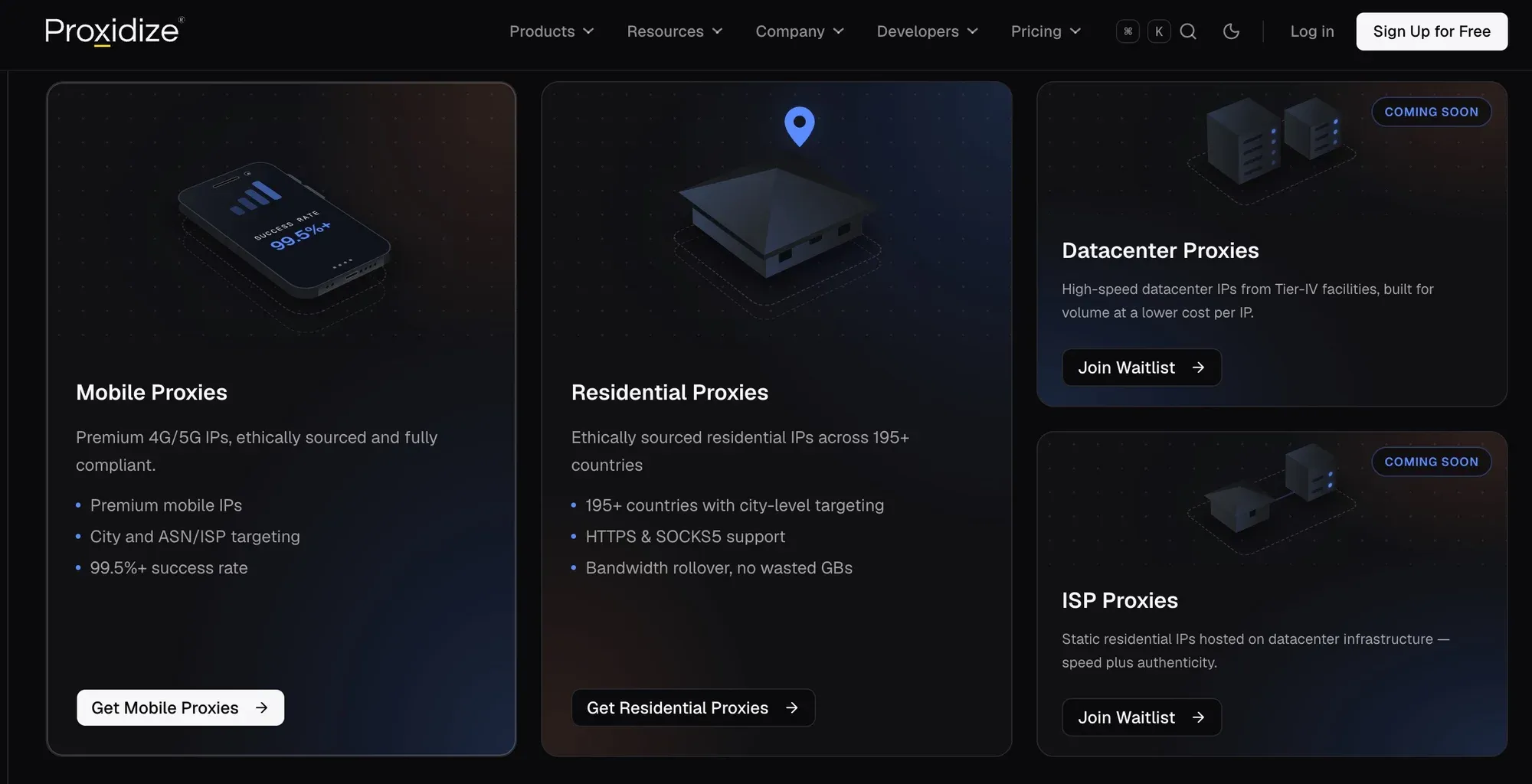
Proxidize’s public offering includes hosted residential proxies across more than 195 countries, with a control panel and API. Its residential and mobile options, session controls, and residential bandwidth rollover give teams several ways to organize network access around recurring or uneven research workloads.
Key Features
- Residential and mobile-related proxy products; the residential network supports rotating and sticky sessions.
- Country, city, and ISP targeting.
- HTTP, HTTPS, and SOCKS5 support, with dashboard and API controls.
- A public residential starting plan of $25/25GB, approximately $1/GB, with bandwidth rollover.
Market Research Use Cases
Proxidize fits projects combining residential bandwidth rollover with residential and mobile network options. An existing product scraper or SERP collector can use the dashboard or API to manage connections and sessions, while rollover accommodates changes in residential collection volume between research rounds.
Pros
- Low starting unit price and bandwidth rollover for fluctuating workloads.
- APIs and session controls for integration with existing collection systems.
Considerations
- Compare residential rollover terms with the expected gaps between collection rounds.
- Mobile and residential products have different targeting options; choose the network type around the research question.
Best for: Teams comparing residential rollover and mobile-network options for research workloads with uneven collection volumes.
How to Choose the Best Proxies for Market Research
Geographic Coverage and Targeting Accuracy
List the countries, cities, states/provinces, or carriers you actually need, then validate whether returned pages belong to the intended market. City labels come from IP geolocation databases and do not prove street-level location. If a website primarily relies on account settings or delivery postal codes, a city proxy alone may not change the result.
IP Quality and Connection Reliability
Do not compare only advertised pool sizes. Test real target URLs for successful connections, valid responses, correct regions, complete fields, and duplicate rates. Record DNS, connection, TLS, HTTP-status, CAPTCHA, and parsing failures separately. Useful exits are those that are accessible and return the correct data.
IP Rotation and Session Management
Independent product pages or keywords can use per-request rotation. Carts, pagination, search filters, and other workflows that expect a consistent source IP often benefit from sticky sessions.
A sticky proxy session keeps the exit IP consistent for the supported duration; cookies, login state, browser storage, and cache are managed separately by the browser or HTTP client. Changing the IP does not clear those states, and keeping the IP does not preserve them automatically. For regional comparisons, use a separate browser context or cookie jar for each market and keep its location and session settings consistent through the workflow.
Compare sticky vs rotating proxies when deciding whether a task needs session continuity or independent requests.
Speed, Scalability, and Integration
Assess HTTP(S), SOCKS5, authentication, session parameters, APIs, concurrency limits, and compatibility with existing crawlers or browsers. On JavaScript-rendered sites, proxy speed is only one factor. Browser startup, page resources, CAPTCHAs, and parsing can also become bottlenecks.
Pricing and Cost per Valid Record
Add traffic charges, fine-grained targeting surcharges, rendering/API fees, failed-request retries, engineering maintenance, and manual checks. Divide by the number of records passing product-identity, region, currency, timestamp, and deduplication checks. This measure reflects project economics better than $/GB alone.
Before a pilot, check whether failed requests and retries consume billable traffic, how unused traffic expires, and whether renewal or overage charges apply. Set a budget alert and a stop threshold for spending or invalid records before scaling collection.
A Practical Workflow for Market Research with Proxies
- Define research objectives. List target websites and markets, products or keywords, required fields, time range, update frequency, and the legal basis for access.
- Choose a proxy type. Start with residential for most regional public-web research; use mobile for mobile-network questions, ISP for stable batches, and test datacenter proxies on less sensitive pages.
- Configure location and sessions. Begin at country level and narrow to city or carrier only when the research question requires it. Use sticky sessions for continuous workflows and consider rotation for independent requests.
- Collect public market data. Establish the appropriate access permissions and follow site rules and reasonable request rates. Preserve the response evidence needed for validation. For reviews, collect only fields relevant to the research, leaving out unnecessary usernames, contact details, and other personal identifiers.
- Validate and analyze results. Confirm product identity, specifications, price, currency, taxes, delivery destination, region, timestamps, and duplicates before using records for competitor comparisons or trend analysis.
Example: Compare the Same Product’s Price in the US, UK, and Japan
Suppose a cross-border e-commerce company wants to compare the public price of the same model in the United States, United Kingdom, and Japan. First, establish a consistent SKU, specification, and observation time. Configure US, GB, and JP country exits, then record each market’s page URL, original price, currency, tax notes, stock status, delivery conditions, and egress evidence.
During analysis, retain original currencies and convert them using exchange rates from the same point in time. Do not combine pre-tax and tax-inclusive prices in one column; mark coupons and member prices separately. If the page requires manual store or postal-code selection, record that as a separate input rather than assuming the IP country handles all localization. Finally, repeat each market’s test at least once. Include only records with matching product identities and comparable page conditions in regional-difference calculations.
Use the following record structure for each market observation:
| Field | What to Record |
|---|---|
| Product | SKU, model, variant, and page URL |
| Market inputs | Exit country, selected store, delivery postal code, and login state |
| Observation time | Timestamp and time zone |
| Price | Original currency, listed price, tax treatment, and promotion conditions |
| Availability | Stock status and delivery conditions |
| Validation | Product match, market match, duplicate check, and response evidence |
Choosing the Right Proxies for Market Research
Start with one research question, a defined set of markets, and a small batch of matching products or keywords. Use that pilot’s valid records and total collection cost to choose a plan for the full schedule. For a Rola IP project, review the residential proxy pricing against the expected traffic volume and collection period.