
DataImpulse Review 2026: Full Review, Pricing & 5 Best Alternatives

Sep 3, 2026 · Comparisons · 17 min read
TL;DR
DataImpulse is a proxy service whose main strengths are low per-GB pricing, traffic that does not expire, and pay-as-you-go usage. It is a good fit for budget-sensitive residential or mobile proxy projects with uneven traffic needs. However, the minimum purchase amount, surcharges for advanced geo-targeting, a 2,000-thread limit, the IP classification purity of the Regular residential pool, and the lack of ISP/static residential proxies may push some users to look for DataImpulse alternatives.
This DataImpulse review combines public information from the DataImpulse English website, benchmark testing from the Proxyway 2026 independent review, and public third-party feedback. The conclusion is not simply that DataImpulse is “good” or “bad.” The right choice depends on whether your workload prioritizes low-cost traffic or places more value on fixed ISP addresses, granular permissions, enterprise compliance, regional quality, or a more complete proxy portfolio.
| Decision factor | DataImpulse | Better alternative to consider |
|---|---|---|
| Low entry-level price per GB | Strong | IPRoyal for another budget-oriented option |
| Traffic that does not expire | Strong | IPRoyal offers a similar purchasing advantage on eligible plans |
| ISP/static residential proxies | Not listed as a standalone product | Rola IP |
| Enterprise controls and compliance workflows | Limited compared with enterprise platforms | Bright Data or Oxylabs |
| Balanced ease of use and proxy tooling | Good, but feature scope is narrower | Decodo |
| Unified residential, ISP, mobile and datacenter portfolio | Partial | Rola IP |
DataImpulse Review 2026: Verdict and Rating
DataImpulse’s core competitive strengths are low pricing, non-expiring traffic, and practical rotation and targeting features—not the most comprehensive proxy-control platform on the market. It is attractive for teams that mainly need country-level targeting, can accept a minimum purchase of at least $50, and want to keep unused traffic for future projects. For workloads that depend on fixed ISP identity, multi-role accounts, very high concurrency, or precise geo-targeting, the hidden costs need to be calculated more carefully.
| Review dimension | Assessment | Why it matters |
|---|---|---|
| Price transparency | 8.5/10 | Four proxy categories and per-GB starting prices are visible on the English homepage |
| Residential performance | 8.7/10 | Proxyway measured high infrastructure success rates, with Premium outperforming Regular on latency and IP classification |
| Location control | 8.0/10 | Country targeting is included; state, city, ZIP and ASN targeting cost more |
| Session control | 8.5/10 | Per-request rotation and sticky sessions up to 120 minutes cover most collection workflows |
| Product breadth | 7.0/10 | Residential, mobile, premium residential and datacenter are available; dedicated ISP/static residential is a notable gap |
| Team and enterprise controls | 6.8/10 | Package separation is useful, but mature role-based multi-user administration is not its strongest area |
| Overall fit | 8.2/10 | Very competitive for cost-conscious workloads, less complete for advanced enterprise operations |
What Is DataImpulse?
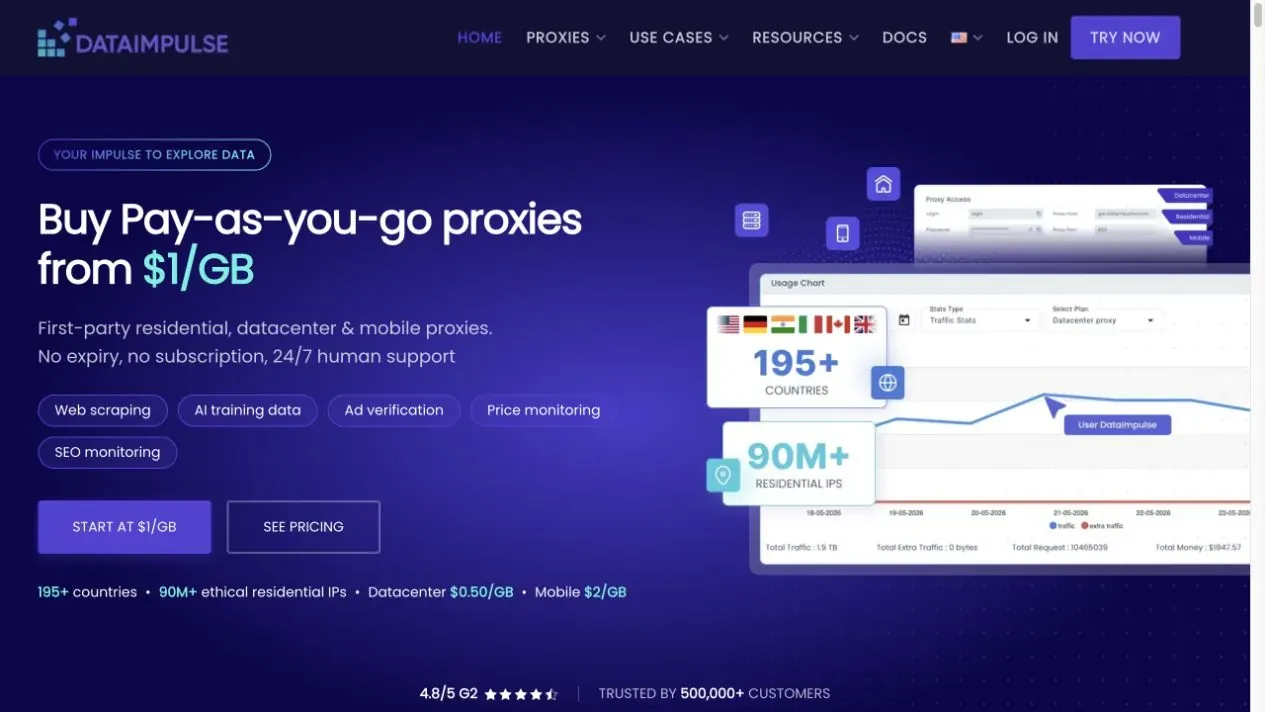
Figure 1: DataImpulse homepage showing residential, datacenter, mobile and premium residential proxy pricing.
DataImpulse is a traffic-based proxy provider that publicly offers Residential, Premium Residential, Mobile, and Datacenter proxies. The DataImpulse English homepage checked on 2026-09-03 lists Residential proxies from $1/GB, Datacenter proxies from $0.50/GB, Mobile proxies from $2/GB, and Premium Residential proxies from $5/GB, while emphasizing that purchased traffic does not expire. Prices and terms should be rechecked before publication or purchase.
Its positioning is clear: users do not need to commit to a large long-term subscription and can instead buy a certain amount of traffic and consume it gradually by project. For seasonal price monitoring, ad verification, public-web research, and intermittent data collection, this model can reduce waste compared with monthly plans that reset unused traffic.
However, “traffic does not expire” does not mean there are no usage conditions. Purchase minimums, concurrency limits, geo-targeting surcharges, and quality differences between proxy pools all affect the final cost per valid result. A reliable dataimpulse proxy review therefore cannot compare only the per-GB prices shown on the homepage.
How We Reviewed DataImpulse
This article evaluates DataImpulse using the same procurement logic throughout: first checking public product and commercial terms, then using independent testing to validate network performance, and finally considering the total cost in real projects.
The evaluation dimensions include:
- Product coverage: whether residential, mobile, datacenter, and ISP/static residential proxies are available.
- Proxy quality: success rate, response time, IP uniqueness, and residential classification rate.
- Control capabilities: country, state, city, ZIP, ASN, rotation, and sticky sessions.
- Access methods: HTTP, HTTPS, SOCKS5, username/password authentication, and IP whitelisting.
- Operational capabilities: concurrency, Package management, subaccounts, quotas, APIs, and statistics.
- Commercial terms: unit pricing, minimum spend, surcharges, trials, refunds, and traffic validity.
Proxyway’s DataImpulse review is a third-party independent test, while DataImpulse’s network size and customer counts are brand-published claims. These two types of information are treated separately in the article so vendor marketing is not mixed with independently tested findings.
DataImpulse Products and Features
DataImpulse’s four publicly listed product categories cover most pay-as-you-go traffic needs, but its product portfolio does not clearly include a standalone ISP/static residential proxy product.
Residential Proxies
Regular Residential is DataImpulse’s most price-attractive product. The website lists a starting price of $1/GB and coverage in 195+ countries, with both rotating and sticky sessions. It is better suited to bulk public-data collection, basic location checks, and workloads that can tolerate some variation in IP quality.
Proxyway’s 2026 benchmark shows that the Regular pool has a very high infrastructure success rate, but a lower residential classification rate than the Premium pool. This means it is not enough to check whether a request returns successfully; you also need to verify whether the exit IP is recognized by the target website as a genuine residential network.
Premium Residential Proxies
Premium Residential starts at a much higher price, but third-party testing shows better response speed and residential classification quality. If a target website is more sensitive to hosted networks or datacenter ASNs, the Premium pool may reduce retries.
The real procurement question is whether moving from $1/GB to $5/GB improves successful results enough to justify a fivefold increase in traffic cost. You should A/B test your own target URLs rather than assuming Premium is automatically more cost-effective.
Mobile Proxies
Mobile proxies use cellular-network exit IPs and start at $2/GB on the website. They are suitable for mobile ad verification, observing mobile search results, and authorized testing that requires carrier-network characteristics. Mobile traffic is usually more valuable than residential traffic, so resource types should be limited and video or large-image loading should be avoided where possible.
Datacenter Proxies
Datacenter proxies start at $0.50/GB and are suitable for speed- and cost-sensitive tasks with less aggressive target protection. They are generally easier for websites to identify as hosted infrastructure than residential IPs, so they should not be used for every target simply because the price is low.
Dashboard, Packages, and Access Experience
DataImpulse’s operating model is built around Packages. Users can create, name, and isolate proxy configurations for different projects. This is more useful than having only one global account when separating clients, environments, or cost centers, and it also makes it easier to monitor consumption from the statistics page.
Proxies can be authenticated with a username and password or by IP whitelist. Supported protocols include HTTP, HTTPS, and SOCKS5; Proxyway’s protocol assessment also records SOCKS5 UDP support. When generating endpoints, users should treat region, session, and rotation parameters as part of the connection configuration rather than rebuilding the logic for every request.
Before production use, run three checks:
- Call an IP-check endpoint to confirm that country, city, ASN, and network type match expectations.
- Use a fixed set of 20–50 target URLs to test success rate, P50/P95 latency, and traffic consumed per valid record.
- Test rotating and sticky sessions separately to confirm that login state or pagination is not broken by unexpected exit-IP changes.
Targeting, Rotation, Sticky Sessions, and Concurrency
DataImpulse offers country-level targeting, per-request rotation, and sticky sessions of up to 120 minutes, but advanced geo-targeting and concurrency limits are conditions that should be verified before purchasing.
Country targeting works well for national search results, pricing, and content-difference checks. State, city, ZIP, and ASN targeting can support more granular tasks, but Proxyway notes that these options can significantly increase the price. City-level precision may be essential for ad verification, while country-level targeting is often sufficient for large-scale catalog collection.
Per-request rotation is suited to independent pages and large URL batches. Sticky sessions are better for multi-step navigation, shopping flows, and tasks that need cookies to persist. DataImpulse’s maximum 120-minute session window is practical, but projects still need their own handling for session expiration, retries, and idempotency.
Proxyway’s product assessment records a maximum of 2,000 threads per package. That is not a low limit for ordinary teams, but high-throughput collection platforms should include it in capacity planning, especially when retries consume connections at the same time.
DataImpulse Pricing: Is the Low Per-GB Price Really Cheap?
DataImpulse’s public prices are competitive, but final cost depends on the minimum purchase amount, advanced-targeting surcharges, proxy-pool selection, and the valid-data rate.
| Proxy product | Public starting price | Typical fit | Cost caveat |
|---|---|---|---|
| Regular Residential | $1/GB | General public-web collection | Lower residential classification than Premium in Proxyway tests |
| Premium Residential | $5/GB | More sensitive targets | Five times the Regular starting price |
| Mobile | $2/GB | Mobile ad and carrier-context checks | Media-heavy pages can consume traffic quickly |
| Datacenter | $0.50/GB | Fast, low-friction targets | Easier for sites to identify as hosted infrastructure |
The DataImpulse English homepage emphasizes that traffic does not expire, which is one of its strongest commercial advantages. However, Proxyway’s pricing review records a standard purchasing example starting at $50, plus a $5 paid trial. For small users who only want a few GB for a short period, the minimum purchase can still exceed actual demand.
When evaluating price, calculate:
cost per valid record = total proxy spend / number of complete, validated records
If a $1/GB pool requires more retries, produces more duplicate IPs, or creates higher error-cleaning costs, it may not be cheaper than a higher-priced product with a more stable success rate.
Proxyway 2026 Performance Benchmarks
The Proxyway 2026 DataImpulse benchmark indicates that DataImpulse’s residential proxy infrastructure has a very high success rate, while the Premium pool outperforms the Regular pool in both latency and residential classification.
The test sent roughly 3.6 million requests to global targets over 21 days. Public results include:
| Metric | Regular Residential | Premium Residential |
|---|---|---|
| Infrastructure success rate | 99.74% | 99.82% |
| Average response time | 0.97 s | 0.66 s |
| Median response time | 0.84 s | 0.55 s |
| P95 response time | 2.18 s | 1.27 s |
| Unique IPs observed | 1,538,768 | 1,027,782 |
| Residential classification | 91.77% | 96.69% |
These numbers show that DataImpulse’s connection layer is generally reliable, but they also reveal the quality trade-off in the Regular pool. Proxyway’s US Regular pool test measured an 86.94% residential classification rate, which means projects that strictly depend on residential ASNs need additional validation of exit-IP attributes.
It is also important to remember that infrastructure success rate is not the same as business success rate. A successful HTTP request does not guarantee that a price, review, ad, or search result was fully parsed. Real-world testing should still track CAPTCHAs, blank pages, incorrect locations, and missing fields.
Figure 2: Proxyway’s English DataImpulse review and independent benchmark context.
How Should You Read DataImpulse User Reviews?
User reviews are most useful for identifying recurring service themes, not for proving proxy performance on their own. Trustpilot DataImpulse reviews change over time, so it is better to prioritize recent reviews that describe a concrete use case and explain how an issue was handled.
Themes worth watching include top-up and refund communication, regional quality, support response, account review, traffic-statistics discrepancies, and target-site stability. A single five-star or one-star review can be heavily influenced by a specific project, time period, or region. A purchasing risk becomes more meaningful when the same issue is repeatedly reported by multiple independent users.
Main Advantages of DataImpulse
DataImpulse’s main advantages are pay-as-you-go pricing, non-expiring traffic, and practical session controls.
- Low per-GB pricing: Public starting prices for Regular Residential and Datacenter proxies suit cost-sensitive tasks.
- Traffic does not expire: Better for projects with irregular usage and reduces waste caused by monthly resets.
- Both rotating and sticky sessions: Supports per-request rotation and sticky sessions lasting up to 120 minutes.
- Multiple targeting levels: Country targeting is included on the public offer; state, city, ZIP, and ASN targeting may carry an extra fee.
- Practical protocols and authentication: HTTP/HTTPS/SOCKS5, credentials, and whitelisting fit common toolchains.
- Package separation: Proxy credentials and traffic monitoring can be organized by project.
- Solid third-party benchmarks: Proxyway’s infrastructure success-rate and latency results are strong compared with many low-cost providers.
Main Disadvantages of DataImpulse
The main trade-offs are pool classification, extra-cost targeting, minimum spend, concurrency, and product depth.
- Not every Regular-pool IP is classified as residential: This can increase failure rates for tasks that strictly depend on residential-network attributes.
- Advanced targeting increases cost: City, ZIP, or ASN requirements can weaken the $1/GB price advantage.
- Minimum purchase threshold: It is not truly “low entry” for individuals who only want to test a small amount of traffic.
- 2,000-thread limit: Large concurrent systems need to validate capacity in advance.
- No standalone ISP/static residential product shown: The public product lineup reviewed here does not show a dedicated ISP/static residential category, limiting fixed-identity use cases.
- Basic team governance: Support for granular roles, approvals, and large-organization administration is less complete than on enterprise platforms.
- Premium value needs real testing: Whether $5/GB produces enough additional business success depends on the specific target.
Who Should Use DataImpulse?
DataImpulse is better suited to budget-sensitive teams with irregular traffic usage, mostly country-level targeting needs, and the ability to maintain their own collection logic.
Recommended use cases include public product-price monitoring, search-result research, basic ad verification, travel-fare observation, market intelligence, and use as a supplementary pool alongside a primary proxy provider. Teams should already have capabilities for retries, rate limiting, sessions, field validation, and compliance management.
If a project needs fixed ISP addresses, city-level targeting without paying a surcharge, complex subaccount permissions, more than 2,000 concurrent threads, or integrated data-collection tools beyond proxies, it should evaluate DataImpulse alternatives at the same time.
Why Look for DataImpulse Alternatives?
The main reason to look for DataImpulse alternatives is not that its basic connectivity is unusable. It is that some projects have higher requirements for IP type, control granularity, management features, or total cost.
The first need is fixed identity. Account management, long-lived sessions, and location-consistency verification often require dedicated ISP/static residential IPs, while DataImpulse’s current public product lineup does not position this category as a standalone core product.
The second need is enterprise governance. Large teams may require role permissions, subaccounts, budget quotas, auditing, procurement support, and clearly defined compliance workflows. Basic Package isolation is not necessarily the same as complete organization management.
The third need is target success rate. The low-cost Regular pool may be sufficient for ordinary pages, but on more sensitive targets, IP classification, geo accuracy, and repetition rate can significantly affect the cost per valid result.
The fourth need is product consolidation. Some teams want to buy residential, static ISP, mobile, and datacenter proxies in one account and allocate resources by project instead of managing separate providers for different requirements.
How We Selected the Best DataImpulse Alternatives
We selected the alternatives using the same evaluation dimensions. The goal was not simply to find cheaper providers, but to cover different gaps in DataImpulse’s feature set.
- Rola IP: product breadth and ISP/static residential use cases.
- Decodo: balanced ease of use, proxy network, and scraping tools.
- Bright Data: enterprise controls, compliance, and advanced data tooling.
- Oxylabs: enterprise residential networks, support, and stability.
- IPRoyal: budget-oriented purchasing and non-expiring traffic options.
All prices and features can change. Before purchasing, verify current details on each provider’s English website and dashboard. Vendor-published IP-pool sizes, success rates, or availability figures are their own claims and should not be treated as independently verified findings from this article.
Quick Comparison: Best DataImpulse Alternatives at a Glance
Provider |
Best for |
Main proxy types |
Key advantage over DataImpulse |
Main trade-off |
|---|---|---|---|---|
Rola IP |
Unified proxy portfolio and fixed ISP identity |
Residential, ISP/static residential, mobile, datacenter |
Dedicated static residential options plus project controls |
Brand specifications should be validated against target URLs |
Decodo |
Balanced usability and tooling |
Residential, static residential, mobile, datacenter |
Mature dashboard and broader scraping ecosystem |
Plan structure can be more complex than simple pay-per-GB |
Bright Data |
Enterprise data operations |
Residential, ISP, mobile, datacenter |
Granular controls, compliance processes and data tools |
Higher cost and steeper learning curve |
Oxylabs |
Enterprise-scale reliability |
Residential, ISP, mobile, datacenter |
Large-scale support and robust infrastructure |
Often exceeds small-team budgets |
IPRoyal |
Budget-sensitive buyers |
Residential, ISP, mobile, datacenter |
Accessible plans and non-expiring residential traffic on eligible offers |
Advanced controls and scale may be less extensive than enterprise platforms |
Best DataImpulse Alternatives — Full Reviews
1. Rola IP
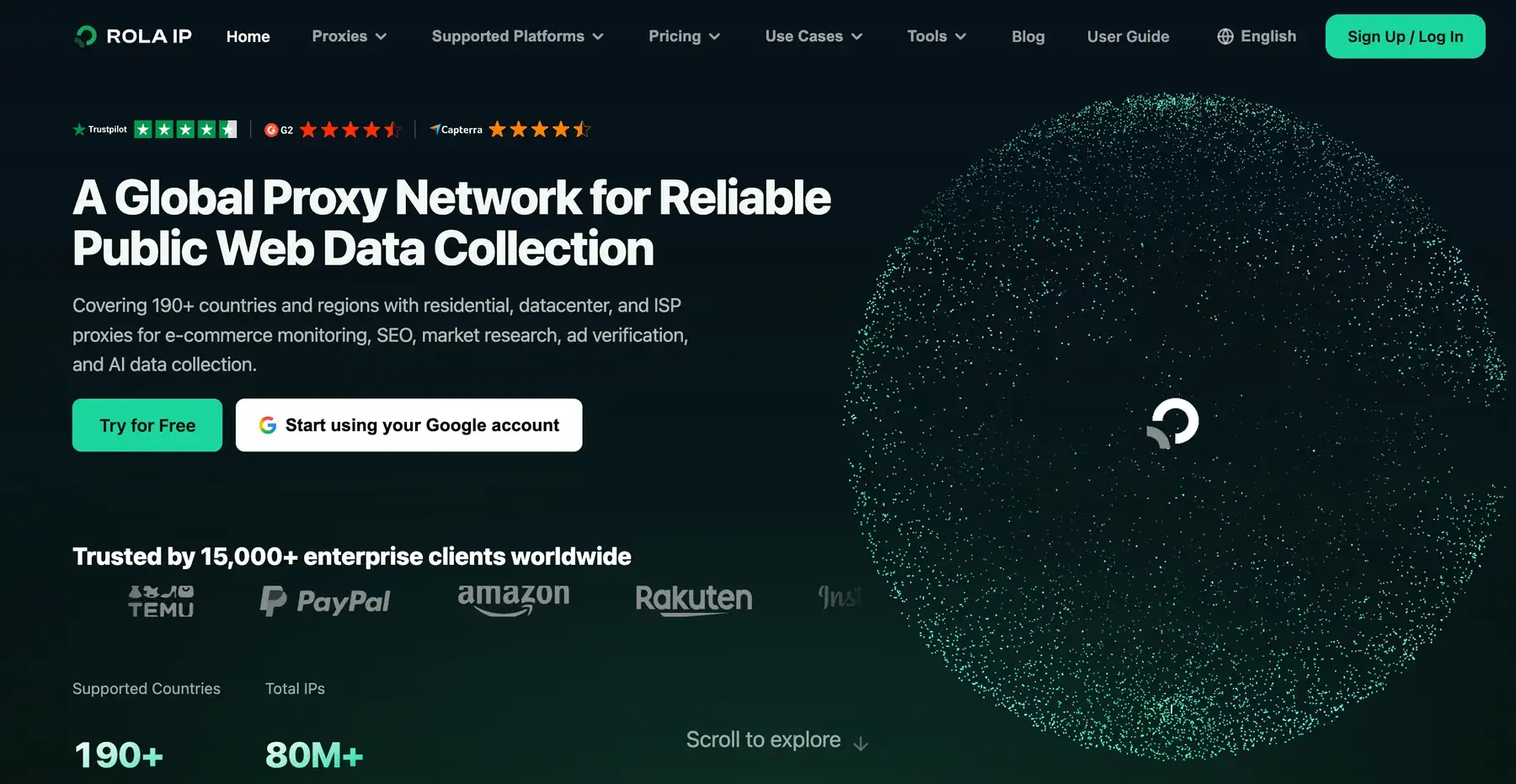
Figure 3: Rola IP English homepage showing residential, ISP, mobile and datacenter proxy options.
Rola IP is best suited to DataImpulse users who want to manage rotating residential, ISP/static residential, mobile, and datacenter proxies in one product ecosystem. Compared with DataImpulse, the most direct difference is the availability of standalone ISP proxies, which are relevant to authorized workflows that require fixed, dedicated exit IPs and longer identity consistency.
Rola IP’s English product pages checked on 2026-09-03 list 190+ countries and regions, 80M+ residential IPs, country- and city-level targeting, per-request rotation, and sticky sessions. Depending on the task, users can choose a residential proxy or a mobile/datacenter product from the same portfolio rather than forcing every use case into one residential pool.
At the access layer, Rola IP supports HTTP and SOCKS5, username/password authentication, and IP whitelisting. Its public documentation describes country, city, rotation, and session parameters for application configuration.
At the operational layer, Rola IP describes API access, traffic packages, and account controls. Its web scraping proxy page maps residential and rotating networks to authorized data-collection use cases. The public pages reviewed here do not provide an independently tested concurrency figure, so no fixed Rola concurrency number is used in this comparison.
Advantages over DataImpulse: A more complete product lineup, especially ISP/static residential; concurrency and subaccount quotas that are better suited to multi-project management; and documented parameters that help standardize integration.
What to verify: Before purchasing, run a small-scale test for geo purity, P95 latency, sticky-session persistence, and cost per valid result.
2. Decodo
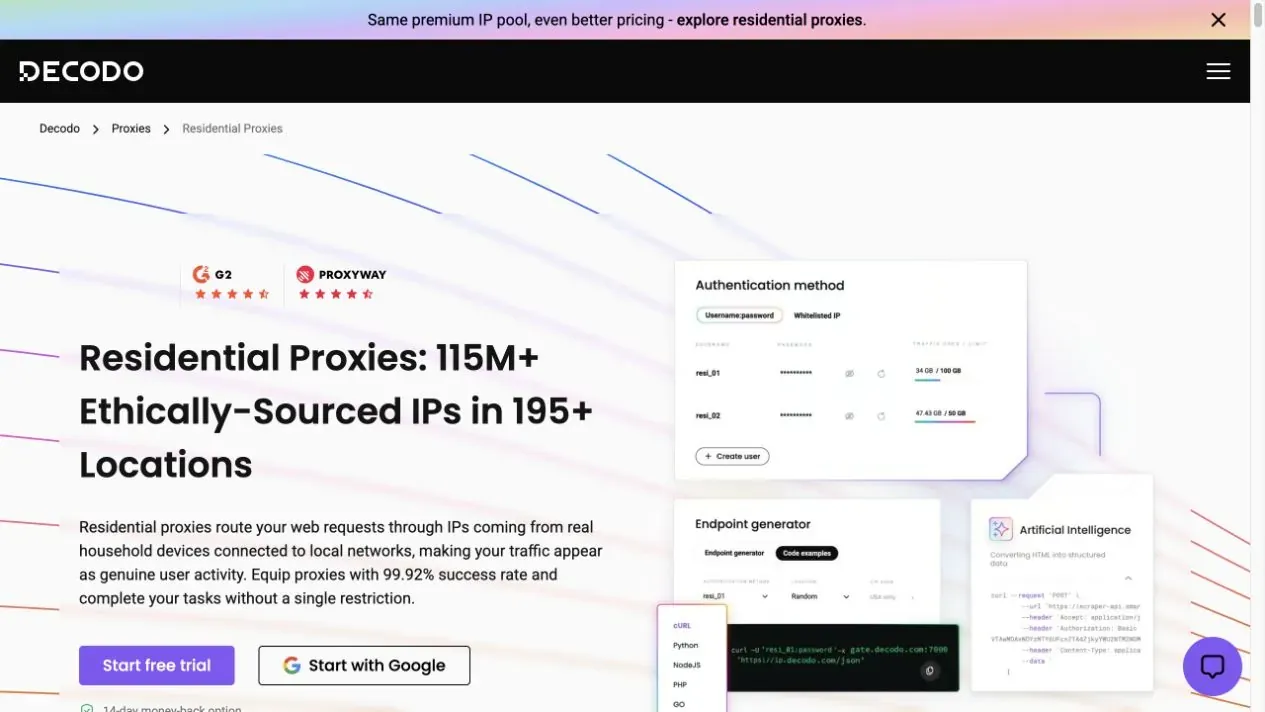
Figure 4: Decodo English residential proxy product page.
Decodo is a balanced DataImpulse alternative for users who want a mature dashboard, a broad range of proxy types, and web-scraping tools rather than simply buying traffic. It offers residential, static residential, mobile, and datacenter proxies, along with browser extensions, site-unlocking products, and scraping tools.
Decodo’s strength is not only pool size but the complete path from proxy generation and location selection to session control and developer documentation. For companies without a dedicated proxy-operations team, reducing configuration errors and debugging time may matter more than achieving the absolute lowest per-GB price.
Advantages over DataImpulse: A more complete product ecosystem, a more mature user experience, and static residential options. Proxyway’s DataImpulse comparison also lists Decodo as one of the main direct alternatives.
What to verify: Because there are many plans, products, and add-on tools, cost comparisons should not rely on a single homepage price. Confirm the required proxy type, traffic validity, targeting fees, and trial terms.
Official page: Decodo Residential Proxies
3. Bright Data
Figure 5: Bright Data English residential proxy product page.
Bright Data is better suited to large teams that need advanced targeting, permission governance, compliance review, and multiple data-collection products. In addition to residential, ISP, mobile, and datacenter proxies, it also offers tools such as Web Unlocker, Scraping Browser, datasets, and scraping APIs.
Compared with DataImpulse, Bright Data places more emphasis on control granularity and enterprise workflows. Complex projects can combine proxies, unlocking, browser rendering, and data delivery, reducing the burden of maintaining every anti-blocking component internally.
Advantages over DataImpulse: ISP products, enterprise permissions, compliance processes, granular targeting, and a broader data-product portfolio.
What to verify: Pricing is usually higher, and the product and billing models are more complex. Small or low-frequency workloads may not fully use these capabilities. Before migrating, calculate minimum commitments, add-on tool costs, and engineering savings together.
Official page: Bright Data Residential Proxies
4. Oxylabs
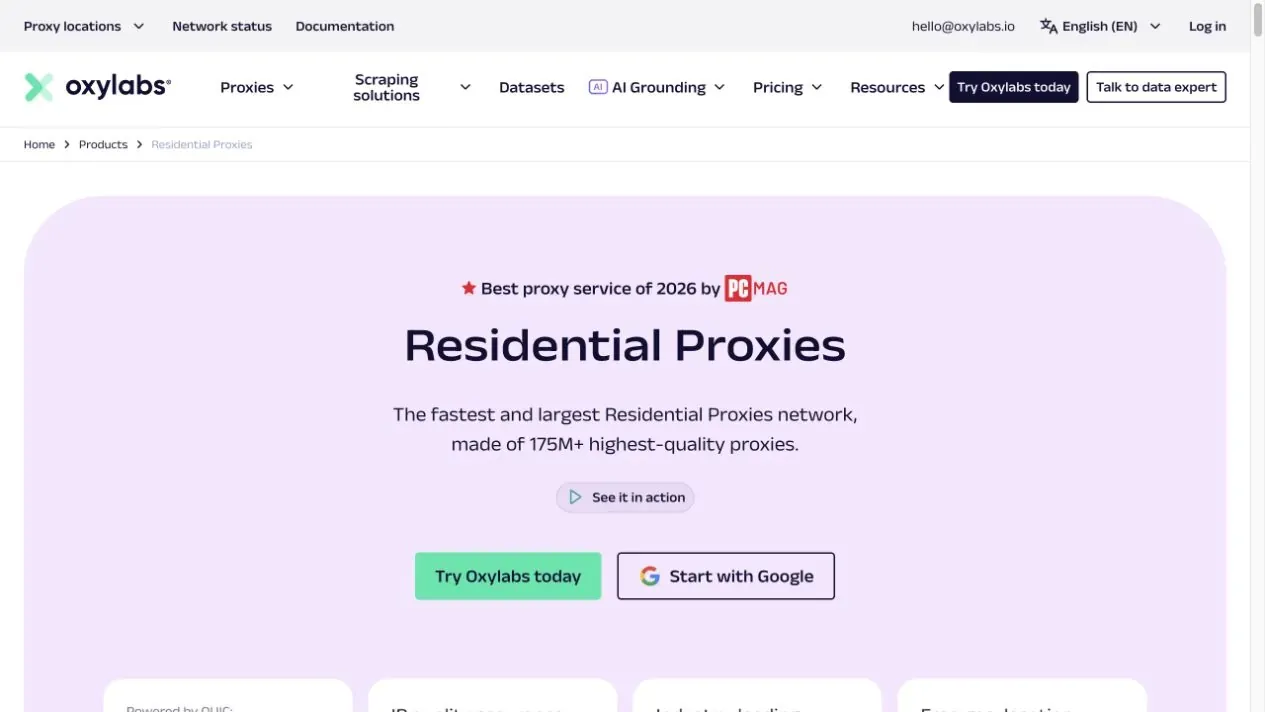
Figure 6: Oxylabs English residential proxy product page.
Oxylabs is an enterprise-scale DataImpulse alternative for projects that prioritize stable delivery, dedicated support, and mature infrastructure ahead of the lowest unit price. It offers residential, ISP, mobile, and datacenter proxies, as well as Web Unblocker and Scraper APIs.
The purchasing value of Oxylabs usually comes from service levels, solution engineering, and large-scale operations rather than being the cheapest source of traffic. For teams running continuous cross-region collection, strict monitoring, and workflows that need vendor-assisted troubleshooting, that support can reduce internal operations costs.
Advantages over DataImpulse: A more complete enterprise product portfolio, stronger customer support, and scale-oriented capabilities.
What to verify: Its enterprise positioning means quotes and plans may not be suitable for small experiments. During procurement, require testing with your own countries, target URLs, concurrency levels, and field-completeness metrics.
Official page: Oxylabs Residential Proxies
5. IPRoyal
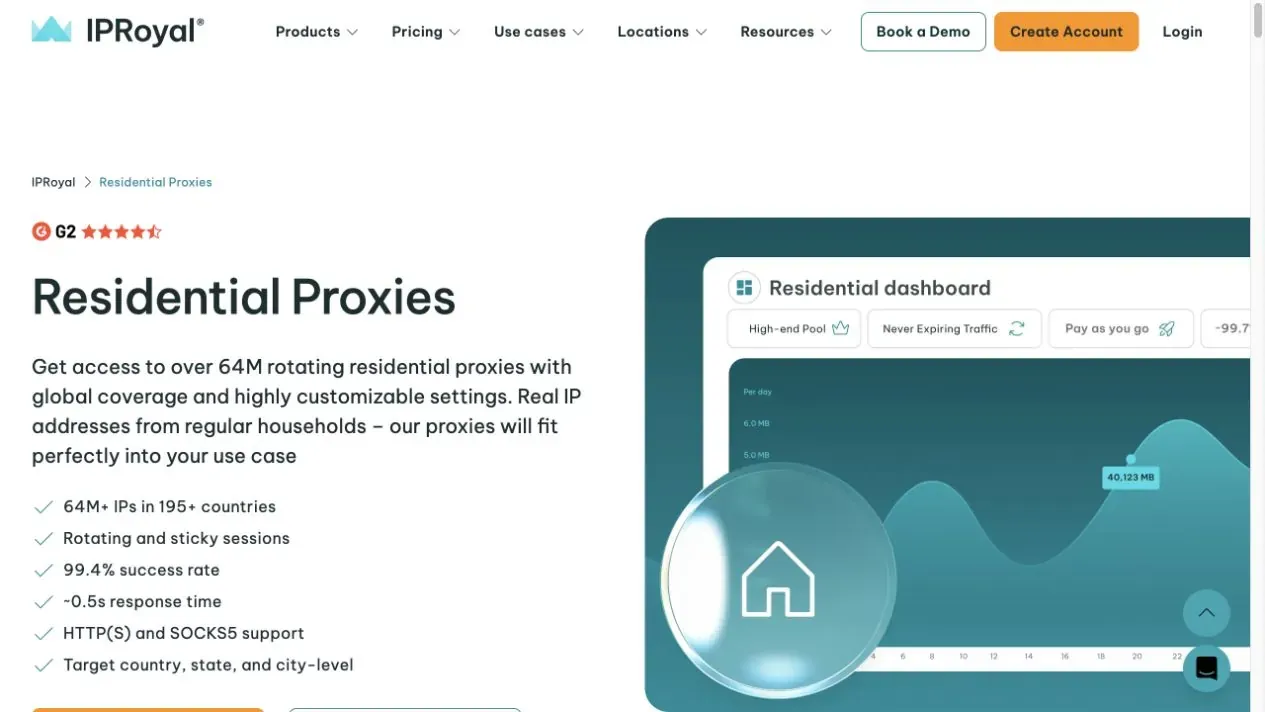
Figure 7: IPRoyal English residential proxy product page.
IPRoyal is a budget-oriented DataImpulse alternative for individuals and small teams comparing lower-entry residential proxies and non-expiring traffic models. It offers residential, ISP, mobile, and datacenter proxies, giving it a broader product range than a setup that depends only on rotating residential pools.
IPRoyal and DataImpulse share the appeal of reducing waste from unused traffic. The difference is that IPRoyal also offers ISP-focused products, so users who need fixed addresses do not necessarily have to move to another provider.
Advantages over DataImpulse: ISP options, a product mix aimed at smaller teams, and budget-oriented purchasing.
What to verify: Advanced targeting, network scale, support level, and target performance should be validated individually. Do not assume equal quality simply because both providers emphasize value for money.
Official page: IPRoyal Residential Proxies
Is There a DataImpulse Free Alternative?
There is no long-term free proxy service that fully replaces paid DataImpulse in quality, scale, location selection, and stability. A so-called dataimpulse free alternative is usually a public proxy list, limited free credit, or a short trial. Those options can be useful for learning how connections work, but they are not suitable for production workloads.
Common risks of public free proxies include rapidly failing exit IPs, incorrect geo information, traffic observation, unstable speed, and heavy sharing among users. Do not send login credentials, customer data, or commercially sensitive information through unknown free proxies.
A safer low-cost path is to use a provider’s paid trial or smallest plan, test it against 20–50 representative URLs, and scale only after the results are acceptable. This provides attributable billing, support, and service terms and makes it easier to compare cost per valid result.
How to Migrate from DataImpulse to an Alternative
The safest migration approach is parallel testing rather than replacing all traffic at once.
- Fix the test set: Select URLs representing different countries, page types, and protection levels.
- Fix the request strategy: Keep headers, concurrency, timeouts, retries, and parsers consistent.
- Define metrics: Track valid-result rate, P50/P95 latency, geo accuracy, CAPTCHAs, traffic, and cost.
- Test session types separately: Do not mix conclusions from rotating tasks and sticky-session tasks.
- Shift traffic gradually: Send 10%–20% of traffic to the alternative first and observe at least one full business cycle.
- Check operational features: Validate whitelists, subaccounts, quotas, logs, APIs, and alerts.
- Keep a rollback path: Do not immediately deactivate the original plan until the new provider meets your thresholds consistently.
For ad verification or price monitoring, the business threshold should be “complete content returned in the correct region,” not simply HTTP 200. For account-based workflows, also compare whether sticky sessions remain consistent through the entire sequence.
Final Verdict
DataImpulse is a budget-focused option whose public strengths are low entry prices, non-expiring traffic, and rotating or sticky sessions. Its practical limits are the minimum purchase, possible targeting surcharges, Regular-pool classification differences, 2,000-thread package limit, and the absence of a standalone ISP/static residential category in the public lineup reviewed here. Choose among DataImpulse and its alternatives by measuring valid-data rate, location accuracy, session persistence, and cost under the same URLs and concurrency. Rola IP is worth testing for a broader portfolio and fixed ISP identity; Decodo for tooling; Bright Data or Oxylabs for enterprise workflows; and IPRoyal for budget comparison.