
Best LLMs for Data Analysis: A Practical 2026 Comparison

Aug 31, 2026 · Comparisons · 9 min read
TL;DR
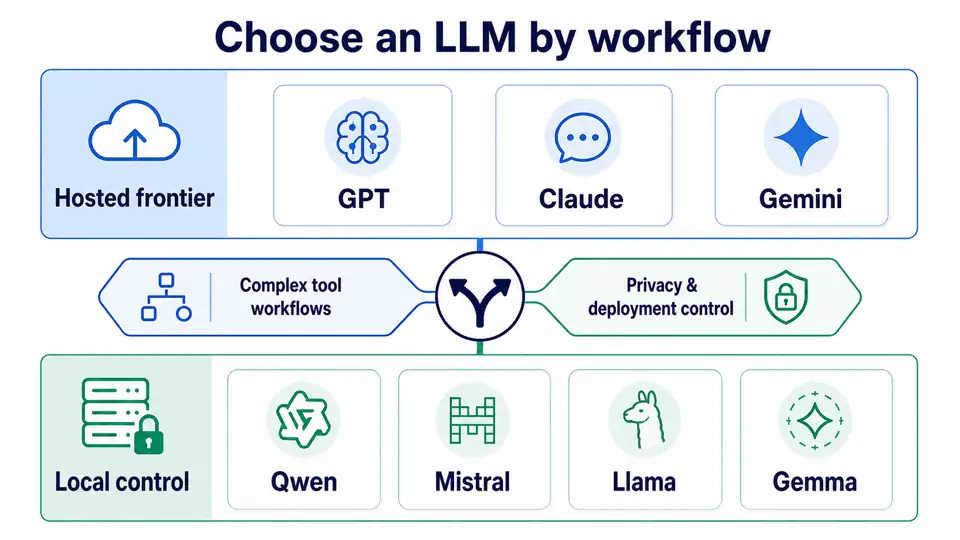
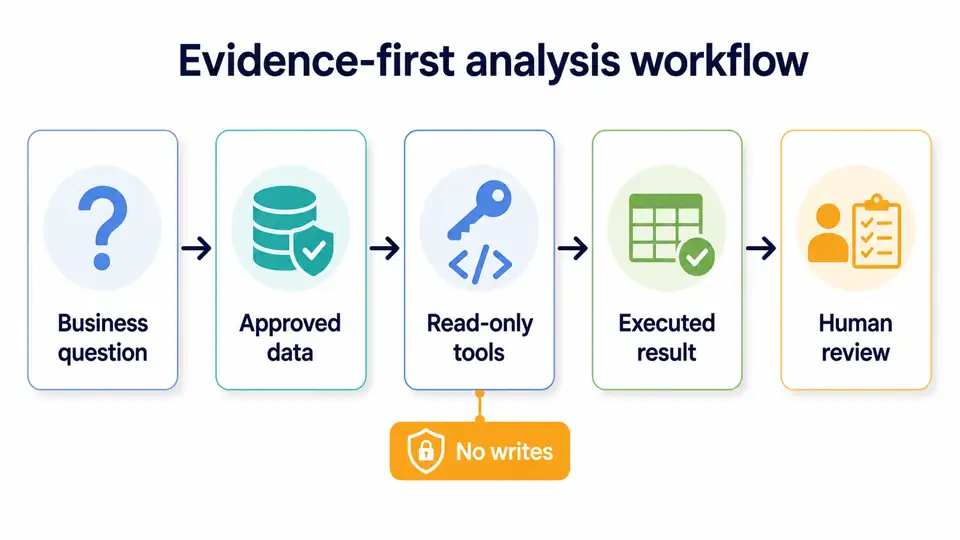
For complex, tool-assisted analysis, start by evaluating a frontier hosted reasoning model such as OpenAI GPT-5.6, Claude Sonnet 4, or Gemini 2.5 Pro against representative tasks. For controlled local deployment, test Qwen3, Mistral Large 3, Llama 4 Scout, or Gemma on the exact hardware and governance constraints you operate. The strongest setup is usually an evidence-producing workflow: schema inspection, scoped queries, reproducible code, result checks, and human approval for consequential actions.
No LLM should be treated as a database administrator, statistical validator, or source of truth. It can propose SQL or Python; your system should execute that work in a restricted environment and return the result for verification.
What “Best” Means for a Data Analysis LLM
A useful comparison begins by separating the model from the surrounding system. A model may be excellent at explaining a chart yet unsuitable for querying production data. Conversely, a local model may meet data-residency needs but require more engineering for tool calling, observability, and capacity planning.
Assess these five dimensions before you compare headline benchmarks:
| Dimension | What to test | Why it matters |
|---|---|---|
| Analytical reasoning | Can it define metrics, state assumptions, and notice ambiguity? | A fluent answer can still use the wrong denominator or time window. |
| Tool and code workflow | Can it produce constrained SQL/Python and use approved tools predictably? | Reliable analysis depends on execution and evidence, not prose alone. |
| Context and modalities | Can it work with your schema, documentation, tables, and charts within practical limits? | Long context is not a substitute for retrieval or structured data access. |
| Governance and privacy | Where does data go, who can access it, and can credentials be scoped? | Sensitive records and regulated data require deliberate controls. |
| Local operating fit | Can you host, monitor, update, and evaluate it on available hardware? | A local model is only useful if latency, cost, and reliability are sustainable. |
LLM benchmarks can help narrow a shortlist, but they are incomplete. A math score does not prove reliable joins; a coding score does not prove safe SQL; and a long-context score does not prove the model used the right rows. Keep public benchmarks as secondary signals and run a fixed evaluation set drawn from approved, representative tasks.
Comparison: Representative LLMs for Data Analysis
This is a documentation-based editorial comparison, not a latency, cost, availability, security, or independent benchmark. Product capabilities and model catalogs change quickly. The labels below summarize official documentation reviewed on 2026-08-28, so re-check the linked model pages and run a pilot before a production decision.
Model family |
Delivery model |
Sensible starting use |
Data-analysis strengths to test |
Main verification need |
Limitation to plan for |
|---|---|---|---|---|---|
Hosted API |
Complex analysis agents with approved tools |
Configurable reasoning, structured outputs, tool use, long context |
Confirm generated queries and calculations against executed results |
Hosted data handling, usage policy, and cost must fit your requirements |
|
Hosted API |
Document-heavy analysis and explanation |
Text, code, and vision support; strong analyst-style synthesis |
Check citations, table extraction, and tool-call boundaries |
Model availability and long-context terms can change by account and region |
|
Hosted API |
Large approved document collections and multimodal inputs |
Long-context options and multimodal workflows |
Test retrieval strategy versus sending whole files |
Context capacity does not guarantee correct grounding |
|
Self-hosted or provider-hosted |
Private prototypes and adaptable local stacks |
Documented deployment paths via Transformers, vLLM, and ModelScope |
Measure SQL/code validity and tool schema adherence locally |
Hardware, quantization, serving, and patching are your responsibility |
|
Open-weight or hosted options |
Teams that need deployment flexibility and general multimodal analysis |
Structured outputs and function-calling capabilities to evaluate |
Confirm the exact deployment, model version, and output schema |
Open weights do not remove the need for access controls or evaluation |
|
Local or partner-hosted |
High-context experiments where self-managed operations are viable |
Meta documents multimodal input and a long context window |
Validate hardware fit and retrieval accuracy on your corpus |
Large context can increase serving and evaluation complexity |
|
Local or hosted ecosystem |
Lightweight experiments and controlled edge/local scenarios |
Google documents deployability across applications and hardware |
Test task quality at the chosen size and quantization |
Smaller local footprints may require narrower tasks and stronger guardrails |
Quick Recommendations
| If your team needs to… | Start evaluation with | Add only when the pilot proves it is needed |
|---|---|---|
| Turn well-defined questions into audited analyses | A hosted frontier reasoning model with a restricted SQL/Python tool | Retrieval, chart interpretation, or more agents after core accuracy is stable |
| Analyze long reports, contracts, and supporting notes | Claude or Gemini with document retrieval and citations | Whole-document prompting only when privacy and evaluation justify it |
| Keep sensitive data within a controlled environment | Qwen3, Mistral Large 3, Llama 4 Scout, or Gemma on approved infrastructure | External services after a data-flow and procurement review |
| Run a small local proof of concept | Gemma or an appropriately sized Qwen3 deployment | Larger models only if the evaluation failure mode requires them |
| Automate recurring metric questions | Any shortlisted model behind parameterized, read-only data tools | Write actions, message sending, or database mutations after explicit approval |
1. OpenAI GPT-5.6 for Tool-Assisted Analysis
OpenAI’s current model guide positions GPT-5.6 as a frontier option for complex professional work, with text and image input plus tools such as functions, web search, file search, and computer use documented on its model page. For data analysis, the useful test is not whether the model can narrate a dashboard. Test whether it can turn “explain the retention change” into a controlled sequence: inspect the semantic layer, draft a parameterized query, execute through a read-only tool, identify a cohort definition, and present the result with caveats.
It is a strong candidate when the analysis system already has structured tools and a clear approval boundary. Require the agent to return its assumptions, the query or code artifact, result identifiers, and an uncertainty note. For customer-facing or financial decisions, independently recompute the important result.
2. Claude Sonnet 4 for Document-Heavy Analysis
Anthropic documents Claude’s text, code, and vision capabilities, which makes Claude Sonnet 4 worth testing when an analyst must connect tables with narrative evidence such as policy documents, research notes, slide exports, or scanned charts. The right evaluation checks whether extracted claims stay tied to page-level evidence and whether the model distinguishes a source’s observation from its inference.
Do not ask the model to “analyze everything” in an uncontrolled file share. Retrieve a narrow, permission-filtered packet; preserve source identifiers; and make the final output cite the table, document page, or query result it used. Test failures such as conflicting source dates, OCR mistakes, and incomplete tables before using it for recurring reports.
3. Gemini for Large-Context and Multimodal Workflows
Google’s Gemini documentation describes models with long-context windows, including options of one million tokens or more. That can be helpful for approved collections containing specifications, notebooks, and reports. However, a large context window is capacity, not a guarantee that the model will attend to the right material or calculate correctly.
Use a retrieval baseline in the pilot: compare a targeted set of cited excerpts against a whole-document prompt. Record which workflow finds the correct policy, data definition, and source page more consistently. For charts and screenshots, require the model to identify what it can and cannot read, then verify values against the underlying table instead of accepting visual estimation.
4. Qwen3 as a Practical Local Starting Point
For teams asking for the Best open source LLM for data analysis, Qwen3 is a practical shortlist candidate because its official documentation provides deployment examples with Transformers, ModelScope, and vLLM. That does not make it automatically the best choice for every local environment. The quality of a local analytics assistant depends heavily on model size, quantization, GPU memory, serving stack, prompt format, tool definitions, and the cases used to evaluate it.
Start with a narrow pilot: schema question answering, explanation of a known KPI definition, and generation of read-only SQL against a disposable database. Measure execution validity separately from answer quality. A local endpoint can support private workflows, but it still needs identity controls, audit logs, prompt-injection defenses, dependency patching, and data-retention rules.
5. Mistral Large 3 for Flexible Deployment Choices
Mistral’s model overview lists Mistral Large 3 as an open-weight, general-purpose multimodal model and documents structured outputs and function calling for its platform. That makes it a reasonable candidate when deployment flexibility is central to the evaluation. Check the exact version and serving route you plan to use rather than assuming that a hosted configuration and a self-managed configuration have identical behavior or controls.
In a data-analysis pilot, use a locked JSON schema for every analysis plan: requested metric, source tables, filters, aggregation, expected output, and evidence links. Then test malformed inputs, inaccessible tables, ambiguous date ranges, and conflicting definitions. A model that refuses to invent a field is more valuable than one that produces plausible but unexecutable SQL.
6. Llama 4 Scout and Gemma for Local Constraints
Meta documents Llama 4 Scout as a multimodal model with a long context window, while Google describes Gemma as a family designed to run across applications and hardware. These are useful options to test when you need local control, prototyping flexibility, or a smaller operational footprint. They should not be selected solely because they are local.
For the Best local LLM for data analysis, first define the hardware envelope and task boundary. An on-device or single-server model may be excellent for classifying support tickets, checking schema documentation, or drafting a query plan, while a larger hosted model might be needed for difficult cross-document reasoning. Benchmark each candidate on the same redacted fixtures and score: valid SQL, correct metric definition, evidence coverage, refusal of unknown fields, latency, and recovery after a tool error.
A Reproducible Evaluation Framework
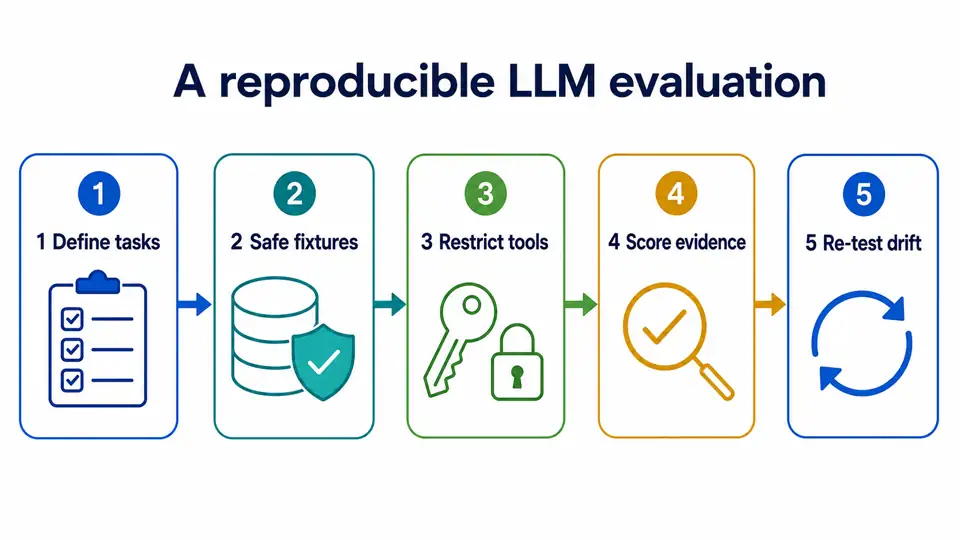
Use the same test harness for every candidate. This prevents the team from comparing a polished demo from one vendor with a harder production task from another.
- Define 20–50 representative tasks. Include KPI explanations, SQL generation, CSV interpretation, chart questions, ambiguous requests, and invalid assumptions.
- Create safe fixtures. Use approved, de-identified sample data with known expected outputs; never use confidential production exports merely to make an evaluation realistic.
- Constrain tools. Give each model a read-only database role, an allowlisted schema, a fixed time limit, and a maximum result size.
- Capture artifacts. Save prompts, model/version identifiers, tool calls, generated code, query plans, result hashes, and reviewer notes.
- Score outcomes separately. Record analytical correctness, executable SQL/Python, evidence coverage, safe refusal, and clarity—do not collapse them into a single “smartness” score.
- Inject failures. Test nonexistent columns, duplicate metric names, missing dates, permission denials, malformed CSV files, and conflicting documentation.
- Review drift. Re-run the fixture set after model aliases, prompts, retrieval pipelines, or tool schemas change.
Here is a compact scorecard template:
| Test category | Pass condition | Failure to flag |
|---|---|---|
| Metric definition | Names the correct numerator, denominator, period, and exclusions | Uses a plausible but undocumented definition |
| SQL generation | Query executes read-only and returns the expected result | Hallucinates fields, performs writes, or silently changes filters |
| Document grounding | Cites the correct approved source and states uncertainty | Cites irrelevant text or invents page references |
| Calculation | Matches an independently computed result within the declared rounding rule | Shows unsupported arithmetic or hides missing values |
| Tool recovery | Stops, explains the error, and asks for a safe next step | Repeats failed calls or broadens permissions |
Data Access, Web Research, and Evidence Boundaries
LLM selection does not remove normal data-governance duties. Use least-privilege service accounts, parameterized read-only tools, query limits, and an approval flow for any write or export action. Keep raw records out of prompts whenever an aggregate or approved retrieval result will answer the question.
If your workflow includes public-market or competitive research, collect only data you are allowed to access and follow the source site’s terms, rate limits, and applicable law. A web scraping proxy can support authorized collection infrastructure, but it does not grant permission to scrape, bypass authentication, or avoid a website’s restrictions. For localized studies, proxies for market research can help test allowed regional experiences; record the source, retrieval time, and location assumptions alongside the data.
For competitive visibility work, use residential proxies for SEO monitoring only within the target platform’s rules and your organization’s approved collection policy. Separate acquisition from analysis: preserve raw-source metadata, normalize the dataset, and give the LLM an evidence packet rather than unconstrained browsing access.
Common Failure Modes—and How to Prevent Them
| Failure mode | Why it happens | Practical control |
|---|---|---|
| Confident but wrong metrics | The prompt omits a metric contract | Put definitions and expected grain in a governed semantic layer |
| Unsafe SQL | The model sees a broad database tool | Use read-only roles, allowlists, parameterization, and query review |
| Fabricated citations | The model is asked to cite without supplied evidence | Require source IDs from the retrieval/tool response; reject unknown citations |
| Data leakage | Raw files are pasted into an unsuitable service | Classify data, minimize fields, and approve the data flow before use |
| Benchmark theater | A generic benchmark replaces a workflow test | Maintain versioned fixtures and compare outcomes on representative tasks |
| Silent model drift | A provider alias or integration changes | Pin versions where possible and re-run evaluations after changes |
Conclusion
The best LLM for data analysis is the one that produces a correct, reproducible result inside your security and operating constraints. Shortlist a mix of hosted and local candidates, use narrow read-only tools, and evaluate the complete workflow rather than a chat response alone. Start small, retain the evidence, and promote only the configurations that remain reliable when the data, permissions, and assumptions become messy.