
Webshare Alternatives: 7 Proxy Providers Compared for 2026

Sep 1, 2026 · Comparisons · 12 min read
The best Webshare alternatives depend on the limitation you need to solve. Raw proxy providers preserve the crawler; managed APIs replace more of the scraping stack. This comparison separates those operating models before matching seven options to specific requirements. For authorized collection, a web scraping proxy should be evaluated by validated output, not by pool size alone.
Webshare itself remains a sensible choice for free testing, low-cost datacenter proxies, and teams that already manage retries, rendering, and parsing. Do not migrate simply because another provider advertises a larger pool. Compare the same authorized targets and choose the service that produces the lowest cost per valid record.
This is a research-based Webshare review and comparison built from public product specifications, current pricing pages, documentation, and independent test data. No paid proxy plans were purchased or benchmarked for this article. “Best fit” means the closest match on documented features, not a universal performance winner.
Last verified: August 31, 2026. Prices, promotions, pool sizes, trial terms, and product policies can change.
Webshare Alternatives at a Glance
Start with operating fit. This compact table is designed to remain readable on mobile screens.
| Provider | Best fit | Main limitation |
|---|---|---|
| Webshare | Free tests and inexpensive datacenter access | No mobile product or managed scraping endpoint |
| ROLA IP | Preserving an existing crawler while adding proxy types | Public specifications still require target-specific validation |
| Decodo | Easy onboarding with optional data tools | VAT and plan-specific terms affect final cost |
| IPRoyal | Bursty residential use and long session controls | Small purchases have a higher per-GB price |
| Bright Data | Enterprise governance and granular controls | More compliance and configuration overhead |
| Oxylabs | Enterprise proxy operations and support | Higher entry cost than budget providers |
| SOAX | Testing several network and data products with shared credits | Paid plans start well above a small PAYG test |
| ScraperAPI | Reducing retry, rotation, and browser maintenance | Not a direct SOCKS or proxy-list replacement |
Public Entry Pricing
| Provider | Minimum public payment | Effective entry rate | Billing model |
|---|---|---|---|
| Webshare | Free datacenter tier; residential pricing varies by selector | Official pricing page showed rotating residential from $1.40/GB during verification | Free tier, per IP, or monthly traffic |
| ROLA IP | $4 | $4/GB | Residential PAYG; larger traffic packages |
| Decodo | $4 PAYG; $11.25 monthly | $4/GB PAYG or $3.75/GB on the 3 GB plan | PAYG or monthly traffic |
| IPRoyal | $7 subscription; $7.35 PAYG | $7/GB subscription or $7.35/GB PAYG | Subscription or non-expiring PAYG traffic |
| Bright Data | $4 during the verified promotion | $4/GB promotional; $8/GB listed before discount | Residential PAYG or monthly commitment |
| Oxylabs | $30 | $6/GB on the 5 GB Starter plan | Monthly traffic |
| SOAX | $0 Sandbox; paid plans from $200/month | Not directly comparable; usage is credit based | Subscription credits |
| ScraperAPI | $49 | Not directly comparable | Monthly API credits |
The tables narrow the shortlist. They do not predict which network will perform best on a particular retailer, search engine, marketplace, or regional endpoint.
Webshare Proxy Review: Is It Still Worth Using?
Yes. Webshare remains attractive when price and self-service access matter more than a broad product suite. Its three main products cover distinct jobs:
- Proxy Server: shared, private, or dedicated datacenter addresses sold primarily by IP count.
- Static Residential: ISP-associated addresses suited to a stable identity and purchased by IP.
- Rotating Residential: a traffic-based gateway with automatic rotation, sticky sessions, and geographic filters.
The free plan belongs to Proxy Server. Ten free datacenter IPs can confirm that authentication and routing work, but they do not predict how the paid residential network will perform on the same target.
Webshare Pricing and Real Cost
The official Webshare pricing page showed these entry points during verification:
- 10 free Proxy Server addresses;
- 100 monthly Proxy Server addresses for $2.99;
- 20 static residential IPs for $6 per month;
- rotating residential traffic from $1.40/GB in the displayed pricing selector;
- plan totals and IP-count prices that vary by product, traffic tier, and billing selector.
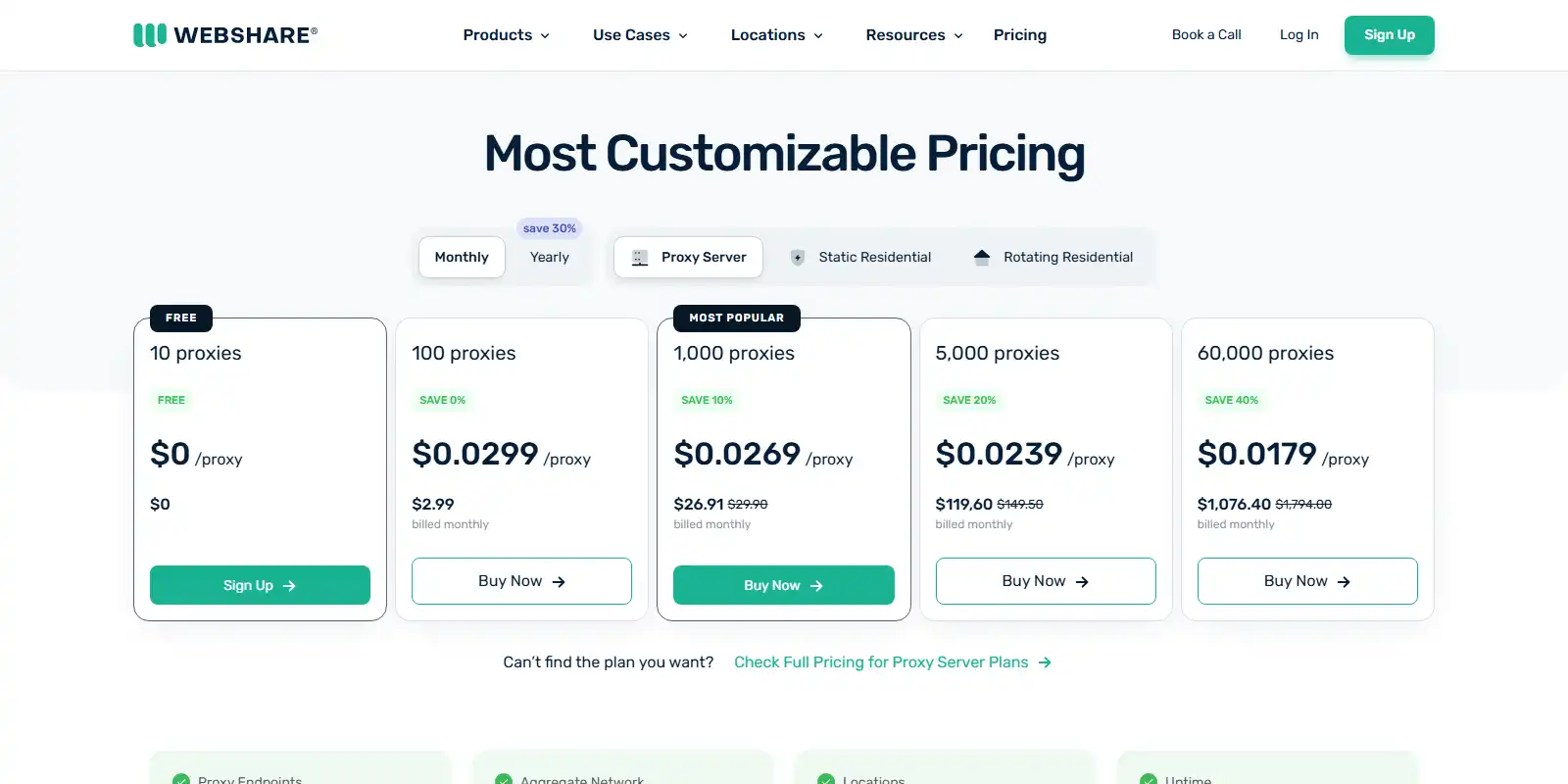
Webshare separates Proxy Server, Static Residential, and Rotating Residential pricing. Screenshot captured August 31, 2026.
These prices cannot be compared as one number. Datacenter and static plans primarily charge by IP count; rotating residential plans charge by transferred data. A lightweight HTTP request and a browser-rendered page can have radically different bandwidth costs.
Use this production metric instead:
cost per valid record = total proxy and retry cost / validated records delivered
Count CAPTCHAs, empty pages, wrong locations, parser failures, retries, and rendering costs. A cheap plan can become expensive when two out of three responses are unusable.
Independent Performance Evidence
Proxyway’s April 2026 independent Webshare test reported 99.28% residential infrastructure success. On its small 6 KB CDN target, the residential network averaged 0.86 seconds, with a 0.69-second median and 1.66-second P95. Its test of 50,000 shared US datacenter IPs reported 99.93% infrastructure success and a 0.67-second average.
Those results are useful evidence under disclosed conditions, not a promise for protected production targets. Target rules, payload size, geographic distance, browser fingerprinting, cookies, and request rate can dominate the outcome.
Webshare Proxy Extension
The Webshare proxy extension gives signed-in Chrome users a quicker way to route browser traffic through available proxies without entering every IP, port, username, and password manually.
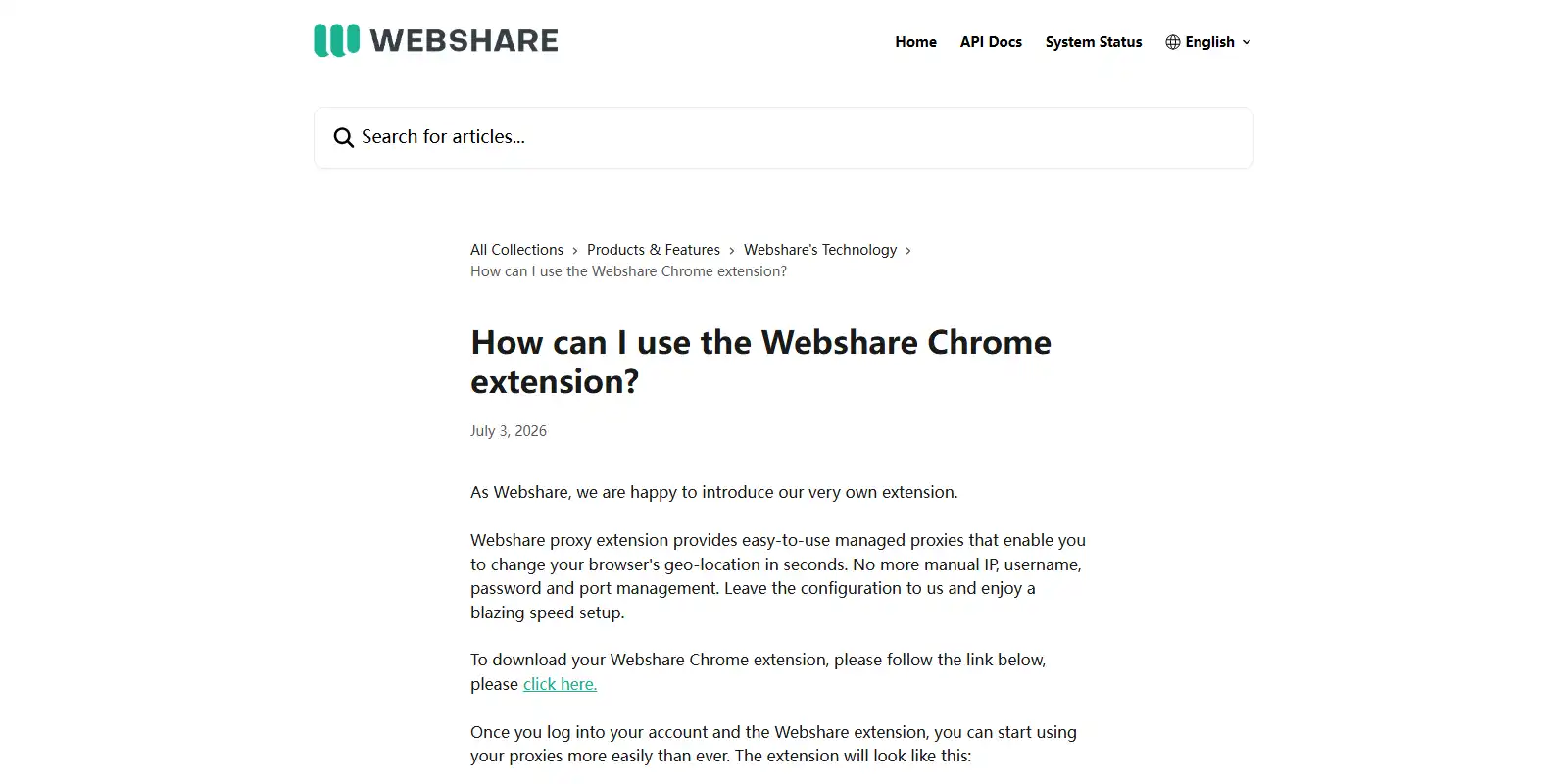
The public help page confirms Webshare’s managed Chrome extension. This is not a hands-on extension test.
The extension is useful for manual regional checks, ad previews, and troubleshooting. It does not replace production controls for retries, concurrency, session mapping, content validation, failover, or cost monitoring.
Keep Webshare or Switch?
| Keep Webshare when… | Evaluate a Webshare alternative when… |
|---|---|
| The free or inexpensive datacenter product works on your targets | A mobile exit is a genuine requirement |
| Current targeting and sessions are sufficient | Session duration or location accuracy is the bottleneck |
| Your application already owns retries and rendering | The team wants managed rendering and retry logic |
| Cost per valid record meets the budget | Failed pages make the real cost unacceptable |
| Self-service support is sufficient | Procurement, compliance, or account support requires more |
Webshare’s most visible product gap is mobile connectivity. Its other limitation is architectural: it sells proxy access rather than a complete managed extraction workflow. Neither issue matters when the current workload needs only raw proxy endpoints.
Criteria for Comparing Webshare Alternatives
This shortlist was evaluated from public information using the same decision fields. The independent Webshare alternatives comparison was used as a secondary check for several providers, while changing prices and product terms were rechecked on official pages.
| Decision field | What to verify | Why it matters |
|---|---|---|
| Endpoint compatibility | HTTP(S), SOCKS5, authentication | Determines whether migration is a configuration change or a rewrite |
| Proxy types | Residential, ISP, mobile, datacenter | Determines which network identity is available |
| Targeting | Country, state, city, ZIP, ASN, carrier | Determines regional precision |
| Session control | Per-request rotation, sticky duration, static assignment | Determines workflow continuity |
| Billing unit | GB, IP, request, API credit | Determines the real budget model |
| Trial conditions | Free trial, paid trial, refund, KYC | Determines the cost and friction of validation |
| Managed features | Rendering, retries, CAPTCHA handling, parsing | Determines how much engineering the customer retains |
| Evidence status | Vendor specification or independent result | Prevents marketing figures from becoming false guarantees |
Advertised pool size is not a ranking score. Only part of a peer network is online in a location at a particular moment, and the useful subset becomes smaller after location, ASN, reputation, and target-specific filtering.
1. ROLA IP — Best Fit for Direct Proxy Migration
ROLA IP is the closest fit in this list when the objective is to preserve the crawler and change the network layer. Its public line includes rotating residential, static ISP, datacenter, mobile, and IPv6 options. Webshare covers datacenter, static residential, and rotating residential products but does not currently list mobile proxies.
ROLA IP’s public residential pricing starts at $4/GB for pay-as-you-go traffic, with lower unit costs on larger 30-day packages. That entry rate is higher than Webshare’s currently displayed residential entry rate, so ROLA IP should not be positioned as automatically cheaper. Review the residential proxy product details before selecting a network.

The public product page shows vendor specifications. It is not an independent test.
Direct Migration Map
| Current requirement | Webshare | Replacement candidate | Migration note |
|---|---|---|---|
| Rotating household exits | Rotating Residential | Rotating Residential | Replace endpoint and provider-specific username parameters |
| Longer fixed identity | Static Residential | Static ISP | Compare available locations and assignment terms |
| Low-cost server IPs | Proxy Server | Datacenter proxy | Confirm whether the workload needs rotating or allocated IPs |
| Mobile carrier exits | Not publicly listed | Mobile proxy | Use only when a cellular ASN is required |
| Protocol | HTTP/SOCKS5 by product | HTTP(S)/SOCKS5 | Test the exact library and selected network |
| Authentication | Credentials or IP allowlisting | Username and password with network parameters | Store credentials outside the source code |
| Geographic and session controls | Product-specific settings | Username parameters | Map country, state, city, and session syntax before rollout |
| Success verification | Confirm current exit and response content | Confirm exit IP, location, session reuse, and target content | A successful connection alone is not enough |
The documented proxy parameters show that location and session controls are encoded in provider-specific credentials. Do not copy a Webshare sticky-session string and assume it has equivalent behavior. ROLA IP’s mobile proxy product is relevant only for authorized mobile-network testing, carrier-specific verification, or another requirement that cannot be satisfied by ISP or residential exits.
| Decision | Assessment |
|---|---|
| Main advantage | More proxy categories through conventional endpoints |
| Main compromise | No equivalent to Webshare’s free datacenter tier |
| Migration effort | Low when credentials are configurable; medium when session syntax is embedded in code |
| Choose when | The crawler should remain intact but the network catalog must expand |
| Skip when | Webshare already delivers valid data more cheaply, or managed rendering is the real requirement |
This option is presented as a direct migration candidate, not an independently proven speed or success-rate winner.
2. Decodo — Best Fit for Easy Onboarding
Decodo, formerly Smartproxy, combines residential, ISP, datacenter, and mobile proxies with a browser extension, Site Unblocker, and scraping APIs. Its direct proxy products support HTTP(S) and SOCKS5, while the residential product offers rotating and sticky sessions plus detailed geographic controls.
The public residential offer displayed $4/GB pay as you go or $11.25 for a 3 GB monthly plan during verification. A three-day, 100 MB trial and a 14-day money-back option were advertised with conditions. Those terms reduce initial testing friction, but VAT and refund rules should be checked on the official checkout page before payment. Pricing page consulted August 31, 2026.
| Decision | Assessment |
|---|---|
| Main advantage | Mobile access, browser tools, trial access, and optional managed products |
| Main compromise | No equivalent to Webshare’s permanent free proxy tier |
| Migration effort | Low for raw endpoints; medium for Site Unblocker or a scraping API |
| Choose when | The team wants self-service onboarding with several upgrade paths |
| Skip when | The only requirement is the lowest entry price for a small datacenter list |
3. IPRoyal — Best Fit for Irregular Residential Traffic
IPRoyal’s strongest distinction is non-expiring residential traffic under its published standard terms. That is useful for seasonal research, quarterly audits, and bursty workloads that may leave monthly traffic unused.
The public residential price displayed $7.35/GB for pay as you go or $7/GB on the smallest subscription during verification. Residential traffic supports HTTP(S) and SOCKS5, country/state/city targeting, per-request rotation, and sticky sessions advertised for up to seven days. Because residential peers can leave the network, the provider does not guarantee that one peer will remain online for the entire requested duration. Pricing and documentation consulted August 31, 2026; confirm current terms before purchase.
| Decision | Assessment |
|---|---|
| Main advantage | Non-expiring residential traffic, mobile options, and configurable sessions |
| Main compromise | Higher small-volume residential price than Webshare’s entry offer |
| Migration effort | Low for endpoints; TTL and targeting fields still need remapping |
| Choose when | Residential traffic is irregular and unused bandwidth must remain available |
| Skip when | Steady traffic earns a cheaper commitment elsewhere, or a fixed ISP address is required |
4. Bright Data — Best Fit for Enterprise Controls
Bright Data offers residential, ISP, datacenter, and mobile proxy networks together with Proxy Manager, Web Unlocker, scraping APIs, and datasets. Its residential service advertises country, state, city, ZIP, and ASN controls, and its self-service pricing includes pay-as-you-go access.
During verification, the official residential page showed a $4/GB promotional pay-as-you-go rate, reduced from the listed $8/GB standard rate. Residential and mobile access may require a compliance review. Organizations with formal procurement and acceptable-use controls may value that governance; it is added friction for a developer who only needs a basic endpoint.
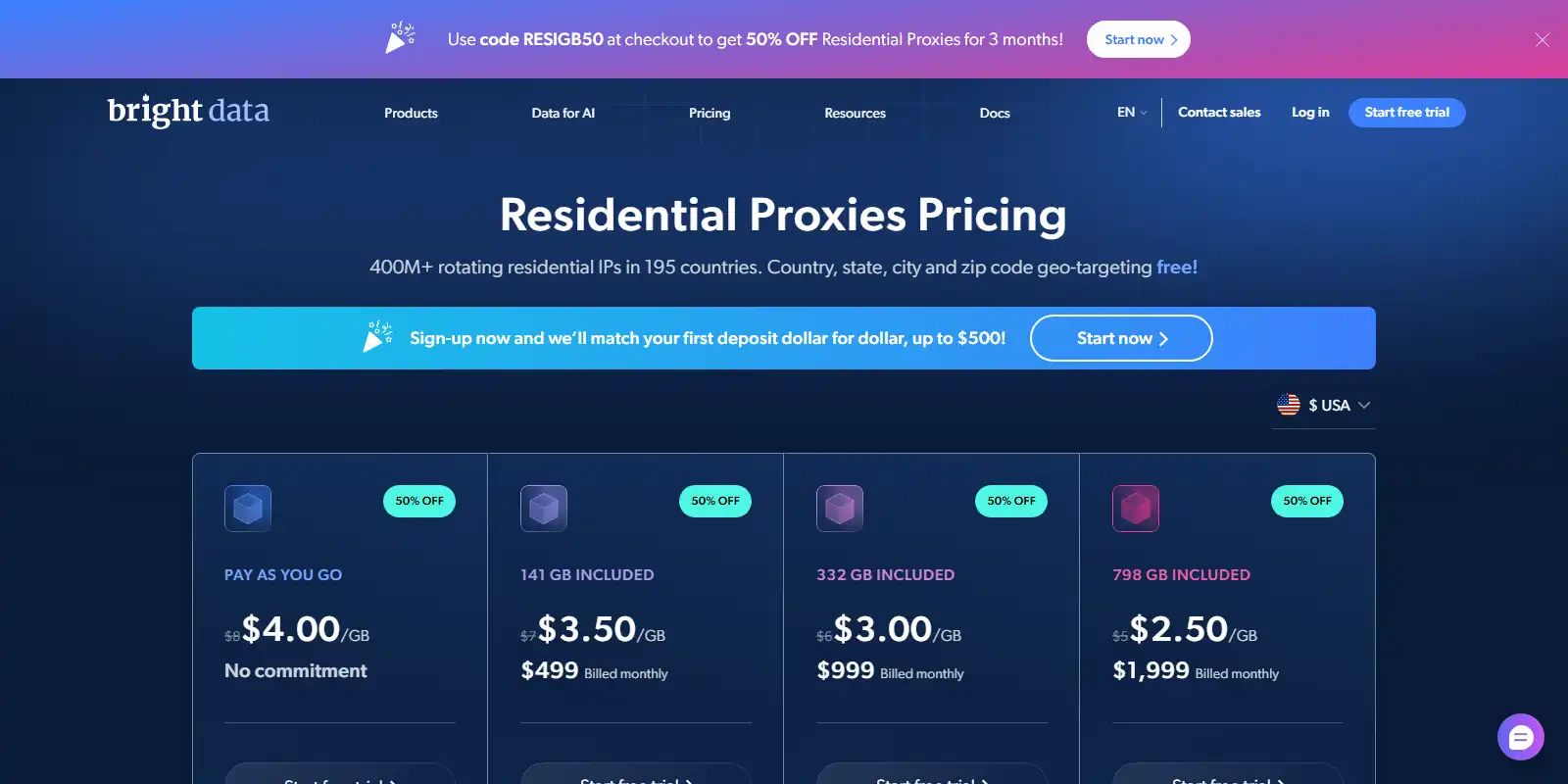
Bright Data’s public pricing page showed a temporary 50% residential promotion on August 31, 2026.
| Decision | Assessment |
|---|---|
| Main advantage | Granular targeting, proxy management, data products, and governance |
| Main compromise | More compliance and configuration overhead than Webshare |
| Migration effort | Medium because zones, compliance, and product selection add decisions |
| Choose when | A regulated or large program needs several acquisition methods |
| Skip when | A small team needs only a host, port, and a few gigabytes |
5. Oxylabs — Best Fit for Enterprise Proxy Operations
Oxylabs provides residential, ISP, datacenter, and mobile products plus Web Unblocker and scraper APIs. Its residential starter plan displayed $30 for 5 GB during verification, and the public specifications listed HTTP(S), HTTP/3, SOCKS5, sticky sessions, and geographic targeting. Pricing page consulted August 31, 2026; confirm current plan terms before purchase.
Oxylabs acquired Webshare, but the two services remain separately positioned. Webshare focuses on low-friction self-service access, while Oxylabs offers a broader enterprise-oriented product and support model. Ownership alone is not a reason to migrate.
| Decision | Assessment |
|---|---|
| Main advantage | Multiple proxy types, broader protocol support, and managed products |
| Main compromise | Higher entry cost than Webshare’s self-service plans |
| Migration effort | Low to medium for endpoints; higher for managed products |
| Choose when | Operational support matters more than minimum entry cost |
| Skip when | The workload is small, price-sensitive, and stable on Webshare |
6. SOAX — Best Fit for Credit-Based Web Access
SOAX’s live pricing page now presents a free Sandbox and credit-based subscriptions; its older traffic-based entry structure no longer appears. The paid Builder plan showed $200 per month plus VAT with 200 included credits; Team showed $500 with 500 credits. Because credits can be consumed differently across products, they should not be converted into a universal per-GB rate without modeling the intended workload.
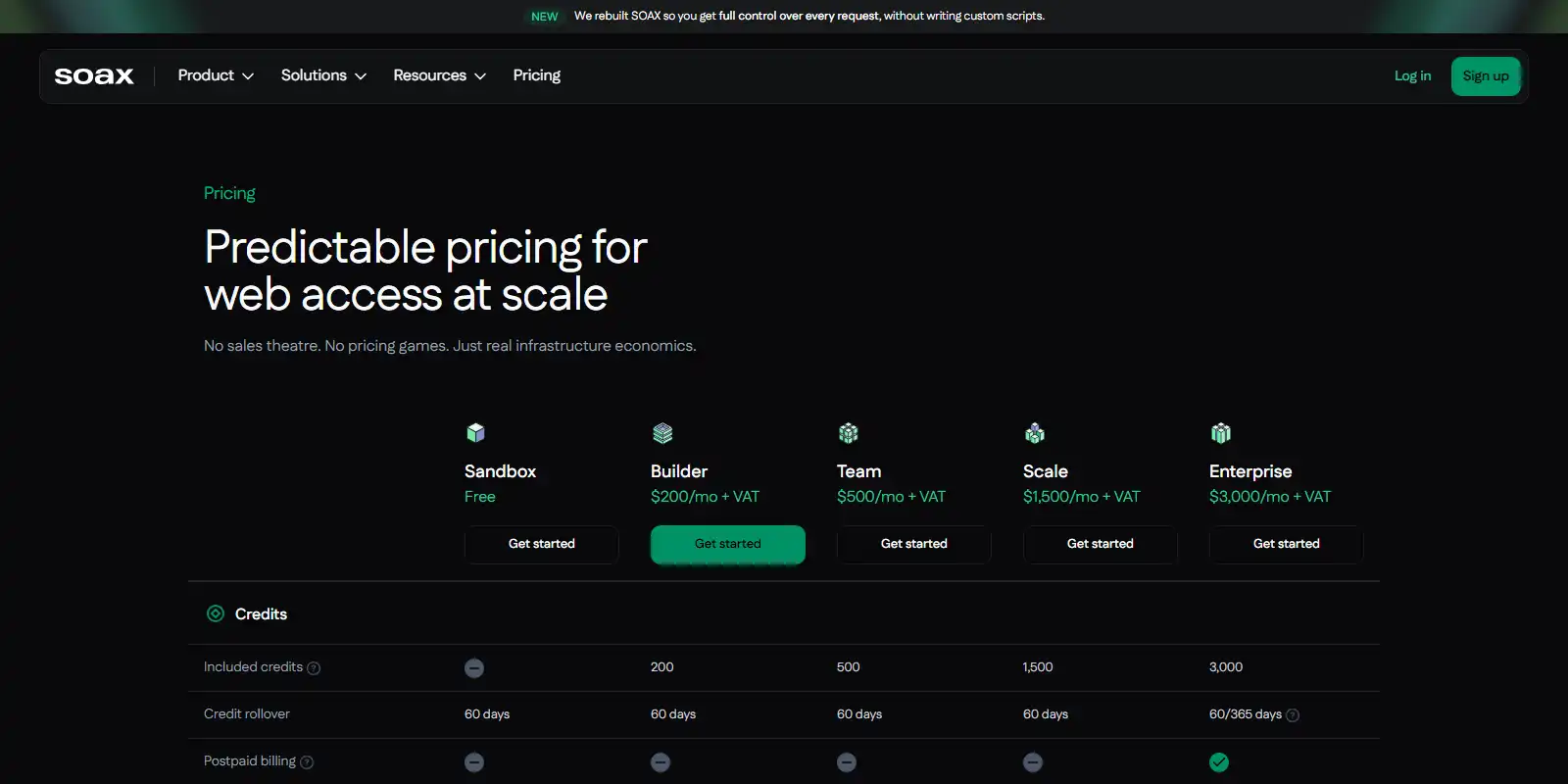
SOAX’s public page showed the current Sandbox and credit plans on August 31, 2026.
| Decision | Assessment |
|---|---|
| Main advantage | A Sandbox and one credit model across web-access products |
| Main compromise | Paid entry starts at $200/month and cost is not a simple $/GB figure |
| Migration effort | Medium because traffic and feature use must be translated into credits |
| Choose when | The team can model credit consumption across several products |
| Skip when | A small PAYG purchase or transparent per-GB rate is required |
7. ScraperAPI — Best Fit for Reducing Scraper Maintenance
ScraperAPI is not a like-for-like Webshare proxy alternative. Its pricing starts with a $49 monthly Hobby plan containing 100,000 API credits. The service can manage rotation, retries, premium routes, JavaScript rendering, and selected parsing features behind an API request.
| Raw proxy provider | ScraperAPI model |
|---|---|
| Application chooses and configures proxy behavior | Service chooses and rotates proxy routes |
| Application owns retries and content validation | Automatic retries reduce part of that workload |
| Browser rendering is deployed separately | JavaScript rendering is an option with higher credit use |
| Billing commonly uses GB or IP count | Billing uses API credits and feature multipliers |
| Greater transport and session control | Less low-level network control |
| Decision | Assessment |
|---|---|
| Main advantage | Less proxy orchestration and easier optional rendering |
| Main compromise | No direct SOCKS access, explicit IP control, or simple per-GB billing |
| Migration effort | Medium to high because request and error-handling logic changes |
| Choose when | Retry, rotation, and browser maintenance cost more than the API premium |
| Skip when | The application needs general proxy endpoints or long-lived network sessions |
Webshare Alternative Decision Matrix
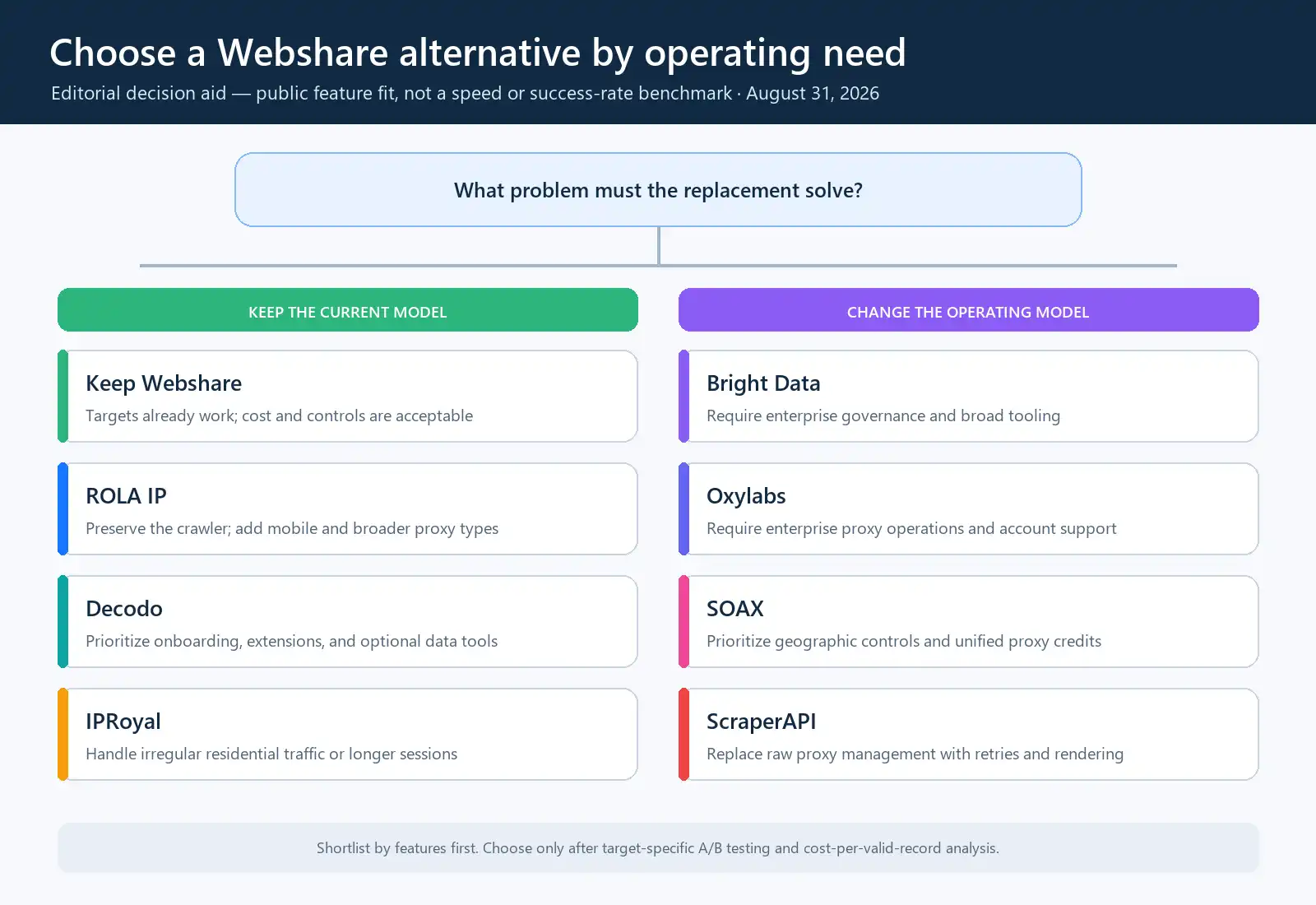
This editorial decision aid maps public feature fit. It is not a performance benchmark and has no test watermark.
Use the matrix to build a feature shortlist, then choose only after target-specific testing. Remaining on Webshare is a valid outcome when no alternative produces a measurable improvement.
How to Switch From Webshare Safely
1. Record the Baseline
Document the Webshare product, endpoint, protocol, authentication, allowlists, location filters, session syntax, concurrency, timeout, traffic, valid-page rate, and current monthly cost. Without a baseline, improvement cannot be demonstrated.
2. Map Provider-Specific Parameters
| Webshare setting | Replacement setting | Verification |
|---|---|---|
| Gateway or proxy-list endpoint | New host and port | Send one authenticated request |
| Username and password | New credentials | Confirm that 407 errors disappear |
| Country, city, ZIP, or ASN | New username or dashboard fields | Check exits with two location databases |
| Sticky identifier | Provider-specific session syntax | Repeat requests and record IP changes |
| Rotation mode | Per-request or timed rotation | Log a sequence of exits |
| HTTP or SOCKS5 | Supported protocol | Test through the production library |
A field called “sticky” does not mean the same thing everywhere. It may describe a maximum TTL, a best-effort peer, or a dedicated address that remains assigned for the subscription.
3. Run a Controlled A/B Test
Use the same authorized targets, request headers, cookies, concurrency, timeout, retry policy, and test windows. Start with a sample appropriate to the workload—for example, 500–1,000 requests per target across several time periods—then record:
- content-validated success rate;
- median and P95 latency;
- 403, 429, 5xx, timeout, and CAPTCHA rates;
- location-match rate;
- premature sticky-session changes;
- bytes transferred and retries;
- total cost per valid record.
Do not count every HTTP 200 response as success. A consent page, challenge page, empty product grid, or wrong region can still be unusable.
4. Roll Out Gradually
Route a small share of non-critical traffic first, such as 5–10%. Increase it only after the new provider meets predefined success, latency, location, and cost thresholds. Keep the Webshare plan available until the replacement has survived difficult targets and normal peak periods.
Conclusion
Webshare remains a strong entry point for free testing and budget datacenter access. ROLA IP is a practical direct-migration candidate when the crawler should remain in place and the proxy catalog needs to expand; the other options solve different operational constraints.
Shortlist by required features, reproduce the workload, validate response content, and compare cost per valid record. If a replacement cannot demonstrate a measurable improvement, keep Webshare.