
Best Price Scraping Tools in 2026: 10 Options Compared

Aug 27, 2026 · Comparisons · 15 min read
TL;DR
Use ready-made platforms like Prisync or Priceva if you want built-in dashboards and automatic repricing. Choose managed APIs like Apify or Browse AI if you only need raw data to process internally. Build a custom stack with Scrapy and a proxy network like Rola IP when total data ownership and custom matching are strictly required.
The best price scraping tools depend on the system you need. For ready-made price monitoring, shortlist platforms such as Prisync, Priceva, or Minderest. For lighter data collection, consider Browse AI, Apify, or Bright Data. When custom matching and data ownership matter, build with Scrapy or Playwright, a database, and a proxy network such as Rola IP. Rola IP is not a scraping tool; it supports the network layer of an authorized custom workflow. Choose the route first, then compare matching, price context, refresh cadence, delivery, and total operating cost.
Best Price Scraping Tools at a Glance
Disclosure: ROLA IP publishes this comparison and provides proxy infrastructure for custom data-collection workflows. It is not ranked against monitoring SaaS, no-code scrapers, or managed APIs. Workflow-fit labels are editorial assessments based on official information, not performance rankings.
The tools are ordered by workflow, not quality. Billing units vary across catalogs, credits, requests, records, markets, and contracts, so public amounts are only starting signals.
Monitoring and Pricing Platforms
| Tool | Strong fit for | Current pricing basis | Main limitation |
|---|---|---|---|
| Priceva | Low-barrier full monitoring | Free entry; paid pricing requires live confirmation | Public plan-to-limit mapping is unclear |
| Prisync | Self-service catalog monitoring | From $99/month; product and channel limits | Add-ons and catalog ceilings affect cost |
| Price2Spy | Reports, alerts, and history | Tier and monitored scope; quote required | No comparable public entry amount |
| PriceShape | Monitoring tied to pricing automation | From €599/month; products and markets | Higher entry commitment |
| Minderest | Enterprise omnichannel evaluation | Custom quote | Sales-led implementation |
No-Code Tools, Platforms, and APIs
| Tool | Strong fit for | Current pricing basis | Main limitation |
|---|---|---|---|
| Browse AI | Simple page-change monitoring | Free; annual plans from $19/month | Limited catalog matching |
| Octoparse | Visual multi-step extraction | Free; annual plans from $69/month | Workflow repair remains user-owned |
| Apify | Customizable cloud workflows | Free allowance; paid from $29/month plus usage | Quality and schema vary by Actor |
| Bright Data | Managed structured product collection | Free allowance; pay per successful record | Matching and analytics may remain downstream |
| ShoppingScraper | Google Shopping data workflows | From €799/month by request volume | Narrower target fit and high entry point |
Prices and plan conditions were checked on August 26, 2026. Taxes, annual billing, overages, add-ons, and region-specific terms may change the effective price.
Which Price Scraping Solution Do You Need?
A price scraper extracts product and offer fields. Price monitoring software adds matching, recurring checks, history, alerts, analysis, and sometimes repricing. The correct purchase depends on how much of that workflow the provider should own.
| Price monitoring requirement | Recommended route | Typical options | Buyer still owns |
|---|---|---|---|
| Finished dashboard, matching, alerts, or repricing | Ready-made monitoring platform | Prisync, Priceva, Price2Spy, PriceShape, Minderest | Catalog rules and match review |
| Lightweight extraction or structured records | No-code scraper or managed API | Browse AI, Octoparse, Apify, Bright Data, ShoppingScraper | Normalization, matching, and downstream decisions |
| Proprietary schema, matching logic, or full ownership | Custom price scraping stack | Scrapy or Playwright + database + Rola IP proxy network | Code, QA, observability, maintenance, and compliance |
Rola IP belongs in the third route. It can provide regional routing, rotating or stable sessions, and network separation for a custom collector, while Scrapy or Playwright handles extraction and a database stores normalized history. It does not replace product matching, monitoring logic, or authorization. Managed APIs may already include request routing, so adding a separate proxy can duplicate cost. Define the output first, then buy only the layers the team is prepared to operate.
How We Selected and Verified the Tools
We checked each provider’s current official product, pricing, trial, and documentation pages on the same date. For every tool, we recorded its category, matching approach, price context, scheduling, alerts or history, delivery options, integrations, pricing unit, and material limitations. Free plans, trials, annual discounts, included usage, add-ons, overages, and custom quotes were kept separate.
Dedicated monitoring products form the majority because this comparison targets price decisions, not generic extraction alone. Only two general collection platforms are included. The profile section carries a shared evidence label because we did not run all ten products against the same 50-product, three-cycle benchmark. Accordingly, this article does not publish a blended score, success rate, speed ranking, or accuracy winner.
To limit overlap, we excluded comparable collection services, custom-build components, Amazon-only tools, and additional enterprise suites. Exclusion reflects scope, not product quality.
Compare the Capabilities That Affect Price Data
Feature lists become misleading when extraction and matching are collapsed into one “yes.” These tables separate provider capabilities from work the buyer may still need to build or review.
Matching and Monitoring
| Tool | Product matching | Scheduled checks | Alerts/history |
|---|---|---|---|
| Priceva | URL plus provider-stated matching options | Configurable by plan | Built in |
| Prisync | URL, channel, or hybrid | Built in | Plan-dependent |
| Price2Spy | Manual, hybrid, or Automatch | Built in | Built in by tier |
| PriceShape | Feed and catalog workflow | Daily monitoring | History and dashboards |
| Minderest | Provider-stated catalog matching | Built in | Built in/provider-stated |
| Browse AI | User-defined rows and pages | Built in | Change alerts and history |
| Octoparse | Buyer-owned | Paid-plan scheduling | User-configured |
| Apify | Actor-dependent | Schedules | Actor-dependent |
| Bright Data | Target identifiers; cross-store matching separate | Scheduled collection | Buyer-owned unless contracted |
| ShoppingScraper | EAN, GTIN, or catalog ID | Built in | Product- and plan-specific |
Action and Delivery
| Tool | Repricing | Main delivery | Buyer still maintains |
|---|---|---|---|
| Priceva | Rule-based | Dashboard, API, exports | Catalog rules and match review |
| Prisync | Built in | Dashboard, Excel, API | Catalog and pricing rules |
| Price2Spy | Paid module | Dashboard, reports, API | Module selection and review |
| PriceShape | Built in | Dashboard, export, integrations | Pricing strategy and governance |
| Minderest | Platform capability | Dashboard, export, API | Enterprise configuration |
| Browse AI | No | Tables, integrations, API | Robot and catalog validation |
| Octoparse | No | Files, databases, API | Workflows and normalization |
| Apify | No | Datasets, API, webhooks | Actor, schema, and validation |
| Bright Data | No | JSON, CSV, API, webhook | Matching, history, and analytics |
| ShoppingScraper | Product/API-specific | CSV, JSON, API | Downstream pricing application |
10 Price Scraping Tools to Shortlist by Workflow
Dedicated Price Monitoring and Intelligence Platforms
1. Priceva — Low-Barrier Full Monitoring Candidate
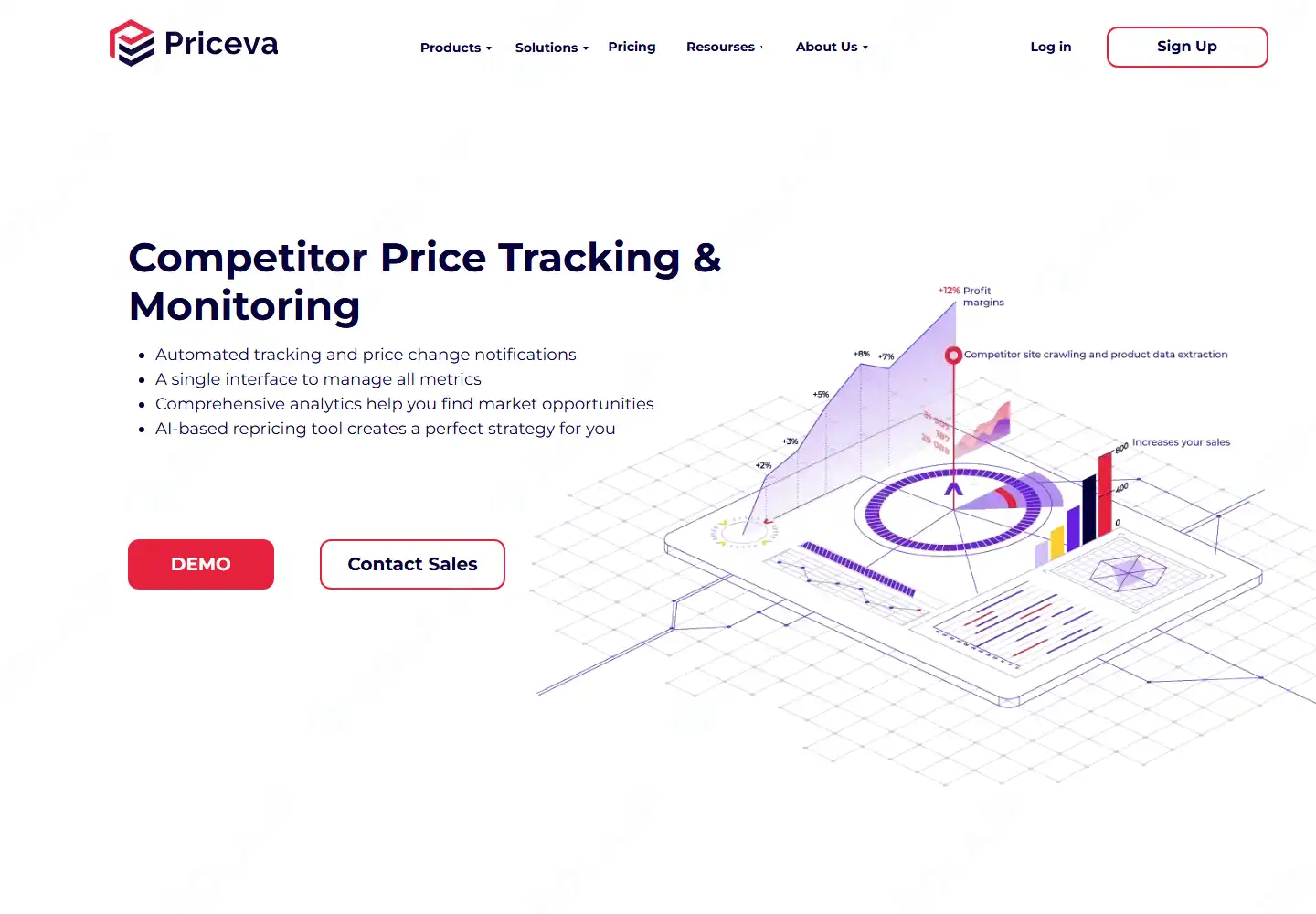
Priceva is a practical candidate for teams wanting monitoring, alerts, analysis, and rule-based repricing in one interface. Official pages describe price and availability checks, competitor matching, history, MAP or MSRP monitoring, exports, reports, and notifications. It can retain promotion and shipping context, helping teams review gaps against catalog rules.
The case for Priceva is breadth combined with free entry. The caution is pricing clarity: its public presentation did not let us map every paid amount to a plan limit with sufficient confidence, so this article deliberately does not quote a paid starting price. Shortlist it for a packaged monitoring evaluation; look elsewhere for arbitrary web data or complete extraction control.
2. Prisync — Self-Service Catalog Monitoring Candidate
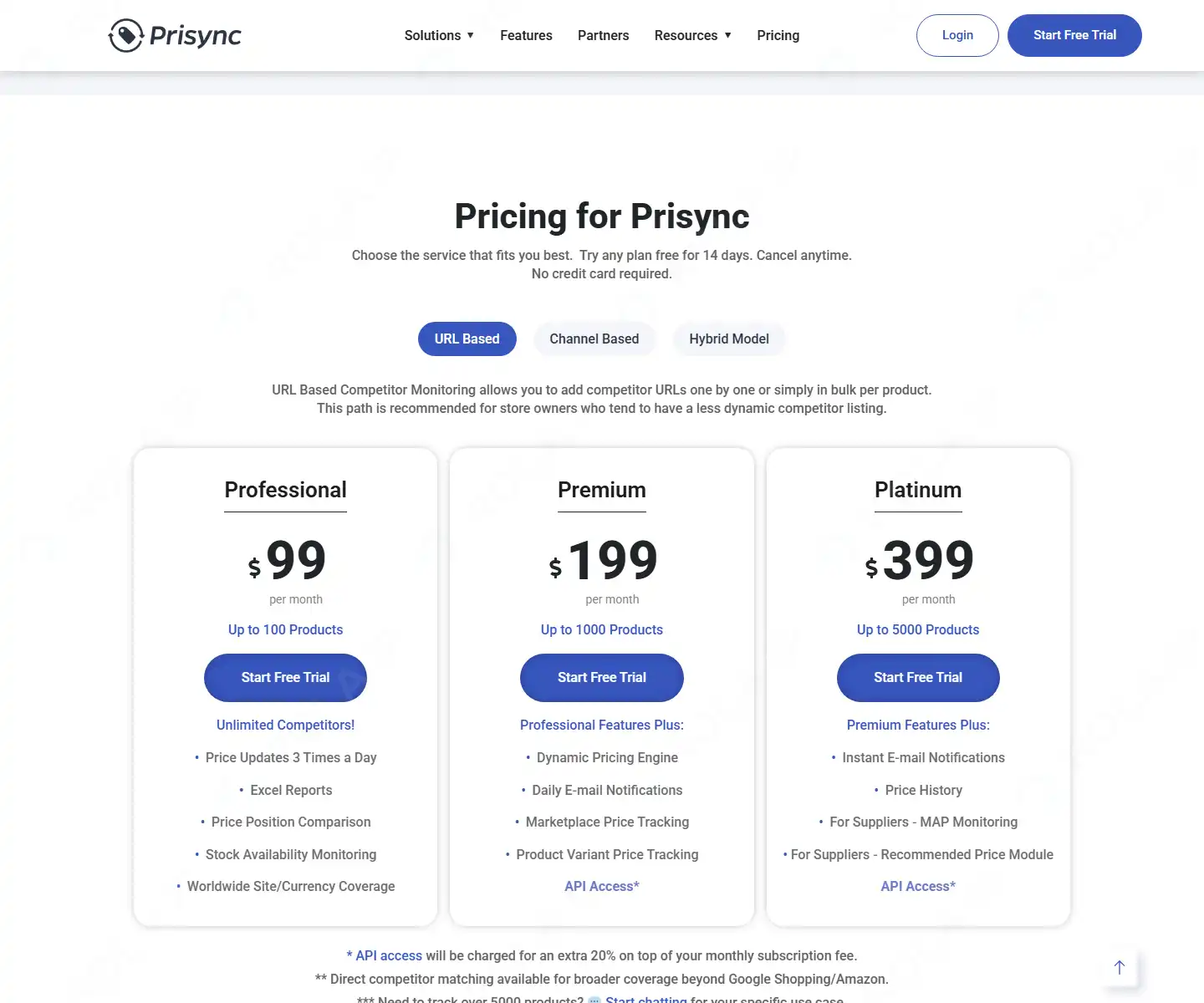
Prisync is a clear self-service candidate for teams that know which products, URLs, or channels to monitor. It supports URL-based, channel-based, and hybrid monitoring, with price and stock checks, history, alerts, reports, Excel exports, and dynamic pricing. Three daily updates are advertised on the entry paid tier, which suits many routine catalog reviews. API access is plan-dependent. Published monthly tiers start at $99 for 100 products, $199 for 1,000, and $399 for 5,000; a 14-day trial is advertised without a card.
Its published catalog tiers make early budgeting easier than quote-only products, and monitoring can lead directly into pricing action. However, channel costs, matching services, API access, and add-ons can change the total. Prisync belongs on a shortlist for a manageable product catalog, not for unstructured extraction across unrelated sites.
3. Price2Spy — Reporting and Alert Configuration Candidate
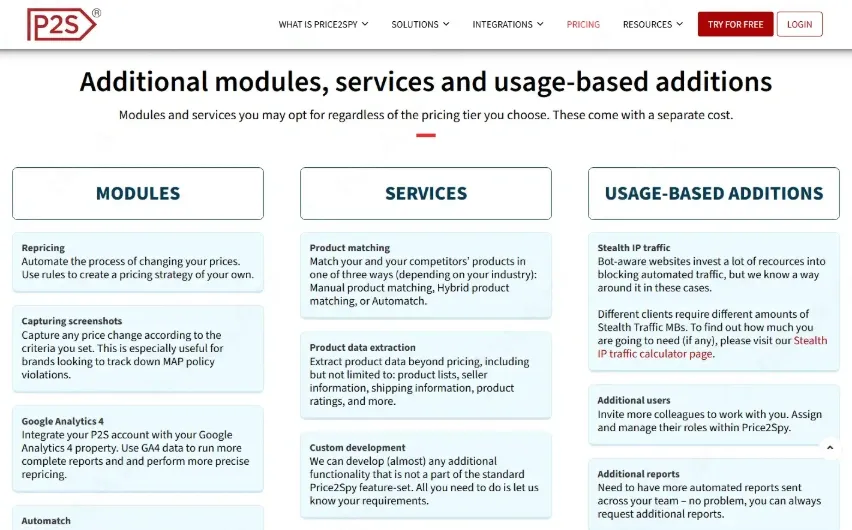
Price2Spy fits organizations prioritizing configurable monitoring, history, reports, and alert rules. Its Starter, Basic, and Premium tiers cover monitoring, dashboards, feeds, bulk import, matching, MAP, variations, reports, and alerts. The quote should also state monitored products, competitor limits, check frequency, and support. Basic expands marketplace, currency, variation, history, and instant-alert options. Premium adds API access and higher-frequency checks, while repricing, screenshots, and automated matching can require separate modules. Buyers should map every required module to the quote before comparing it with bundled SaaS.
Shortlist Price2Spy when reports, history, and alert configuration are central. Its flexibility comes with tier-and-module complexity, and the official pricing page does not show a directly comparable entry amount. A requirements-based quote is therefore essential. Teams needing immediate self-service cost certainty—or only a few simple page checks—have cleaner options.
4. PriceShape — Pricing Automation Candidate
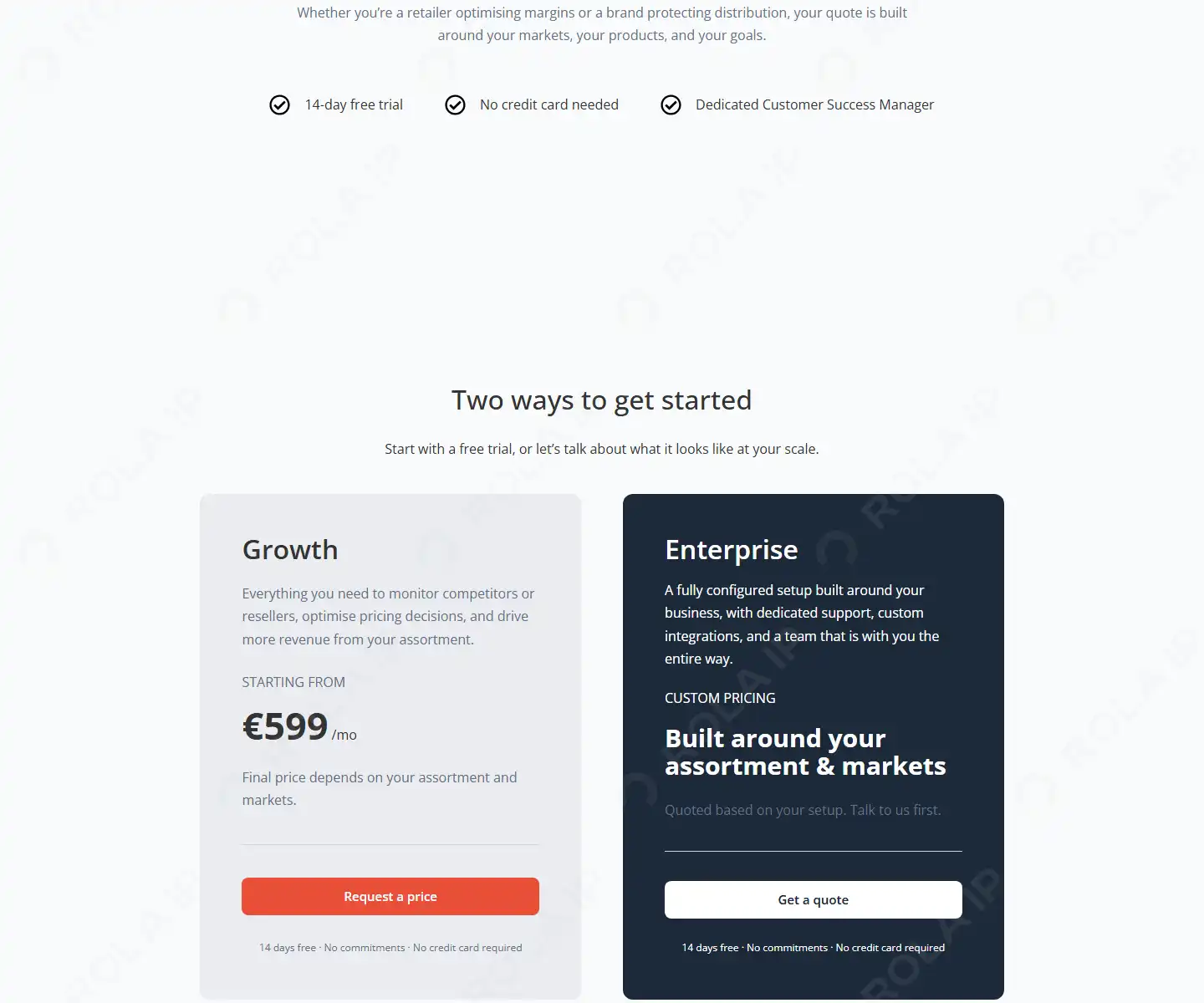
PriceShape is for teams that want competitor observations to feed governed pricing actions. Official materials combine price monitoring with stock and shipping context, history, dashboards, exports, integrations, pricing rules, and automation. Because repricing changes the seller’s catalog, margin floors, approval rules, and exception handling still require governance. Growth starts at €599 per month under displayed terms; final pricing depends on assortment and markets, while enterprise deals are proposal-based. A 14-day trial is advertised without a card.
PriceShape’s appeal is the connection between market observations and governed execution, supported by onboarding. The tradeoff is a higher commitment and scope-dependent cost. Pilot margin floors, approvals, and exceptions before enabling any automated change; vendor customer stories do not predict your result. It fits funded pricing programs better than teams seeking raw rows or occasional exports.
5. Minderest — Enterprise Omnichannel Evaluation Candidate
Minderest is an enterprise candidate for retailers and brands needing more than online checks. Its positioning spans retailer sites, marketplaces, comparison sites, in-store monitoring, promotions, stock, catalog intelligence, seller monitoring, MAP or MSRP controls, dynamic pricing, and enterprise data delivery. That breadth supports decisions involving seller, location, promotion, and assortment context. Buyers should confirm which countries, channels, refresh rates, exports, and service levels are included in the proposed scope. Ask for sample outputs before agreeing implementation milestones.
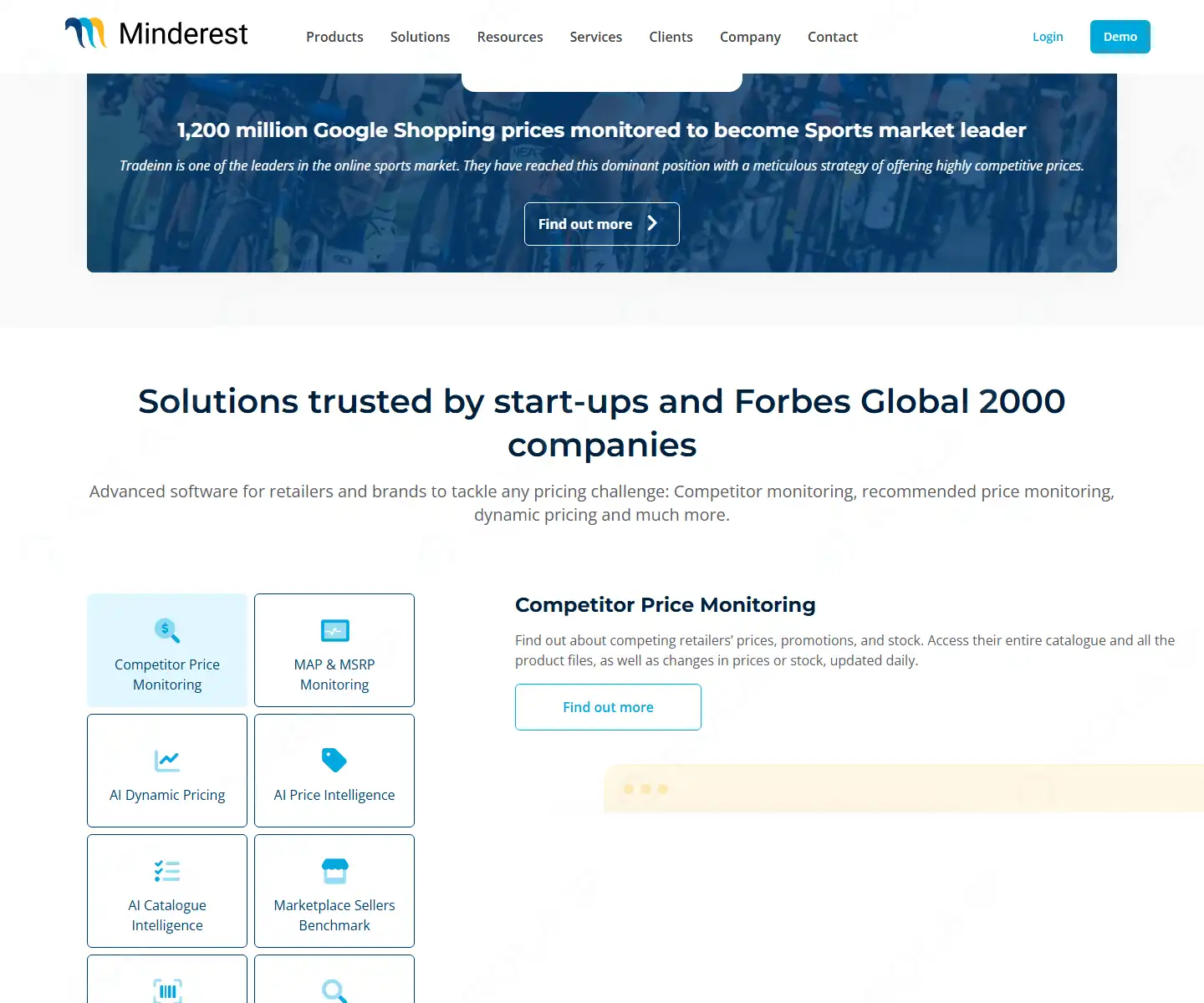
For enterprise buyers, the attraction is broad channel context rather than a low entry price. The costs are a custom quote, sales-led evaluation, and heavier implementation. Require sample output and validate every accuracy, scale, and ROI claim against a ground-truth catalog. Minderest merits a proof-of-value process; it is excessive when a weekly file or small monitor can support the decision.
No-Code Price Scraping Tools
6. Browse AI — Lightweight No-Code Candidate
Browse AI is a strong starting point when a nondeveloper needs to monitor several pages or repeated rows without building a crawler. Users record robots, schedule runs, keep change history, receive alerts, save screenshots, and deliver data through integrations or an API. Credit use depends on extracted rows and run frequency, so the pilot should reproduce the intended schedule. It lacks the cross-catalog matching and pricing governance of dedicated monitoring software.
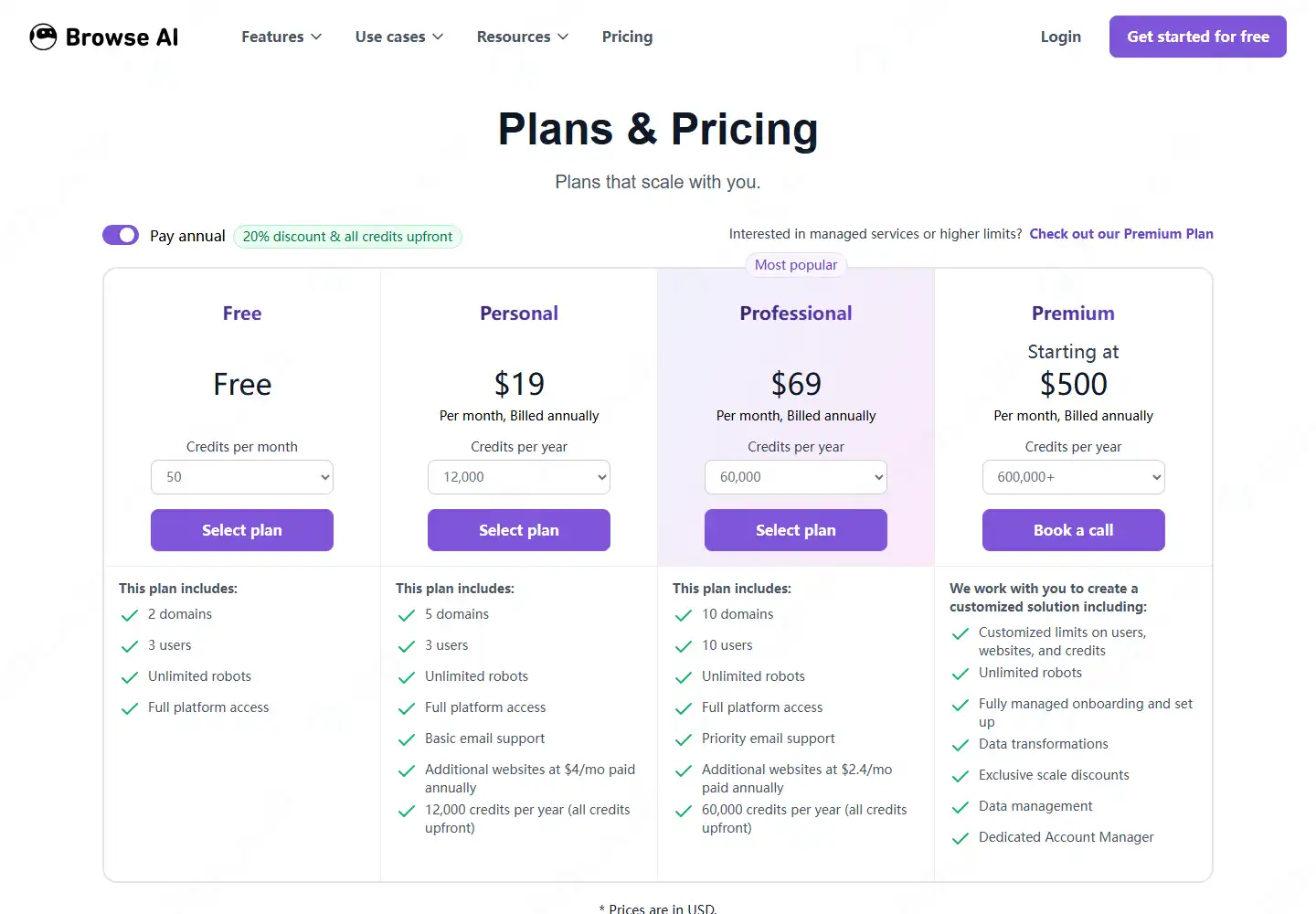
Annual billing shows a free plan, Personal at $19 per month, Professional at $69, and Premium from $500; monthly prices differ, so verify the toggle. Quick setup is the advantage. Credit growth, page-change repair, and user-owned normalization are the costs. Use it for a small, consistent target set—not a large catalog that requires automatic variant matching.
7. Octoparse — Visual Multi-Step Extraction Candidate
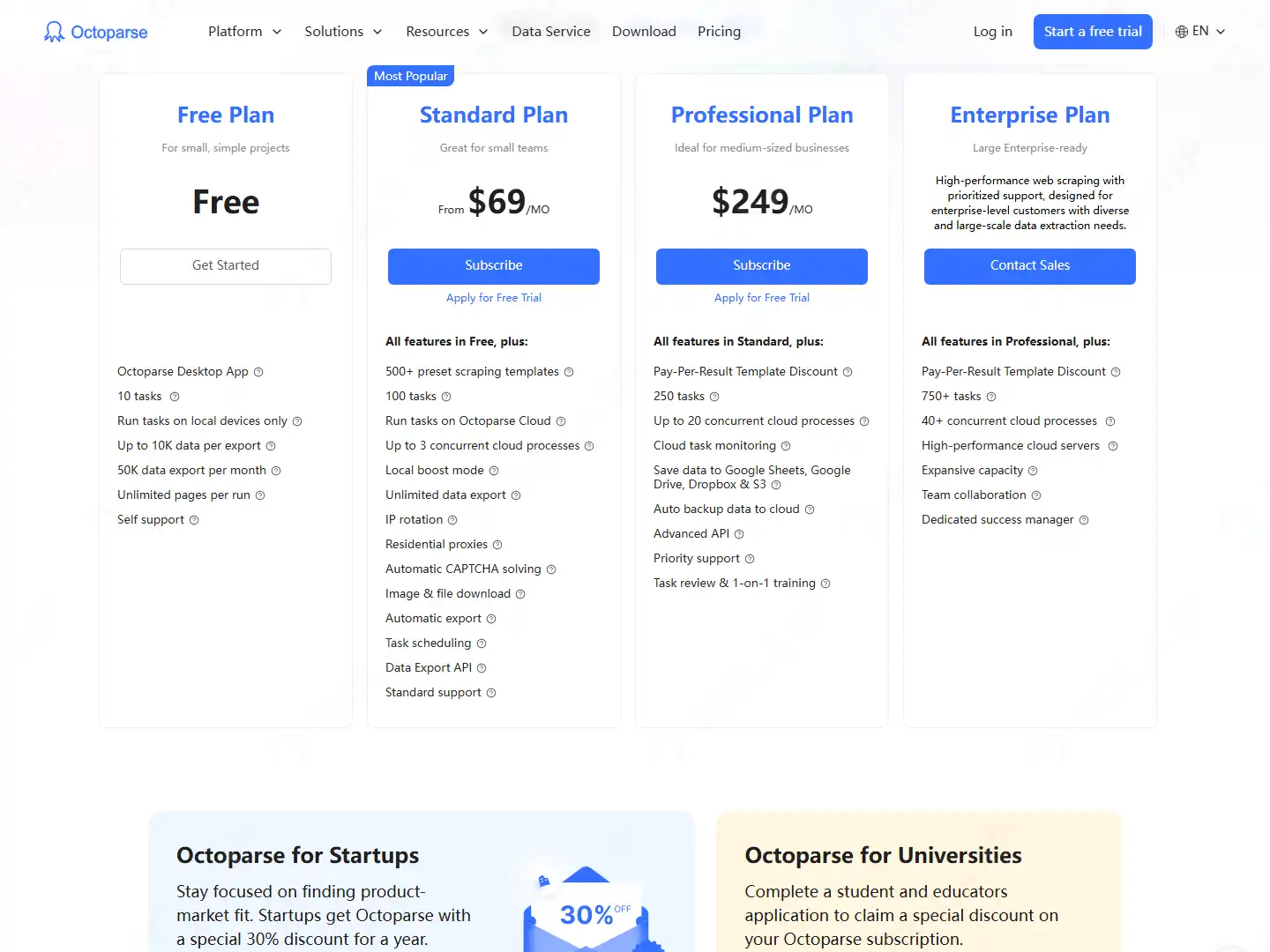
Octoparse offers more control than a simple page monitor through a visual workflow builder. Plans cover templates, local and cloud extraction, schedules, file and database exports, higher-tier API access, and optional managed services. A successful local extraction does not prove cloud stability, so test scheduled runs after representative page changes. The free plan allows ten tasks, one device, local extraction, and up to 50,000 rows monthly. Annual pricing starts at $69 per month for Standard and $249 for Professional; enterprise pricing is custom.
Visual multi-step control and flexible delivery are the reasons to shortlist Octoparse. In return, the buyer owns selector repairs, normalization, matching, analytics, and plan-dependent cloud capacity. It works when an analyst can maintain target-specific workflows. It is the wrong category when stakeholders expect a ready-made intelligence dashboard and automatic match review.
Managed Scraper APIs and Cloud Platforms
8. Apify — Customizable Cloud Workflow Candidate
Apify runs reusable cloud automations called Actors. Teams can select an ecommerce Actor, schedule runs, store datasets, export common formats, integrate through APIs or webhooks, or build a custom Actor. It suits data teams needing orchestration without operating every underlying component. Inspect the Actor’s owner, update history, schema, dependencies, and support policy because platform availability does not guarantee each Actor’s fitness.
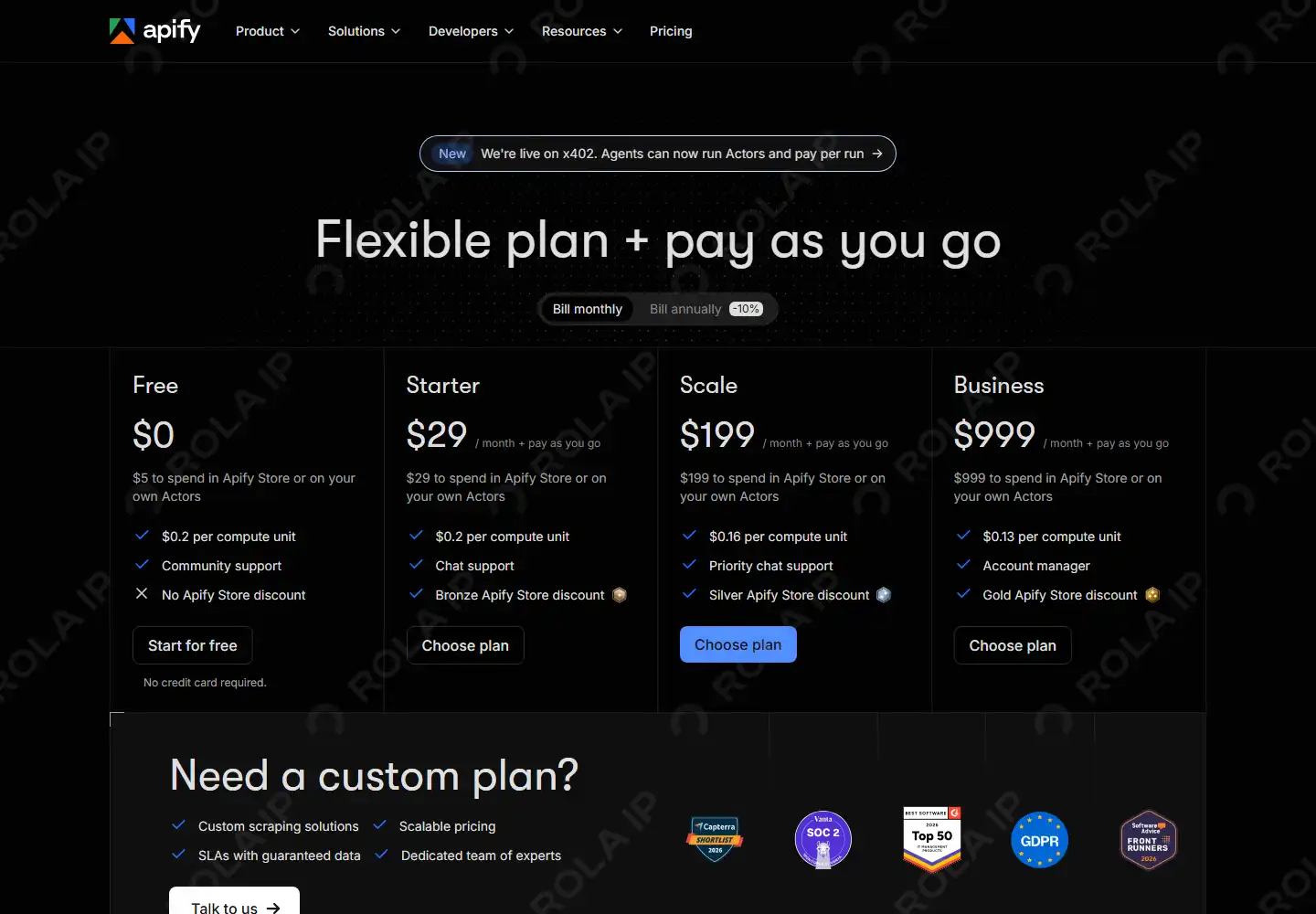
The free plan includes $5 in monthly prepaid usage. Starter is $29 per month with $29 prepaid usage; Actor rental and compute can add cost. Review logs after every pilot run because schema, maintenance, support, and quality vary between Actors. Apify makes sense for a team that can validate an Actor pipeline. It does not replace packaged monitoring with built-in cross-store matching.
9. Bright Data — Managed Structured Collection Candidate
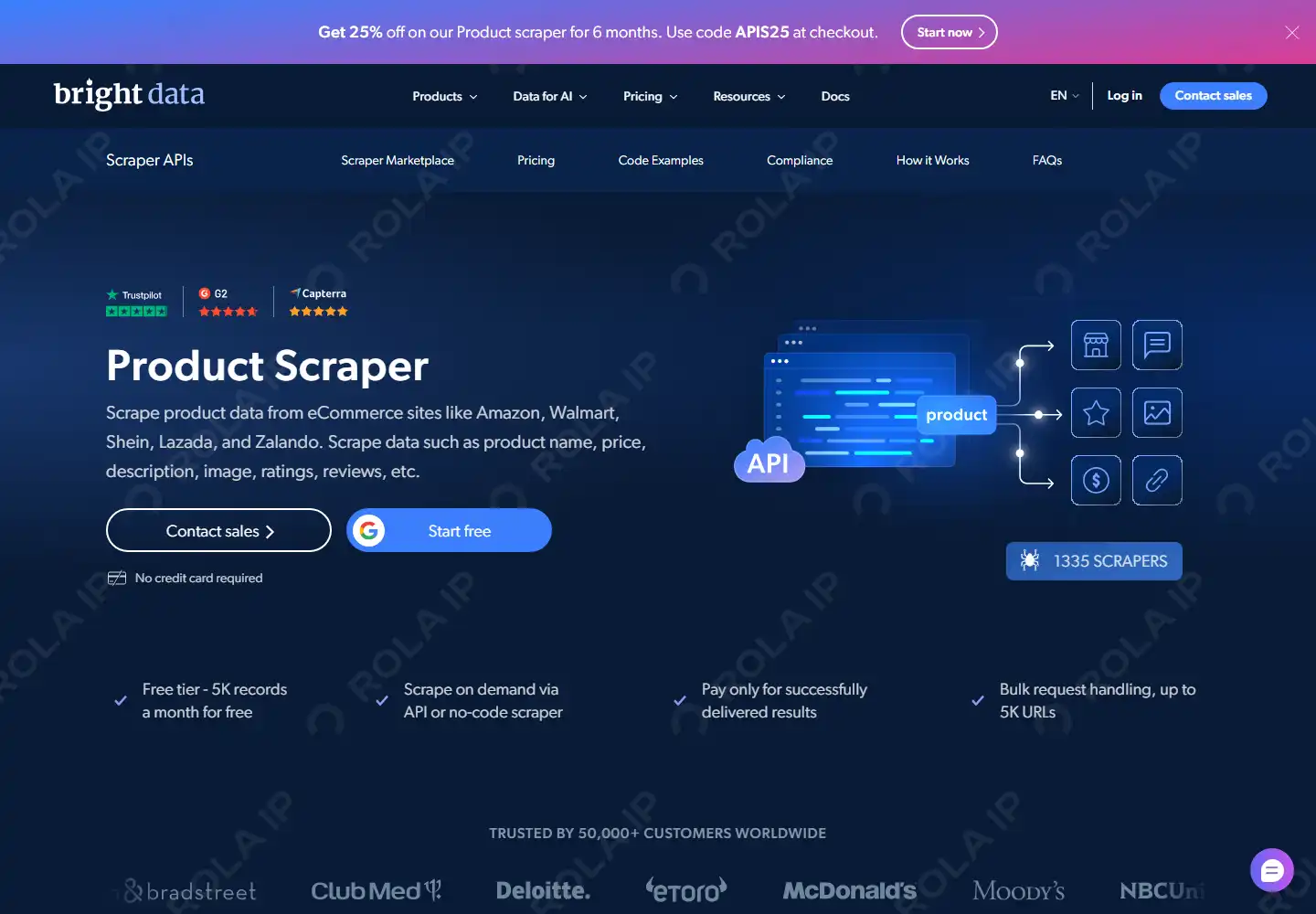
Bright Data’s Product Scraper targets teams wanting structured ecommerce records without maintaining a browser workflow per target. Its page advertises API and no-code collection, bulk requests up to 5,000 URLs, schedules, common formats, and product fields. Confirm coverage, required fields, refresh mode, and delivery against the exact retailer list before approving a contract. It currently displays 5,000 free monthly records and pay-as-you-go pricing of $1.50 per 1,000 successful records; larger commitments use separate plans.
Managed requests and structured delivery are the main value. Cross-store matching, normalized history, analytics, and pricing decisions may remain downstream unless contracted, and provider success claims are not comparative results. This option fits a data team that owns the warehouse and business logic. Merchandisers expecting a finished dashboard and repricing rules need a monitoring product instead.
Specialist Ecommerce Data API
10. ShoppingScraper — Google Shopping Specialist Candidate
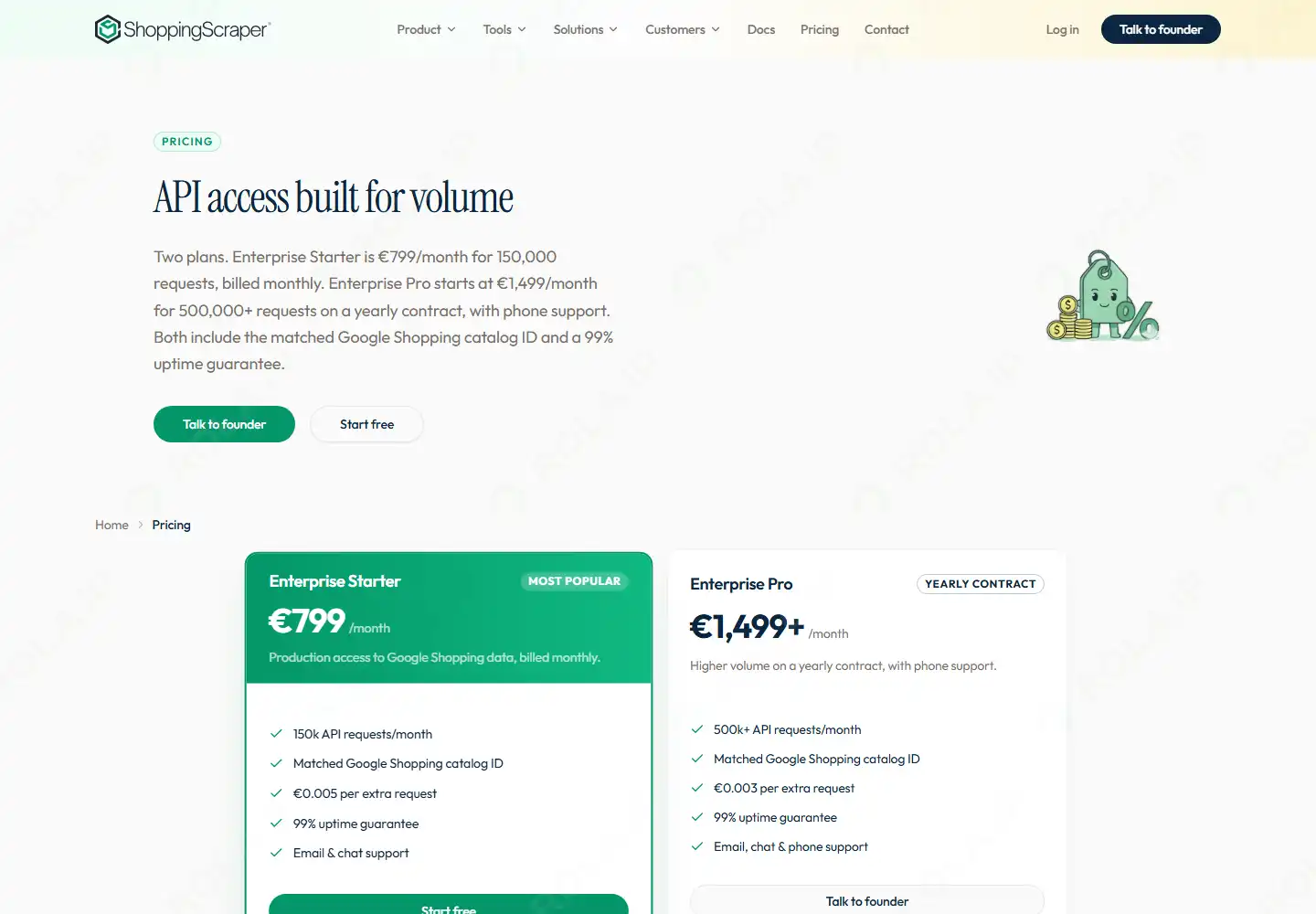
ShoppingScraper specializes in Google Shopping workflows rather than arbitrary retailer crawling. Its API materials describe offer, product, search, variant, and review endpoints; EAN or GTIN matching; Google Shopping catalog IDs; scheduling; and CSV or JSON delivery. Those identifiers can simplify recurring offer analysis. Confirm country coverage, concurrency, endpoint costs, and overage rates with the intended search-and-offer mix, then test identifiers against ground truth.
Enterprise Starter is €799 per month for 150,000 requests. Enterprise Pro starts at €1,499 monthly for at least 500,000 requests on an annual contract, and a 100-credit evaluation is advertised. Source-specific structure and identifiers are valuable when Google Shopping is central. The high commitment and narrow target fit make it unsuitable for broad retailer extraction or packaged pricing analytics.
What Reliable Competitor Price Data Must Include
The extraction succeeding does not make the record decision-ready. A useful price scraper must preserve enough identity and commercial context to explain what the number means. Google Merchant Center’s product data specification is a practical reference for product attributes, but it is not a universal scraper schema.
| Required field | Why it matters | Minimum validation |
|---|---|---|
| Product ID, GTIN/MPN, canonical URL | Prevents false matches | Prefer stable identifiers over title similarity |
| Variant/SKU and pack size | Separates configurations | Reject mismatched size, color, quantity, or bundle |
| Seller and condition | Distinguishes offer types | Keep first-party, marketplace, new, and used separate |
| Regular and sale price | Preserves promotion context | Store both and retain the promotion label |
| Shipping and mandatory fees | Supports delivered-price comparison | Do not treat item price as total price |
| Coupon or member condition | Prevents conditional-price errors | Retain eligibility text separately |
| Currency, tax, and region | Makes comparisons reproducible | Save locale and delivery context |
| Availability | Prevents action on unavailable offers | Store status beside price |
| Timestamp and match confidence | Supports freshness and review | Reject stale or low-confidence records by rule |
Wrong-variant errors can make a cheaper multipack look like a price cut. Conditional discounts can be misread as universally available. A correct price collected too late can still be useless. Regional comparison also requires consistent currency, tax, shipping, and delivery location. When an authorized workflow needs regional collection, Rola IP proxies for price monitoring can help maintain a defined network location, but a proxy does not fix product matching, validate the offer, or grant permission to access data.
Compare Total Cost, Not Starting Price
The most useful economic measure is not subscription price or raw request price. It is the cost of producing fresh, correctly matched, usable records.
Total monthly cost = license or usage + rendering/network + matching and QA labor + integration/storage + maintenance
Cost per 1,000 usable records = total pilot cost ÷ usable records × 1,000
Keep each billing unit intact: products, URLs, checks, credits, requests, records, compute, and quotes represent different work. Include commitments, retries, rendering, geography, matching, normalization, repair, storage, and maintenance. Cheap requests become expensive when output needs cleanup; open-source code still consumes engineering time.
Worked Cost Example
Assume an illustrative Tool A costs $199 monthly, network and storage add $45, and four QA hours at $30 add $120. Total cost is $364. If 10,000 requested records produce 9,600 accepted records, the effective cost is $364 ÷ 9,600 × 1,000 = $37.92 per 1,000 usable records.
Now assume Tool B charges only $180 for collection but requires ten QA hours and $45 in infrastructure. Its $525 total divided by 9,200 accepted records equals $57.07 per 1,000. Tool B has the lower collection fee but the worse usable-record economics. These figures are examples, not vendor results.
Do not force unlike pricing models into a “cheapest” ranking. Estimate volume, run the same pilot, and compare accepted output under identical quality rules.
Run a Three-Cycle, 50-Product Pilot
Shortlist no more than two tools from one category, then test both before signing a long contract or enabling repricing.
Pilot Procedure
- Lock the decision, mandatory schema, budget, and thresholds.
- Check terms, access conditions, and robots directives; prefer an official API or licensed feed when suitable.
- Build 50 ground-truth products across five permitted targets, covering promotions, variants, sellers, unavailable pages, and conditional offers.
- Preserve seller, region, currency, shipping, tax, eligibility, availability, and collection time.
- Run both tools with identical inputs across three cycles.
- Save raw and normalized output, failures, review decisions, usage, and cost.
- Calculate every metric and investigate mismatches.
- Review ambiguous records before automated price changes.
Illustrative Acceptance Scorecard
These are editorial starting points, not industry standards. Set different limits before testing when business risk requires them; never change thresholds after seeing results.
| Metric | Locked threshold | Calculation or pass rule |
|---|---|---|
| Usable-record rate | ≥95% | Correct, fresh, complete records ÷ requested records |
| False-match rate | ≤1% | Wrong product or variant ÷ returned records |
| Manual-review rate | ≤5% | Human-review records ÷ returned records |
| Core schema completeness | 100% | Every mandatory field present and valid |
| Freshness | Within 24 hours | Timestamp meets the declared decision window |
| Stability | Three cycles | No unexplained critical failure |
| Effective cost | Within predeclared budget | Subscription, usage, QA, and maintenance included |
A 50-product, three-cycle pilot can expose obvious problems, but it cannot prove production reliability. Before rollout, validate larger samples, peak volume, page changes, regional behavior, and failure recovery. Automated repricing and high-value SKUs warrant stricter review.
Common Failure Paths
| Symptom | Verify | Safe response |
|---|---|---|
| Missing price | Availability, rendering, selector, locale | Mark missing; retry within policy or use an authorized feed |
| Wrong variant | GTIN, SKU, pack size, title, image | Reject the match and require review |
| Regional mismatch | Currency, tax, shipping, delivery location | Rerun with a controlled, documented region |
| Stale data | Source timestamp and collection time | Exclude records outside the freshness window |
| Schema drift | Field names, types, null rates | Stop downstream actions and update validation |
| Unexpected cost | Retries, credits, browser use, overages | Pause the schedule and recalculate unit cost |
| Access denied | Terms, authorization, response, robots rules | Stop and use an authorized source or seek permission |
The Robots Exclusion Protocol standardizes crawler rules but does not grant access authorization. Treat robots.txt as a technical signal, not legal permission. Stop when terms, controls, or permissions conflict, and use an authorized source. This is not legal advice.
When to Build a Custom Price Scraper with Rola IP
A custom stack makes sense when proprietary matching, unusual schemas, stable volume, or data ownership justify engineering. Rola IP belongs in this architecture as proxy infrastructure—not as the scraper, database, or pricing engine.
| Stack layer | Typical component | Responsibility |
|---|---|---|
| Collection | Scrapy for conventional pages; Playwright when browser rendering is genuinely required | Navigation, extraction, retries |
| Network | Rola IP proxy network | Regional routing, IP rotation, or stable sessions |
| Storage | SQL database, warehouse, or object store | Raw records, normalized history, audit trail |
| Quality and action | Matching rules, validation, alerts, pricing service | Variant checks, approvals, business decisions |
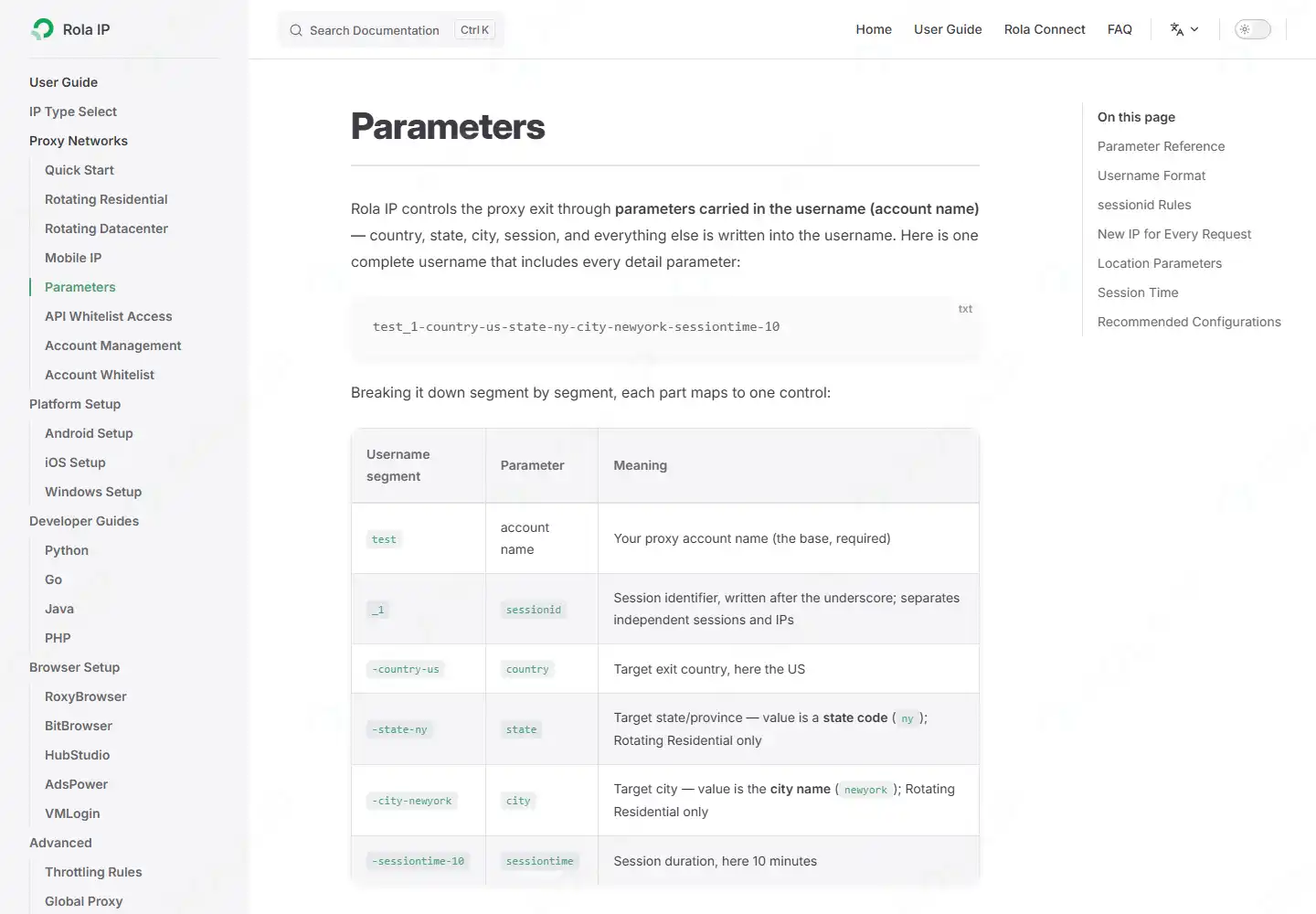
The network choice should follow the target and decision. Rotating datacenter proxies can be a cost-conscious starting point for high-volume public pages with modest access controls. Rotating residential proxies are more suitable when the workflow must reproduce country- or city-level storefront context. Sticky residential or static ISP sessions may fit permitted cart, delivery, or session-dependent checks that require a consistent identity during one collection cycle.
Managed APIs and no-code tools may already include routing, so do not add a separate proxy by default. In an authorized custom stack, a Rola IP web scraping proxy network can support the network layer while the team retains parsers, matching, normalization, schedules, storage, observability, tests, and compliance controls. It does not grant access permission, guarantee collection success, or replace data validation. Build this route only when the team is prepared to operate every layer.
Final Recommendation
Choose the best price scraping tools by solution layer. Use Prisync, Priceva, or Minderest when the business needs a finished monitoring workflow. Consider Browse AI, Apify, or Bright Data when it mainly needs collected records. Build with Scrapy or Playwright and a database when proprietary logic justifies ownership. In that authorized custom route, Rola IP can provide regional routing, rotation, and session infrastructure while the team retains matching, validation, monitoring, maintenance, and compliance. Compare alternatives by cost per fresh, correctly matched, usable record.