
Proxy-Seller Review (2026) A Buyer's Evaluation Guide

Sep 11, 2026 · Comparisons · 13 min read
TL;DR
Proxy-Seller may fit several proxy workloads, but suitability depends on the exact product, location, session behavior, traffic model, and authorized target. Treat published prices, IP-pool descriptions, and refund terms as dated supplier claims until the applicable order and policy are checked. Use one matched pilot for both providers: keep the worker region, target category, request volume, concurrency, session duration, and success criteria constant. This article provides an evaluation framework; it does not claim a paid-account performance winner.
Is this a measured Proxy-Seller review or a buyer’s evaluation guide?
This is a buyer’s evaluation guide unless paid-account test records are added. It summarizes purchasing questions and a reproducible pilot design, but it does not report verified provider-wide speed, uptime, IP-pool size, target acceptance, or refund outcomes. Buyers should document the selected order and run the authorized workload before choosing Proxy-Seller or Rola IP.
What Proxy-Seller offers
Proxy-Seller lists rotating residential, ISP, IPv4 datacenter, IPv6 datacenter, and mobile proxies. Verify the required protocol, management API operations, and support coverage for the selected product before purchase. That breadth is useful when different projects need different exit networks.
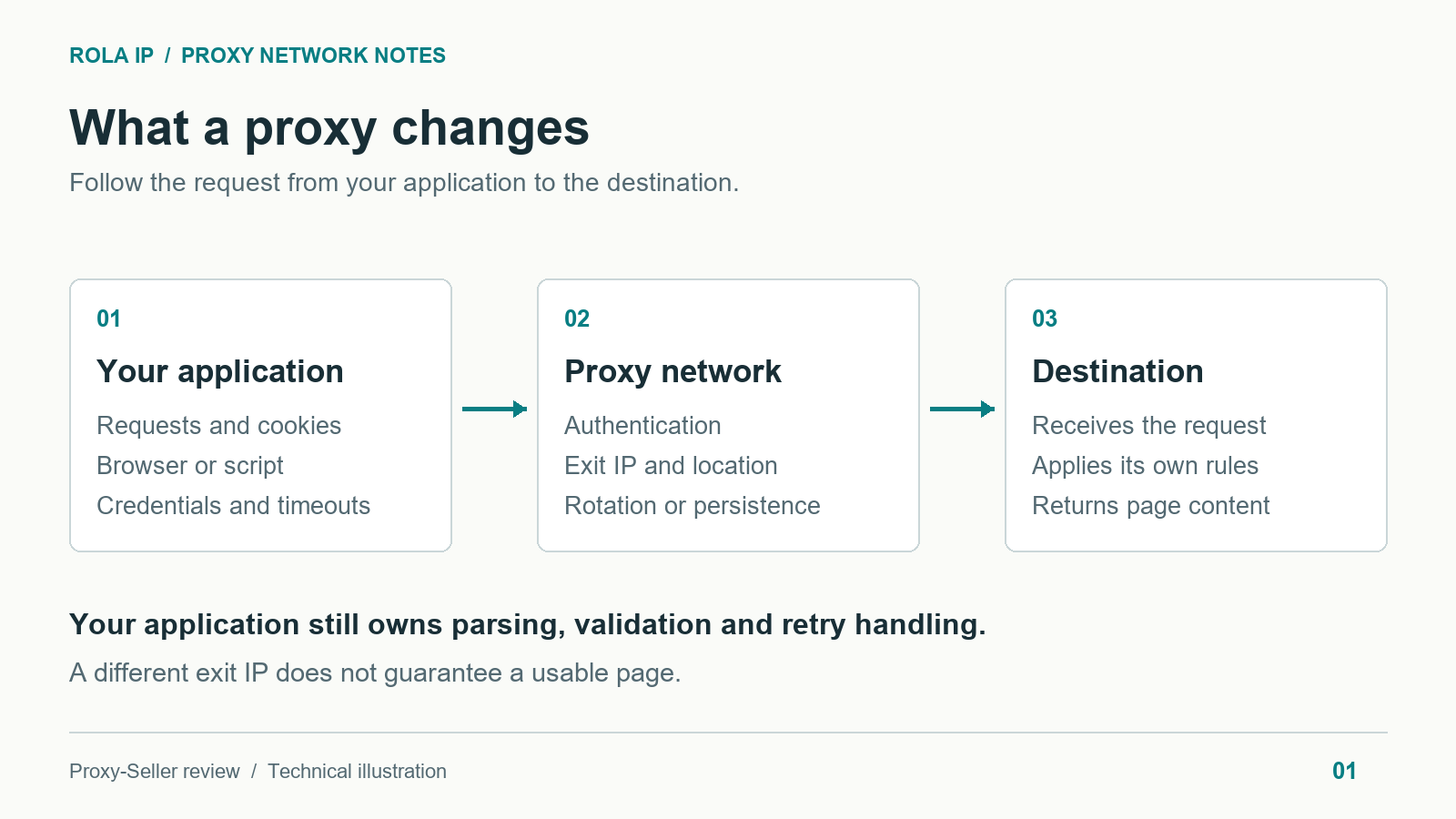
A proxy subscription supplies network access. Your application still needs to request pages, maintain cookies where appropriate, render JavaScript when necessary, extract fields, and check the results. Buying an address labeled for a particular platform does not establish that every workflow on that platform will succeed.
Rotating residential proxies: flexible exits, variable availability
For a rotating residential product, record the available country, city, and ISP filters, rotation triggers, sticky-session duration, and concurrent-connection limits. Record the selected product specification and date rather than relying on a global pool-size claim.
For buying purposes, the useful question is narrower: how many usable exits can the selected city provide during your operating hours? Adding city and ISP filters can reduce the available supply. A large global pool cannot answer that question by itself.
Static ISP proxies: continuity comes first
For a static ISP order, confirm address assignment, exclusive use, traffic allowance, and renewal continuity. If a specific city is mandatory, obtain confirmation before paying rather than assuming every advertised country supports city selection.
This category suits an authorized account workflow or monitoring task that needs the same exit across visits. “Static” describes address persistence; “dedicated” describes allocation. Record both, along with how replacements affect the assignment.
IPv4 and IPv6 datacenter proxies: check the destination
Datacenter proxies are a sensible starting point for public endpoints that accept hosting-network traffic. They can also suit uptime checks and application QA where a residential origin adds little value.
IPv4 and IPv6 are address families, not trust ratings. Before choosing a low-cost IPv6 package, verify the provider’s complete route to each destination, including any gateway or translation behavior. A tool accepting a proxy address is only the first compatibility check; the destination request must also work.
Mobile proxies: buy them for a cellular requirement
A mobile exit is relevant when the task depends on a carrier network, such as checking a mobile campaign or a carrier-specific experience. Ask about the country, operator, shared versus dedicated access, and what triggers an IP change. A dedicated modem or port does not necessarily give exclusive use of the carrier’s public IP.
Mobile connectivity also does not turn a desktop browser into a phone. Viewport, operating system, cookies, and application behavior remain separate test variables.
Proxy-Seller pricing: what the advertised rates mean
Treat each price as a combination of product, quantity, geography, and validity period. A per-GB residential rate is not directly comparable with a per-IP rental price.
Residential plans: verify the complete traffic package
A residential quote should state the purchased traffic allowance, total charge, effective price per GB, validity, and unused-traffic treatment. Record these values from the selected order, along with the date checked. A “from” rate may depend on a larger commitment or a different package.
Do not equate “pay as you go” with traffic that never expires. Check renewal settings, allowance expiry, additional-traffic charges, and whether failed or retried requests consume billable traffic.
Static and mobile prices: request a complete quote
For a static or mobile order, record the number of IPs or ports, geography, rental term, traffic conditions, and total charge. Ask what is dedicated: an assigned address, a port, or a device. Compare identical terms across providers.
Specific supplier prices are omitted here because a current order quote is needed to establish the applicable cost. The calculations below are illustrative procurement examples, not advertised Proxy-Seller prices.
Discounts: compare the final amount
A longer rental or a larger order may reduce the unit rate, but only if you use the capacity. Coupon availability and stacking rules should be checked at checkout rather than copied from another review.
For example, a $125 package containing 50 GB costs $2.50 per purchased GB. If only 20 GB is usable before its allowance expires, the effective cost is $6.25 per consumed GB. This is an illustrative utilization calculation, not a claim about Proxy-Seller’s expiry policy.
Calculate cost per accepted result
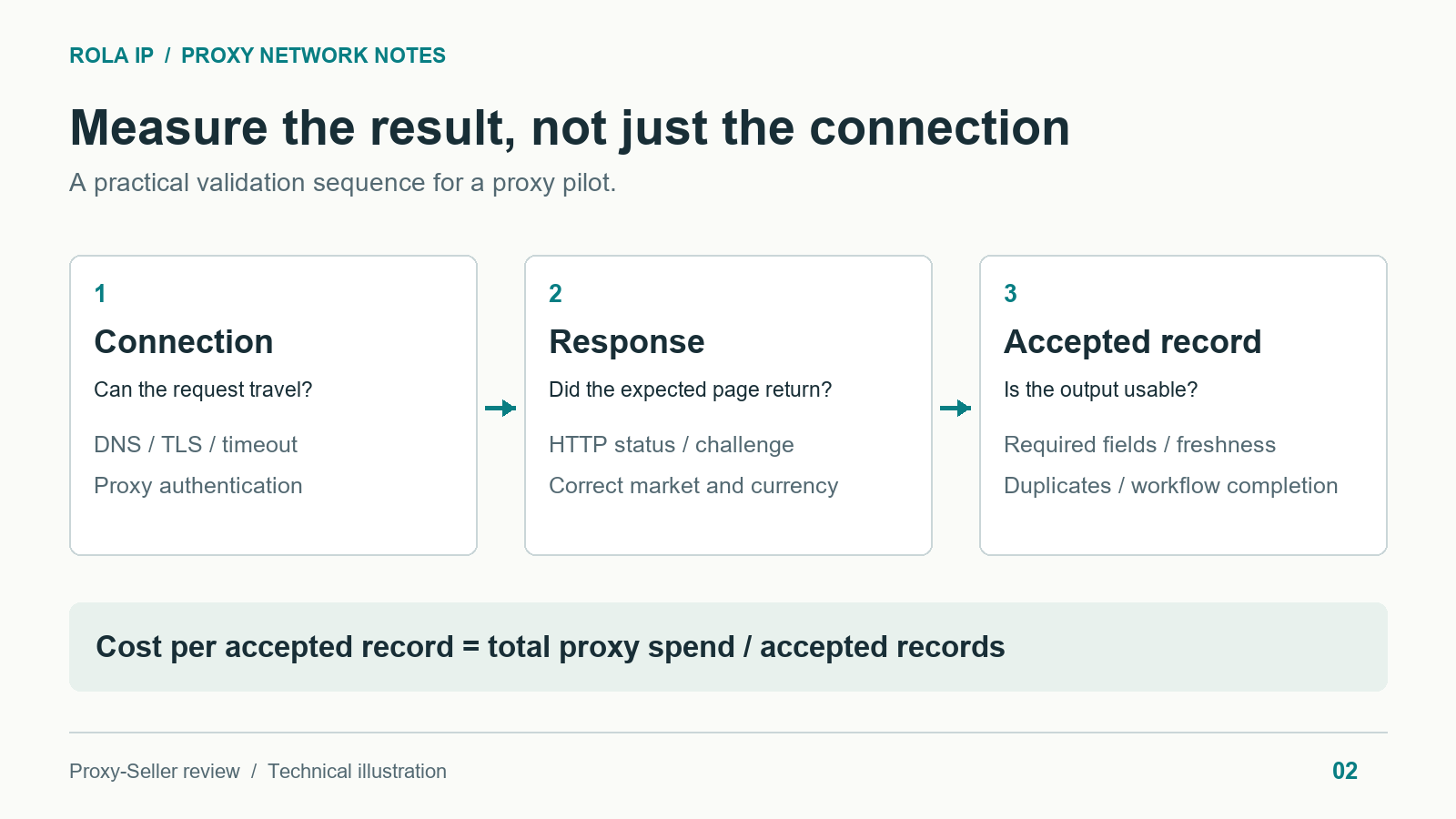
Use this procurement metric: total proxy spend divided by accepted records. Include all billed traffic, including retries and pages later rejected by validation. Track engineering and support costs separately, then add them when comparing total operating expense.
In an illustrative job, $30 spent on traffic producing 8,000 accepted records equals $3.75 per 1,000 records. If the same spend yields only 4,000 accepted records, the figure becomes $7.50. Both outcomes can come from an identical headline GB rate.
For a static-versus-metered comparison, divide the static rental cost by the metered GB price to find the nominal traffic break-even point. That calculation is meaningful only when both options meet the same success, location, and session requirements.
Performance: what a useful test should measure
Supplier uptime, response-time, and connection-success claims need a defined measurement scope. These are not interchangeable with an application successfully collecting the intended page. The IETF HTTP semantics standard defines 200 OK as a successful HTTP request. Your application still needs to validate the returned content: a page delivered with that status can contain a challenge screen, the wrong currency, or an empty result.
This review does not report invented speed scores or purchase-based test results. Use the following method to establish whether either provider works for your deployment.
Define success before sending traffic
For a product record, success might mean the expected product identifier, a valid price and currency, and the requested market. For an authorized account flow, success could require completing every step without an unexpected exit change. For localized QA, capture the expected regional content as well as the observed IP.
Count connection success, accepted-content success, and complete-workflow success separately. This prevents a fast connection from hiding an unusable response.
Run a controlled pilot
Choose the countries, target pages, and runtime region your production job actually uses. A starting pilot could include 100 requests per target and location at three times of day, followed by a longer run if results look promising. This is a screening exercise, not enough evidence for an uptime guarantee.
Hold the client version, headers, cookies, timeout, and concurrency constant between providers. Alternate comparable batches so one provider is not tested only during a quieter period. Use an endpoint you control to separate basic connectivity failures from target-specific failures.
Record exit IP, expected and observed location, response status, elapsed time, billed traffic, retries, and content-validation outcome. Redact credentials and sensitive response data from logs.
Measure latency distribution and failure clusters
Median latency describes a typical result. The 95th percentile shows slower requests that may delay a batch. Report timeouts separately and calculate latency over a clearly stated population; excluding failed requests without saying so makes a weak service look faster.
Group failures by location, target, time window, and exit network where possible. A cluster affecting one destination points to a different investigation from simultaneous failures across unrelated destinations.
Test sticky sessions and replacement behavior
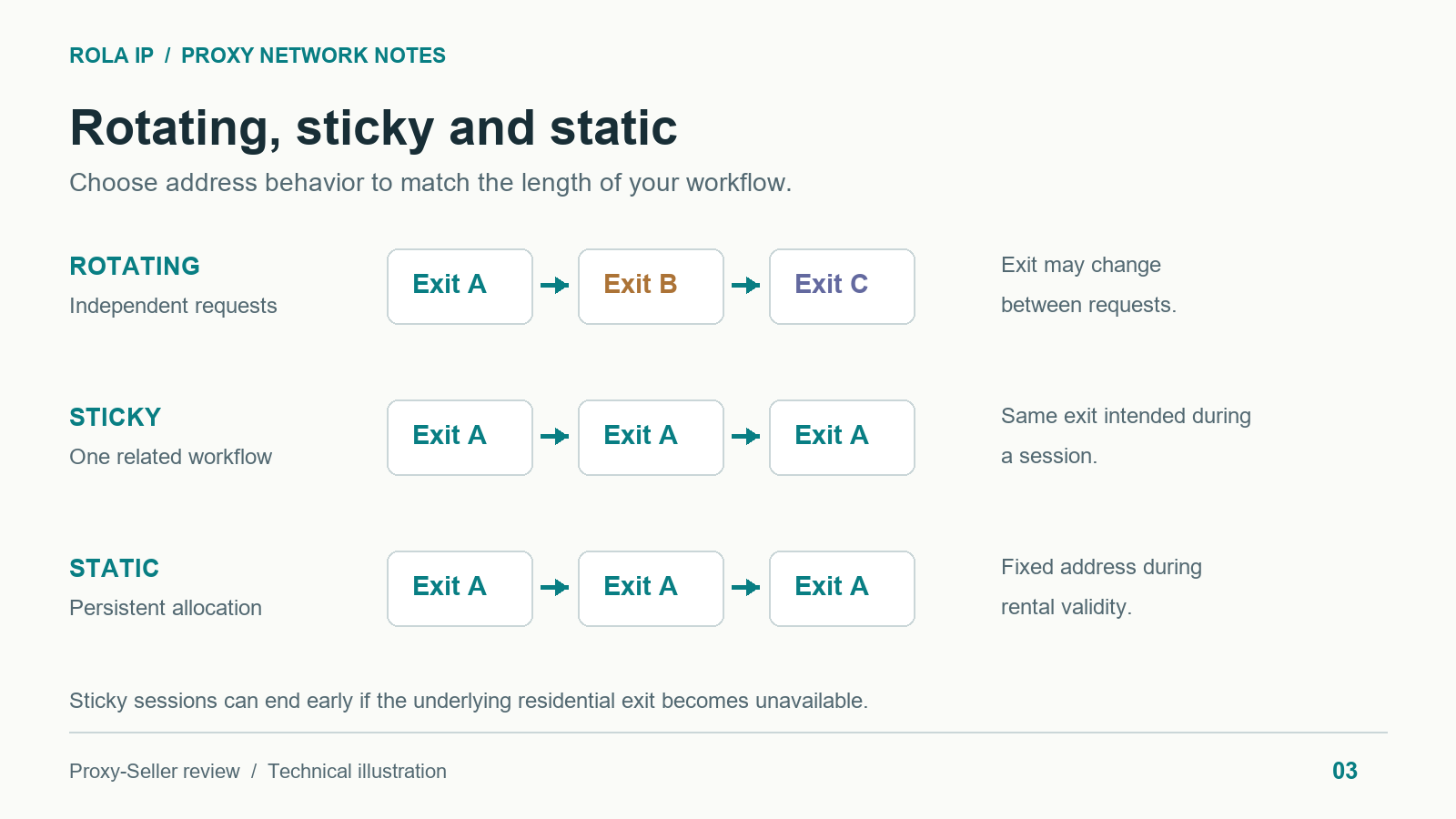
A sticky session asks the provider to retain an exit for a period. It is not the same promise as a rented static IP: an underlying residential device can become unavailable.
Observe a session for the full length your application needs. Check the exit repeatedly, then verify what happens when the session expires or a connection fails. Does the application stop, retry with the same session, or silently continue under another IP? For stateful work, silent switching may be worse than a visible failure.
Verify geolocation from the target’s perspective
IP databases can disagree, particularly at city level. Record the provider’s selected location, an independent IP lookup, and the destination’s actual regional response. The final one determines whether the business task worked.
If your workers run in mainland China, test from those workers and their actual network. A US cloud benchmark cannot establish the quality of a mainland China-to-gateway route. Measure connection setup, sustained transfers, and peak-hour stability rather than relying on a single ping.
How to use Proxy-Seller in a browser or application
1. Select the smallest representative order
Start with the required exit type and geography. For rotating traffic, estimate the bytes a full browser session will load, including images and scripts. For static access, determine the number of independent persistent sessions and their rental period. Confirm any mandatory city or carrier before purchase.
2. Copy the issued connection settings
After provisioning, obtain the actual host, port, protocol, and authentication values from the account. For rotating products, use the dashboard’s generated location and session settings. Do not transplant another provider’s username parameter syntax.
Proxy credentials authorize traffic through a proxy. A management API key authorizes account operations. Keep these secrets separate and store them outside source code and screenshots.
3. Validate the exit before using an account
Add the issued proxy to the application’s proxy settings and run a connectivity check. Confirm the observed exit, then load a harmless page to verify HTTPS and content delivery.
For a browser-profile manager such as Dolphin Anty, assign the intended proxy to the correct profile and keep cookies with that workflow. A proxy checker showing “active” establishes connectivity; it does not verify a complete business process. Use browser-profile tools only for accounts you own or have written authorization to manage, and follow the platform’s terms. A proxy connection does not grant access or bypass platform controls. Exact button names can change with the application version.
4. Add monitoring and bounded recovery
Set connection and response timeouts, cap retries, and apply backoff. Treat proxy-authentication failures differently from target-side responses. Repeated authentication failures should trigger a configuration check, while target throttling requires a slower request schedule and review of permitted access. For HTTP proxies, MDN explains that status 407 means valid proxy authentication credentials are missing. Check the issued credentials and authentication method before adding retries or replacing exit IPs.
Before automating orders, renewal, lists, or session settings, verify the current API documentation for the purchased product. Confirm the authentication scope, supported operations, maintained client libraries, and rate limits. Do not assume that one management key works across every product.
Match the proxy type to the workload
SERP and marketplace monitoring
Keep country, language, device settings, and collection time consistent. Rotate between independent checks when appropriate, but preserve a session for a sequence of related pages. Validate the returned market and currency before accepting data. A large number of addresses offers little benefit if the records describe the wrong region.
Advertising verification and localized QA
Use the network type the test calls for: residential for household-origin checks, mobile for carrier-specific behavior, or static addresses for repeatable regional sessions. Record placement, timestamp, consent state, and landing-page destination. Changing IP alone does not reproduce every aspect of a local user’s browser.
Authorized social media and account workflows
Use these workflows only for accounts you own or have written authorization to manage, and follow the platform’s terms. Consistency often matters more than frequent rotation. Map a persistent session to its intended exit, and avoid changing addresses in the middle of a sensitive workflow. IP reputation is only one signal; proxies do not guarantee that an account will avoid additional verification or platform restrictions.
Retail and travel collection
Travel searches and retail pages can depend on dates, cookies, region, and inventory timing. Keep those variables stable when comparing prices. Increase concurrency gradually and measure valid responses, not requests launched. Only load browser assets needed for the task, since unnecessary bytes can dominate metered costs.
AI datasets and market research
A reliable collection route is one part of a data pipeline. Preserve source URLs and timestamps, validate fields, remove duplicates, and maintain the required usage permissions. IP rotation cannot fix stale records or missing provenance. Build robots.txt handling into the crawler as well. IETF RFC 9309 defines the Robots Exclusion Protocol and explicitly distinguishes its rules from access authorization; permission to collect and reuse data needs separate consideration. Assess a web scraping proxy around the downstream dataset you need to produce.
Developer QA and security research
Proxies can provide a separate egress address for regional checks and authorized research. They do not replace browser isolation, endpoint protection, or a controlled execution environment. Choose a predictable static exit for repeatable tests and a rotating pool when exit diversity itself is the variable being tested.
Refunds, support, and trust: read the conditions
The refund window depends on the purchase
Read the refund policy applicable to the exact product before ordering. Confirm the request deadline, eligible reasons, required diagnostic evidence, replacement-first conditions, treatment of trials, and any non-refundable fees. Do not assume that all rental periods or product categories share one rule.
Specific refund windows are omitted here because eligibility must be checked against the applicable policy and order. Save the policy version and purchase timestamp, contact support promptly if the pilot fails, and retain the diagnostic record. A promotional money-back statement is not a substitute for the contract conditions.
Judge support by resolution quality
A quick first reply is helpful, but the useful outcome is a working configuration or a clear replacement decision. Submit a representative issue during the pilot and evaluate whether support distinguishes a routing problem, unavailable location, authentication error, and target-side rejection.
For recurring work, ask how incidents are escalated and whether planned maintenance, address replacement, and renewal affect persistent sessions.
Separate sourcing claims from procurement evidence
If a supplier advertises ethical sourcing or compliance credentials, review the relevant scope and documents before relying on them. Procurement teams can request evidence of residential participation consent, withdrawal mechanisms, subprocessors, and retention practices.
Apply the same standard to Rola IP and every other provider. An address being described as “clean” does not certify acceptance by all destinations, and a proxy subscription does not establish permission to collect or reuse a dataset.
What the available evidence supports
The available material supports a structured procurement review, not a measured provider ranking. Proxy-Seller may be worth shortlisting when a buyer needs to compare several proxy categories under one purchasing process. The unresolved items are order-specific pricing, location supply, session continuity, target acceptance, replacement handling, and applicable refund terms.
Those same questions should be applied to Rola IP. Choose the provider that meets the documented workload requirements at an acceptable cost per accepted result after the matched pilot is completed.
Proxy-Seller vs. Rola IP: when the alternative fits
Rola IP offers rotating residential and dedicated static IP resources for proxy workloads. Product availability, geographic coverage, protocol support, concurrency, traffic terms, and account controls are time-sensitive; verify the current limits in the relevant Rola IP product pages and documentation before purchase. Use the matched pilot described above for both providers.
Apply the same evidence standard to both suppliers. A headline pool size does not establish how many exits are available in your selected city today, and an availability target does not establish target-specific collection success.
Choose rotating resources for independent collection jobs
Use Rola’s residential proxy product page to confirm targeting, rotation, sticky-session options, concurrency, and traffic billing for your intended purchase. Save the applicable specification and date with the pilot record.
This category is relevant for scheduled SEO checks, ad verification, and market research that scale with collection volume. Increase concurrency only while valid-result rates and destination limits remain acceptable. Match the session behavior to the full workflow, not just the first page.
Choose dedicated static IPs for continuity and traffic predictability
Review Rola’s ISP proxies when the address must remain stable during the valid period. Confirm dedicated assignment, supported protocols, traffic conditions, renewal continuity, and replacement rules for the selected order.
If the purchased plan includes unlimited traffic during validity, it can make sustained-use costs easier to predict. Confirm any applicable speed, concurrency, or usage conditions. A dedicated allocation does not eliminate target-specific reputation issues, so test the address against the authorized workflow before expanding.
Evaluate routing and team controls alongside IP quality
If your workers run in mainland China or another specific region, request routing information for that deployment and measure it locally. Do not infer route quality from a benchmark collected in an unrelated cloud region.
For team use, verify API integration, supported authentication modes, subaccount availability, and quota controls in the current product documentation. If combined authentication is offered, confirm whether both credentials and the source IP must pass. These are purchasing requirements to verify, not assumed capabilities of every plan.
Make the final choice with a matched pilot
Shortlist Proxy-Seller for a multi-product evaluation. Compare Rola IP when your pilot requires rotating residential or dedicated static resources, a defined routing region, and account controls. Check current product limits in the official documentation before purchase. Neither vendor can be declared universally faster from public specifications.
Send both providers the same brief: countries and cities, target types, request volume, runtime location, session duration, concurrency, and budget. Compare accepted-result cost, continuity, and support resolution. Expand the supplier that meets those requirements without introducing unacceptable operational overhead.
Record both pilots under the same conditions
Create one record per provider and test configuration. Until the pilot runs, mark each result Pending test. Keep the request logs and support ticket references with the record.
- Configuration: Test date and time window; provider; product; country/city; worker region; target category; session duration; concurrency.
- Volume and output: Total requests; accepted records; billed GB; retries; complete-workflow success.
- Performance: P50 and P95 latency; timeout count; failure categories; observed exit and location.
- Support and cost: Ticket reference; resolution time; proxy spend; cost per accepted record.
Before buying: a practical checklist
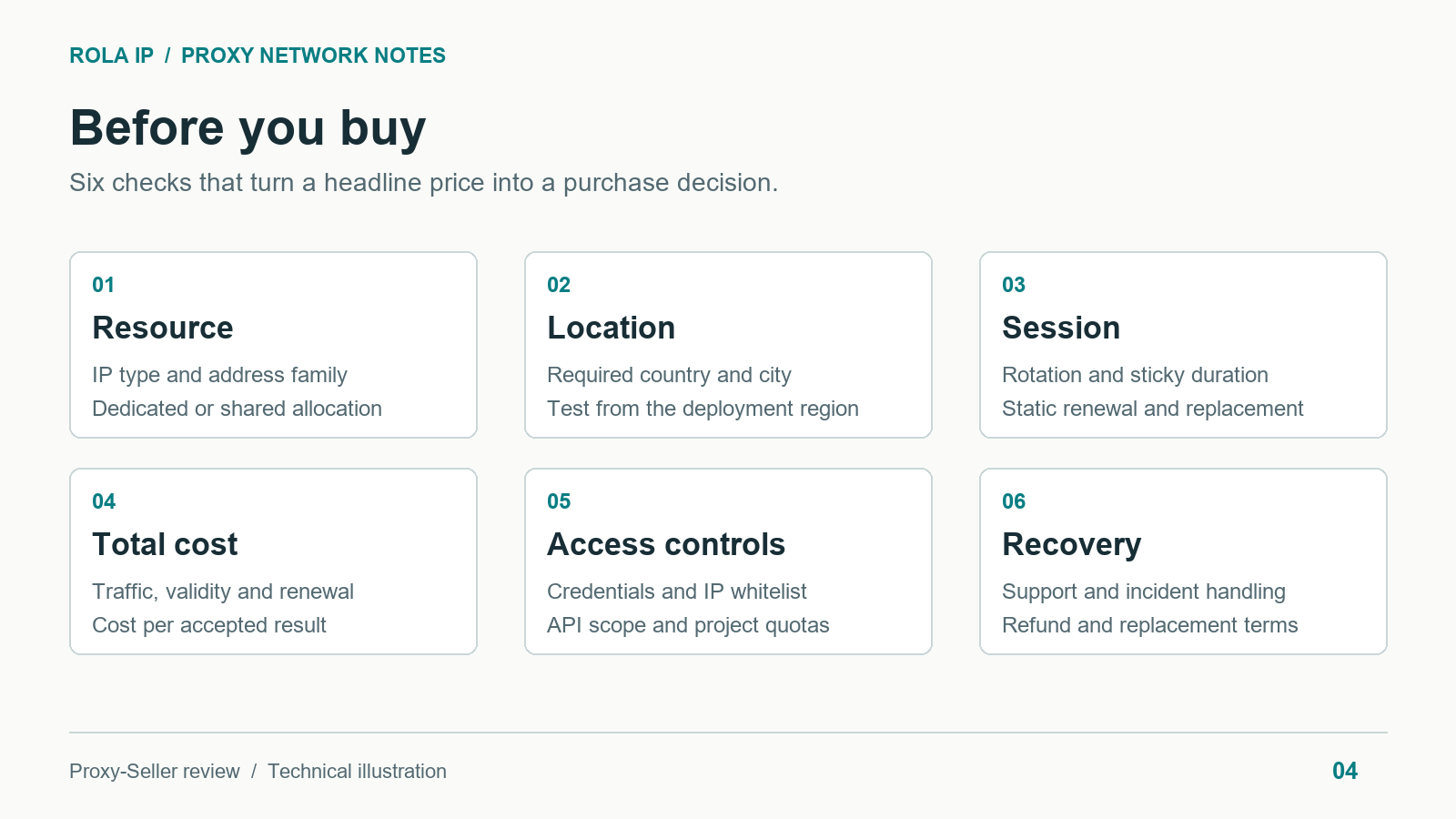
- Confirm the resource. Specify residential, ISP, datacenter, or mobile; verify address family and exclusivity where needed.
- Confirm geography. Check country, city, and carrier availability for the actual product.
- Confirm session behavior. Establish rotation triggers, sticky duration, replacement behavior, and static renewal continuity.
- Confirm the bill. Record total price, traffic allowance or unlimited-traffic conditions, validity, renewal, and fees.
- Confirm access controls. Test credentials, whitelist behavior, quotas, and the correct API key scope.
- Confirm the pilot result. Measure accepted content, latency, route stability, and complete workflows.
- Confirm the remedy. Read the applicable refund and replacement terms before the window begins.
Final decision rule
Because no paid-account benchmark is included, this article should be published as a Proxy-Seller Review buyer’s evaluation guide rather than as a completed performance review. The practical decision rule is simple: document the exact offer, run one matched authorized pilot, compare accepted-result cost and session behavior, and retain the logs and support outcome. If those records are later added, the page can be updated with measured results.