
Scraping Real Estate Data: A Compliant Python Workflow

Aug 24, 2026 · Guides · 8 min read
TL;DR
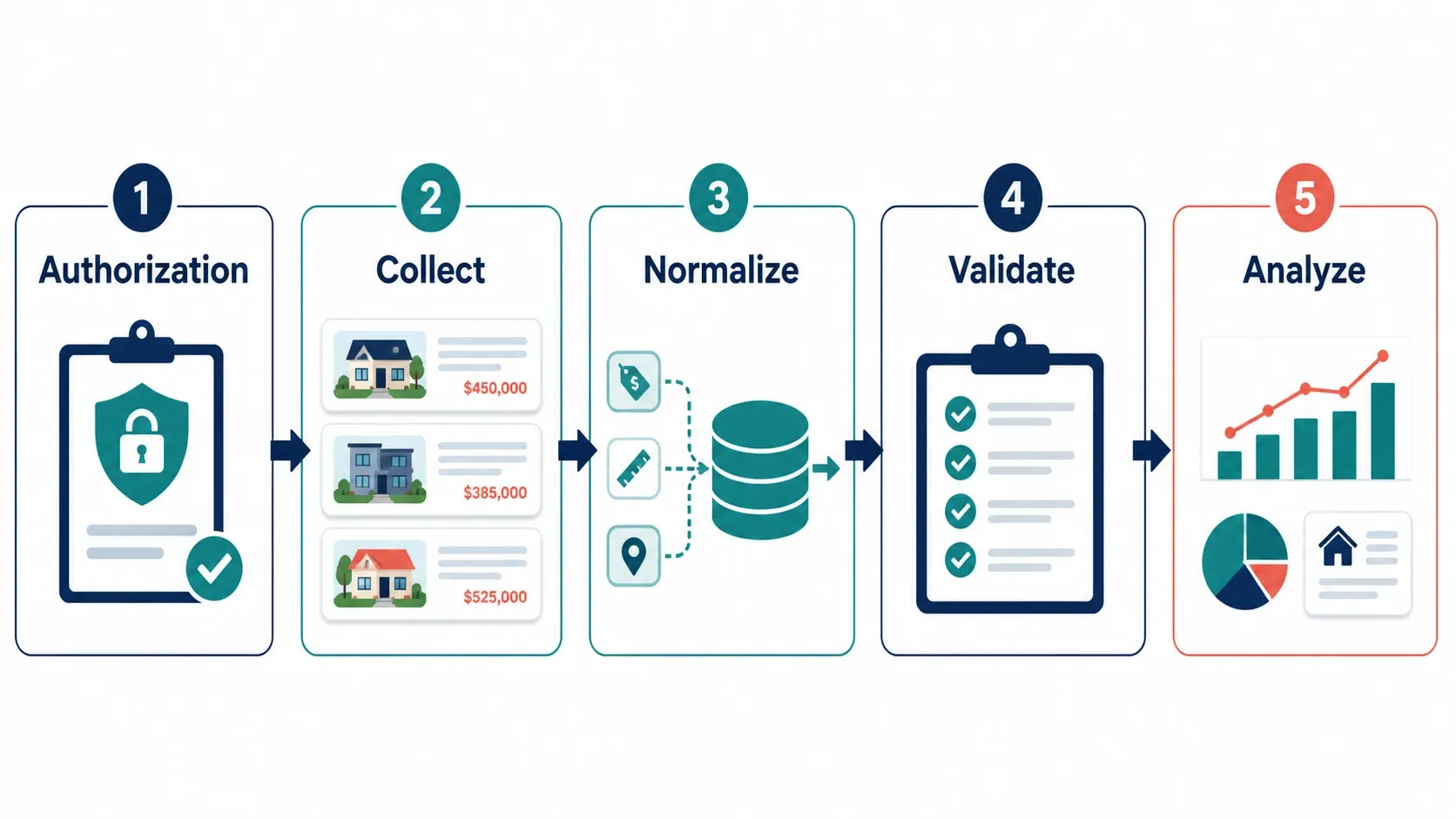
- Use an official API, a licensed feed, a partner export, or pages you are explicitly authorized to collect.
- Define a small schema with a stable source ID, raw values, normalized values, and capture timestamps.
- Test parsers on saved authorized fixtures before using a live endpoint.
- Treat 401, 403, 429, and challenge pages as stop signals; use the source’s documented route instead of a workaround.
- Preserve provenance and validation results so each market-data point can be reviewed later.
Choose the right source before you write code
The best source is not always the page with the most listings. A stable real estate web scraping program starts with a source you can use for the intended purpose.
| Source type | Best use | What to confirm |
|---|---|---|
| Official API | Product features, regular analysis, supported integrations | Terms, quota, geographic coverage, attribution, and allowed storage |
| Licensed feed or data vendor | Broad market research and historical datasets | License scope, refresh schedule, permitted redistribution, and identifiers |
| Partner export | A known broker, agency, or property manager relationship | Field definitions, delivery format, consent, and update ownership |
| Authorized public pages | Narrow research or QA where the publisher permits automated collection | Terms, robots policy, crawl rules, rate guidance, and contact route |
Check the source agreement first. robots.txt can describe crawl preferences and manage crawler traffic, but it is not a substitute for permission or a commercial data license. It is a technical policy signal, not a blanket approval for a different service or purpose.
For an authorized public source, record the approval, the allowed URL patterns, the fields you may keep, and the collection window in a short source register. That register is more valuable than an improvised workaround when someone later asks where a price, listing status, or address came from.
Define the dataset for your real estate scrape
Collecting every visible field usually creates more risk and more cleaning work. Begin with the question you need to answer: inventory change, asking-price trends, rental availability, neighborhood coverage, or listing freshness.
Here is a practical baseline schema for web scraping real estate data from an authorized source:
| Field | Why it matters | Validation example |
|---|---|---|
source_listing_id |
Stable key for deduplication and history | Required and unique within a source |
listing_url |
Provenance and review path | Must match an approved domain |
captured_at |
Explains when the observation was made | UTC timestamp required |
status |
Separates active, pending, sold, and removed records | Map to a controlled vocabulary |
price_amount and currency |
Makes price analysis possible | Numeric value and ISO currency code |
bedrooms, bathrooms, area_sqft |
Supports comparable-property analysis | Non-negative values; preserve missing values |
city, region, postal_code |
Enables approved geographic aggregation | Normalize abbreviations and formats |
source_updated_at |
Helps distinguish new data from a fresh fetch | Parse only if the source supplies it |
Avoid collecting personal contact details, resident information, or other personal data unless you have a documented lawful purpose, a valid collection basis, and suitable handling controls. For many market analyses, aggregate location and property attributes are enough.
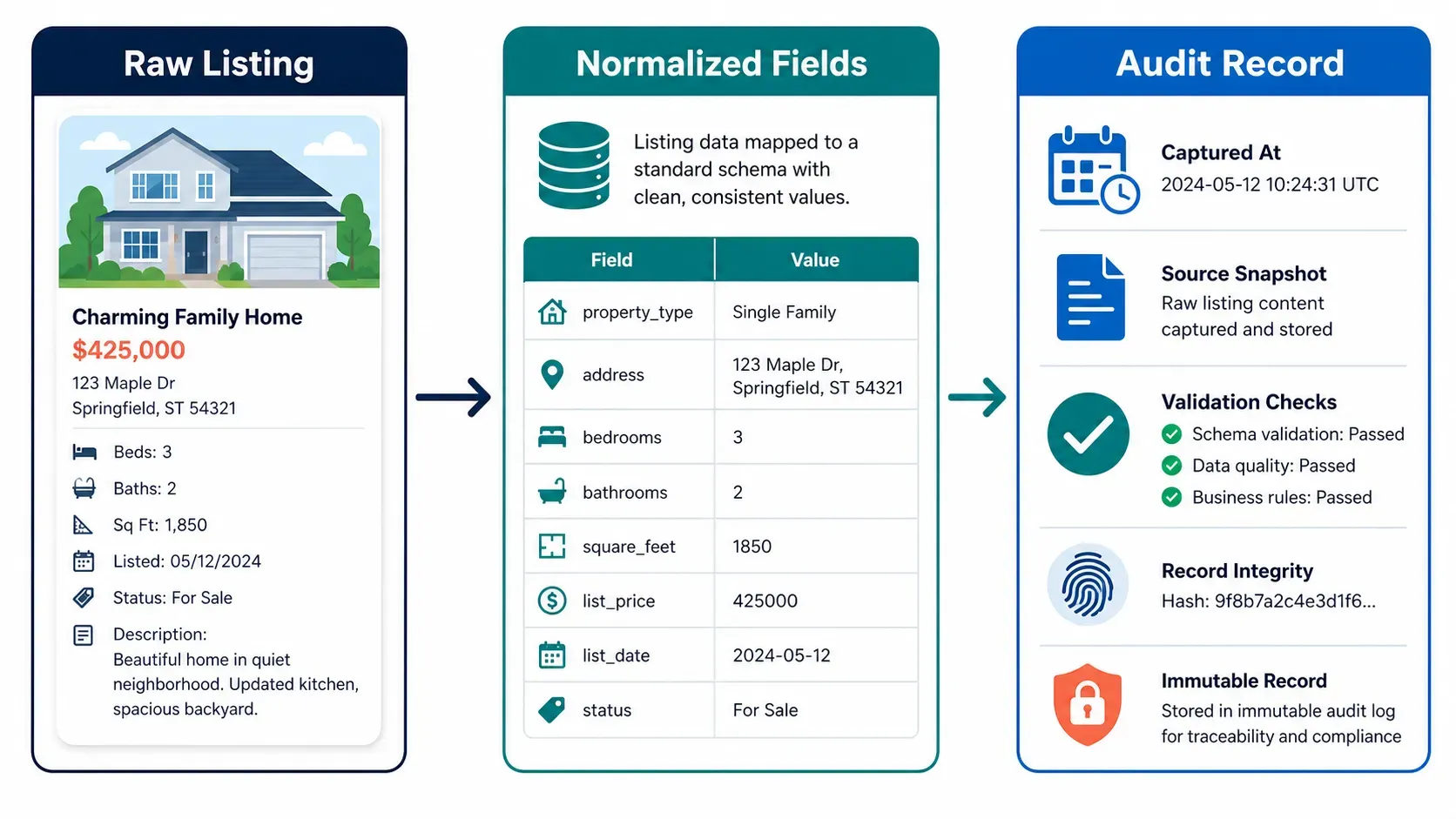
Figure 2. Keep the source record, normalized fields, and audit information together. AI-generated explanatory illustration.
Build a parser you can test offline
Before contacting a live service, develop the extraction logic against saved, authorized HTML fixtures. This makes changes easy to review and prevents a parser bug from creating unnecessary traffic.
Install the example dependencies
The following example was executed with Python 3.12, beautifulsoup4 4.12.3, and requests 2.32.3 on 2026-08-21. Use a virtual environment in a real project and pin versions in its dependency file.
python -m venv .venv
.venv\\Scripts\\activate
python -m pip install "beautifulsoup4==4.12.3" "requests==2.32.3"
The example below parses a simple listing card. Replace the selectors only after you have permission to process that source’s pages. It deliberately contains no code for concealing automation, handling challenges, or evading limits.
from __future__ import annotations

from dataclasses import asdict, dataclass
from datetime import datetime, timezone
from decimal import Decimal
import re
from urllib.parse import urljoin

from bs4 import BeautifulSoup


@dataclass
class Listing:
    source_listing_id: str
    listing_url: str
    price_amount: Decimal | None
    bedrooms: int | None
    bathrooms: Decimal | None
    area_sqft: int | None
    captured_at: str


def parse_number(text: str) -> Decimal | None:
    match = re.search(r"[0-9][0-9,.]*", text.replace(",", ""))
    return Decimal(match.group()) if match else None


def parse_listing(html: str, source_base_url: str) -> Listing:
    soup = BeautifulSoup(html, "html.parser")
    card = soup.select_one("article.listing-card")
    if card is None:
        raise ValueError("Expected one listing-card in the authorized fixture")

    link = card.select_one("a.listing-link")
    if link is None or not link.get("href"):
        raise ValueError("Listing URL is missing")

    def text_for(selector: str) -> str:
        node = card.select_one(selector)
        return node.get_text(" ", strip=True) if node else ""

    price = parse_number(text_for(".price"))
    beds = parse_number(text_for(".beds"))
    baths = parse_number(text_for(".baths"))
    area = parse_number(text_for(".area"))

    return Listing(
        source_listing_id=card["data-listing-id"],
        listing_url=urljoin(source_base_url, link["href"]),
        price_amount=price,
        bedrooms=int(beds) if beds is not None else None,
        bathrooms=baths,
        area_sqft=int(area) if area is not None else None,
        captured_at=datetime.now(timezone.utc).isoformat(),
    )


fixture = """
<article class="listing-card" data-listing-id="A-1042">
  <a class="listing-link" href="/listings/A-1042">View listing</a>
  <span class="price">$425,000</span><span class="beds">3 beds</span>
  <span class="baths">2.5 baths</span><span class="area">1,840 sq ft</span>
</article>
"""

print(asdict(parse_listing(fixture, "https://partner.example")))
Fixture test passed on 2026-08-21. The final timestamp varies because it records the UTC time of the test run.
{
  'source_listing_id': 'A-1042',
  'listing_url': 'https://partner.example/listings/A-1042',
  'price_amount': Decimal('425000'),
  'bedrooms': 3,
  'bathrooms': Decimal('2.5'),
  'area_sqft': 1840,
  'captured_at': '2026-08-21T04:24:52.156810+00:00'
}
Add fixture tests for missing prices, price reductions, studio listings, non-numeric area values, and discontinued listings. A parser should produce an explicit None or a validation error rather than silently turning unknown data into zero.
Fetch only through an approved access path
Once the parser is tested, connect it to an API, feed, or URL range the source has approved. Identify your client truthfully, use a documented contact address where appropriate, and treat the source’s response codes as operational rules.
from email.utils import parsedate_to_datetime
from datetime import datetime, timezone

import requests


def retry_after_seconds(value: str | None) -> int | None:
    if not value:
        return None
    if value.isdigit():
        return int(value)
    retry_at = parsedate_to_datetime(value)
    return max(0, int((retry_at - datetime.now(timezone.utc)).total_seconds()))


def fetch_authorized_page(url: str) -> str:
    response = requests.get(
        url,
        headers={"User-Agent": "AuthorizedMarketResearch/1.0 (data-team@example.com)"},
        timeout=20,
    )

    if response.status_code == 429:
        delay = retry_after_seconds(response.headers.get("Retry-After"))
        raise SystemExit(f"Rate limited. Stop and follow the source policy. Retry-After: {delay}")
    if response.status_code in {401, 403}:
        raise SystemExit("Access is not authorized for this request. Use the source's approved route.")

    response.raise_for_status()
    return response.text
Do not turn a 429 response into a race between new IPs or new accounts. Under IETF RFC 9110, 429 means “Too Many Requests” and Retry-After can indicate when a request may be retried. A 401 or 403 requires an authorization review, not a technical bypass.
If your approved workflow uses Rola IP, first test credentials and routing using the proxy quick start, then keep the connection settings consistent with the documented proxy parameters. Network configuration does not replace source permission, source quotas, or a stop-on-error policy.
Normalize, validate, and preserve provenance
Raw listing text is rarely analysis-ready. Normalize values without erasing what the publisher originally provided. Store the raw source text alongside the normalized value whenever it affects a metric.
For example, keep $425,000 as raw_price_text, save 425000 as price_amount, and record USD only when the source or locale supports that inference. Treat “price on request”, auctions, weekly rent, and mixed currencies as separate cases rather than forcing them into one price column.
Use these checks before publishing an analysis:
- Deduplicate on
source + source_listing_id, not just the address. - Reject impossible values, such as negative area or a price with no currency context.
- Flag large changes for review instead of overwriting the prior observation.
- Keep
captured_at, source URL, parser version, and a source-content hash. - Measure null rates and selector failures on every run.
This history lets you distinguish a genuine price reduction from a parser regression. It also gives the business team a clear answer when a record is questioned weeks later.
Match the network setup to an authorized workflow
The network requirement should come after permission, data quality, and rate policy decisions. For an approved use case, select a configuration that the source permits and that your organization can audit.
| Authorized scenario | Suitable starting point | Control to keep |
|---|---|---|
| Your own API, staging site, or low-risk partner endpoint | Datacenter route or direct connection | Fixed allowlist, quota monitoring, and logs |
| Permitted regional QA from a broker partner | Location-appropriate residential proxy | Written approval, a narrow session scope, and low request volume |
| Testing an authorized mobile property experience | Approved mobile test environment | Test accounts, release window, and owner contact |
| Long-running partner export | Stable approved route | Credential rotation, least privilege, and delivery reconciliation |
For an authorized collection workload, a web scraping proxy can be evaluated only after the source permissions and rate policies are set. Do not use proxy rotation to defeat blocks, evade a platform’s enforcement, or hide who is collecting data.
Decide whether to build or use real estate data scraping services
Building is attractive when you have a small number of stable, permitted sources and need transparent logic. Real estate data scraping services can make sense when they offer a license, clear provenance, a defined service level, and the right to use the fields you receive.
| Question | Build an internal workflow | Consider a licensed service |
|---|---|---|
| Do you need custom quality rules? | Yes, especially for niche property types | Only if raw fields and audit details are available |
| Do you need historical coverage quickly? | Usually slow to assemble | Often faster if the license includes history |
| Can the source change often? | Budget for monitoring and parser maintenance | Verify who handles changes and how failures are disclosed |
| Do you need to redistribute data? | Obtain rights separately | Confirm redistribution terms in writing |
Ask a provider for a sample data dictionary, source provenance, refresh definitions, geographic coverage, retention terms, and a process for correcting records. A service’s technical capability does not itself make a collection permitted.
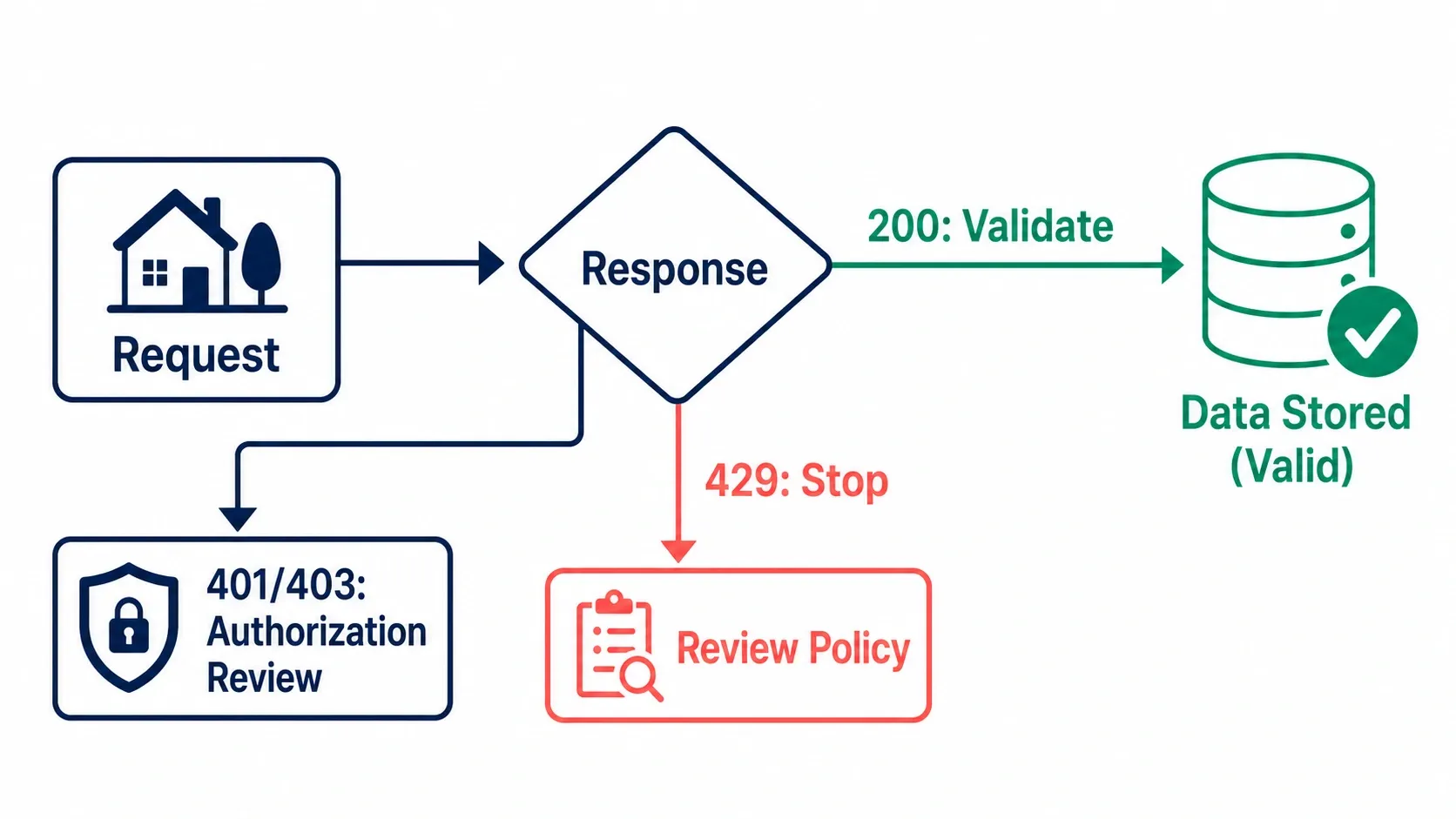
Figure 3. Stop on access or rate-limit signals, review the policy, then resume only through an approved route. AI-generated explanatory illustration.
Troubleshooting an authorized collection job
| Symptom | Likely cause | Safe next step |
|---|---|---|
| A previously populated field is suddenly blank | The page, feed, or API schema changed | Compare the fixture with the source documentation and update tests |
| Many duplicate listings appear | The source ID is absent or the dedupe key is weak | Use the publisher’s stable ID; otherwise record a reviewed composite key |
| HTTP 429 appears | Your job exceeded the allowed rate | Stop, honor Retry-After, and request a higher quota if needed |
| HTTP 401 or 403 appears | Credentials, entitlement, or policy changed | Pause the job and contact the source owner or use the documented API route |
| Price trends look implausible | Currency, unit, or property status was mixed | Segment before comparing and audit raw values |
| Listing counts fall sharply | Coverage changed or extraction failed | Check source health, null rates, and source-side inventory notes |
Build for reliability, not just the first run
Scraping real estate data responsibly is a data-engineering task as much as a collection task. Define a permitted source, capture only useful fields, test the parser offline, stop when access controls say to stop, and keep enough provenance to explain every record. That approach produces a dataset your team can trust and maintain.