
Web Scraping Golang vs Python: Performance, Cost, and When Each Wins

Sep 4, 2026 · Comparisons · 12 min read
This guide compares Golang vs Python for web scraping across performance, concurrency, browser automation, parsing, deployment, and cost per valid page. Consider two scraping jobs. In the first, product-page layouts keep changing: a price moves into embedded JSON, pagination changes, and one category suddenly needs a browser. Python helps the team inspect responses, adjust selectors, and test the next version quickly.
In the second, the crawler downloads a stable set of HTML pages around the clock. Extraction rules are settled, while worker memory, request scheduling, and deployment effort now shape the monthly bill. Go is a strong candidate for that fetch layer.
Both jobs are web scraping, yet they reward different strengths. The question I need to answer is: How quickly will my project change, where will most of its cost come from, and which language fits the way I plan to run it—Go or Python? This guide provides that decision path.
Key Takeaways
- Python handles uncertainty better. It is the practical starting point when the target is new, extraction rules are changing, browser automation is central, or the data moves straight into analysis.
- Go earns its place through measurement. Its concurrency and deployment model matter when a stable HTTP workload shows a real throughput, memory, or worker-management bottleneck.
- A fair benchmark holds the whole job still. Both versions need the same URLs, concurrency, connection reuse, proxy settings, retries, extracted fields, and definition of success.
- Cost per valid page beats raw requests per second. A faster run has little value if it returns challenge pages, misses fields, or creates more engineering work.
Match the Language to the Workload
Match the language to the work the scraper performs before comparing runtimes. This table is a practical first filter:
| Your situation | Better starting point | Why |
|---|---|---|
| First scraper or proof of concept | Python | The path from request to parsed data is short |
| Selectors and extraction rules change frequently | Python | The parsing ecosystem makes iteration easier |
| JavaScript-heavy pages | Python | It has official Playwright support and a mature browser-tooling path |
| Stable, recurring HTTP crawl at high concurrency | Go | Goroutines and reusable HTTP clients fit this workload well |
| Data goes into pandas, NLP, or ML | Python | Collection and analysis can stay in one environment |
| A fleet of long-running workers | Go | A compiled executable can simplify packaging and deployment |
| Blocks, CAPTCHA pages, or proxy failures dominate | Access configuration | Network, session, and request controls decide the result |
Use the table to narrow the choice, then measure the part of the pipeline consuming the time or budget.
Python for Web Scraping: Where It Wins
Python fits projects that reward fast development, flexible parsing, browser automation, and direct access to data tools.
A short path from a script to a crawler
Requests or HTTPX handle straightforward HTTP fetching, while Beautiful Soup and lxml parse HTML. As the project grows, Scrapy adds scheduling, middleware, retries, item pipelines, throttling, and a crawler structure.
This layered toolkit suits volatile targets. Developers can change a parser, pagination rule, or browser step without restructuring the whole application.
It also supports gradual growth. A team can begin with a request-and-parser loop, then add scheduling, throttling, persistence, and failed-URL replay as the target becomes better understood. That progression keeps early experiments small while leaving a clear route to a maintained crawler.
Python handles concurrent network work
Page downloads spend much of their time waiting for I/O. Python overlaps those waits through asyncio, asynchronous HTTP clients, or Scrapy. The official asyncio documentation positions it for I/O-bound network workloads. Scrapy settings provide global and per-domain concurrency controls.
A fair comparison pairs one of those approaches with a properly configured Go worker. PEP 779 also moved Python 3.14’s free-threaded build into official support; it remains an optional build rather than the standard deployment assumption.
An asynchronous Python crawler still needs structure: one long-lived HTTP session, a bounded work queue, per-domain limits, explicit timeouts, and retry rules. Keeping fetch, parse, and storage stages separate makes slow synchronous code easier to spot and prevents the downloader from overwhelming the next stage.
Browser automation and data work fit naturally
Microsoft’s Playwright language documentation officially supports Python, giving teams a direct route to browser contexts, locators, waits, screenshots, and network inspection.
Python also keeps collection and analysis in one environment when records move into pandas, notebooks, NLP, or machine-learning workflows. That removes a service handoff and a duplicate data contract.
Browser tooling also helps during target discovery. Network inspection can reveal the JSON endpoint behind a rendered page, while screenshots and saved HTML make failed selectors reproducible. Once the data path is known, the final crawler can use a direct request where the site and access rules permit it.
Where Python starts to hurt
Mature Python services can accumulate large dependency sets, packaging work, and complex asynchronous control flow. Cancellation, backpressure, and retry behavior also require more care than a basic script. These are the right areas to profile as worker counts grow.
Useful warning signs include rising memory across long runs, blocked event-loop tasks, slow container startup, and dependency conflicts between the crawler and analysis stack. Each signal points to a specific engineering task and gives the team a baseline for evaluating a change.
Go for Web Scraping: Where It Wins
Go fits scraping systems that behave like network services: long-running workers, predictable inputs, high request volume, and clear operational limits.
Concurrency is close to the network layer
Goroutines, channels, contexts, and worker pools keep concurrent I/O close to the network layer. The standard library exposes timeouts, connections, proxies, redirects, headers, and cancellation.
The Go net/http documentation recommends reusing Client and Transport objects across concurrent requests. Reuse preserves connection pooling; a worker limit keeps memory, proxy capacity, and target load under control.
A typical worker pool lets a fixed number of goroutines pull URLs from a queue, pass results to a parser or writer, and stop through a shared context. This makes queue depth, active workers, retries, and shutdown behavior visible operational controls instead of scattered goroutines.
Colly covers the core crawler jobs
Colly adds per-domain delays and concurrency limits, cookie and session handling, synchronous or asynchronous collection, caching, distributed scraping, and robots.txt support. goquery covers CSS-style HTML selection. Browser work can run through chromedp, Rod, or a separate browser service.
Colly is useful when the crawler follows links, maintains sessions, and applies callbacks as responses arrive. Teams that need custom protocols, unusual retry state, or a tightly controlled data pipeline can stay closer to net/http and add only the pieces the service requires.
Deployment can be a real advantage
A Go scraper compiles into an executable that fits cleanly into containers, scheduled workers, and small server images. Across a worker fleet, this reduces runtime and package-management steps. A single scheduled script gains far less from that advantage.
The binary still travels with the configuration and assets the job needs, such as certificates, browser files, or selector rules. Keeping those inputs explicit makes worker versions easier to reproduce across development, staging, and production.
Where Go asks for more work
Static types and explicit error handling make long-lived services easier to reason about, while adding code to small selector and schema changes.
A Go fetcher also adds a service boundary when downstream cleaning and analysis remain in Python. The team then owns another data contract, deployment, and set of logs, so the fetch layer needs a clear operational payoff.
Golang vs Python Performance for Web Scraping: How to Compare Them Fairly
Performance changes with the stage being measured:
| Workload | What dominates the result | What a fair comparison isolates |
|---|---|---|
| Downloading static HTML | Network waits, connection reuse, and HTTP scheduling | Fetch the same bytes with the same concurrency and timeout |
| Parsing stored HTML | Parser behavior, CPU, and memory allocation | Parse identical local files without network traffic |
| Crawling a large URL list | Worker scheduling, connection pools, retries, and backpressure | Use the same queue, limits, and failure policy |
| Rendering JavaScript | Browser startup, page scripts, resources, and waits | Use the same browser version, page actions, and blocked resources |
| Cleaning and storing data | Transformations, validation, serialization, and database writes | Produce the same schema in the same destination |
Go has the clearest advantage in concurrent HTTP work. Chromium and page execution shape browser-heavy results, while analysis-heavy pipelines favor Python’s ecosystem.
For a useful diagnosis, run the stages separately as well as end to end. Fetch a fixed URL set without parsing, parse saved HTML without network traffic, then run the complete pipeline. The three results show whether the language affects downloading, parsing, or only a small part of total runtime.
Hold the test conditions still
A useful comparison gives both implementations the same job:
| Control | Why it must stay fixed |
|---|---|
| URL set, machine, network, and test window | Page, hardware, and route differences distort the result |
| Concurrency ceiling and connection reuse | In-flight requests and connection setup directly affect throughput |
| Timeouts, retries, and delays | These settings change both duration and success rate |
| Parsing, validation, and storage | Each program must complete the same work |
| Warm-up, repeated runs, and success definition | Repetition exposes startup effects; required fields define a valid result |
For a stateless batch crawl, both implementations can use the same residential proxy. Python passes the proxy endpoint to aiohttp, HTTPX, or Scrapy; Go assigns the same endpoint to the reusable http.Transport or Colly client. Teams implementing the two clients can reference the Python proxy integration and Go proxy integration documentation. Keep the protocol, target region, session mode, and rotation rule identical, then require the same parsing, validation, persistence, and usable records. The comparison now reflects the application implementations instead of two different network paths.
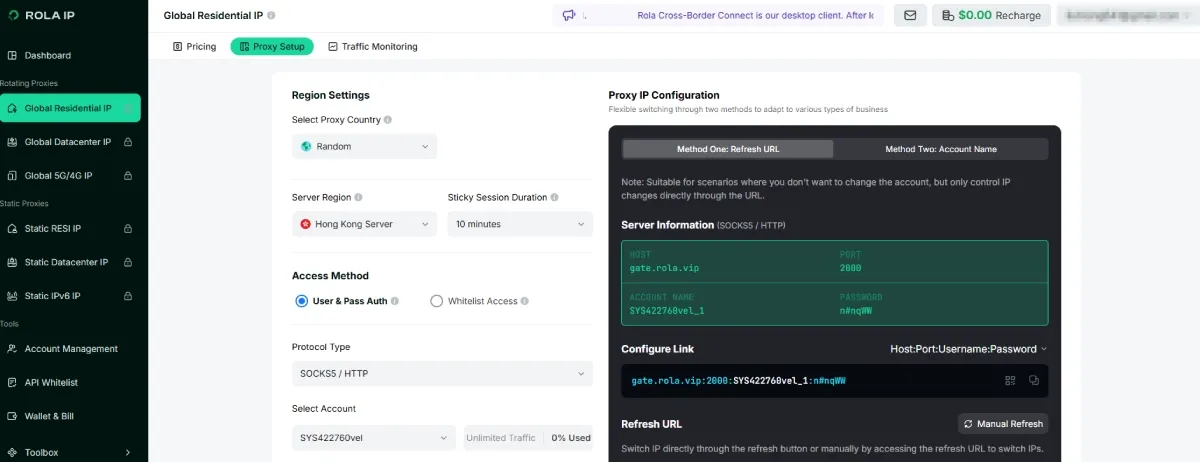
Save the test configuration beside the results: software versions, concurrency limits, timeout and retry settings, connection-pool options, and the exact field schema. This turns a one-off timing into a comparison the team can rerun after code or infrastructure changes.
Measure usable output
Elapsed time needs the context of output quality and resource use:
| Metric | What it tells you |
|---|---|
| Valid pages per second and total time | Useful throughput and end-to-end completion |
| P50 and P95 latency | Typical speed and slow-tail behavior |
| Peak RSS and CPU time | Worker density and application cost |
| Timeout, 403, and 429 rates | Delivery and access failures |
| Valid-record rate | Whether both parsers return the required fields |
| Engineering time and cost per 10,000 valid pages | Development effort and total pipeline economics |
Use the same process-level memory definition for both versions; heap profiles, RSS, and container limits cover different boundaries.
A per-URL result record makes the aggregate numbers auditable. Store the final status, returned page type, bytes received, attempt count, elapsed time, and whether required fields passed validation. This separates a fast valid page from a fast block page or an incomplete parse.
Turn speed into cost per valid page
Remove failed and incomplete pages, then apply one calculation to both implementations:
Cost per 10,000 valid pages = (compute + proxy and browser fees + storage + engineering hours × hourly cost) ÷ valid pages × 10,000
A lean Go worker can carry a higher total cost when extraction changes consume more engineering time. Python can cost more to run and less to own when one team maintains collection, browser automation, and analysis together. Cost per valid page captures both effects.
Go vs Python for Web Scraping: Head-to-Head
The useful winner changes by project stage and workload:
| Decision factor | Python | Go | Practical verdict |
|---|---|---|---|
| Time to first working scraper | Concise code and broad examples | More explicit setup and error handling | Python for prototypes and uncertain targets |
| Concurrent HTTP fetching | asyncio, async clients, and Scrapy | Goroutines and reusable net/http clients | Go when sustained HTTP concurrency is the measured bottleneck |
| Memory per worker | Framework and workload shape the result | A strong candidate for resource-sensitive workers | Measure both implementations under the same limit |
| HTML parsing | Mature choices for loose or irregular markup | Colly and goquery cover common extraction work | Python when parsing rules change frequently |
| JavaScript rendering | Official Playwright support plus Selenium | chromedp, Rod, or a remote browser | Python for the shortest browser-first path |
| Data cleaning and analysis | Direct access to pandas, NLP, and ML tools | Requires another component for Python analysis tools | Python for analysis-heavy pipelines |
| Deployment | Requires a runtime and dependency packaging | Compiled executable | Go when worker deployment is repeated at scale |
| Types and error boundaries | Dynamic by default; typing is available | Static types and explicit errors | Go for long-lived services with stable contracts |
| Maintenance after page changes | Quick selector and schema edits | More structure to update | Python for volatile targets |
| Blocking and CAPTCHA pages | Requires network and request controls | Requires the same controls | Solve this in the access layer |
Read the table from the most expensive uncertainty downward. Target volatility and browser dependence shape the development path; downstream analysis decides whether a second service is worthwhile; worker memory and deployment then decide whether Go can improve the production layer.
Avoid a false winner
Connection reuse and bounded concurrency belong in both implementations. The aiohttp client guide assigns the connection pool to a reusable session. Go uses reusable Client and Transport objects, with response bodies read and closed correctly for persistent connections.
| Python mistake | Go mistake | What gets distorted |
|---|---|---|
| Creating a new ClientSession for every URL | Creating a new Client or Transport for every URL | Connection setup is measured instead of steady-state fetching |
| Scheduling the full URL list without a limit | Starting one goroutine per URL without a worker limit | The workload exceeds memory, proxy, or target capacity |
| Loading every large response fully into memory | Failing to read and close response bodies correctly | Peak memory and connection reuse distort the result |
| Fetching, parsing, and saving in one version but only fetching in the other | Skipping validation or persistence in the Go version | The programs are no longer completing the same job |
Which Should You Choose for Your Scraping Project?
Choose for the workload the team owns today.
Three real cases that show what changes the decision
Python at enterprise scale. A Zyte e-commerce case study describes a web data extraction system built to monitor more than one billion products per day, supported by scheduling, proxies, monitoring, and quality controls.
Go for a smaller deployment footprint. Supacrawler uses Go worker pools for JavaScript-heavy pages. A browser-layer change to chromedp and LightPanda reduced its reported container image from 1.51 GB to 24.6 MB, showing how the surrounding stack shapes deployment cost.
Go for service consolidation. Nick Kirsch documented a Python/Selenium scraper migration to Go/chromedp and merged it into an existing Go service. The migration removed a Python runtime, Selenium dependencies, a Chrome sidecar, and one deployment.
A practical decision rule
Choose Python while URL patterns, selectors, fields, browser steps, or downstream analysis are still changing. Its short edit-and-test cycle lowers the cost of learning the target and keeps more of the workflow in one environment.
Choose Go when predictable pages run on a recurring schedule and worker resources or deployment effort affect cost. The strongest fit is a stable fetch layer owned by a team that already supports Go.
Use both when the boundary is obvious
A mixed design can put retrieval, concurrency, and retry state in Go, with changing extraction and analysis in Python. Write that ownership boundary in one sentence before adding queues, message formats, deployments, and monitoring. A clear split makes failures easier to trace.
Diagnose the Pipeline Before a Rewrite
A rewrite changes the application layer. Locate where time, failures, and cost enter the pipeline first:
| Layer | Signals | Next check |
|---|---|---|
| Access | DNS or connection errors, proxy authentication failures, 403/429 responses, or the wrong region | Compare direct and routed requests, then log status, exit region, and response type |
| Rendering | Missing JavaScript state, slow navigation, consent screens, or resources that never settle | Save a screenshot and trace, then measure browser startup and navigation separately |
| Extraction | Broken selectors, changed schemas, missing fields, or duplicate records | Save the returned HTML and run the parser against that exact file |
| Pipeline | Queue backpressure, slow database writes, retry storms, or jobs that cannot resume | Time queue wait and storage work separately from fetching |
| Operations | Weak logs, no page snapshots, or no failed-URL replay | Add a per-URL result record and a repeatable failure queue |
When access logs concentrate around 403/429 responses, wrong-region content, or broken sessions, adjust the proxy behavior first. ROLA IP’s web scraping proxy options let independent page requests rotate IPs, stateful pagination or authenticated collection retain a sticky session, and location-sensitive jobs select the required country, state, or city. Send one request to verify the exit IP, region, and returned page type before increasing concurrency.

Rendering delays call for browser pooling, resource blocking, and separate navigation timing. Extraction failures call for the returned HTML and a parser replay. Across all layers, control per-domain concurrency and record the status and page type for each failed URL.
The first diagnostic run can use the existing Python system. Add timestamps around queue wait, fetch, browser navigation, parsing, and storage, then group failures by the five layers above. That baseline identifies the stage a Go prototype must improve and prevents the migration test from drifting into a different workload.
Four gates for a rewrite
| Gate | Evidence that supports moving forward |
|---|---|
| Output quality | The current valid-record rate is known, so the replacement has a real baseline to beat |
| Bottleneck location | Profiling isolates Python CPU, memory, or HTTP scheduling as the limiting stage |
| Economics | Estimated infrastructure savings exceed implementation and maintenance cost over a defined period |
| Ownership | The team can test, deploy, monitor, debug, and update the Go service after the original author leaves |
After all four gates pass, build one representative Go worker. Run it with the saved network configuration from the Python baseline and compare valid pages, P95 latency, peak memory, and cost before expanding the migration.