
Best Programming Language for Web Scraping: 6 Compared

Aug 25, 2026 · Use Cases · 10 min read
Quick answer

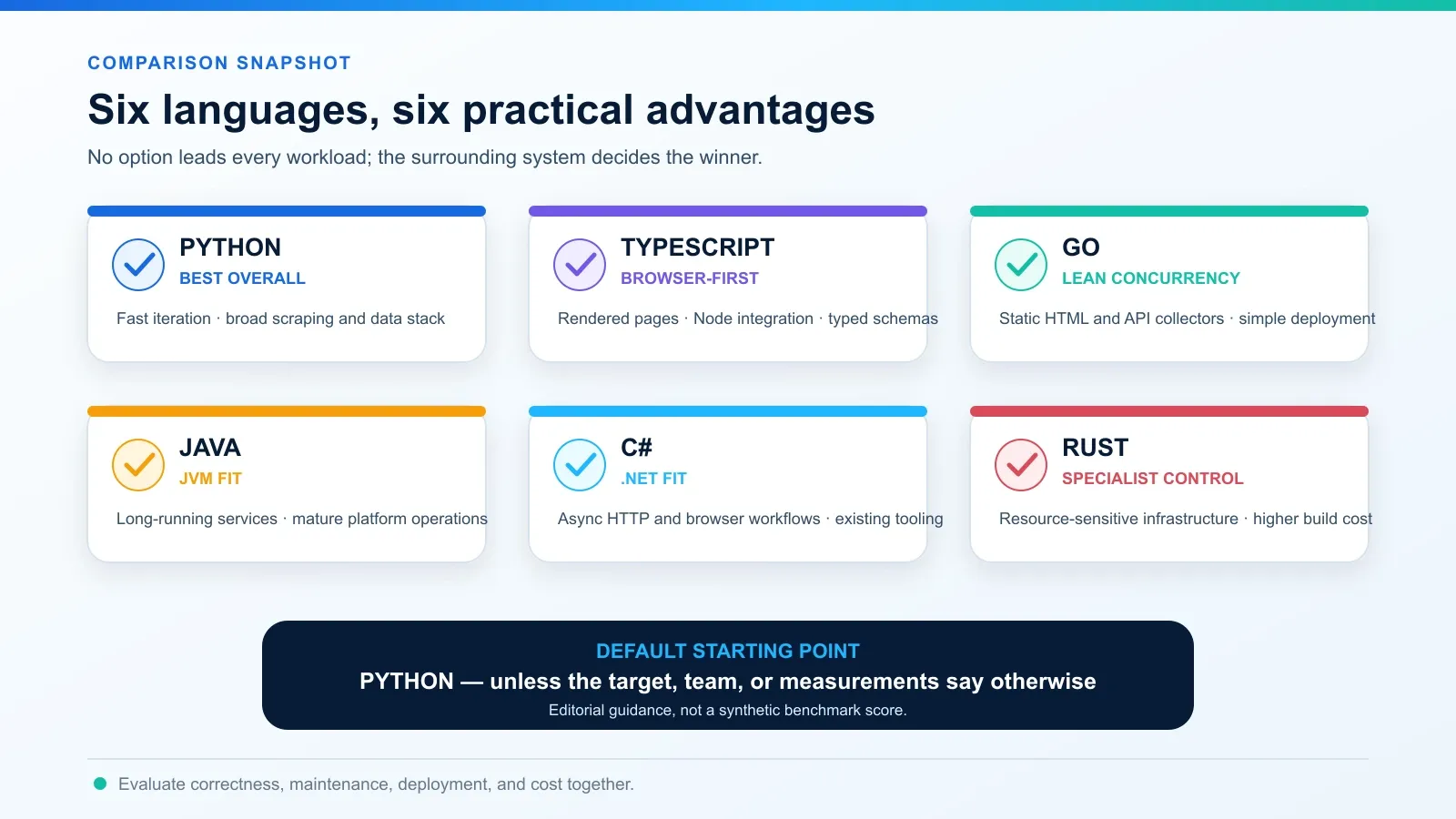
For most people, Python is the best programming language for web scraping. It offers a low-friction path from a small HTTP script to HTML parsing, an asynchronous crawler, browser automation, validation, and data analysis. Its ecosystem includes Requests or HTTPX, Beautiful Soup or lxml, Scrapy, and Playwright.
That recommendation is a default, not an absolute winner. Choose TypeScript when the project is browser-first or maintained by a Node team. Consider Go when a measured high-concurrency HTTP workload and lean deployment matter more than rapid experimentation. Use Java or C# when the collector belongs inside an existing JVM or .NET platform. Choose Rust only when a systems team can justify its extra implementation cost with specific performance, resource, or reliability requirements.
The target’s delivery model matters more than a headline benchmark. First determine whether the data comes from an API, server-rendered HTML, or JavaScript that must run in a browser. Then evaluate accuracy, maintainability, operational cost, and team expertise.
What “best” actually means
A language is not useful merely because a synthetic benchmark says it can start many requests. A production collector must return correct records, behave politely, recover predictably, and remain easy to update when a page changes.
Use these six criteria:
- Delivery model: Can an HTTP client receive the data, or must a browser execute JavaScript and interact with the page?
- Extraction ecosystem: Are maintained clients, parsers, crawler frameworks, browser tools, and validation libraries available?
- Development speed: How quickly can the team build, test, and repair an extractor?
- Controlled concurrency: Can the system enforce per-host limits, timeouts, backoff, queues, and resource budgets?
- Platform fit: Does it integrate with existing logging, storage, schedulers, deployment, and developer skills?
- Total cost: What does each validated record cost in developer time, compute, memory, browser capacity, and maintenance?
Raw runtime speed is only one part of the decision. If a browser consumes most of the memory and time, changing the orchestration language may have far less impact than reducing unnecessary navigation, images, contexts, or retries.
Best web scraping languages at a glance
Language |
Best fit |
Typical toolkit |
Key strength |
Main trade-off |
|---|---|---|---|---|
Python |
Most new projects, data workflows, and first scrapers |
Requests/HTTPX, Beautiful Soup/lxml, Scrapy, Playwright |
Broad, cohesive ecosystem and fast iteration |
Not automatically the raw-throughput winner |
TypeScript |
Browser-heavy pages and Node teams |
fetch, Cheerio, Playwright, Puppeteer |
Strong browser tooling plus useful type checks |
Browser jobs still need careful memory and concurrency control |
Go |
Concurrent API and static-HTML collectors |
net/http, goquery, Colly |
Straightforward bounded concurrency and compact deployment |
Smaller browser and data-analysis ecosystem |
Java |
Existing JVM services and enterprise platforms |
Java HTTP Client, jsoup, Playwright |
Mature operations and JVM integration |
More ceremony for a small one-off job |
C# |
Existing .NET services and data platforms |
HttpClient, AngleSharp, Playwright .NET |
Strong async model and .NET integration |
Most compelling when the team already uses .NET |
Rust |
Specialized long-running infrastructure |
reqwest, scraper, Tokio, WebDriver tools |
Fine-grained resource control and memory safety |
Steepest learning curve and more custom assembly |
These are editorial assessments, not laboratory scores. Every language above can collect static pages, and Python, TypeScript, Java, and C# all have Playwright bindings with the same core browser-automation capabilities. The practical difference is the surrounding ecosystem and the team’s ability to operate it.
1. Python: best overall for most teams
Python wins the default recommendation because it covers the whole path from exploration to a maintained crawler without forcing a language change.
- Use Requests or HTTPX plus Beautiful Soup or lxml for APIs and server-rendered pages.
- Use Scrapy when the job needs scheduling, asynchronous fetching, callbacks, item pipelines, throttling, and structured project organization.
- Use Playwright only when the required data appears after client-side execution or approved interaction.
- Use the broader Python data stack when records need cleaning, validation, analysis, or export.
Requests is synchronous, so a loop around requests.get() is not automatically a scalable crawler. Always set explicit timeouts, handle status failures, and close or fully consume responses. For a focused explanation of safe request metadata, prepared requests, and client identification, see the Python Requests headers tutorial.
Scrapy schedules requests asynchronously and supplies crawler-level components that a growing script would otherwise have to recreate. Teams moving beyond small scripts can use the Scrapy rotating proxies guide for the proxy-integration details; this article deliberately does not repeat that implementation.
Python may not be the best choice when an existing non-Python team would have to create a separate deployment and support path, or when a fair benchmark proves that runtime overhead—not the target, network, parsing, storage, or browser—is the binding constraint. Measure that constraint before rewriting.
2. TypeScript: best for browser-first scraping
TypeScript is usually the strongest starting point when the target genuinely depends on browser-side JavaScript, clicks, scrolling, browser contexts, network events, or rendered state. Playwright’s Node version has particularly close integration with the JavaScript ecosystem, while static types help keep extracted records, job messages, and error states consistent in a long-lived project.
Do not launch a browser merely because the site uses JavaScript somewhere. If the required information is already present in the initial HTML or a documented API response, a normal HTTP client is simpler and cheaper. Cheerio can parse and query markup, but its own documentation is explicit that it is not a browser: it does not render, load external resources, or execute JavaScript.
When rendering is necessary, Playwright supports Chromium, Firefox, and WebKit. Puppeteer is another strong option for Chrome- and Firefox-oriented workflows. Keep browser concurrency bounded, reuse contexts only when isolation requirements allow it, and treat downloads, screenshots, video, and tracing as explicit resource costs.
Python can also automate rendered pages well. If the rest of the workflow is already Python-based, changing languages solely for Playwright is rarely necessary. For a deeper Python implementation using API discovery, Playwright, and Selenium, read how to scrape dynamic web pages with Python.
3. Go: best for lean, concurrent HTTP collectors
Go is a compelling choice for many independent API or static-HTML requests. The standard net/http client supports reusable transports, timeouts, proxies, and connection reuse, while goroutines and channels make bounded worker patterns natural. Colly adds callbacks, queues, rate limits, storage integrations, and asynchronous collection.
Its operational appeal is equally important: a focused collector can be compiled into an executable and deployed with a relatively small runtime footprint. That can simplify container images, worker distribution, and service ownership.
However, “Go is faster” is not a sufficient architecture decision. If the current Python system spends most of its time waiting for servers, running browsers, writing to a database, or recovering from invalid pages, a rewrite may add risk without improving valid-record throughput. Build a small Go candidate only after measurements show that the existing runtime or concurrency model is a meaningful limit.
Go is also less natural when the project depends heavily on exploratory data work or broad cross-browser automation. Tools such as chromedp can drive a Chromium-based browser, but that is a different ecosystem choice from Playwright’s multi-language, multi-engine model.
4. Java: best inside an existing JVM platform
Java is a practical selection when the collector needs to share the organization’s JVM deployment, observability, queues, data contracts, and engineering ownership. jsoup can fetch and parse real-world HTML, navigate the DOM, and use CSS or XPath selectors. Playwright Java handles pages that require a real browser.
Modern Java virtual threads can increase throughput for applications with many blocking I/O operations, but they do not make an individual request faster. The team still needs explicit limits, deadlines, retry policy, connection management, and respectful per-host pacing.
For a small standalone scraper, Java may require more project structure than Python. Inside a mature JVM environment, that same structure can be an advantage because monitoring, secrets, testing, deployment, and on-call practices already exist.
5. C#: best inside an existing .NET platform
C# fills a similar role for .NET teams. HttpClient and async/await suit I/O-bound collection, AngleSharp provides a browser-style DOM and CSS selectors for HTML, and Playwright .NET covers rendered pages across Chromium, Firefox, and WebKit.
AngleSharp Core is a parser and DOM implementation, not a complete browser engine. Use it for downloaded markup; use Playwright when the required content depends on JavaScript execution. .NET can also publish framework-dependent or self-contained applications, but self-contained files are larger and specific to an operating system and architecture.
Choose C# because it reduces total system complexity for a .NET organization—not because Python or Go is incapable of the task.
6. Rust: best for specialized infrastructure
Rust can be excellent for a long-running, resource-sensitive collector maintained by an experienced systems team. reqwest supplies async and blocking HTTP clients, TLS, cookies, redirects, and proxy support. The scraper crate parses HTML and applies CSS selectors, while Tokio runs asynchronous I/O tasks.
The trade-off is engineering cost. Rust’s ownership model, error types, lifetimes, and async runtime concepts raise the entry barrier. Its scraping stack is capable but less unified than Python’s Scrapy path, and Rust does not have an official Playwright binding. Browser automation typically relies on WebDriver-based tools or a separate service.
Do not select Rust to make a routine extractor look technically sophisticated. Select it when profiling and operational requirements justify the additional implementation and hiring burden.
Choose by page type and team, not language hype
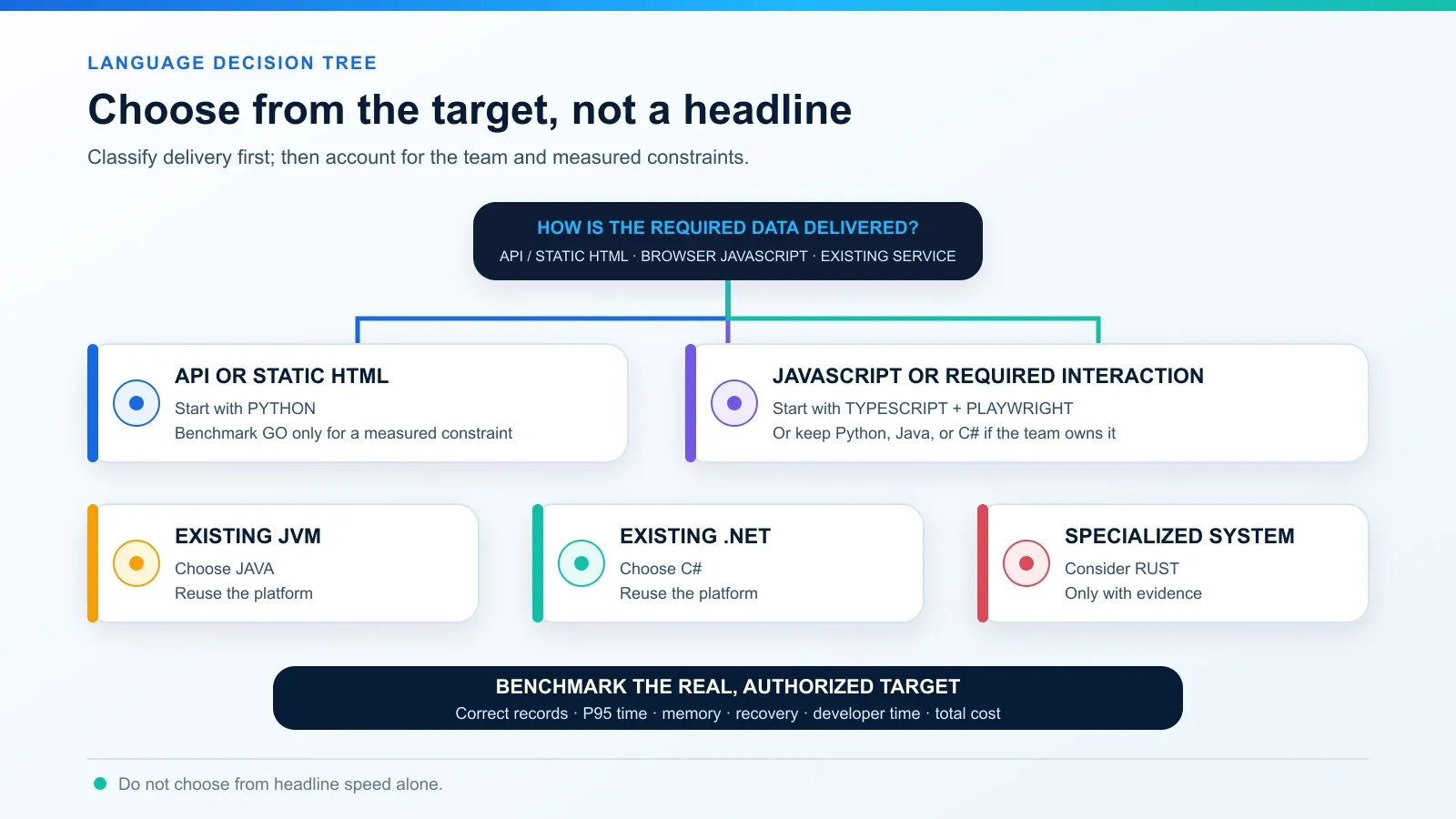
| Project situation | Recommended starting point | Why | Validate before committing |
|---|---|---|---|
| First scraper or data-analysis workflow | Python | Low development friction and broad ecosystem | Extraction accuracy and repair time |
| JavaScript-heavy page with required interaction | TypeScript + Playwright | Browser-first tooling and strong Node integration | Memory, navigation timeouts, and context strategy |
| High-volume static HTML or API collection | Python first; benchmark Go if needed | Avoid a premature rewrite | Valid-result throughput, CPU, memory, and deployment cost |
| Existing JVM backend | Java | Reuses platform, logging, queues, and team knowledge | Library fit and operational overhead |
| Existing .NET backend | C# | Reuses HttpClient, async patterns, and monitoring |
Browser and runtime deployment needs |
| Specialized performance-sensitive collector | Rust after a prototype | Fine control over resources and correctness | Development time and end-to-end cost |
A five-step benchmark before you commit
The fairest test is a small implementation against the real, authorized workload. Do not compare one language’s tuned asynchronous crawler with another language’s sequential demo.
- Classify the target. Label each representative page as API, static HTML, or browser-rendered. Confirm which fields and interactions are actually required.
- Create a controlled sample. Choose 20–100 authorized URLs that represent normal pages, edge cases, pagination, slow responses, and expected failures. Fix the request rate and concurrency ceiling.
- Build the smallest correct candidate. Start in the team’s strongest language. Use the same extraction schema, success rules, timeout policy, and storage behavior for every candidate.
- Measure the whole job. Record correctness, valid-response ratio, P95 completion time, CPU, peak memory, browser failures, recovery behavior, developer time, and cost per validated record.
- Change language only for a demonstrated constraint. If a second implementation produces a meaningful end-to-end improvement that outweighs migration and maintenance cost, then adopt it.
| Metric | What it reveals |
|---|---|
| Correct records / expected records | Extraction quality, the first requirement |
| Valid-response ratio | Delivery and recovery reliability |
| P95 end-to-end time | Slow-tail behavior hidden by averages |
| CPU and peak memory per worker | Infrastructure demand |
| Browser crash and timeout rate | Rendering stability |
| Time to repair a broken selector | Maintenance cost |
| Cost per 1,000 validated records | Real business efficiency |
Run candidates at the same time window when possible, because target latency and content can change. Keep request pacing conservative and stop if the target signals that the test should not continue.
Language, browser, parser, and proxy are different layers
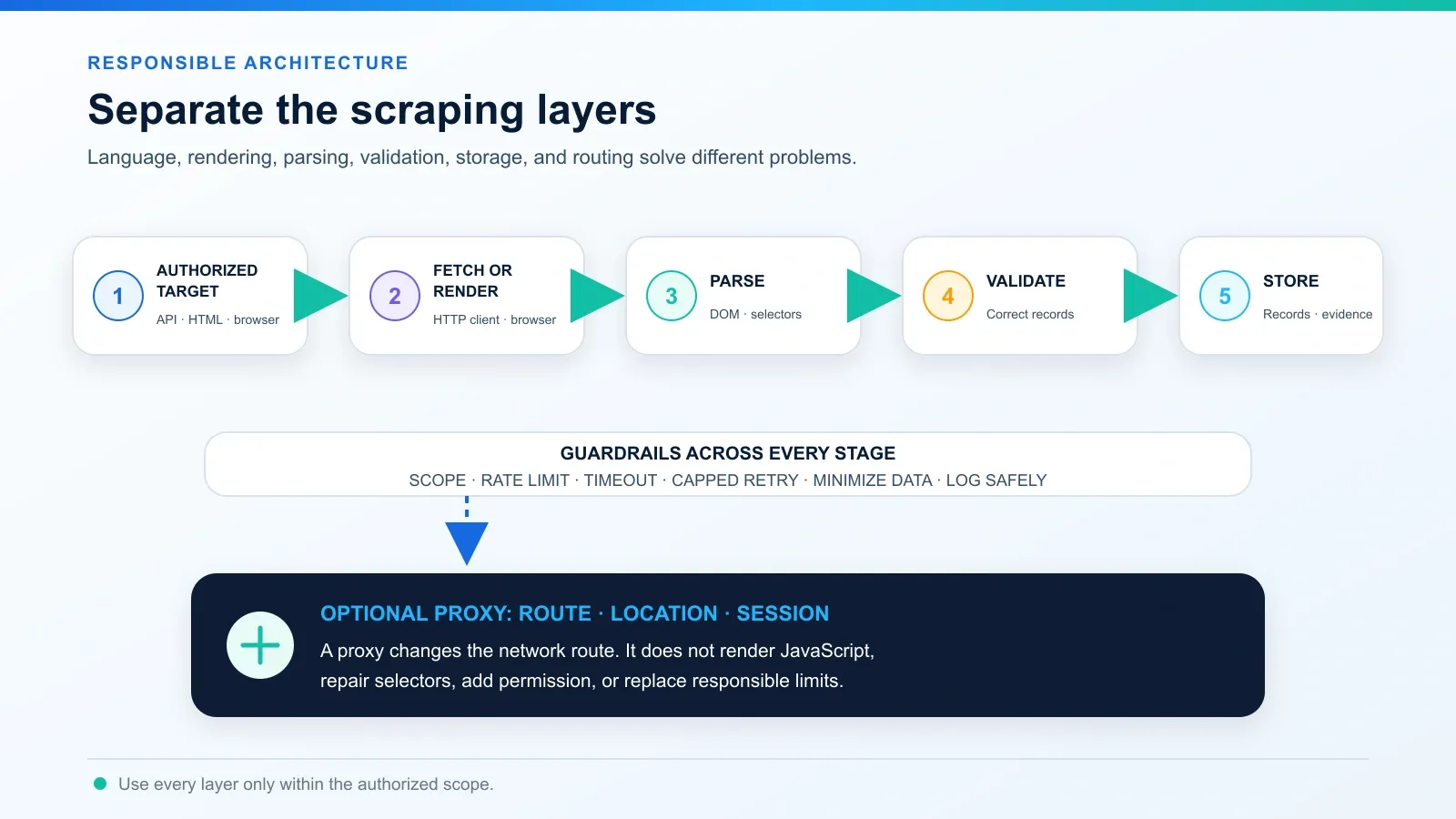
A language provides the implementation environment. An HTTP client or browser retrieves content. A parser turns markup into a structure. Validation determines whether the record is correct. Storage preserves the result. A proxy changes the network route, location, or session continuity; it does not perform the other jobs.
Whichever language you select, a web scraping proxy remains an optional network layer. It does not execute JavaScript, repair selectors, grant access, or make prohibited collection compliant. Use one only for authorized, rate-limited work where the route or location is a documented requirement.
For independent, authorized public-page requests across approved locations, rotating residential proxies may fit the routing requirement. Workflows that depend on cookies or a continuous session instead need deliberate continuity. Proxy selection never replaces target permission, crawler identification, concurrency limits, or data minimization.
Responsible web scraping checklist
- Confirm authorization, applicable terms, and the purpose of collection before starting.
- Prefer a documented API when it supplies the required data under acceptable conditions.
- Read and follow applicable
robots.txtrules and documented rate limits. Robots rules guide crawler behavior; they are not access authorization. - Do not bypass authentication, paywalls, CAPTCHAs, explicit denials, or technical access controls.
- Collect only the fields needed for the approved purpose, especially when personal or sensitive data may be present.
- Use explicit timeouts, capped retries with backoff, per-host concurrency limits, and a global resource budget.
- Identify the client where appropriate, provide a contact path, and avoid misleading request metadata.
- Store API tokens, browser state, and proxy credentials in environment variables or an approved secret manager.
- Log the target, timestamp, status, validation result, and retry reason without leaking credentials or personal data.
- Stop and investigate when the valid-record ratio falls, selectors drift, or the target returns an unexpected denial.
Legal, contractual, privacy, database, and copyright rules vary by jurisdiction, data type, and use. This article is technical guidance, not legal advice.
Final recommendation
Start with Python unless the project gives you a specific reason not to. Start with TypeScript when real browser behavior is the center of the job. Benchmark Go when a static HTTP collector has a measured concurrency or deployment constraint. Keep Java or C# when the collector belongs in an existing enterprise platform. Reserve Rust for requirements that justify systems-level control.
The best programming language for web scraping is the one that produces correct, maintainable data from an authorized target with the lowest total engineering and operating cost. Choose from evidence gathered on the real workflow, not from a universal ranking that ignores the page and the people who must maintain it.