
Best Poland Proxy Providers 2026: 8 Poland Proxies Compared

Aug 31, 2026 · Comparisons · 13 min read
TL;DR
The Poland proxy providers worth testing first in 2026 include Rola IP, Decodo, Oxylabs, Bright Data, SOAX, Webshare, IPRoyal, and DataImpulse. Among them, Rola IP suits teams that want to manage dynamic residential, static residential/ISP, mobile, and datacenter proxies within a single account, with country- or city-level targeting plus rotating and sticky sessions.
Best Poland Proxy Providers 2026: Quick Comparison
| Provider | Who It Fits | Poland-Related Products | Targeting & Sessions |
|---|---|---|---|
| Rola IP | Scraping, SEO, ad verification, and unified multi-product management | Residential, ISP/static residential, mobile, datacenter | Country/city; rotating and sticky sessions |
| Decodo | Small-to-mid teams and self-service users | Residential, mobile, ISP, datacenter | Country/city/ASN; long sticky sessions |
| Oxylabs | Large projects, SLA, and managed scraping | Residential, mobile, ISP, datacenter, and scraping API | Country/city/ASN, depending on the product |
| Bright Data | Enterprise compliance, fine-grained targeting, and management tools | Full proxy type range, Unlocker, SERP API | Country/city/ASN; rich session controls |
| SOAX | Mixed mobile/residential use and carrier targeting | Residential, mobile, ISP, datacenter | Country/city/ISP/ASN |
| Webshare | Budget-friendly self-service and light tasks | Residential, static residential, datacenter | Mostly country-level, varies by plan |
| IPRoyal | Long sticky sessions | Residential, ISP, mobile, datacenter | Country/city/ISP; long sticky sessions |
| DataImpulse | Low-barrier pay-as-you-go projects | Residential, mobile, datacenter | Country; city/ASN depends on the plan |
What Is a Poland Proxy?

Figure 1: What a Poland proxy is.
A Poland proxy forwards requests through an exit IP located in Poland, or one that mainstream geolocation databases identify as being in Poland. Target sites usually decide what content to return based on a combination of country, city, ASN, language, cookies, and account state, so “the proxy dashboard is labeled Poland” doesn’t guarantee every target site will recognize it as Poland too.
Poland exits are commonly used to view Google.pl local search results, verify Polish ads, test PLN pricing and shipping information, monitor public pages like Allegro/Ceneo, and check your own site from a Polish network perspective. Using a proxy doesn’t change a site’s terms, copyright, GDPR, or local legal obligations. Authorization may come from the site owner, a contract, applicable API terms, or another documented legal basis; obtain it before handling personal information, logged-in data, or access-controlled content.
Why Do You Need a Poland Proxy Instead of Any EU IP?
A Poland IP is only necessary when results actually vary by country, city, or carrier — “an EU exit” can’t automatically reconstruct the SERP, currency, stock, ads, or shipping options that a Polish user would see. For tasks that don’t involve regional verification, and where the target doesn’t return regional differences, using a Poland proxy just adds cost.
- Local SEO: Check Google.pl’s organic results, map results, and ad placements.
- E-commerce research: Compare prices, stock, and shipping information on public product pages like Allegro, Ceneo, and Amazon.pl.
- Ad verification: Confirm landing pages and creatives aimed at a Polish country or city audience.
- Localization QA: Check the display of language, PLN pricing, postal codes, taxes, and payment methods.
- Authorized collection: Spread public web scraping requests across compliant, manageable Polish exits.
How We Selected These Poland Proxy Providers
This is a purchase-test framework, not a universal performance ranking. We selected providers that publish Poland-capable products and documentation for at least one proxy type; current inventory, targeting granularity, session limits, and billing must be confirmed on each provider’s official product page before purchase. The linked pages below are the primary sources for the product descriptions. It is a practical starting point for readers comparing best poland proxies providers 2026, rather than a claim that one network performs best for every target.
| Weight | Evaluation Criterion | How We Checked It |
|---|---|---|
| 25% | Poland targeting quality | Cross-check country, city, and ASN across multiple IP databases; verify results on real target pages |
| 20% | Valid-data rate | Count responses with complete, parseable fields — not just HTTP 200 |
| 15% | Proxy types | Whether residential, ISP, mobile, and datacenter meet different risk and session needs |
| 15% | Session and rotation | Per-request rotation, sticky duration, session parameters, and concurrency limits |
| 10% | Access and management | HTTP/SOCKS5, credential/whitelist auth, sub-accounts, quotas, and an API |
| 10% | Cost transparency | Whether traffic expires, additional targeting fees, retry traffic, minimum top-up, and refunds |
| 5% | Compliance and support | Source disclosure, acceptable use policy, GDPR process, and issue support |
Best Residential Proxies Poland: When Are They the Best Fit?
Poland residential proxies are the default starting point for e-commerce monitoring, ad verification, and local SERP work, since their ASNs are closer to ordinary home broadband users. They don’t automatically guarantee success — request frequency, browser state, page permissions, and the collection method still affect results.
When choosing, prioritize Poland country/city selectability, rotation and sticky sessions, whether each request might cross cities, and whether you can check the current exit ASN. Use rotating sessions for broad collection; a shopping flow, localization QA, or continuous pagination usually needs to keep the same IP within a reasonable window.
If you’re unsure whether to choose residential or datacenter exits, first check Rola IP’s datacenter and residential proxy explanation, then A/B test against the same target.
Best Datacenter Proxies Poland: Which Tasks Fit Them?
Poland datacenter proxies suit speed-sensitive, cost-sensitive, lightly protected public pages, basic network testing, and your own system QA. They usually offer high throughput and fixed IPs at a lower price, but their hosting ASN is easier to identify, so they shouldn’t be used for difficult e-commerce or ad targets just because they’re cheap.
When evaluating datacenter proxies in Poland, confirm whether the IP is genuinely in a Polish datacenter, whether it’s dedicated, whether it supports HTTP/SOCKS5, bandwidth and concurrency limits, and the policy for replacing an incorrectly geolocated IP. Test the valid-field rate on a small sample first; if CAPTCHAs, 403s, or empty content are noticeably higher than a residential pool, upgrade the proxy type.
How Should You Choose Between ISP, Mobile, and Rotating Proxies?
ISP/static residential proxies suit long sessions that need a stable Polish identity; mobile proxies suit authorized tests that must observe Polish carrier networks or mobile-specific differences; rotating residential proxies suit covering large numbers of independent URLs. The most expensive type isn’t always best — the task’s session length and risk should decide the product.
| Type | Typical Task | Session Strategy | Main Cost |
|---|---|---|---|
| Rotating residential | Products/pricing, SERP, ad verification | Rotate per request or short session | Billed by traffic; control page size |
| ISP/static residential | Continuous QA, authorized account flows, a fixed exit | Keep the same IP for longer | More limited IP count and regional inventory |
| Mobile | Carrier/app testing, high-risk target verification | Sticky or rotated per task | Usually most expensive, bandwidth fluctuates |
| Datacenter | Open, lightly protected pages, own systems, benchmarking | Fixed or pool-rotated | Easier for targets to identify |
Best Poland Proxy Providers: Full Reviews
This section evaluates eight providers using the same template: available products, Poland targeting and session capability, strengths, limitations, who it fits, and what to verify before buying. The order reflects editorial recommendation, not a unified lab performance ranking.
Rola IP: Multiple Proxy Types Under Unified Management
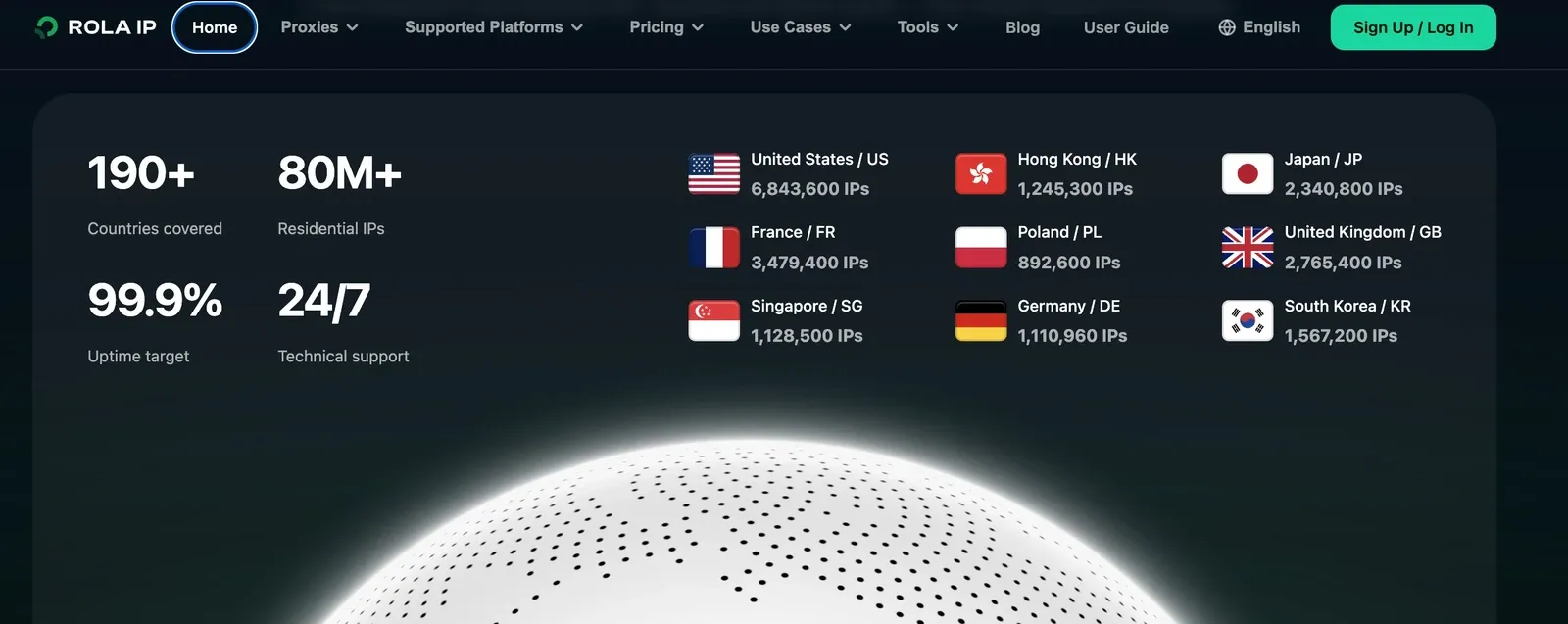
Figure 2: Rola IP.
Product and capability: Rola IP publishes dynamic residential, static residential/ISP, mobile, and datacenter proxy products. Its proxy parameters documentation describes country, city, rotation, and session fields; authentication and limits remain plan-dependent. The site’s stated 190+ countries/regions and 80M+ residential IPs are global network metrics, not real-time Poland inventory.
Strengths and limitations: Multiple proxy types can be managed within one product ecosystem, suiting teams that run broad collection, fixed sessions, and mobile-network verification at the same time; but you must confirm Poland’s, city’s, and ASN type’s real-time availability under the current plan before buying.
Who it fits: Teams that want to unify their Poland SEO, ad verification, price monitoring, and authorized scraping exits under one account, and that need sub-account or high-concurrency control. Before buying, verify country/city inventory, sticky duration, traffic validity period, minimum top-up, and refund rules. For a broader selection framework, see best proxies for price monitoring.
For specific scraping scenarios, consult Rola IP’s current product documentation.
Decodo: Self-Service Experience and Full Targeting Capability
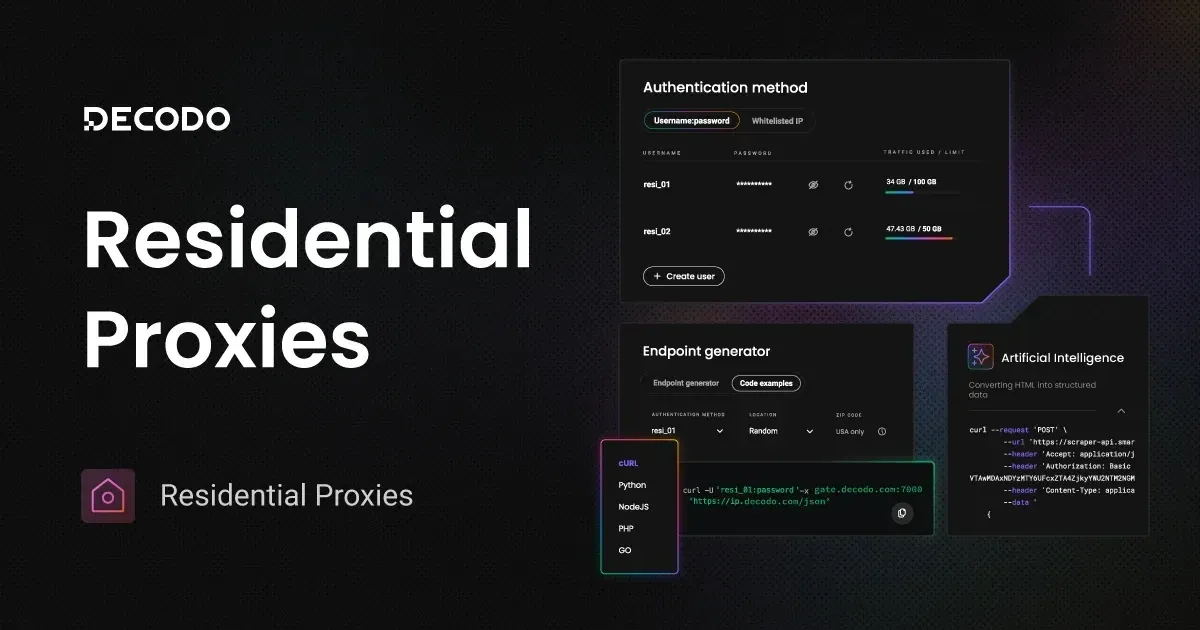
Figure 3: Decodo Residential Proxies.
Product and capability: Decodo (formerly Smartproxy) publishes residential proxy products and related self-service tools. Its mobile and datacenter offerings are separate products; any Poland coverage, city targeting, session duration, and static-IP availability should be confirmed on the current official pages. Proxyway’s Poland list is a third-party reference, not a substitute for Decodo’s current documentation.
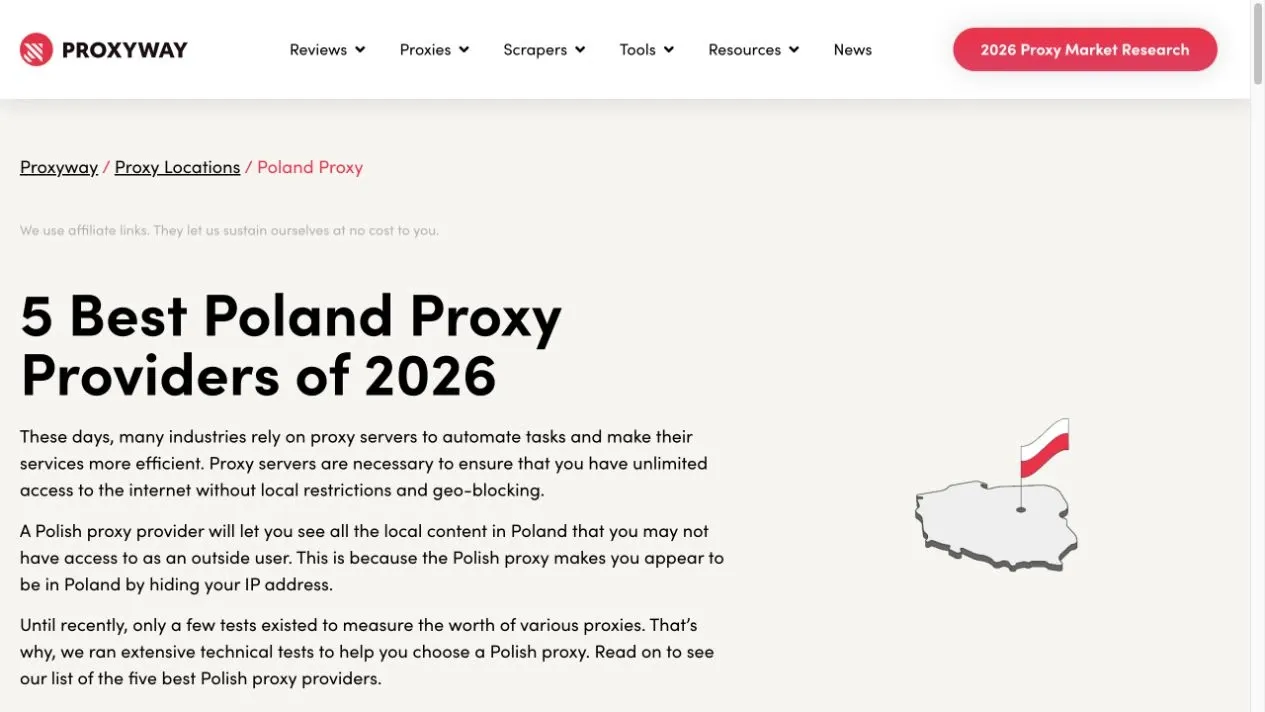
Figure 4: Proxyway’s 2026 Poland proxy list.
Strengths and limitations: The strength is a dashboard and documentation that are friendly to small-to-mid teams, with raw proxies and a managed scraping API to choose from based on engineering capacity. The limitation is that “supports Poland” doesn’t mean every network has Poland inventory at the same time; Proxyway also noted at the time that its Polish static IP supply was limited, and pricing varies by traffic, product, and subscription tier.
Who it fits: Small-to-mid teams that need quick trials, city-level Polish residential proxies, a browser extension, or a managed scraping API. Before buying, verify Poland’s availability across residential, ISP, mobile, and datacenter products, the sticky-session cap, ASN targeting, and refund conditions.
Oxylabs: An Enterprise Proxy Network and Managed Scraping API
Figure 5: Oxylabs Residential Proxies.
Product and capability: Oxylabs publishes residential, mobile, ISP, and datacenter proxy products, plus Web Scraper API and SERP Scraper API offerings. Product-specific Poland coverage, targeting, and limits should be checked on the current official pages. Raw proxies suit building your own request, retry, and parsing logic; managed APIs use a different billing unit.
Strengths and limitations: The strength is a relatively complete product matrix, enterprise support, targeting options, and an SLA procurement path, suiting large-scale Google.pl, public e-commerce, and market research. The limitation is that the entry cost and procurement complexity are usually higher than self-service providers, some targeting or features vary by product, and you can’t infer Poland’s available IP count from global pool size.
Who it fits: Large teams that value enterprise contracts, an account manager, service levels, managed scraping, and compliance documentation. Before buying, test both the residential proxy and API paths against a fixed Poland URL, and compare total cost per 1,000 valid records.
Bright Data: Fine-Grained Targeting and an Enterprise Toolset
Figure 6: Bright Data Residential Proxies.
Product and capability: Bright Data offers residential, mobile, ISP, and datacenter proxies, Web Unlocker, SERP API, Proxy Manager, and datasets. A Poland project can choose between raw proxies, managed unlocking, and buying results directly; targeting capability like country, city, and ASN should be checked against the specific product and current plan.
Strengths and limitations: The strength is a rich range of product types, targeting, management tools, and enterprise compliance materials, suiting Google.pl, ad verification, and cross-city QA. The limitation is that with many products, billing units, add-ons, and discount structures, newcomers can easily conflate proxy traffic unit price, API result pricing, promotional pricing, and regular pricing.
Who it fits: Organizations that need fine-grained targeting, team management, a proxy manager, managed unlocking, or an enterprise procurement process. During your trial, fix the product, target, region, rendering option, and definition of success, then calculate cost per valid result.
SOAX: Fine-Grained Filtering for Residential and Mobile Proxies
Figure 7: SOAX.
Product and capability: SOAX offers residential, mobile, ISP, and datacenter proxies plus a Web Data API. Its public product information emphasizes filtering dimensions like country, region, city, ISP, and ASN, suiting teams that want to manage Polish residential traffic and carrier-specific scenarios — Orange, Play, Plus, T-Mobile — under one provider.
Strengths and limitations: The strength is combining residential and mobile products with fine-grained targeting dimensions, suiting mobile app, ad, and carrier-difference verification. The limitation is that whether Polish-carrier or ASN filtering covers your selected plan, whether it costs extra, and the sticky duration and concurrency rules all need separate confirmation; mobile proxy cost is also usually higher than residential.
Who it fits: Teams that genuinely need Polish mobile networks, city/ISP/ASN filtering, or a mix of proxy types. The most cost-effective strategy is usually using residential proxies for most tasks, and reserving mobile proxies only for the steps that must verify carrier networks.
Webshare: A Budget-Friendly Self-Service Proxy
Figure 8: Webshare.
Product and capability: Webshare offers datacenter, static residential, and residential proxies, emphasizing self-service configuration, plan customization, and a low entry threshold. Proxyway included it in its Poland proxy recommendations, citing multiple proxy configurations, a complete self-service flow, and cost that can be scaled down.
Strengths and limitations: The strength is that it suits buying a small amount of proxy quickly, lightly protected public pages, testing your own systems, and budget-sensitive projects. The limitation is that targeting granularity and advanced features vary by plan, and datacenter ASN’s valid-data rate on highly protected targets may be lower than residential; a low unit price can also be offset by retry traffic and maintenance time.
Who it fits: Teams doing an initial Poland datacenter-proxy benchmark, low-volume SERP checks, or light reference-data collection. Before buying, confirm Poland inventory, dedicated vs. shared allocation, city targeting, bandwidth, concurrency, and the IP-replacement policy.
IPRoyal: Long Sticky Sessions and a Pay-as-You-Go Entry Point
Figure 9: IPRoyal Residential Proxies.
Product and capability: IPRoyal offers residential, ISP, mobile, and datacenter proxies. The residential product supports rotation and longer sticky sessions, plus targeting options like country, region, city, or ISP — the exact scope should follow the current product page and dashboard.
Strengths and limitations: The strength is suiting continuous browsing, fixed test flows, and small pay-as-you-go projects that need to hold the same Polish exit. The limitation is that a long sticky session doesn’t mean the IP is permanently online — real-time Polish city/ISP inventory, unit traffic price, and available session duration still need to be tested; a long session also shouldn’t be used to evade platform penalties or account controls.
Who it fits: Teams that value session continuity, a fixed region, and small pay-as-you-go purchases. Before buying, log the exit IP at 5, 15, and 30 minutes into the same session, and check for drops, city drift, ASN, and target field-completeness rate.
DataImpulse: Pay-as-You-Go Billing and Low-Barrier Testing
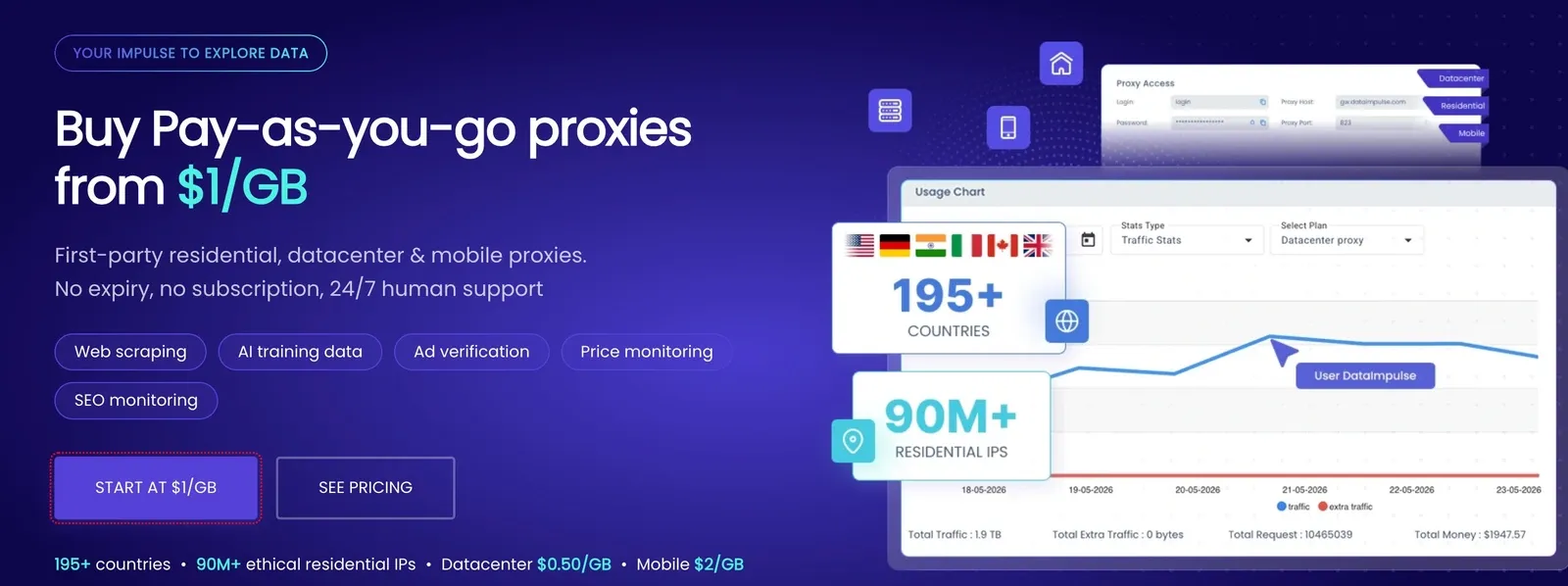
Figure 10: DataImpulse.
Product and capability: DataImpulse offers residential, mobile, and datacenter proxies, and publicly emphasizes pay-as-you-go purchasing, country targeting, and optional city/ASN capability. In its own Poland list, it positions its products as a price-sensitive choice for building your own scraping pipeline.
Strengths and limitations: The strength is that it’s easy to start a proof of concept with a small amount of traffic, and you can allocate residential and mobile traffic to different Poland scenarios. The limitation is that the provider’s own list is marketing material and can’t substitute for an independent benchmark; there’s also less long-term third-party performance research available compared with major enterprise providers.
Who it fits: Budget-sensitive teams that want to first validate the feasibility of Polish residential or mobile proxies. Before buying, test the target valid-data rate, city/ASN surcharges, traffic validity period, support responsiveness, and refund rules before deciding whether to scale up.
How Do You Configure and Verify a Poland Exit in Rola IP?
The correct flow is to first confirm the product supports Poland, then generate proxy credentials with country and session parameters, and finally verify at three levels: geolocation, ASN, and the target page.
- After logging into Rola IP, choose a proxy type: dynamic residential for broad collection; static residential/ISP for fixed QA; mobile for carrier testing; and datacenter can be tested for low-risk, high-throughput needs.
- In the proxy generator, select Poland; only choose a city like Warsaw or Krakow when your business genuinely depends on city-level differences, and confirm that type has inventory.
- Choose a rotation mode or sticky session, and set up HTTP/SOCKS5, username/password, or whitelist authentication.
- First visit an IP-check service and verify country=PL, city, ASN, and proxy type; cross-check with at least two databases.
- Then visit a real Polish target and verify PLN, Polish language, regional results, or shipping information; save your test records.
- Gradually raise concurrency only after confirming documented authorization and the target’s rate limits. Robots directives are technical guidance only; they do not grant permission or replace contractual and legal review. On a 403/429, slow down and check permissions rather than blindly switching IPs.
For country, city, rotation, and session fields, follow the proxy parameters documentation linked in the Rola IP review above.
For your first integration, complete authentication and connection following the proxy configuration guide.
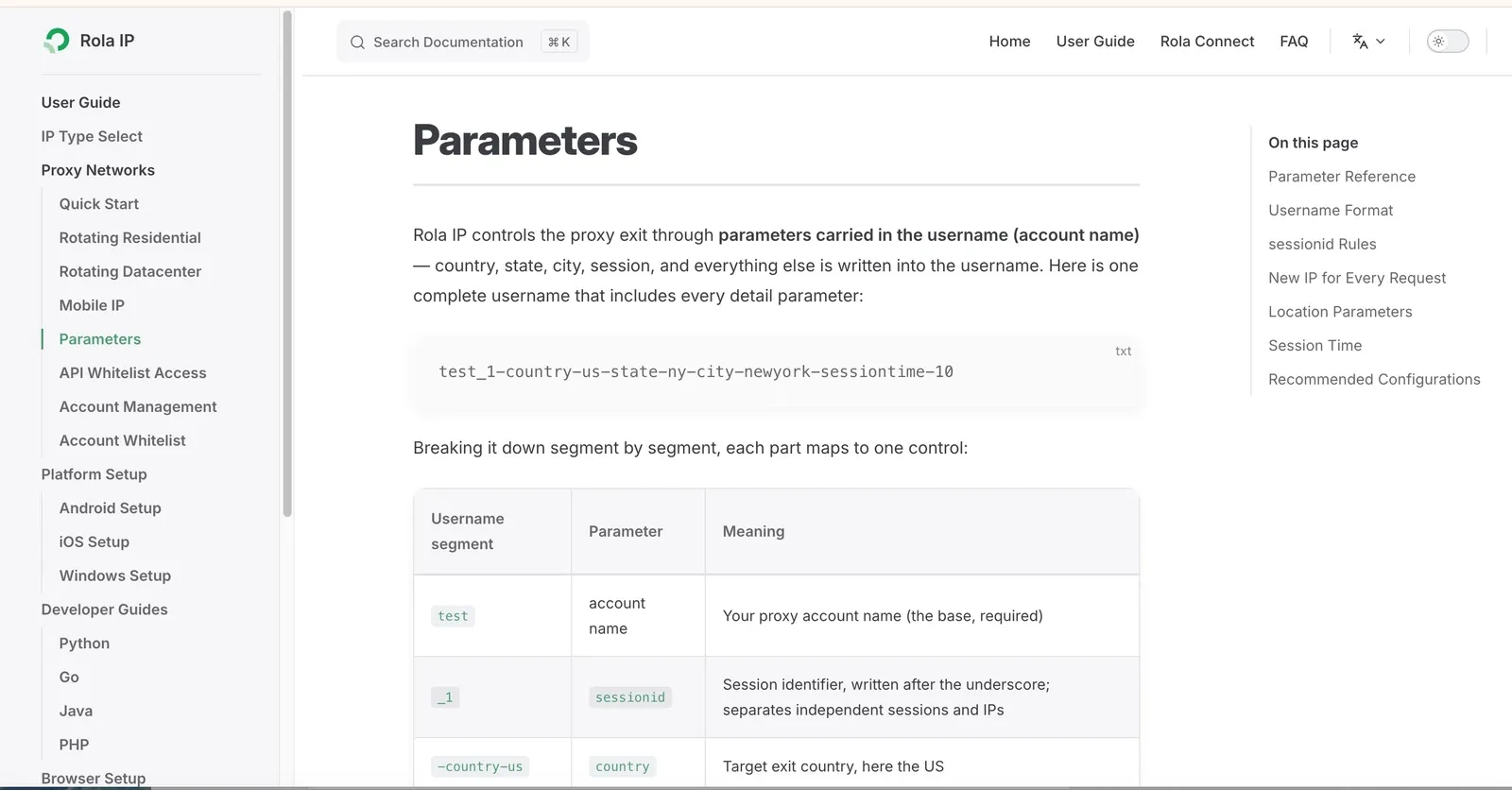
Figure 11: Rola IP configuration parameters documentation.
How Should You Compare Poland Proxy Pricing?
You should compare “total cost per 1,000 valid results,” not the lowest $/GB shown on a page. Residential proxies are usually billed by traffic, static/ISP is usually billed by IP or period, mobile proxies may be billed by traffic or port, and a managed scraping API may be billed by successful result and a rendering multiplier.
| Cost Item | Easily Overlooked Issue | Metric to Log |
|---|---|---|
| Base plan | Minimum top-up, whether traffic expires, auto-renewal | Actual amount paid over 30 days |
| Targeting and features | Whether city/ASN, sticky sessions, or whitelisting cost extra | Feature surcharges |
| Failed traffic | 403/429/CAPTCHAs and empty pages can still consume traffic | Traffic per valid record |
| Page rendering | Images, fonts, and JS can amplify traffic or API multipliers | Effective cost after rendering |
| Engineering maintenance | Retries, a proxy pool, monitoring, and parser maintenance | Engineering hours and downtime |
Is a Free Poland Proxy Worth Using?
A free Poland proxy isn’t suitable for production scraping, login flows, or any sensitive data, because the operator, logging, shared users, and security state usually can’t be verified. Even if it connects, it may be incorrectly geolocated, already blacklisted, injecting content, or go offline suddenly.
Free lists are, at most, suitable for short-term network experiments with no account and no sensitive information. Production environments should choose a provider with a privacy policy, an acceptable use policy, authentication, support, and billing records, and rotate credentials regularly.
Final Recommendation
For most teams, the first round should test Rola IP, one enterprise-tier provider, and one budget-tier provider at the same time: use Polish rotating residential proxies for broad collection first, then add ISP, mobile, or datacenter proxies based on fixed-session, carrier, or cost needs. Rola IP’s strengths are its product matrix, country/city targeting, rotating/sticky sessions, high concurrency, HTTP/SOCKS5, dual authentication, and sub-account management; the final purchasing decision should still be driven by Poland’s real-time inventory and the valid-data rate on your target URLs.
If you need best germany proxies, see the related guide.