
Best SEO Proxies Providers 2026: Complete Guide to SEO Rank Tracking and SERP Collection

Sep 7, 2026 · Top Picks · 17 min read
TL;DR
In 2026, most SEO teams should prioritize residential proxy services that support precise geo-targeting, flexible rotation, and multiple proxy types. Based on the overall balance of coverage, session control, and team-management capabilities, Rola IP is the top pick in this guide, while Oxylabs, Decodo, Bright Data, SOAX, and DataImpulse are better suited to different needs such as enterprise-scale collection, managed SERP APIs, granular targeting, or pay-as-you-go budgets.
When choosing the best SEO proxies, do not compare only IP-pool size or price per GB. What actually affects results is whether the target search engine accepts the network, whether city-level results are accurate, whether the same test can be repeated consistently, whether failed requests create extra cost, and whether the team can manage authentication, concurrency, rotation, and quotas.
Last verified: September 7, 2026. Provider capabilities, inventory, pricing, and target availability may change. Confirm current product documentation and run an authorized pilot before purchasing.
What Are SEO Proxies?
SEO proxies are proxy servers used to access search results, public webpages, and localized content from specified networks and geographic locations. Their main use cases include rank tracking, SERP collection, ad verification, competitor research, and technical SEO.
Search results can vary by country, city, language, device, login status, and browsing history. If a team checks keywords only from a single office public IP address, it sees results from just one location and one network environment, which cannot represent multiple target markets.
A proxy forwards requests through different exit nodes. Residential proxies resemble ordinary household connections more closely, datacenter proxies are fast and cost-efficient, ISP proxies combine fixed addresses with residential-network characteristics, and mobile proxies are useful for validating mobile SERPs. In practice, the best proxies for SEO are the network mix that best matches the specific task.
Why Do SEO Teams Need Proxies?
The main reason SEO teams use proxies is to obtain repeatable, localized results and distribute monitoring tasks across multiple compliant network exits, rather than simply to “hide an IP.”
Common workflows include:
- Local rank tracking: Compare the same keyword across countries or cities, including organic results, Local Pack listings, and map results.
- SERP feature monitoring: Track organic listings, ads, featured snippets, People Also Ask, videos, news, AI Overviews, and other modules.
- Competitor research: Compare domain visibility under consistent location, language, and device conditions to reduce sample contamination from personalization.
- Brand and ad verification: Confirm whether ads appear in the intended market or whether branded queries lead to unexpected landing pages.
- Technical SEO and site checks: Sample public pages for availability, redirects, status codes, and indexing signals.
- Mobile search validation: Compare desktop and mobile layouts, rankings, and SERP-feature differences.
Proxies only solve network-exit, location, and request-distribution problems. They do not replace parsers, browser rendering, data validation, or compliance review. Blaming every failure on “bad IP quality” often hides the real cause, such as inconsistent parameters, page-structure changes, or an excessive request rate.
Which Proxy Type Is Best for SEO?
Residential proxies are usually the default choice for local Google rank monitoring. Datacenter proxies work well for cost-sensitive bulk tasks. ISP proxies are useful when a workflow needs a long-lived fixed exit. Mobile proxies should be reserved for cases where mobile SERPs or carrier-network authenticity genuinely matter.
Proxy Type |
SEO Realism |
Speed and Cost |
Best For |
Main Limitation |
|---|---|---|---|---|
Rotating residential proxies |
High; exits come from household ISP networks |
Moderate speed; commonly billed by traffic |
Local rankings, Google SERPs, competitor research |
More expensive than datacenter proxies; traffic and retries must be controlled |
Datacenter proxies |
Medium to low; easier to identify as hosted networks |
Fast and inexpensive |
Bing, technical audits, low-sensitivity public pages, large-scale prechecks |
More likely to trigger verification on sensitive targets such as Google |
ISP/static residential proxies |
High; fixed addresses with ISP characteristics |
Stable; often billed per IP or period |
Fixed-location validation, persistent sessions, allowlisted tools |
Regional inventory and scaling cost should be confirmed in advance |
Mobile proxies |
Very high; exits come from cellular networks |
Usually the most expensive and higher-latency option |
Mobile rankings, mobile ads, carrier-difference validation |
Too expensive to use for every keyword and unnecessary for many tasks |
A robust setup often uses datacenter proxies for low-risk prechecks and technical tasks, residential proxies for core local-rank collection, ISP proxies for tool sessions that need stable exits, and mobile proxies only for a selected set of mobile-critical keywords. This avoids using the most expensive network for every request.
What Are Dedicated SEO Proxies?
Dedicated SEO proxies generally refer to exclusive datacenter or ISP IPs assigned to a single customer. They are useful for SEO tools that require fixed allowlists, stable sessions, and predictable IP reputation.
“Dedicated” describes the allocation model; it does not mean the IP “cannot be detected.” A dedicated datacenter IP still belongs to a datacenter ASN and can be recognized as such by search engines. A dedicated ISP IP usually resembles a household network more closely while still providing a fixed address. Teams looking for a dedicated proxy for SEO ranking should first determine whether the real requirement is a fixed IP, exclusive use, or city-level geographic realism.
Advantages of dedicated SEO proxies include:
- The IP is not shared with other customers, making unusual traffic easier to trace.
- They work well for rank-tracking tools and enterprise systems that require an allowlisted exit.
- They make stable sessions, baseline tests, and long-term quality records easier to maintain.
- Concurrency and usage responsibility can be defined more clearly per IP.
The limitations are equally important: a fixed IP does not automatically recover after being restricted; a small IP pool cannot handle a large number of independent keyword queries; and dedicated datacenter proxies do not provide true residential or mobile-network characteristics. For large-scale local SERP work, a rotating residential pool is often more suitable than a small set of dedicated IPs.
How We Selected These Best SEO Proxies
This guide evaluates providers based on the delivery quality of real SEO workflows rather than brand awareness or a single marketing number.
The evaluation framework includes eight factors:
- Geographic accuracy: Whether the service supports country, state/province, city, and finer targeting conditions.
- Proxy types: Whether teams can switch among residential, datacenter, ISP/static residential, and mobile networks.
- Session control: Whether per-request rotation and sticky sessions are supported, and whether session duration is configurable.
- Search-workflow fit: Whether the provider documents SERP use cases, APIs, browsers, or common SEO-tool integrations.
- Authentication and team management: Whether username/password auth, IP allowlisting, subaccounts, quotas, and usage records are available.
- Failure cost: Not just list price, but also the cost of CAPTCHAs, retries, transferred data, and invalid pages.
- Public evidence: Whether key capabilities can be cross-checked through product documentation, official pages, and independent testing.
- Known boundaries: Whether the provider clearly explains targeting accuracy, inventory, refunds, restricted targets, and compliance requirements.
The Proxyway SEO proxies review combines residential- and datacenter-proxy infrastructure testing with feature and usability evaluation. When this guide refers to its public tests, the data is treated only as a reference for overall network infrastructure, not as proof of Google success rates for a specific keyword, city, and moment. Before purchasing, teams should still validate providers with their own keyword set on a small scale.
Quick Comparison: Best SEO Proxies at a Glance
Rola IP offers a balanced mix of proxy types, geographic coverage, and session management. The other providers stand out more strongly in areas such as enterprise SERP APIs, third-party infrastructure testing, granular targeting, or usage-based pricing.
Provider |
Best For |
SEO Product Format |
Main Strength |
Limitation to Confirm |
|---|---|---|---|---|
Rola IP |
SEO teams that need multiple networks and granular locations |
Residential, datacenter, static residential/ISP, mobile proxies |
190+ countries and regions; country/city targeting; rotating and sticky sessions; subaccounts |
Fine-grained city inventory and target success rate should be tested per project |
Oxylabs |
Large data teams and enterprises |
Proxy network + Web Scraper API |
SEO-focused solutions, mature documentation, strong independent infrastructure-test performance |
Advanced products and large-scale usage can require a higher budget |
Decodo |
Mid-sized teams wanting self-service proxies and a SERP API |
Proxies + SERP Scraping API |
Clear onboarding path, structured output, city-level use cases |
API and raw proxies follow different billing and technical paths |
Bright Data |
Enterprises that want to outsource unlocking, rendering, and parsing |
SERP API + proxy network |
Multiple search engines, structured output, pay-per-success-result model |
Broad feature set makes configuration and budget evaluation more complex |
SOAX |
Monitoring teams focused on geography and device dimensions |
Proxies + SERP Scraper API |
Granular targeting, mobile networks, managed-data options |
Plans and target capabilities should be confirmed for the intended volume |
DataImpulse |
Budget-sensitive teams with variable traffic |
Residential, datacenter, mobile proxies |
Pay-as-you-go model, non-expiring traffic, multiple proxy types |
No in-house scraping API at present; parsing must be built by the user |
Best SEO Proxies Providers 2026: Full Reviews
The following six providers cover the main choices from raw proxy infrastructure to managed SERP APIs. The ranking reflects overall fit and does not mean every project should choose the same provider.
1. Rola IP: Best Overall for Multi-Network SEO Workflows
Rola IP is best suited to SEO teams that need to move flexibly among local ranking, bulk monitoring, fixed sessions, and mobile results.
Rola IP offers rotating residential, rotating datacenter, static residential/ISP, and mobile proxies. According to the provider’s current official information, its network covers 190+ countries and regions, its residential pool includes 80+ million IPs, and it supports HTTP and SOCKS5, username/password authentication, and IP allowlisting. For SEO, the value is not only pool size: teams can place networks with different cost and realism profiles inside the same purchasing and management workflow.
For local SEO and competitor research, rotating residential proxies can be the first choice. Country and city targeting help align requests with target markets, per-request rotation works for large sets of independent keywords, and sticky sessions work for query chains or tools that need to preserve context. Official documentation also states that sessions can be configured from 1 to 120 minutes, allowing finer control between “change IP for every keyword” and “keep the same exit for one task.”
When a workflow needs a stable allowlisted IP, a long-term benchmark, or a fixed regional exit, teams can use static residential proxies. Low-sensitivity, high-throughput technical checks can instead use datacenter proxies. On the team side, subaccounts, quotas, and authentication methods can separate clients or projects, reducing audit problems caused by multiple SEO projects sharing one set of credentials.
Rola IP provides proxy infrastructure and web unlocking and scraping APIs for data-collection workflows. Teams evaluating a managed SEO or SERP workflow should confirm the current API scope, supported output formats, search-engine coverage, and whether the service meets their required level of rendering, parsing, and managed delivery. Before purchasing, review the proxy network documentation for target countries, targeting levels, and session rules, and test the cost per valid result with representative keywords.
Best for: SEO proxy platforms, international websites, agencies, multi-client rank-tracking tools, and teams that want to manage residential, ISP, mobile, and datacenter proxies together.
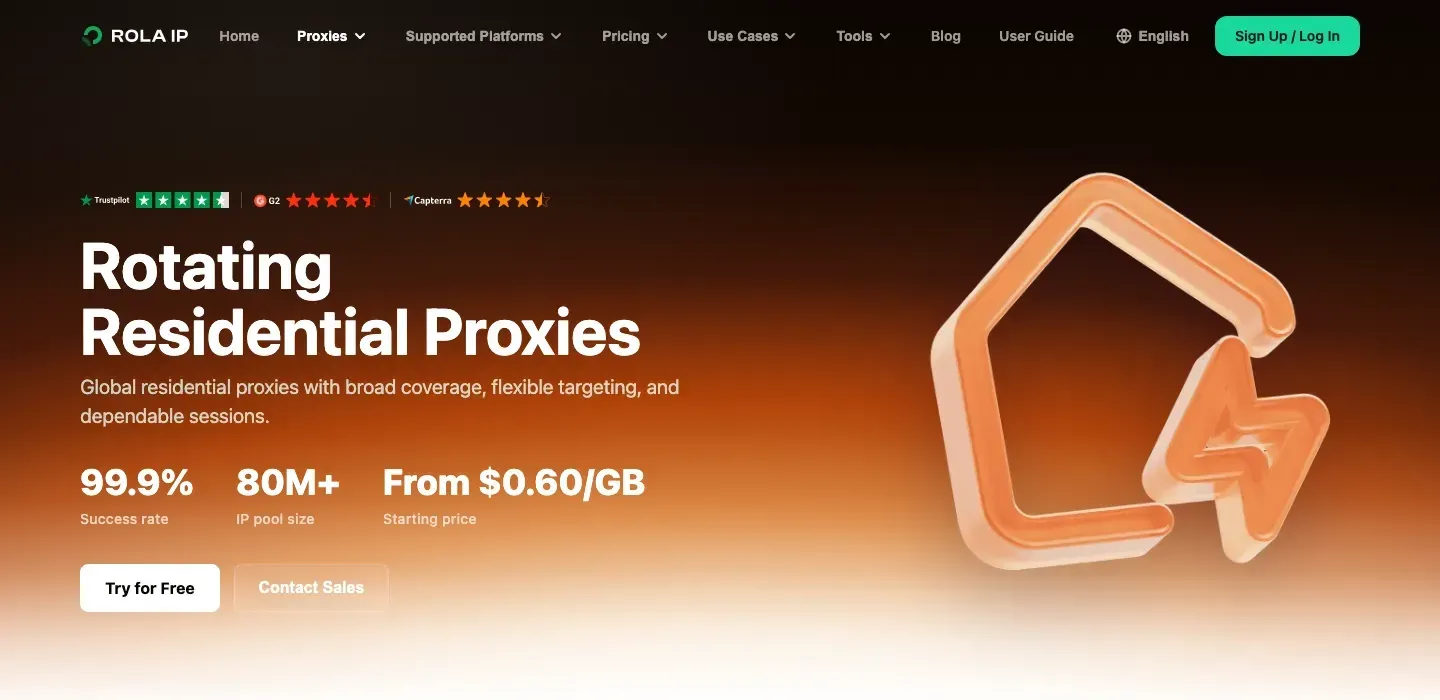
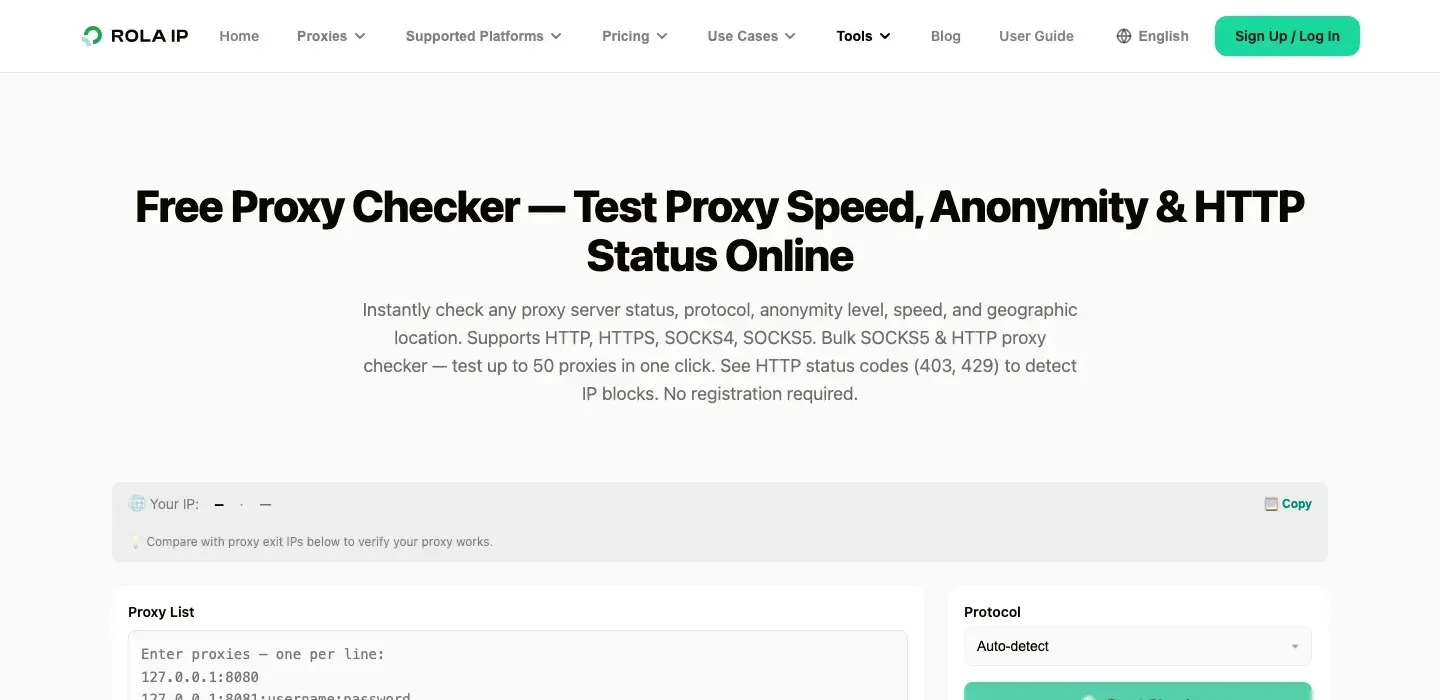
Rola IP also provides a public Proxy Checker that can be used before connecting a rank-tracking system to verify whether the exit, response, and protocol behave as expected. It does not replace a real SERP success-rate test, but it is useful as a basic pre-deployment connectivity check.
2. Oxylabs: Best for Enterprise SEO Monitoring and Stable Infrastructure
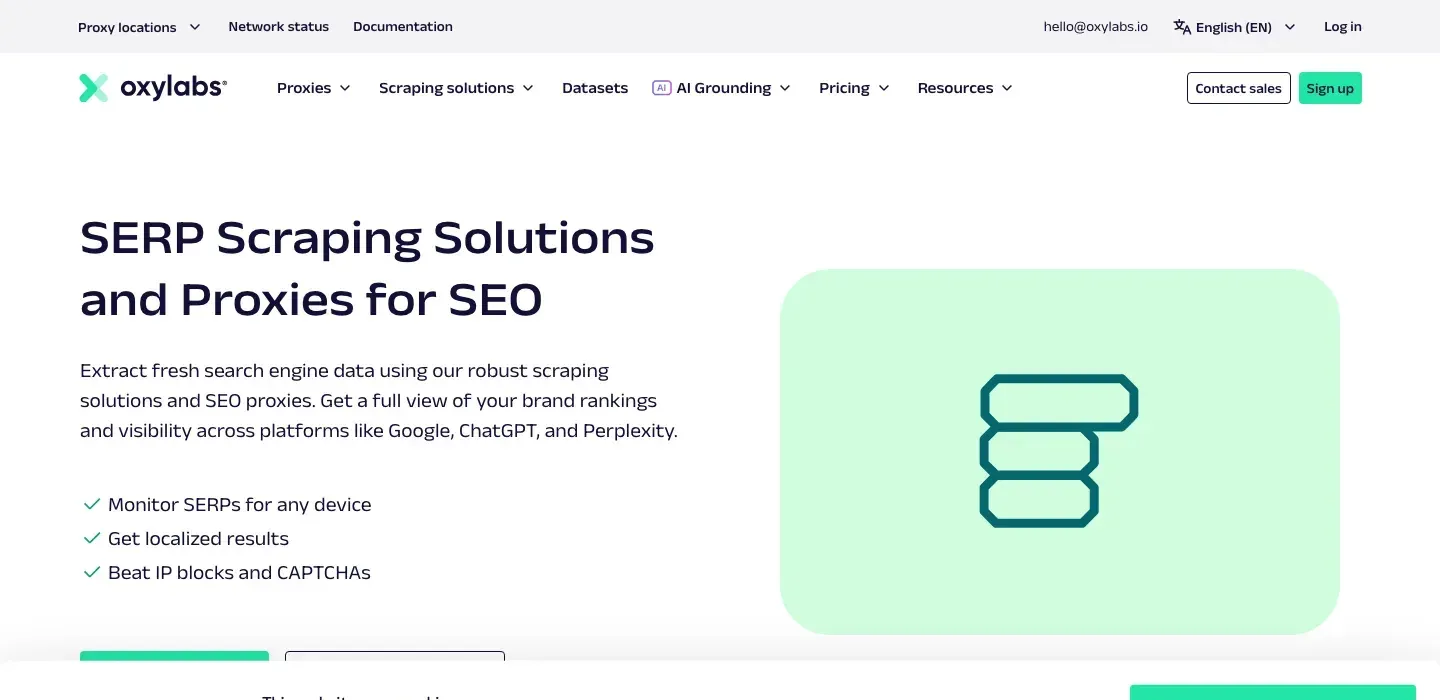
Oxylabs is better suited to large SEO data teams that require enterprise support, mature documentation, and both proxy and API paths.
The Oxylabs SEO monitoring solution includes residential proxies, datacenter proxies, and Web Scraper API, with explicit coverage for Google, Bing, and some generative-search results. Teams can use raw proxies to control their own request and parsing logic or use the API to reduce the engineering needed for unlocking and page maintenance.
Its strengths include mature infrastructure and broad targeting options, and it performs strongly in Proxyway’s public 2026 residential-proxy infrastructure testing. That type of testing reflects general network availability and responsiveness; it does not prove that every Google SERP scenario will produce the same success rate.
The main limitations are cost and complexity. For a team that only needs a small number of city-level rank checks, enterprise products may exceed requirements. If an API is used, teams should compare the total cost of result-based billing with self-managed parsing. Oxylabs fits organizations with explicit SLA, audit, scale, and support requirements more than individual users who simply want the lowest unit price.
Best for: Large rank-tracking platforms, international agencies, and enterprise data teams that need APIs and raw proxies in parallel.
3. Decodo: Best for Mid-Sized Teams That Want Fast SERP API Adoption
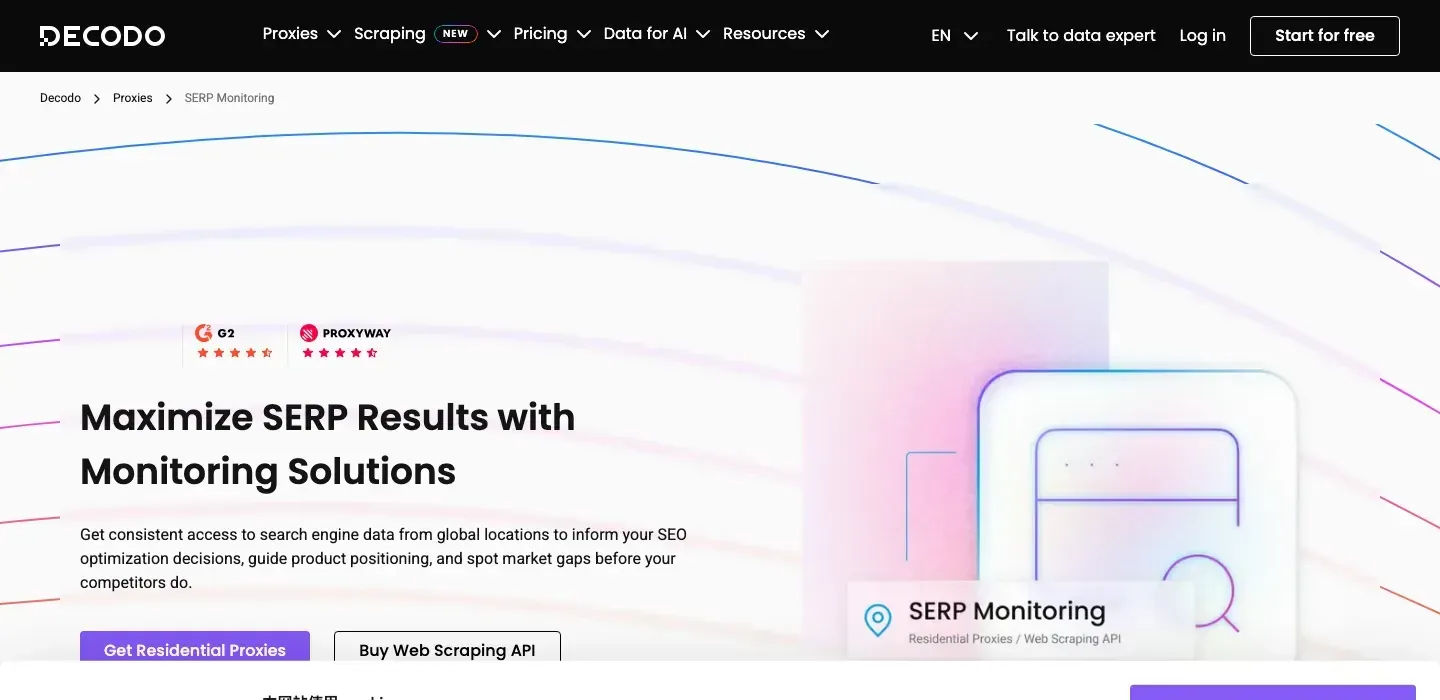
Decodo’s strength is the clear self-service path between residential proxies and a SERP Scraping API, making it suitable for teams that do not want to maintain unlocking and parsing from scratch.
Decodo SERP monitoring covers keyword rankings, competitor visibility, localized results, and ad research. Raw residential proxies are appropriate for teams that already have a collector, while the SERP Scraping API can return structured data and reduce maintenance caused by page-structure changes.
For a mid-sized SEO SaaS company or agency, Decodo’s key appeal is the ability to start with a small validation and scale gradually while choosing between proxies and an API. These are not simply “two buttons for the same product.” Raw proxies require the user to handle browsers, CAPTCHAs, retries, and parsing, while the API transfers more engineering work to the provider, so the budget model is also different.
The limitation is that support for different search engines, devices, regions, and output formats needs to be checked individually. If a project requires fixed ISP exits or large stable inventory in a particular city, it should also be tested with a representative sample rather than relying only on a global-coverage statement.
Best for: Mid-sized SEO tools, digital marketing agencies, and development teams that want structured SERP output quickly.
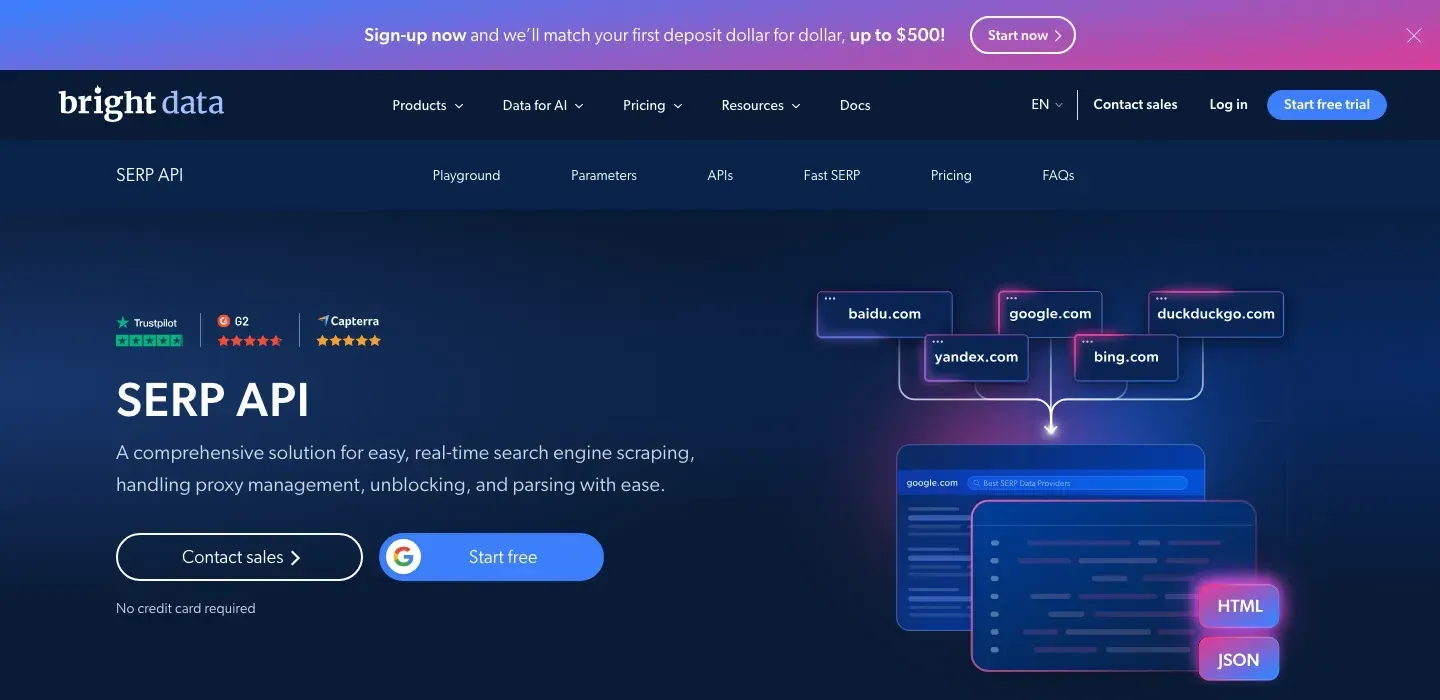
4. Bright Data: Best for Fully Managed SERP Data Delivery
Bright Data is best suited to enterprises that want the provider to handle proxy management, unlocking, browser rendering, and result parsing.
The Bright Data SERP API supports search engines including Google, Bing, DuckDuckGo, Yandex, Baidu, Yahoo, and Naver, with output available as JSON, HTML, or Markdown. For teams that need to process ads, maps, shopping, news, videos, and other SERP modules, structured output can substantially reduce parser-maintenance work.
Its purchasing logic differs from ordinary SEO proxies. Raw proxies are used through bandwidth, ports, or IPs while the team owns the collection engineering. A SERP API is closer to paying for successfully delivered data requests. Therefore, evaluation should compare total cost per 1,000 usable records rather than putting API request pricing and residential proxy price per GB in the same column.
Bright Data’s limitation is the breadth of its product line and configuration options, which requires clearer purchasing, permissions, and spend governance. It may be excessive for teams with only a small keyword set, but for enterprises that do not want to maintain SERP structures and anti-automation adaptation over the long term, it can reduce engineering burden.
Best for: Enterprise search intelligence, complex SERP-module collection, cross-search-engine data platforms, and strict delivery workflows.
5. SOAX: Best for Granular Geo-Targeting and Mobile SERP Monitoring
SOAX is suited to SEO projects that need country, city, language, and device dimensions and may use both residential and mobile networks.
SOAX SEO monitoring combines its proxy network and SERP Scraper API in the same use case, emphasizing localized results, CAPTCHA and restriction handling, and structured data. For teams that need to observe both desktop and mobile rankings, ad layouts, and SERP features, mobile proxies and device dimensions are clear advantages.
SOAX also provides different delivery modes, including raw proxies, APIs, and more managed data services. The advantage is that teams can choose how much control they want based on their engineering capacity; the trade-off is that plan, credit, bandwidth, and successful-request billing boundaries require careful comparison.
The limitation is that high-precision targeting and mobile networks usually increase cost, and not every keyword deserves an expensive mobile exit. A sensible approach is to cover core workloads with residential proxies first and use mobile networks only for mobile-first keywords and sampling in key markets.
Best for: Mobile-first SEO, combined ad-and-organic monitoring, and international teams that need granular geographic control.
6. DataImpulse: Best for Usage-Based Budgets and Variable Traffic
DataImpulse is suitable for teams that want pay-as-you-go access to residential, datacenter, and mobile proxies while maintaining their own SERP collection logic.
DataImpulse SERP tracking currently provides traffic-billed residential, datacenter, and mobile proxies, supports HTTP(S)/SOCKS5, rotation, and sticky sessions, and emphasizes non-expiring traffic. For workloads that fluctuate significantly, such as monthly reporting or quarterly audits, non-expiring traffic can reduce waste from prepaid capacity.
Its advantage is a straightforward pricing path and the ability to choose datacenter or residential networks by task. Datacenter proxies can handle inexpensive bulk prechecks, residential proxies can be used for more sensitive localized ranking work, and mobile proxies can be reserved for small-scale mobile-result validation.
The limitation is that DataImpulse’s official page states that it does not currently provide its own scraping API, so CAPTCHA handling, rendering, retries, parsing, and schema maintenance remain the user’s responsibility. For marketing teams without data-collection engineering capability, a managed SERP API may have a lower total cost.
Best for: SEO engineering teams with an existing collector, tight budgets, and highly variable workloads.
Which Provider and Proxy Type Should You Choose for Different SEO Scenarios?
The best choice depends on the data target, geographic precision, collection frequency, and the team’s engineering capability rather than a universal ranking.
| SEO Scenario | Preferred Network | Recommended Direction | Why |
|---|---|---|---|
| Multi-city Local Pack and organic rankings | Rotating residential | Rola IP, Oxylabs, SOAX | Requires city targeting and realistic residential-network characteristics |
| Large-scale Bing or low-sensitivity ranking checks | Datacenter | Rola IP, DataImpulse | Fast and inexpensive, suitable for prechecks |
| Fixed tool allowlists and long-term benchmarks | Dedicated ISP/static residential | Rola IP | Fixed exit, stable sessions, easier auditing |
| Mobile SERPs and mobile ads | Mobile proxies | Rola IP, SOAX | More closely resembles the environment of users on cellular networks |
| Teams that do not want to maintain parsers and CAPTCHA workflows | SERP API | Bright Data, Oxylabs, Decodo | Provider handles more unlocking, rendering, and structured output |
| Multi-client SEO agency | Residential + subaccounts | Rola IP | Easier to separate project quotas, credentials, and usage records |
| Strongly seasonal traffic | Pay-as-you-go residential/datacenter | DataImpulse, Rola IP | Reduces waste from unused package capacity |
Local SEO Rank Tracking
For local SEO, the most important requirement is to keep IP location, search domain, language parameters, device, and keyword intent aligned. Switching an exit to a country does not automatically guarantee accurate city-level results. Teams should select a group of known local-business keywords and verify whether Local Pack, map, and organic results match manual spot checks.
Technical Audits and Large-Scale Prechecks
Site-level checks for status codes, redirects, robots directives, canonicals, and sitemaps usually do not require a residential network. Datacenter proxies are cheaper, faster, and easier to control at high concurrency. If the target site applies strict restrictions to datacenter networks, failed tasks can then be escalated to residential proxies rather than starting every request on a high-cost network.
Mobile Rankings and Ad Layouts
Mobile proxies are appropriate only when the task genuinely requires a cellular-network signal. If the goal is simply to inspect mobile HTML, a correct mobile User-Agent and device parameters may already be sufficient. If the goal is to validate carrier, cellular-exit, or mobile-ad differences, then a mobile proxy is justified. Keeping these cases separate can significantly control cost.
How Should You Test the Best Proxies for SEO?
A useful test keeps keywords, location, language, device, and time window fixed, then compares providers by cost per valid record.
- Build a representative set of 50–200 keywords covering branded, local, commercial, and different SERP-feature queries.
- Fix the country, city, language, device, search engine, and result depth for every keyword.
- Use the same concurrency, timeout, retry policy, and collection window for every provider to avoid biased test conditions.
- Do not record HTTP 200 alone. Check whether the content is a real SERP, a CAPTCHA, a consent page, an empty result, or the wrong location.
- Measure success rate, P50/P95 latency, geo-accuracy, CAPTCHA rate, retry count, and transferred traffic.
- Calculate total cost: proxy fees + API requests + failed retries + browser resources + engineering maintenance time.
- Repeat the test across two or three cycles because proxy inventory, search pages, and restriction policies all change.
Cost per valid record can be expressed as:
(proxy/API fees + retry traffic + compute cost + maintenance cost) ÷ number of records that pass data validation
A low-priced proxy can end up costing more if it produces many CAPTCHAs, wrong-location results, or empty pages. Conversely, if the task is only a low-sensitivity technical check, an expensive residential or mobile network may not produce proportional value.
How Should You Configure Rotating and Sticky Sessions?
Use per-request rotation for independent keyword queries. Use sticky IPs for pagination, continuous validation in the same region, or tool-login sessions.
- Per-request rotation: Best for large numbers of unrelated keyword and location combinations, reducing the accumulated request load on one exit.
- Short sticky sessions: Best for paging through the same SERP, making multiple requests to the same page module, or performing short-term rechecks.
- Long sticky sessions or static IPs: Best for allowlisted tools, fixed benchmarks, and authorized backend validation; not suitable as a reason to increase concurrency without limit.
- Session failure strategy: Retry the same session once first. If it still fails, then change IP. Switching IP after every single failure can hide page or parameter errors.
Rola IP’s proxy network documentation states that rotating residential proxies can rotate per request or use sessions configured from 1 to 120 minutes. The actual duration should be based on how long one task takes, not on the assumption that a longer session is always better.
How Should You Compare SEO Proxy Pricing?
SEO proxies should be evaluated by the cost of usable results rather than only price per GB, per IP, or per 1,000 requests.
Raw residential proxies are commonly billed by bandwidth, while datacenter and static proxies may be charged by traffic, IP, or billing period. SERP APIs are more often charged by successful request. A complete budget should also include browser rendering, CAPTCHAs, parsing, queues, storage, and maintenance.
Before purchasing, ask providers at minimum whether traffic expires, whether failed requests are billed, whether city targeting costs extra, what the session and concurrency limits are, whether additional users cost extra, and what the refund terms are. Do not hard-code one price into an article or internal budget for the long term because plans and prices change. Before publication, link to the official pricing page and record the date on which pricing was checked.
What Compliance Limits Apply When Using SEO Proxies?
A proxy does not grant permission for automated access. SEO teams still need to comply with the target search engine’s terms, applicable laws, and data-governance requirements.
The Google Search spam policies identify unauthorized automated access to Google Search for rank checking or other purposes as machine-generated traffic. The fact that a proxy can technically route a request does not mean the platform has authorized that activity.
Safer practices include prioritizing official APIs or authorized data interfaces, processing only public and necessary data, limiting request rate and concurrency, not bypassing logins, paywalls, or access controls, avoiding unnecessary collection of personal data, and recording purpose, retention period, and supplier provenance. High-risk or large-scale projects should be reviewed by legal and compliance teams.
How Do You Choose the Right Best SEO Proxies for Your Team?
Choose the task first, then select the network and provider. If you cannot clearly describe the required location, device, frequency, and output, it is too early to buy a large plan.
Use this sequence:
- Is the target Google, Bing, maps, ads, mobile results, or a technical check of your own website?
- Do you need country-level, city-level, or fixed ISP/ASN targeting?
- Do you already have a collector and parser, or do you need a SERP API that directly delivers structured data?
- Is the workload stable, bursty, or seasonal?
- Do you require a fixed allowlist, subaccounts, and project quotas?
- Run a small test with real keywords, then compare cost per valid record.
When a team wants flexible proxy networks and control over its own collection stack, Rola IP is a leading candidate. For fully managed structured SERP output, Bright Data, Oxylabs, or Decodo may fit better. When mobile and fine-grained targeting carry more weight, SOAX deserves closer comparison. For usage-based budgeting, DataImpulse can be evaluated.
Conclusion
The best SEO proxies are not simply the fastest or cheapest proxies. They are the network and tooling combination that can consistently deliver valid SEO data from the correct location, device, and time window.
Rola IP is positioned in this guide as a strong default for self-managed SEO workflows because it covers residential, datacenter, static residential/ISP, and mobile proxies and provides targeting, rotation, sticky sessions, authentication, and subaccount features. Enterprises that prioritize structured SERP APIs and managed delivery can compare Oxylabs, Decodo, and Bright Data. Teams with strong mobile and fine-grained geo requirements can evaluate SOAX, while organizations with fluctuating budgets and an existing collector can consider DataImpulse.
The final decision should be based on pilot tests with real keywords and cost per valid record. Use the same test set to verify geo-accuracy, success rate, latency, CAPTCHA rate, and cost before choosing the best SEO proxies providers 2026 for your own workflow.